
The QAnon Shaman Was Sentenced to 41 Months in Prison
So how many will Trump get?
,_seen_holding_a_Qanon_sign_(cropped).jpg)
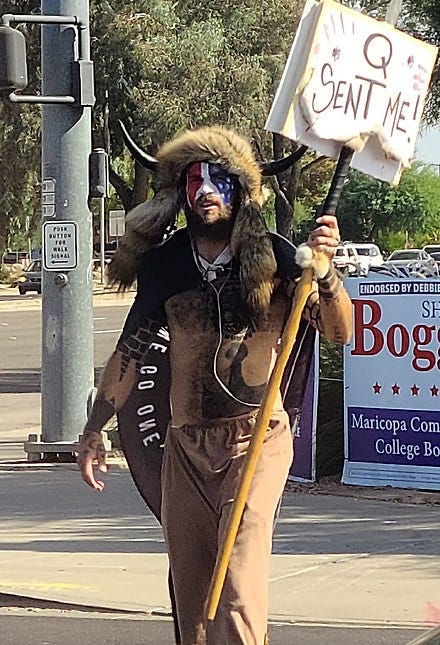
The “QAnon Shaman,” Jacob Angeli Chansley (also known as the “Q Shaman” and “Yellowstone Wolf”), one of the most visible and vocal members of the mob who invaded the U.S. Capitol on January 6th, was sentenced November 18th to forty-one months in federal prison.
Two weeks after the 2020 election, Mr. Chansley was already encouraging a large social media following to “identify traitors in our government” and “stop the steal.” He is reported to have announced, “We shall have no real hope to survive the enemies arrayed against us until we hang the traitors lurking among us.” He joined the mob on January 6th as it shouted “Keep moving forward! Fight for Trump, fight for Trump!” As he departed the Senate floor on January 6th he left a note on the dais of the vice president reading “It’s Only A Matter of Time. Justice is Coming!”
From the first, Chansley’s trial was as colorful as his appearance on the floor of the Senate. After asking Donald Trump to pardon him (a petition that was not granted), his attorney announced that he was willing to testify against the president at his second impeachment trial. After persuading a federal judge to allow him a strictly organic diet in detention, he granted an interview to 60 Minutes, where he described his actions as an attempt to “bring God back to the Senate.”
Although he had claimed to be “allowed” into the Senate Chamber, Chansley was on video recorded that day entering the Capitol after windows were smashed, using a bullhorn to excite the mob. And while he had a long history of activism in Arizona, where he often used his Shaman image as a means to approach people and raise his claims of conspiracies, he had no criminal record. After a psychiatric evaluation, the judge found him mentally competent for trial.
According to Chansley’s trial attorney, Albert Watkins, his client believed he was there at the behest of the president. “Does our president bear responsibility?” Mr. Watkins told the New York Times in September when Mr. Chansley pled guilty to a single felony count of obstructing an official proceeding of Congress: “Hell, yes, he does.”
The QAnon Shaman’s conviction raises the issue of what legal responsibility, and potential punishment, is due to the former president. Trump, of course, seems psychologically incapable of admitting his responsibility for any of his crimes, but those crimes are far more extensive than anything done by Mr. Chansley. While the QAnon Shaman didn’t even try to make the defense that he “was only following orders” — a defense that no court would accept — it is also true that he does not bear the same degree of responsibility as the men who gave those orders.
Criminal investigations
Proving how far up the chain of command the orders to encourage and prepare for violence went is going to be a long, difficult process, but the House investigatory committee has already made a strong start. Testimony is being taken; subpoenas continue to be issued. Steve Bannon, who has made a public display of rejecting his subpoena in the name of an illusory “executive privilege,” has been charged by the Department of Justice for the crime of Contempt of Congress. Other subjects must take that into account as they consider their own subpoenas and testimony.
When a prosecutor is investigating a complex criminal enterprise, the method is straightforward: bust the small fry first. Turn them to prosecute the next level up the ladder. Turn the next level to get to the level after that, and turn them to get to the top. We are already seeing charges being arranged for the former president’s personal attorney, Rudy Giuliani, for a felony related to his activities in Ukraine. (The raid of Giuliani’s home earlier this year required a warrant with sufficient evidence to indict, with or without whatever records were found.) Chief of Staff Mark Meadows is under subpoena, and former Justice Department official Jeffrey Clark reported but refused to testify. Now he is being also being referred for contempt, which will end like Bannon unless he cuts a deal to testify.
The January 6th committee keeps grinding out the subpoenas: John Eastman, Jason Miller, Michael Flynn, Stephen Miller, Kayleigh McEnany. The vice is tightening, and only one needs to crack. After that comes the run for the exits. Meanwhile, Vice President Pence’s staff has already indicated they are willing to cooperate with the committee.
Moreover, this is not the only Trump-related crime currently under investigation, at both the state and federal levels. Prosecutors don’t like to tip their hand, either as to the subjects or the progress of ongoing investigations, so it seems likely that this is a minimum of what is heading down the track at the former president. There may well be more:
In New York State, Attorney General Letitia James has been spending the last few years investigating the Trump Organization. What began as a civil investigation has morphed into a criminal one, which has combined with an ongoing criminal investigation by District Attorney of Manhattan Cy Vance, who led the drive to subpoena eight years’ worth of Trump’s tax returns. Criminal indictments have been brought against both the Trump Organization and senior officer Allen Weisselberg, including fifteen counts of various financial crimes, including federal tax fraud, falsifying business records, grand larceny, and conspiracy.
News accounts indicate a second grand jury is hearing further testimony. Further indictments are probably coming (prosecutors don’t take financial crimes to a grand jury unless they are confident of indictment), and every officer of the Trump Organization that outranks Weisselberg shares one common feature: they are all named “Trump”.
Letitia James has also announced she will be campaigning to be the next governor of New York. This means she not only thinks she has a case she can win, but a case she can win soon, to get all the political advantage she can, in time for her primary campaign in 2022.
The Westchester County District Attorney’s probe into Donald Trump also appears to be larger than originally reported. According to Rolling Stone, two former Trump insiders have turned to give evidence of over a million dollars of insurance fraud at Trump’s National Golf Club Westchester, which was already under investigation for financial misdealings.
In Georgia, Fulton County DA Fani Williams is investigating whether Trump put pressure on Georgia’s Secretary of State to “find” sufficient votes to overturn the election of 2020. Not only does Secretary of State Raffensperger (a Republican) say that he felt under threat and that Trump was in violation of Georgia election law, there is a recording of the phone call in which Trump put pressure on him. Criminal charges may include election fraud conspiracy, criminal solicitation of election fraud, and interference with the duties of an elections official. At the speed she is going, impaneling a special grand jury, Ms. Willis may be able to stake the claim to the first Trump indictment, as well as an indictment for Trump Chief of Staff Mark Meadows, who traveled to Georgia at the same time Trump was pressuring people from the Oval Office.
The Attorney General for the District of Colombia has also opened an investigation into the events of January 6th, and is reported to be looking to bring an indictment against Trump under a local statute that makes it “unlawful for a person to incite or provoke violence where there is a likelihood that such violence will ensue.” If convicted, Trump may be sentenced to up to six months in jail for that act alone. In a second complaint, the DA has sued Trump over the diversion of inaugural funds to Trump properties and to Trump-allied organizations charging exorbitant rates.
Civil suits
In Michigan, voting rights activists are joined by the NAACP in a civil suit alleging Trump violated the Voting Rights Act, which forbids the intimidation of elections officials.
Another civil suit has been filed by two Capitol police for the injuries they suffered in the insurrection. Filing for both punitive and compensatory damages, the officers claim that “As the leader of this violent mob, Trump was in a position of extraordinary influence over his followers, who committed assault and battery“ on the officers. They further charge “Defendant Trump conspired with the Proud Boys and others to, among other things, incite an unlawful riot on January 6 with the goal of disrupting congressional certification of President Biden’s electoral victory.”
Yet another seven Capitol police officers have filed a suit against Trump and others, alleging violations of the Ku Klux Klan Act, passed during Reconstruction to forbid any conspiracy “to prevent, by force, intimidation, or threat” federal officeholders to perform their duties, or to flee the location where those duties are performed.
Representatives Bennie Thompson and Eric Swalwell have each sued Trump for inciting the insurrection. Swalwell includes among his targets, Donald Trump, Mo Brooks, and Rudy Giuliani. The NAACP has joined Representative Thompson in accusing the former president of violating the KKK Act.
Other cases against Trump can now proceed because he is out of office. E. Jean Carrol still claims that Trump assaulted her in the mid-1990s, an accusation the president rejected. He claimed that she was “totally lying” and “not my type.” Carroll has sued for defamation and has saved what she claims is evidence of the original sexual assault. Summer Zervos, a former contestant on The Apprentice, also accuses him of defamation after he insulted her following her accusation of sexual assault. Trump may be forced to testify under oath in both cases.
Mary Trump, the former president’s niece, is suing for her share of the family fortune, which she claims she was cheated out of.
If this wasn’t enough, there are civil suits over multi-level marketing scams and a fraudulent hotel deal in Panama. The civil complaint about the multi-level marketing scheme charges Trump and his children with operating “a large and complex enterprise with a singular goal: to enrich themselves by systematically defrauding economically marginalized people looking to invest in their educations, start their own small businesses, and pursue the American Dream.”
Can Trump get away with all of this?
It may not be possible to convict Trump on all of these crimes. The real problem for a prosecutor is not proving wrongdoing, but proving criminal intent. On the other hand, Trump’s persistent action to hide evidence — from the courts, and from Congress — is in itself an admission of an awareness of something to hide, which helps to establish intent.
And it isn’t necessary to convict on all charges. Look at the number of them. While Trump is raising money that he claims is for his 2024 presidential campaign (which he can run from prison if the GOP is foolish enough to nominate him), it seems that a lot of it is going to go to Trump’s legal expenses and penalties.
With so much, known and unknown, on Trump’s horizon, there will likely be some time in prison (probably starting in New York and running concurrently) and a great deal of cash lost in damages and other penalties. How much? It is too complicated and interdependent a question to even speculate. Multiple crimes, multiple jurisdictions (and that’s not even including the international crimes: a golf course in Scotland, a hotel in Panama, a tower in Kazakhstan, and the much lusted-for Trump Moscow). Perhaps all we can do today is end with a final quote from the QAnon Shaman:
“It’s Only A Matter of Time. Justice is Coming!”