
The Puzzle of How Life Began
How hard was kick-starting Life if it only took a few hundred million years…?
Let the waters bring forth abundantly…
Imagine we had an ocean saturated with the raw materials of life, the primordial soup. How did the raw materials self-assemble into the first protocell? Or say we had a hot spring, a pond, something shallow on land that could cycle between wet and dry — how did we get from a warm shallow pool of organic compounds to life? Or perhaps we had a black smoker hydrothermal vent at the bottom of a primeval ocean, spewing tons of chemicals and pulsing with every kind of energy except solar — how did that drive the origin of life?
It’s a puzzle, ain’t it? The smartest scientists since Darwin have puzzled over the origins of life, and centuries later we’re still guessing and grasping at straws.
Imagine, if time were a measure of difficulty, then conjuring life from non-living pond scum was apparently relatively easy on Earth. From having a hot crust with boiling water about 4.3 billion years ago, we had our first clear signs of bacteria by 3.7 to 3.85 billion years ago. Let’s call it half a billion years for life to become well established enough to leave clear fossils.
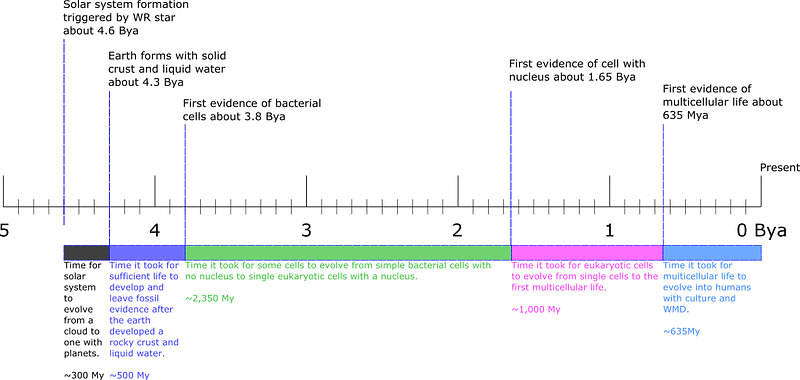
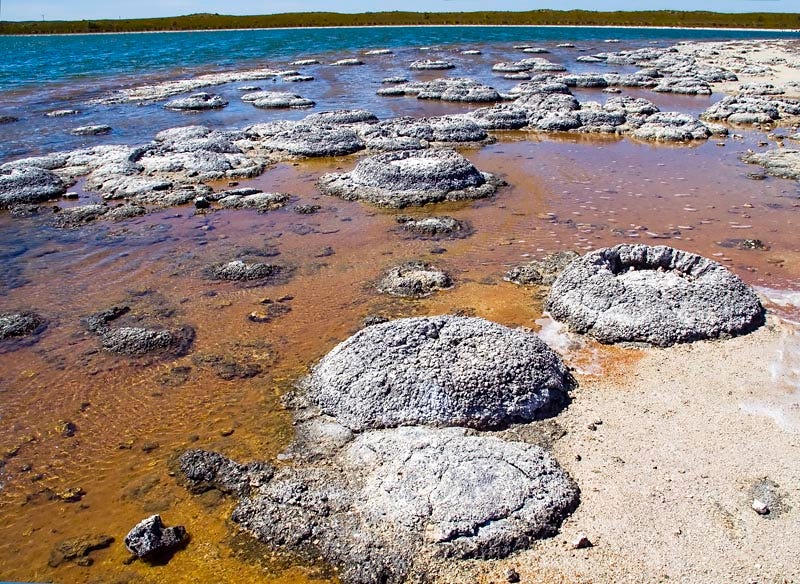
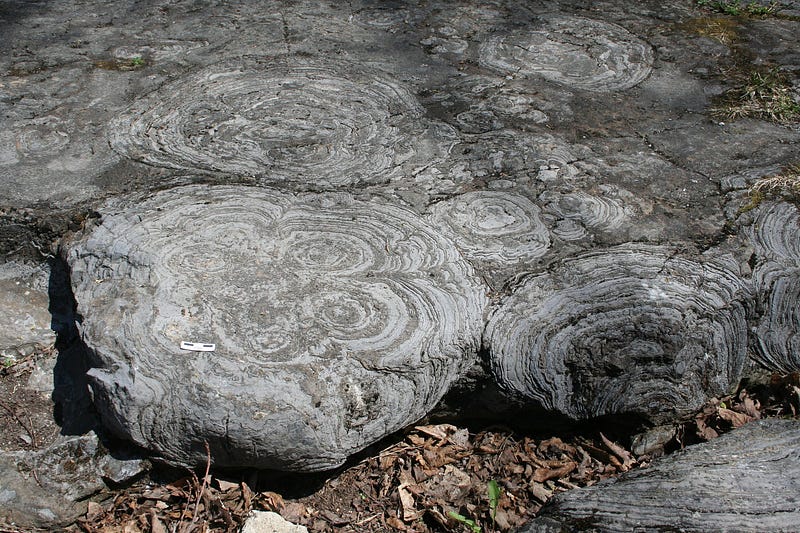
The first evidence of a eukaryote, a cell with a nucleus like we have, was about 1.65 billion years ago. That took well over a two billion years, for prokaryotic (un-nucleated) cells to develop into eukaryotes. More than four times as long for the first bacteria to give rise to the first eukaryote, as for life to form in the first place from. Over two billion years during which simple single bacterial cells ruled the planet. Over two billion years for nothing to develop more complicated than a bacterial mat called a stromatolite, living structures we can still see off the coast of Australia and a few other places around the world. Two billion years? And life arose within half a billion years once conditions were “amenable”.
The first evidence of multicellular life was about 635 million years ago. It took another billion years for single eukaryotic cells to figure out how to work as a team.
It took only half a billion years, or 500 million years, to evolve from a squishy ball of cells floating in water, to humans gossiping about that earlier life to other humans they don’t know, about how simple and untalented that ball of cells was. Apparently creating humans was not a particularly difficult process either.
Now, after I’ve spent several paragraphs laying out how much less time it took for life to arise in the first place, making ~500 million years feel like a snap of the fingers, I need to be clear that passage of time is not a valid measure for the difficulty of a particular step in the evolution of life.
Organisms evolve in response to some pressure, the environment, competition, sexual selection, etc. One possible reason that it took two billion years for single prokaryotic cells to evolve into single eukaryotic cells could be that the environment was relatively stable and required no particular innovation like a nucleus, mitochondria, and other organelles.
We know that eukaryotes evolved when oxygen built up to toxic levels in the atmosphere from the byproducts of photosynthesis. If that great oxygenation event happened immediately after life first arose, it is possible that eukaryotes may have evolved right away without that 2-billion-year interval. It is also possible life could have been extinguished by so much oxygen so soon after life arose. Perhaps prokaryotes required that time gap in order to build up an inventory of other genetic innovations which enabled eukaryotes to arise in response to the toxic buildup of oxygen. We don’t know. It is all speculation. But we do have the timeline of fossil finds and the approximate timing of life’s milestones.
How did life arise?
How did life arise if it was so easy that it only took half a billion years?
Here is one more perspective on the ease or difficulty of creating life…
One of the central functions of living things today is to store, process, and duplicate information — information on how to build itself, and how to function… today DNA and RNA carry that information. We have reason to believe that RNA preceded DNA. How do we get from the building blocks (nucleotides) to a string of RNA carrying the code for our earliest cell? And once we have that RNA, how would the information in it be processed or duplicated?
Another central function of living cells is to catalyze reactions, to extract energy from its surroundings, to synthesize new biochemicals, to read the information in the DNA, make messages and to duplicate that store of information, etc. Today proteins do almost all of that enzymatic work within a cell. If you have all the amino acids in the primordial soup, how do you link them into a functional protein? More importantly, how do you repeat that unlikely act? How do you store the instructions for making that protein?
One of the most important and defining parts of a cell is the membrane, because it separates the cell from its environment, and ensures that within the cell are the perfect conditions for all the chemistry of life. Today we have cell membranes composed of lipids which define the boundary of a cell. If you have simple bubble-like membranes, how do you package the right chemicals, and how do the first bubbles grow and divide?
The conundrum appears more intellectual than physical since an abiotic world solved the problem in a relatively short time. Just half a billion years! How complicated could a bacterium be to make? Let’s tease that apart just a bit.
A bacterium has a few thousand genes that carry instructions for making proteins. Those thousands of genes carry on average a few thousand letters of code for each protein. The millions of letters of genetic code are not the extent of the complexity in a tiny single-celled bacterium. It goes far beyond that.
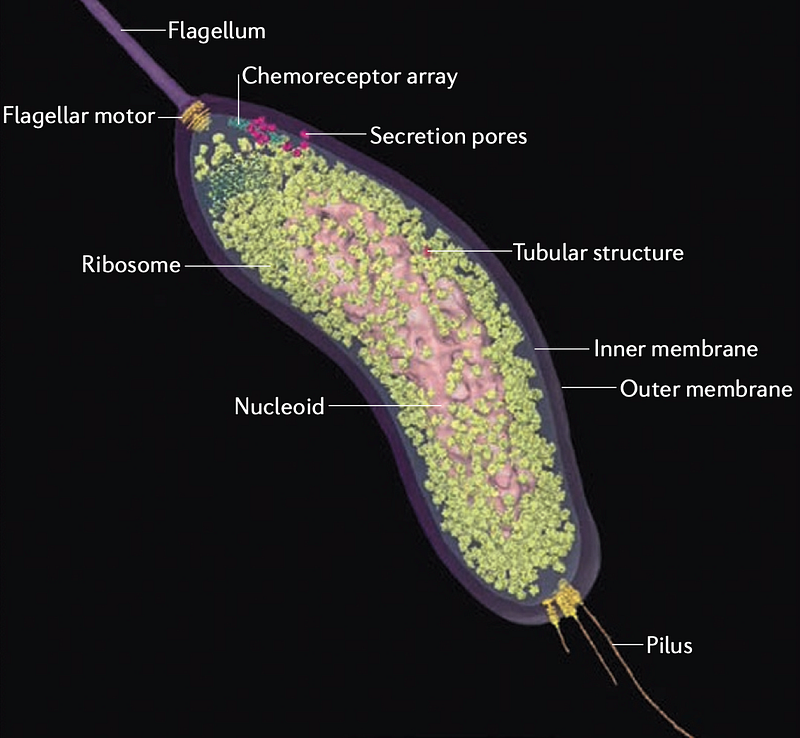
Each protein has a complex three-dimensional shape that the gene encodes. That shape is essential for its function, which is often as an enzyme to catalyze some specific reaction. Each protein, like our enzyme of interest, not only has to bind to the thing it will catalyze (could be another protein, a nucleic acid like DNA, a fatty acid, sugar, anything really), but our enzyme also binds to other proteins.
Think of a nut that has to thread onto a bolt. The two have to match up pretty well to operate as a simple connector. Proteins are the same way. They must match up like all the mechanical components in a motor.
Speaking of motors, one of the most basic functions of a simple cell is to move. Towards food or other energy sources. Away from toxic or other noxious chemicals or environments. Perhaps towards each other for the very first bacterial nookie. The molecular motor driving bacteria have probably remained mostly as we see them today, composed of proteins making the equivalent of the stator, rotor, bushing, shaft and propeller… check out the following images and animation of bacterial flagellar motor.
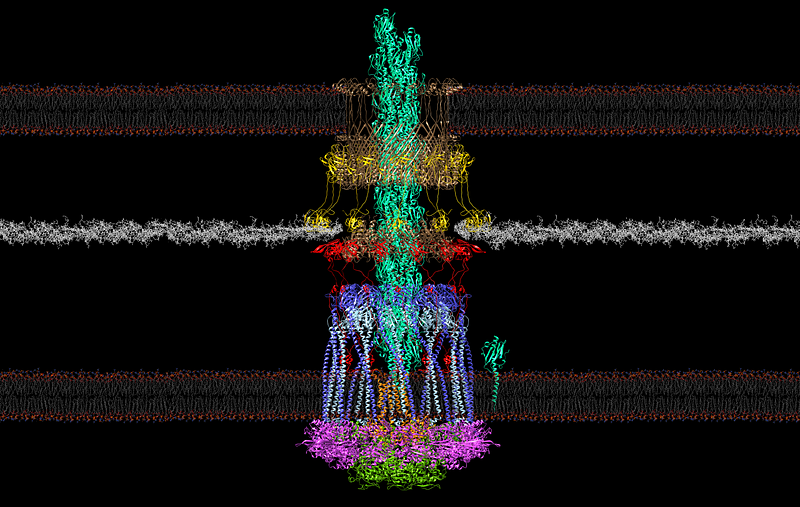
So, a machine looking very similar to today’s bacterial flagella and associated molecular motors, must have evolved more than 4 billion years ago. The complexity of just this one cellular machine shows how proteins must interact precisely with multiple partners.
Most often those other partner proteins regulate our protein of interest, telling it when to turn on and when to turn off. Our enzyme might bind dozens or hundreds of other proteins during its work in the bacterial cell. And each of those regulating proteins may bind to dozens or hundreds of other proteins, and each of those… you get the idea.
The bacterial cell’s proteins form a complex network of interactions. The picture of the total network of interacting proteins in a simple bacterial cell looks like a fuzz ball, and is called an interactome (each point represents a protein, and each line between points represents a binding between those two proteins).
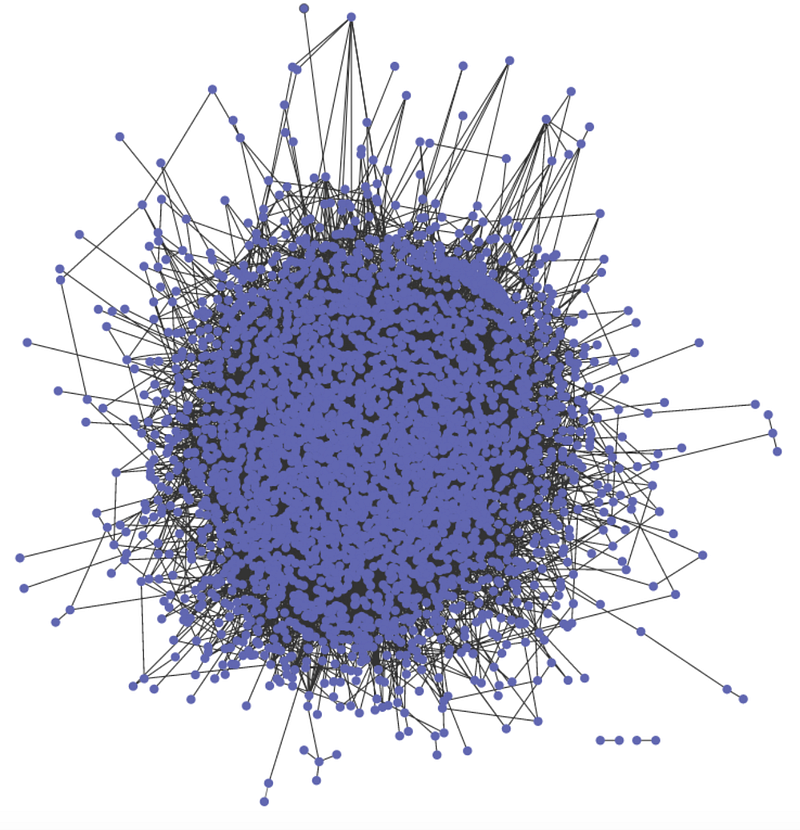
But proteins also interact with every other chemical in the cell. Each nucleic acid, each nutrient and signaling molecule, all those chemicals are also part of an even larger network.
Untangling that fuzz ball to try and reconstruct which biochemicals came first in the earliest protocell is a crazy hard problem.
We are nowhere near cracking the problem, but one of the leading researchers in the field, John W. Szostak at the Massachusetts General Hospital, has a picture starting to form on how this chemical evolution leading to life could have played out.
Be fruitful and multiply…
According to Szostak, small non-living bubbles made of fatty acids enclosed a soup with random sequences of some kind of oligonucleotides, chemicals similar to but not exactly like our RNA or DNA. The watery environment supplied most of the biochemicals that were transported across the fatty acid membrane and into these bubbles.
The environment was also critical to the growth and division of these bubbles, since the bubbles had no machinery to control those processes. Newly made bubbles of fatty acids merged with the existing primitive bubble-cells and contributed to their growth. New kinds of lipids such as phospholipids introduced into the film of the bubble enabled it to grow at the expense of bubbles without those novel phospholipids. This might have been one of the earliest examples of pseudo-Darwinian competition.
This simple physical difference of having a tiny bit more phospholipid, and the resulting competitive benefits, drove the selection of bubbles with more phospholipids. Eventually some of these little bubbles had so much phospholipid that it changed the properties of the membrane. It became harder for the bubbles to import biochemicals across a phospholipid-heavy membrane, than across the earlier fatty acid one.
Now there was a new selective pressure — for a bubble to develop a simple membrane transport machine. A small, simple protein, a short chain of amino acids, became a tremendous competitive advantage because it happened to shuttle important biochemicals across the otherwise impermeable phospholipid membrane.
Suddenly there was yet another selective pressure — for a bubble to develop the means to make more proteins to maintain and improve membrane transport. RNA is the enzymatic heart of ribosomes today, the cellular machine that makes proteins. This is unlike almost every other enzyme which are almost always proteins. Ribozymes are much rarer but occur in a number of very core cellular processes like translation of RNA to protein. The ancestral ribozyme at the heart of protein synthesis may have begun here.
Maybe the protein synthesis ribozyme was the first RNA, or maybe not. Maybe it wasn’t even an RNA at first. But somewhere and somehow RNA came into the picture. Once RNA arrived within the cell perhaps with a functional role such as protein synthesis, the ability of RNA to store information arose naturally. This came about as the RNA soon showed an ability to copy itself within the cell.
This is as far as the Szostak paper takes the speculative story of the origin of life. The important thing is that his lab and others have piecemeal, and experimentally, demonstrated some of the steps within that story.
It is not the only story. And the story is neither as complete nor convincing as it is told. Yet so far this may be the best story we have on the origin of life.
And it was so…
Well, we don’t know if it was so. Almost every point of this story is contested. But scientists seem to be coalescing around the basic outlines of the story: that the solar system is about 4.65 billion years old, the Earth and Moon are about 4.56 billion years old, that the Earth had a crust and water by about 4.3 billion years, and not long after that the prebiotic phase of chemistry began its formative period. Then quite rapidly, somewhere around 4 billion years ago, life had begun. Life was so prevalent and successful that our first fossils of these tiny, fragile, single-celled animalcules were made somewhere around 3.8 billion years ago. We have those rocks, those fossils, and scientists continue to arm-wrestle over whether the oldest ones are evidence of life or not. But at that point, the argument is over a hundred million years here or there. Most seem to be within a rounding error of 4 billion years.
The rest of the story is contested so vigorously it is hard to make a consensus narrative. Were the basic biochemicals like amino acids and nucleotides and fatty acids mostly synthesized on Earth or transported here on the backs of asteroids? Did informational, or metabolic, or membrane components come first? What was the sequence of protocell assembly? How did the protocell work? How did it evolve? How did it step across the threshold into Life? We only know that it did so. And behold, it was very good.


