avatarChristopher P Jones

Free AI web copilot to create summaries, insights and extended knowledge, download it at here

3686

Abstract

wift ship hand and foot upright in the step of the mast, and let the ropes be made fast at the ends to the mast itself, that with delight thou mayest listen to the voice of the two Sirens.”</p><p id="5de2">Dressing Ulysses in white, Waterhouse places him as the focal point of the image: bound to the mast, he was able to sail past the Sirens’ tuneful onslaught unharmed.</p><figure id="3277"><img src="https://cdn-images-1.readmedium.com/v2/resize:fit:800/1*yj1JFbYH5yGkASLZP2yYaQ.jpeg"><figcaption>Detail of ‘Ulysses and the Sirens’ (1891) by John William Waterhouse. Oil on canvas. 100.6 x 202 cm. National Gallery of Victoria, Melbourne, Australia. Image source <a href="https://commons.wikimedia.org/wiki/File%3AWATERHOUSE_-_Ulises_y_las_Sirenas_(National_Gallery_of_Victoria%2C_Melbourne%2C_1891._%C3%93leo_sobre_lienzo%2C_100.6_x_202_cm).jpg">Wikimedia Commons</a></figcaption></figure><p id="170b">With the bird-women prowling open-mouthed around the ship, the painting takes us forcefully into the moment of the Sirens’ predatory arrival. A rich palette of colours — blues, purples, russet reds, browns and yellows — makes up the torrid image.</p><p id="b602">Waterhouse was not the only artist of the period to produce representations of Ulysses and the Sirens. Ostensibly an example of the triumph of human intelligence over the seductive power of temptation, artists like William Etty and Herbert James Draper painted depictions of the subject with overtones of a patriarchal heroism — arguably suited to the imperialistic ethos of the Victorian era.</p><h1 id="4997">Critical Controversies</h1><p id="9a03">When art critics encountered Waterhouse’s painting when it was first displayed in 1891 at the Royal Academy, London, a number of them were unnerved by what they saw as the artist’s imaginative diversions from Homer’s original poem — as if to deviate from the source text was artistic licence too far.</p><p id="c4a9">Not only had Waterhouse painted seven Sirens instead of the two mentioned in the poem, he also had them stalking the boat and actively assailing the sailors. Expecting (or perhaps hoping) to see the Sirens as voluptuous mermaid-like nymphs singing from a distant rock, the critics were alarmed by this horde of macabre creatures that they found instead.</p><p id="d0f1">Writing in <i>The Pictorial: Academy and Salon Pictures of 1891, </i>one commentator was confounded by the lack of feminine charm: “‘Sirens’, said I to myself, ‘I had no notion of them except as lovely creatures of the Loreley kind, strictly confined to their own rock, to whose fatal contact they lured the voyager by their singing’”. Another critic protested that their “vulture claws preclude the possibility of such birds uttering dulcet strains of music”.</p><p id="4243">It could be argued that the critics’ chagrin was unfounded: there was no physical description of the Sirens in Homer’s original text, and even when tradition in art was established, they were regularly depicted as human-headed birds. It was only centuries later that the more voluptuous mermaid type became popular.</p><figure id="6b7b"><img src="https://cdn-images-1.readmedium.com/v2/resize:fit:800/1*YC7_tbdWqSv7bVI-eP0r_A.jpeg"><figcaption>The Siren Painter Greek, Vulci, 5th century BC Stamnos decorated with Odysseus and the Sirens earthenware. Height 35 cm. British Museum, London, UK. Image source <a href="https://commons.wikimedia.org/wiki/File:Odysseus_Sirens_BM_E440_n2.jpg">Wikimedia Commons</a></figcaption></figure><p id="dad9">Not all critics were as shocked. A more perceptive reviewer, Marion H. Spielmann, writing in <i>The Magazine of Art</i>, noted that there was a clear precursor

Options

to Waterhouse’s bird-like Sirens — to be found in the decorations of classical Greek vases, such as found on 5th century BC Stamnos pottery.</p><p id="752c">It is thought that an example of one such earthenware pot in the British Museum was the true source of Waterhouse’s inspiration.</p><h1 id="3342">Female Venality</h1><p id="d8b9">Perhaps what really dismayed the critics was the uncomfortable vision of women as active aggressors who enacted more than just supernatural temptation.</p><p id="8c11">Images of seductive temptresses were well established in art, for this was the era of the <i>femme fatale</i>. Suggesting a certain level of insecurity about the increasing autonomy of women during this time, notable European artists ranging from Dante Gabriel Rossetti to Edvard Munch were fascinated by the concept of female venality under the guise of beauty. They drew on female archetypes from history, including Cleopatra and Lucrezia Borgia, as well as biblical figures like Salome, Judith, and Delilah, and mythical icons such as Circe, Helen of Troy, and Medea, to express their personal anxieties about the opposite sex.</p><p id="f0f8">As women campaigned for greater economic, political, and educational rights — for instance, in the UK the <i>Women’s Property Act</i> of 1882 allowed married women to have complete personal control over all of their property — paintings showing dangerous women grew ever more popular.</p><figure id="6069"><img src="https://cdn-images-1.readmedium.com/v2/resize:fit:800/1*mGHLdKe-aM2UNUIzRSgY_Q.jpeg"><figcaption>Detail of ‘Ulysses and the Sirens’ (1891) by John William Waterhouse. Oil on canvas. 100.6 x 202 cm. National Gallery of Victoria, Melbourne, Australia. Image source <a href="https://commons.wikimedia.org/wiki/File%3AWATERHOUSE_-_Ulises_y_las_Sirenas_(National_Gallery_of_Victoria%2C_Melbourne%2C_1891._%C3%93leo_sobre_lienzo%2C_100.6_x_202_cm).jpg">Wikimedia Commons</a></figcaption></figure><p id="a97d">Yet whilst <i>femme fatale</i> depictions tended to dwell on the erotic or seductive aspects of the motif, Waterhouse’s animalised Sirens were neither erotic or seductive — but simply tormenting, occupying a nightmarish and surreal atmosphere.</p><p id="d744">Perhaps what Waterhouse painted was a desexualised version of the <i>femme fatale</i> that represented the fears and insecurities of the Victorian male all too well. With the sinister bird-like creatures hovering above the choppy sea, bearing sharp talons and piercing eyes, Waterhouse pushed the boundaries of academic art — making this painting a testament to his skill and willingness to explore new artistic styles. Creating <i>Ulysses and the Sirens</i> also cemented a turning point in his subject choices, away from maudlin scenes of Classical Rome and the “Orient”, towards the drama of Greek legend.</p><figure id="3b53"><img src="https://cdn-images-1.readmedium.com/v2/resize:fit:800/1*igQbKCOI4qGLg6JzYP7H9w.png"><figcaption></figcaption></figure><p id="2c45">If you liked this, you may also be interested in my book <a href="https://www.chrisjoneswrites.co.uk/masterpieces-of-art-explained/"><i>Masterpieces of Art Explained</i></a><i>, </i>an examination of some of art’s most enthralling images.</p><h1 id="6fe0">Would you like to get…</h1><p id="44b8">A free guide to the <i>Essential Styles in Western Art History</i>, plus updates and exclusive news about me and my writing? <a href="https://www.chrisjoneswrites.co.uk/sign-up-art/">Download for free here</a>.</p><h1 id="8ae8">Join me…</h1><p id="811e">On <a href="https://www.instagram.com/greatpaintingsexplained/">Instagram</a> for more great paintings on the go!</p></article></body>

Why the Critics Were Ruffled by this Victorian Masterpiece

Exploring the meaning of “Ulysses and the Sirens” by John William Waterhouse
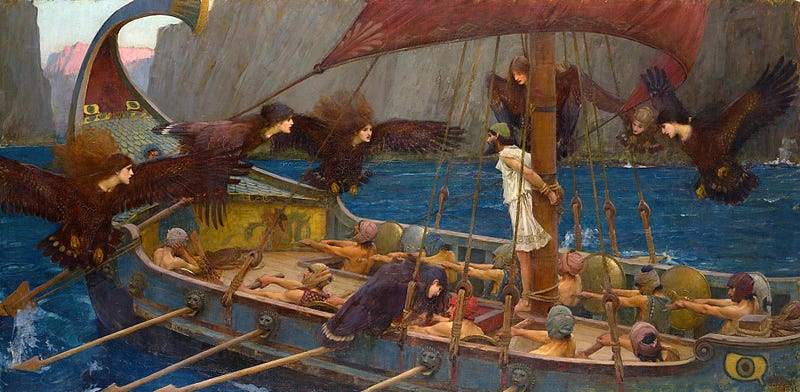
Ulysses and the Sirens (1891) by John William Waterhouse. Oil on canvas. 100.6 x 202 cm. National Gallery of Victoria, Melbourne, Australia. Image source Wikimedia Commons

John William Waterhouse’s compelling painting shows a ship passing through a treacherous strait of shadowy blue water.

Surrounded by flying creatures known as Sirens, the ship’s crew labour at their oars. In the far distance, sunlight clips the top of the mountain, promising salvation if only they can make it that far.

The painting’s inspiration comes from the epic story of the hero Ulysses (also known as Odysseus) who embarked on a perilous journey home to the island of Ithaca after fighting in the Trojan War. One of his most famous encounters was with the Sirens, as recounted in book 12 of Homer’s epic poem The Odyssey.

Yet, despite its grand scale and highly-charged subject matter, the painting caused controversy among the critics for its provocative depiction of the Sirens.

The Sirens’ Song

In the scene the ship is being rowed by a dozen men, whose oars reach the water through lion-mouth holes in the galley’s sides. Notice how each of the men’s heads are wrapped in colourful bandages — this is to protect them from the alluring calls of the half-woman, half-bird creatures that appear to invade the vessel.
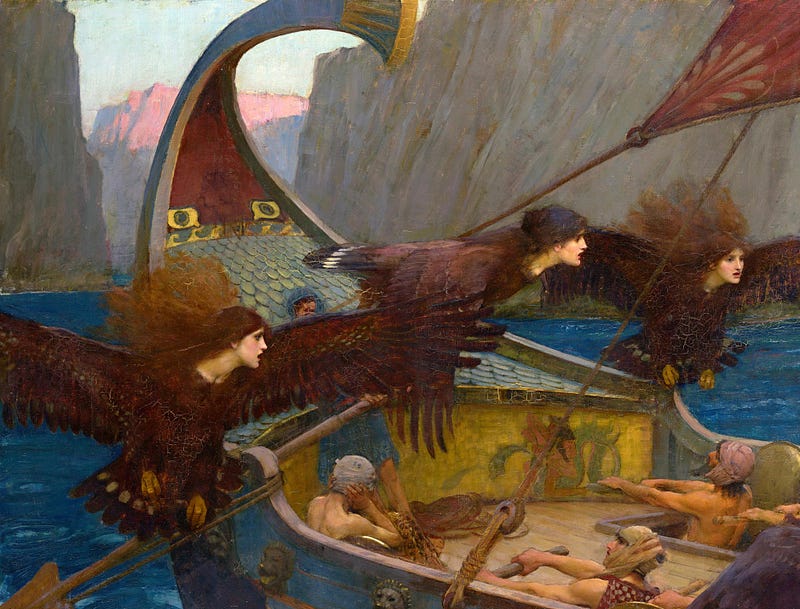
Detail of ‘Ulysses and the Sirens’ (1891) by John William Waterhouse. Oil on canvas. 100.6 x 202 cm. National Gallery of Victoria, Melbourne, Australia. Image source Wikimedia Commons

The Sirens were mythical creatures who lived on an island in the Mediterranean Sea. They were known for their hypnotic and bewitching song that would lure sailors to their death and wreck their ships on the rocky shores of their island.

To evade their seductive melodies, the sorceress Circe advised Ulysses to “anoint the ears of thy comrades with sweet wax [..] lest any of the rest may hear” — a detail which Waterhouse chose to render as bandages around the men’s heads.
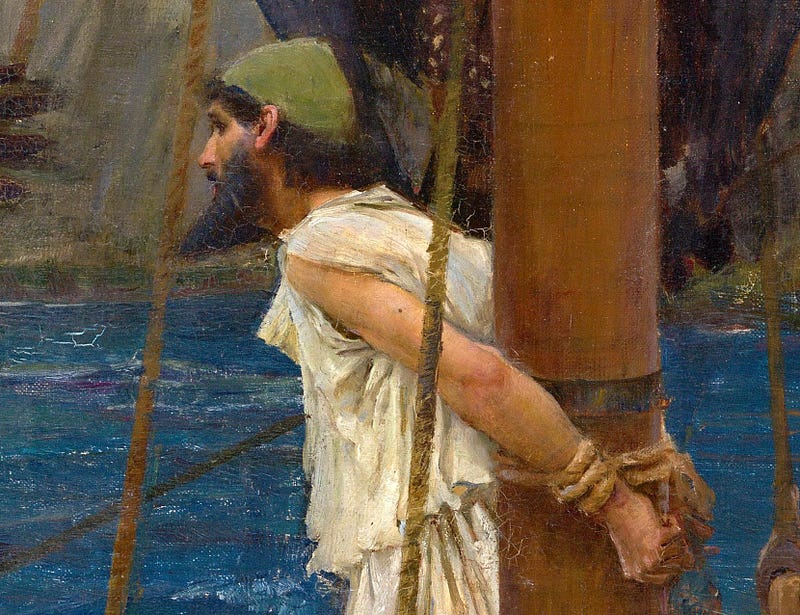
Detail of ‘Ulysses and the Sirens’ (1891) by John William Waterhouse. Oil on canvas. 100.6 x 202 cm. National Gallery of Victoria, Melbourne, Australia. Image source Wikimedia Commons

The only man without his ears covered was Ulysses himself, who ordered his crew to tie him to the mast of the ship, on Circe’s advice: “But if thou thyself hast a will to listen, let them bind thee in the swift ship hand and foot upright in the step of the mast, and let the ropes be made fast at the ends to the mast itself, that with delight thou mayest listen to the voice of the two Sirens.”

Dressing Ulysses in white, Waterhouse places him as the focal point of the image: bound to the mast, he was able to sail past the Sirens’ tuneful onslaught unharmed.
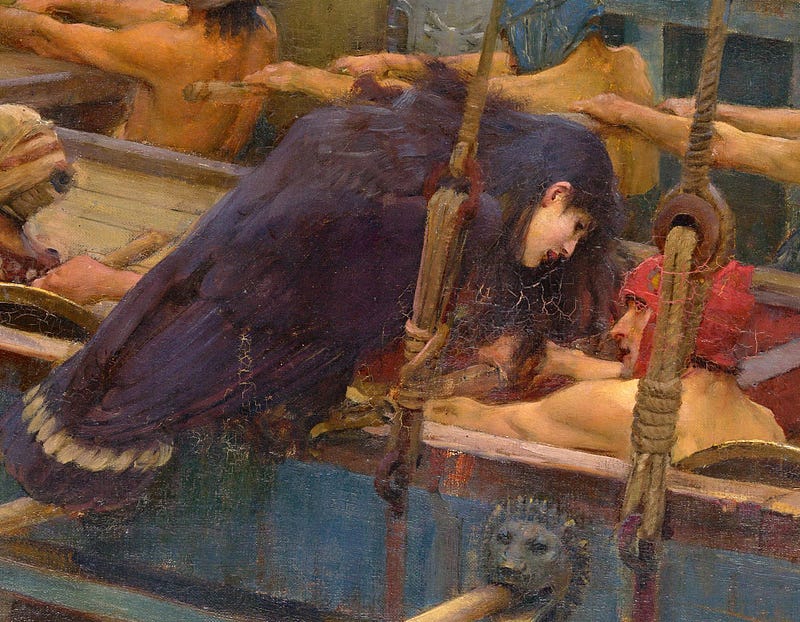
Detail of ‘Ulysses and the Sirens’ (1891) by John William Waterhouse. Oil on canvas. 100.6 x 202 cm. National Gallery of Victoria, Melbourne, Australia. Image source Wikimedia Commons

With the bird-women prowling open-mouthed around the ship, the painting takes us forcefully into the moment of the Sirens’ predatory arrival. A rich palette of colours — blues, purples, russet reds, browns and yellows — makes up the torrid image.

Waterhouse was not the only artist of the period to produce representations of Ulysses and the Sirens. Ostensibly an example of the triumph of human intelligence over the seductive power of temptation, artists like William Etty and Herbert James Draper painted depictions of the subject with overtones of a patriarchal heroism — arguably suited to the imperialistic ethos of the Victorian era.

Critical Controversies

When art critics encountered Waterhouse’s painting when it was first displayed in 1891 at the Royal Academy, London, a number of them were unnerved by what they saw as the artist’s imaginative diversions from Homer’s original poem — as if to deviate from the source text was artistic licence too far.

Not only had Waterhouse painted seven Sirens instead of the two mentioned in the poem, he also had them stalking the boat and actively assailing the sailors. Expecting (or perhaps hoping) to see the Sirens as voluptuous mermaid-like nymphs singing from a distant rock, the critics were alarmed by this horde of macabre creatures that they found instead.

Writing in The Pictorial: Academy and Salon Pictures of 1891, one commentator was confounded by the lack of feminine charm: “‘Sirens’, said I to myself, ‘I had no notion of them except as lovely creatures of the Loreley kind, strictly confined to their own rock, to whose fatal contact they lured the voyager by their singing’”. Another critic protested that their “vulture claws preclude the possibility of such birds uttering dulcet strains of music”.

It could be argued that the critics’ chagrin was unfounded: there was no physical description of the Sirens in Homer’s original text, and even when tradition in art was established, they were regularly depicted as human-headed birds. It was only centuries later that the more voluptuous mermaid type became popular.
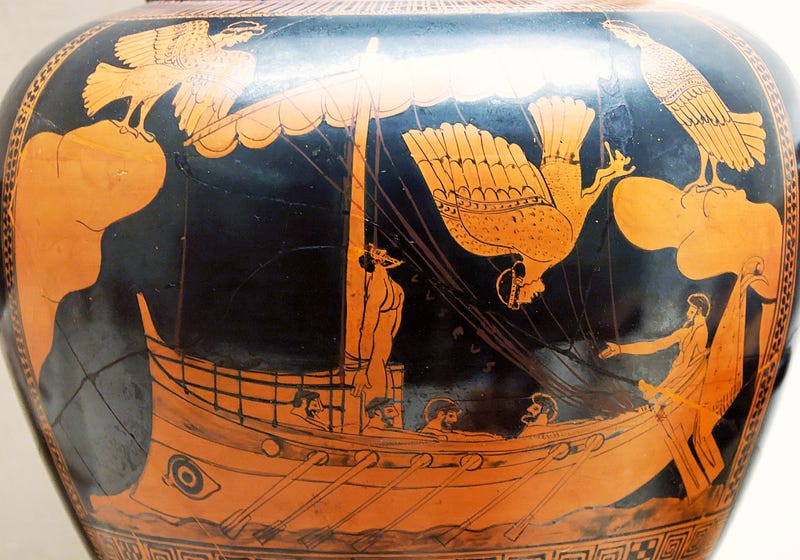
The Siren Painter Greek, Vulci, 5th century BC Stamnos decorated with Odysseus and the Sirens earthenware. Height 35 cm. British Museum, London, UK. Image source Wikimedia Commons

Not all critics were as shocked. A more perceptive reviewer, Marion H. Spielmann, writing in The Magazine of Art, noted that there was a clear precursor to Waterhouse’s bird-like Sirens — to be found in the decorations of classical Greek vases, such as found on 5th century BC Stamnos pottery.

It is thought that an example of one such earthenware pot in the British Museum was the true source of Waterhouse’s inspiration.

Female Venality

Perhaps what really dismayed the critics was the uncomfortable vision of women as active aggressors who enacted more than just supernatural temptation.

Images of seductive temptresses were well established in art, for this was the era of the femme fatale. Suggesting a certain level of insecurity about the increasing autonomy of women during this time, notable European artists ranging from Dante Gabriel Rossetti to Edvard Munch were fascinated by the concept of female venality under the guise of beauty. They drew on female archetypes from history, including Cleopatra and Lucrezia Borgia, as well as biblical figures like Salome, Judith, and Delilah, and mythical icons such as Circe, Helen of Troy, and Medea, to express their personal anxieties about the opposite sex.

As women campaigned for greater economic, political, and educational rights — for instance, in the UK the Women’s Property Act of 1882 allowed married women to have complete personal control over all of their property — paintings showing dangerous women grew ever more popular.
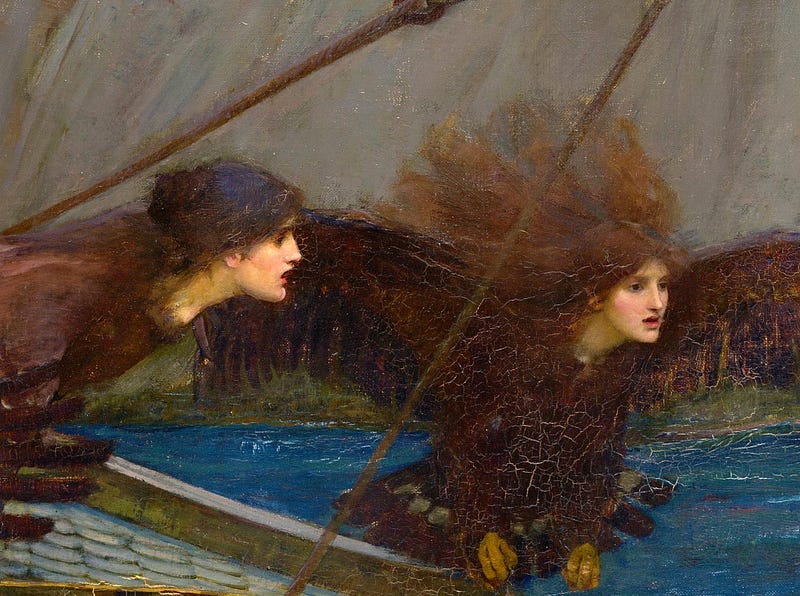
Detail of ‘Ulysses and the Sirens’ (1891) by John William Waterhouse. Oil on canvas. 100.6 x 202 cm. National Gallery of Victoria, Melbourne, Australia. Image source Wikimedia Commons

Yet whilst femme fatale depictions tended to dwell on the erotic or seductive aspects of the motif, Waterhouse’s animalised Sirens were neither erotic or seductive — but simply tormenting, occupying a nightmarish and surreal atmosphere.

Perhaps what Waterhouse painted was a desexualised version of the femme fatale that represented the fears and insecurities of the Victorian male all too well. With the sinister bird-like creatures hovering above the choppy sea, bearing sharp talons and piercing eyes, Waterhouse pushed the boundaries of academic art — making this painting a testament to his skill and willingness to explore new artistic styles. Creating Ulysses and the Sirens also cemented a turning point in his subject choices, away from maudlin scenes of Classical Rome and the “Orient”, towards the drama of Greek legend.

If you liked this, you may also be interested in my book Masterpieces of Art Explained, an examination of some of art’s most enthralling images.

Would you like to get…

A free guide to the Essential Styles in Western Art History, plus updates and exclusive news about me and my writing? Download for free here.

Join me…

On Instagram for more great paintings on the go!

Art
Art History
Mythology
Painting
Inspiration
Recommended from ReadMedium