
The Psychological Trick That Allows People To Kill
How Dehumanization Has Enabled Slavery and Murder
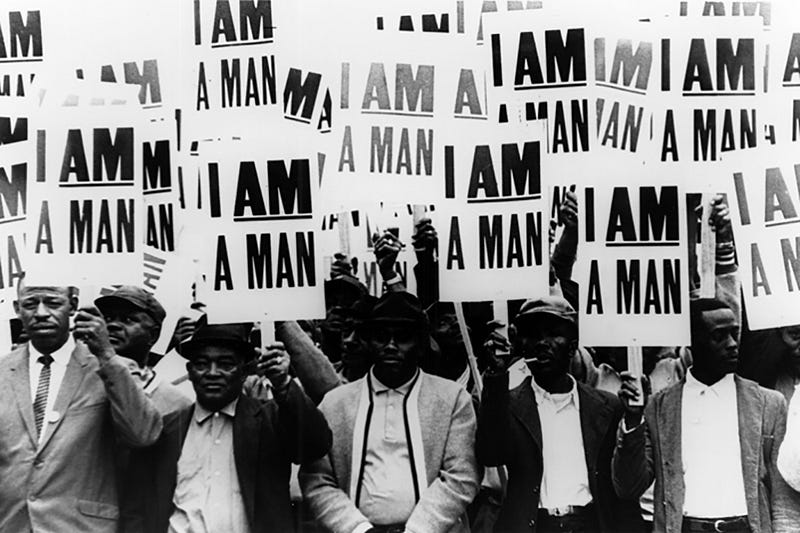
“A lot of guys really supported that whole concept that if they don’t speak English and they have darker skin, they’re not as human as us, so we can do what we want.”
Specialist Josh Middleton, 2nd Battalion, 82nd Airborne Division. Four-month tour in Baghdad and Mosul beginning December 2004*
“I guess while I was there, the general attitude was, ‘A dead Iraqi is just another dead Iraqi… You know, so what?’ […] when they get home, in dealing with veteran issues and meeting other veterans, it seems like the guilt really takes place, takes root, then.”
Specialist Jeff Englehart, 26, 3rd Brigade, 1st Infantry. In Baquba for a year beginning February 2004*
When we think of dehumanization, we think of the treatment of the Jews — murdered on an industrial scale — by the Nazis. Or the way sub-Saharan Africa was ravaged by the transatlantic slave trade.
In both cases, people were robbed of their human dignity by systemic racism. These are extreme cases of racism and its depressingly inevitable trajectory toward exploitation and murder.
Mass murder and warfare seem to be as old as time, we are resigned to the basic fact that human beings wage war. But the philosopher David Livingstone Smith makes a compelling case that the principle psychological mechanism behind mass murder and subjugation — dehumanization — has an origin and an explanation.
Tantalisingly, he even seems to suggest that this is a problem that can be solved.
The Origins of Dehumanization
Human beings are generally relaxed about killing animals but are innately reluctant to kill those of our own kind.
It takes a special kind of mechanism “to overcome the very deep and natural inhibitions [people] have against treating other people like game animals or vermin or dangerous predators,” Smith told NPR. That mechanism, Smith argues, is dehumanization. It’s regarding people as somehow sub-human, even though they look human.
What’s the basis of such a radical leap? The starting point of this phenomenon is what is often called “the great chain of being”.
For thousands of years, cultures have organized everything in the world in a hierarchy with gods (or God) at the top and inert matter at the base.
Between the divine pinnacle and the base, all things are arranged in pecking order: with worms and bottom feeders down below, then insects, reptiles, birds and mammals in ascending order and human beings close to the divine, and very much at the apex of earthly life.
Such thinking has persisted, even within the secular and scientific mindset of the Western world. Many believe, for example, that human beings are biologically superior or higher up on the “evolutionary scale” than frogs, dogs or jellyfish.
This is simply not the case according to Darwinian evolutionary theory, which is intrinsically anti-hierarchical (Darwin was even reluctant to use the word “evolution” to describe his theory, because of its qualitative associations).
Since these hierarchies of all-beings are so embedded in different cultures, it then becomes easier to arrange different species into hierarchies, including our own.
With the emergence of agriculture, human beings began to settle and build hierarchical societies with a far more strict division of labour than their hunter-gatherer ancestors. A successful agricultural economy has two important requirements: lots of land and lots of labour.
Smith’s argument, which is convincing, is that dehumanization emerged with agrarian economies so that land could be captured and slaves were taken to work that land.
As tribes became kingdoms, xenophobia became rife. Smith points to ancient Egyptian texts as among the oldest that liken foreigners to animals.
Aristotle’s Case for Pillage and Slavery
Dehumanizing rhetoric was common in the “civilized” ancient world but began to be justified on an intellectual level.
In his Politics, Aristotle made a distinction between fellow Greeks and “barbarians”. This allowed the philosopher to not only articulate why there were profound differences between people, but also to justify slavery and the imperial conquests of the Greeks.
How did the great philosopher of antiquity pull this cruel trick off?
For Aristotle, there is an “essence” to being human that is not visible to the eye (it is contrasted with appearance). That essence is in rationality.**
The Greeks were rational, according to Aristotle, and as such fully human. They supposedly had an innate superiority to barbarians, whose ability to reason was rudimentary.
Even today we associate “barbarism” and “barbarians” with a kind of uncultured, unintelligent sub-humanity, when in fact barbarian cultures of the ancient world were perfectly fine and sophisticated. Barbarians were simply a fantasy of otherness concocted to fuel xenophobia and a gigantic slave trade.
So while some people look human, according to Aristotle, they are not fully human because they either lack or are deficient in that invisible essence – rationality. Their basic grasp of reason means that they can be ruled over as slaves.
He wrote,
“Just as some are by nature free, so others are by nature slaves, and for these latter the condition of slavery is both beneficial and just.”
The interesting words here are “by nature”. This is to say that whatever quantity or quality of “humaness” you have, it is innate — it is natural, there is nothing that can be done to change it.
Aristotle’s ideas would have far-reaching and terrible implications. The philosopher was widely read in both the Christian and Islamic worlds of the Middle Ages. The idea that some people are less human than others allowed the justification and even (ironically) the rationalization of imperial conquest and slavery.
Aristotle acknowledged that warfare is a form of acquisition, not only for land and resources but also for “men who are not prepared to be ruled even though they are born for subjugation.”
He went further, stating that “war is just by nature” since it puts people who should be slaves into slavery — because putting them to their innate purpose was just.
This continued for centuries and continues today. While Aristotle’s bogus idea is not wholly responsible for slavery, it has provided a figleaf of intellectual credibility to otherwise naked exploitation and murder. Intelligent apologists for slavery and mass murder have popped up throughout history and often cite Aristotle as they justify the acts of their paymasters.
Smith names eminent sixteenth-century intellectuals such as the Spaniard Juan Ginés de Sepúlveda and the Scottish theologian John Mair. Both argued that the native people of the new world were sub-human beasts and therefore could be treated accordingly.
While Aristotle used rationality as human essence, eighteenth-century colonists used “soul”, and slavery-apologists of the scientific nineteenth century used “species”. The people they butchered and enslaved were part animal, they claimed, because they were fundamentally different in essence.
The Meaning of Humanity
While the world seems somewhat more enlightened, the problem persists. The belief in a human essence has stuck, and the insidious shadow it casts— dehumanization — remains too.
The problem is that “human” is not a well-defined concept. Smith reminds us that Homo Sapien is a scientific term, but “Human” is a folk category. Scientists can dig up skeletons and define them as Homo Sapien, what they cannot do is define the skeleton as Human. It is precisely this conceptual malleability of “human” that allows cultures to shape its meaning to their own purposes.
When a label is open to interpretation, it becomes an adjective, and a qualitative one at that. Think of how loose the word “human” is, how it shape-shifts. We don’t use “canine” or “primate” in the same senses we use “human”. Think of the word “humanity” — we ascribe this word to actions and to people in greater or lesser quantity.
Smith also dismisses other, seemingly weaker, ideas of dehumanization, such as the treatment of people as numbers, or “cogs” in a bureaucratic system, or the treatment of women as sex objects in pornography.
Smith argues that dehumanization is not a temporary treatment. “Taking away a person’s individuality isn’t the same as obliterating their humanity. An anonymous human is still human.”
And so it is with the derogatory treatment of people being less human, or mere means to an ends. In all these cases that are arguably examples of dehumanization, Smith holds that they are not because dehumanization is purely — as he holds it — to regard a person as subhuman. That is, they look human, but they are not considered so.
Smith makes approaches dehumanization by this process of subtraction because the concept — like the very idea of “human” — is a “tangle of meanings”, and to discuss dehumanization meaningfully, it’s important to pin it down.
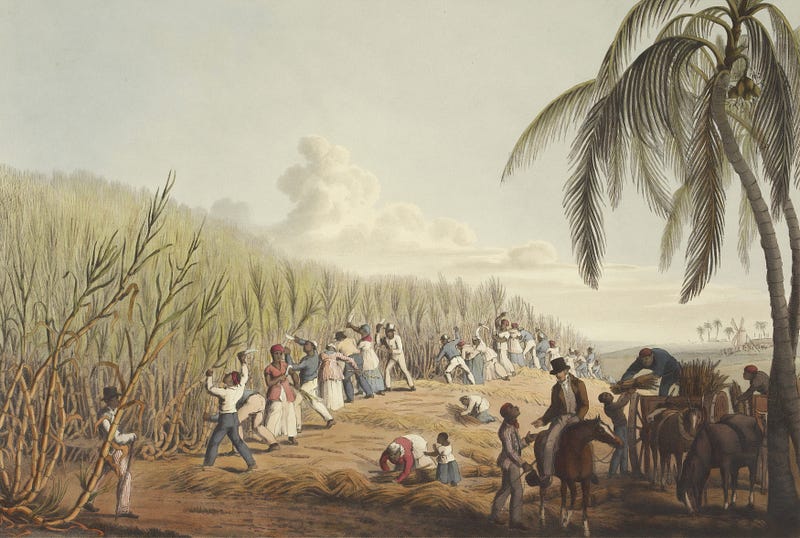
Dehumanization Works Both Ways
Smith’s work on this matter is both bravely speculative and thorough but it falls short of explaining the whole gamut of human cruelty. By expanding this notion, we can understand why people can be so vicious to one another in many more respects than Smith accounts for.
The problem with Smith’s argument is its internal strength — that he too narrowly defines dehumanization. Smith’s definition makes dehumanization tantamount to racism. By his own admission, his idea of dehumanization is purely psychological — “it occurs [only] in people’s heads.”
But dehumanization really depends on a complex of factors before it eventually escalates into full-blown subjugation and mass murder.
Smith implies, for example, that only dehumanization as he defines it seems to make us capable of killing other human beings on a mass scale. While this kind of dehumanization is a prerequisite for many instances of war and pillage, it’s not the sole mechanism behind it.
Think, for example, of civil wars where neighbors can literally end up on opposing sides. It’s impossible to think that fighters on the side of the Union of America, or the Parliamentarians of England, would think of those they were willing to kill as “subhuman.”
Focusing too narrowly on the perception of what human means is looking at the problem from the wrong end of the telescope. While scientists and philosophers can split hairs over what “human” is, it’s easy, on the whole, to agree on what human is. We do it all the time.
The problem is that human essence has been posited to discern not between humans and animals, but between human beings. This is simply done by giving the essence a greater or lesser quality.
Essence has been inferred from difference, not sameness. As the anthropologist Claude Lévi-Strauss put it, “Humanity is confined to the borders of the tribe, the linguistic group, or even, in some instances, to the village.”
So we can confer inner lives on the people we are most familiar with, and therefore understand them to be as fully human as we are. In trying to figure out why some people are different, the xenophobic guesses that they are deficient in something — human essence. The less familiar people are, the less human they seem.
And so “humanity” becomes tantamount to virtue. Some acts are more humane — and therefore more human — than others. “Humanity” is defined as both the state of being human, and acting in a compassionate and generous way.
It is regarded as a criterion — a benchmark or standard by which we can value actions as in, how humane was that action? Yet, it’s invisible and undefinable. It’s as if our ethical currency has no backing and is, as such, easy to debase.
The Ethics of “Humanity”
How does this work? Well, to paraphrase Protagoras and Shakespeare, the measure of all things is man, and there is no good or bad in the world, but thinking makes it so. People are the ends of all means because there are no means without people defining themselves, in some way, as the ends of those means.
“I need to quench my thirst”, or “I should take out a loan to buy a car”, or “I need slaves to work my employer’s fields”, “I will cleanse this land of the enemy” are what the Enlightenment philosopher Immanuel Kant called “hypothetical imperatives”. An imperative is any proposition that declares a certain action to be necessary — whether or not it is right or wrong.
What makes actions “right” or “wrong” on an ethical level is where people (including yourself) are placed in that equation — as means, or ends. In one formulation of his famous Categorical Imperative, Kant wrote:
“Act in such a way that you treat humanity, whether in your own person or in the person of any other, never merely as a means to an end, but always at the same time as an end.”
While hypothetical imperatives — “I/you need to do X” — are subjective. The categorical imperative is objective — “one ought to do Y”. That “ought” is the demand of community and compassion. It is the demand that aknowledges that the other has a will that is as free as yours.
This, for Kant, is the very basis of ethics. Not rules about conduct that are passed down as “moral law”, but acknowledgement of the other’s same ability to make up their own minds. What follows from that is an innate understanding of the moral law within us.
The free will of a human being is the end of all action, to treat that free will as a means to an end only is to momentarily deny or negate the possibility of freedom in general. If we are not free there is no basis for humanity, because to have humanity is to act freely.
Whether consciously or not, this is the ethical dichotomy that crops up in Abraham Lincoln’s debate with Stephen A. Douglas, an apologist for slavery in America:
“That is the real issue. That is the issue that will continue in this country…. It is the eternal struggle between these two principles — right and wrong — throughout the world. They are the two principles that have stood face to face from the beginning of time; and will ever continue to struggle. The one is the common right of humanity and the other the divine right of kings. It is the same principle in whatever shape it develops itself. It is the same spirit that says, “You work and toil and earn bread, and I’ll eat it.” No matter in what shape it comes, whether from the mouth of a king who seeks to bestride the people of his own nation and live by the fruit of their labor, or from one race of men as an apology for enslaving another race, it is the same tyrannical principle.”
Lincoln sets up Kant’s dichotomy as “divine right” and “common right”. Divine suggests a lack of freedom — a divinely ordained way things should be, whilst common right — which Lincoln associates to “humanity”, is the embrace of freedom.
It is in this very debate that Lincoln goes on to accuse Douglas of “dishumanizing” (reported in the press as “dehumanizing”) black people in order to put them at the service of white people.
Dehumanization is then a process that we actually go through. It does not merely “exist in the head” of those doing the dehumanizing, as David Livingstone Smith argues. We are robbed — or rob ourselves — of humanity because it was always a conferred attribute anyway.
Humanity (both being and acting human) is not an energy or a power within us. It is virtual, not substantive — it is an effect of our living in community. It’s why we typically recognize it more in people we are familiar with, than in foreigners.
The Mechanism of Dehumanization
So while all violence entails dehumanization, it does so in a much broader sense than along the narrow lines that Smith puts across.
So what is the mechanism of dehumanization if it’s not merely psychological?
It’s the idea or instinct that others — those being dehumanised — do not have access to or are in denial of a truth (that they can’t understand a truth that is grasped by those persecuting). Failing to grasp that truth makes them inferior. But being put to the service of that truth is also to be dehumanized.
What do I mean by this? When I write “truth”, I don’t mean “the truth”, I mean an opinion that is taken to be “the truth” by its holder — it is a hypothetical imperative taken to be categorical.
Such a truth can be any prerequisite for violence. It could be that a particular soccer team is “the greatest”, which is why football hooligans in Europe have been known to kill each other in brawls. I’ve chosen this kind of tribalism and violence, because it is a petty and wretched example of how grown men, who should know better, engage in senseless acts of violence.
The victim is dehumanised in the sense that they become a fungible part of a mass opposed to this truth — their destruction is a means to an ends. The perpetrator is dehumanized because they are putting themselves at the service of this truth — they are also only a means to an end.
This is how dehumanization works both ways. When people are treated only as a means to an ends, their humanity is debased — sometimes willingly. The hooligan dehumanizes those who oppose his “truth”, while dehumanizing himself by placing himself in service of that “truth” as if he is a machine or an animal put to work.
Soldiers are the perfect example of this, which is why hooligans and criminals often refer to themselves as soldiers. At times of war soldiers are often made to be a means to an end to such an extreme degree that they lose any moral culpability to themselves.
We refer to people in the armed forces as means by way of synecdoche and metaphor as much as those that dehumanise — “all hands on deck”, “boots on the ground”. We call them “forces”. These are of course harmless turns of phrase, but it shows the power that ideas have in shaping our perception of people.
Now let’s shift from the absurdity of hooliganism to the horror of Nazism.
Under the Nazi regime jews were forced to mark themselves in an act of social exclusion — they were made to wear badges (the infamous yellow Star of David), they were given uniforms as both a way to distinguish them, but also make them the same. Along with propaganda films like The Eternal Jew comparing them to rats, this dehumanized them as a fungible, undifferentiated mass.
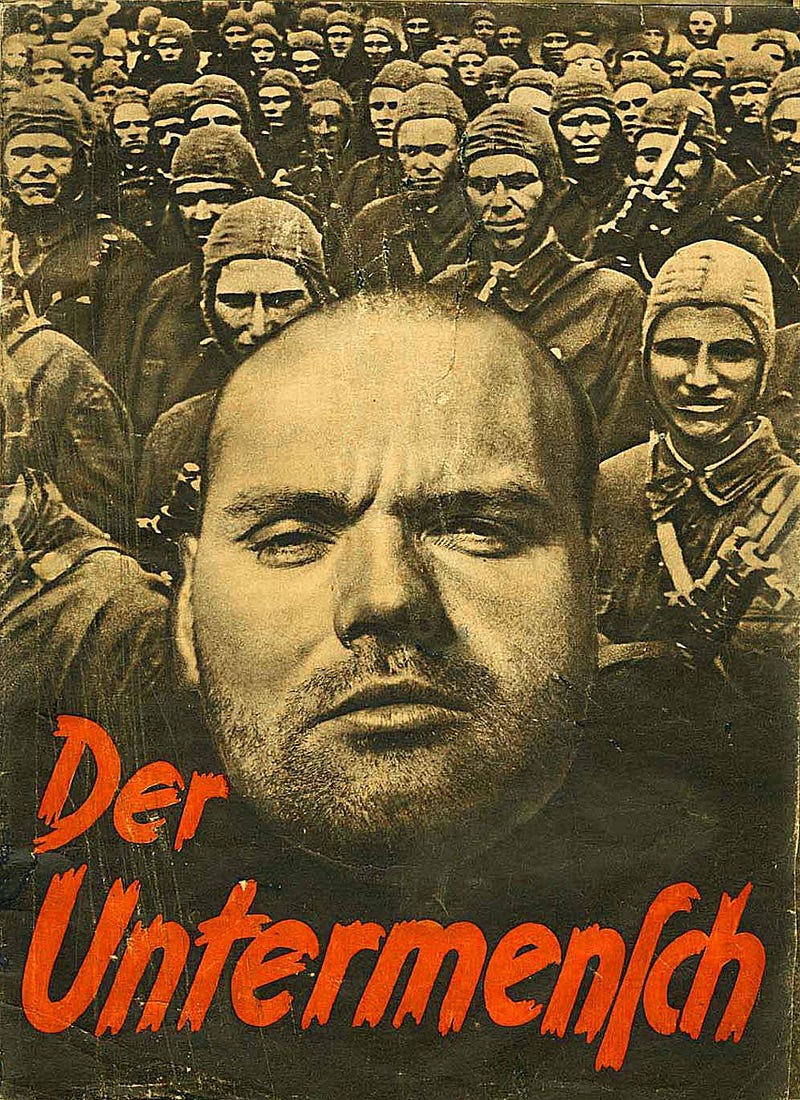
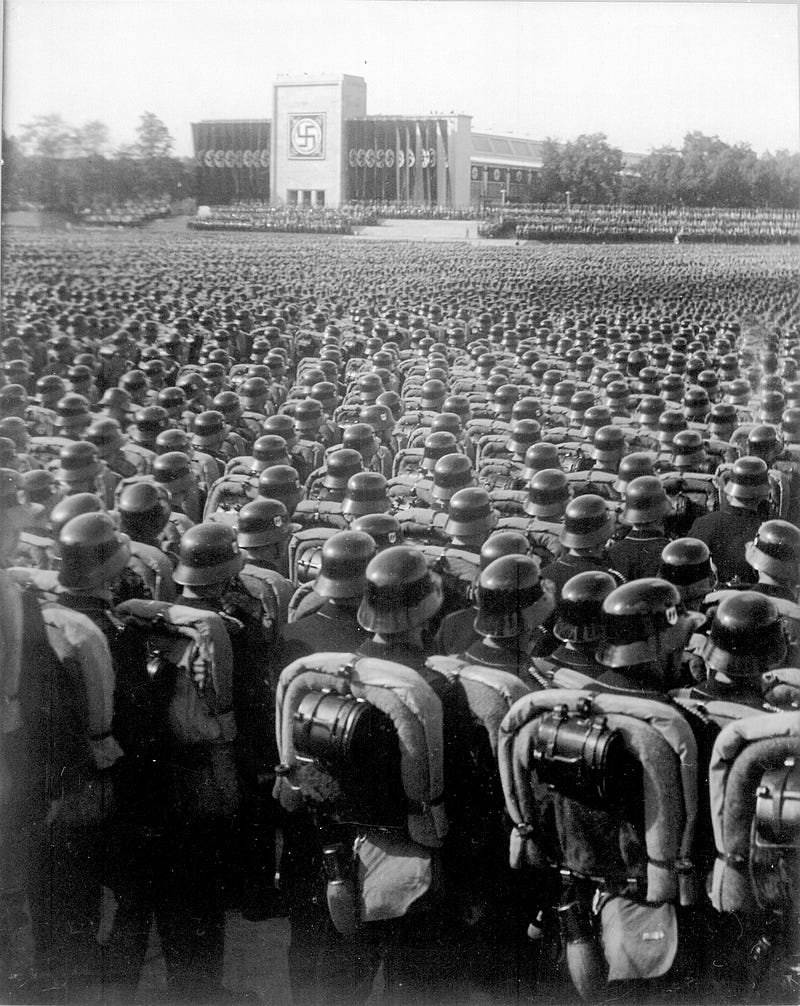
But similarly, the Nazis made Germans an undifferentiated mass — all in the service of the Nazi “truth”. The Nazi philosopher Martin Heidegger wrote that “the Führer has awakened this will in the whole nation, and has fused it into one single will.… Heil Hitler!”
The key word here is “fused”. Think of the Nuremberg Rally — that undifferentiated mass of uniformed Nazis marching in lock-step under their banners.
All those people, with their own hopes and dreams, their quirks and their eccentricities became — volunterily or not — this one “will” that Heidegger described.
On both sides of the horror of Nazism human beings became a means to an end and were treated as such. The “truth” that the Nazi’s were obsessed with was that the aryan race was the superior race, and that this superior race required the establishment of an empire (“lebensraum”) in Eastern Europe. Jewish and Slavic people were perceived as an obstacle to that “truth”, because they either didn’t recognize that truth, or they denied it.
So in the mind of the perpetrator of violence, people either fail to grasp a truth willingly — as is the case of civil conflict or even football violence, or they innately fail to grasp it — as in the case of racism. They can therefore be put to use as a means to an end that is that truth.
It’s only an act of self-deception, a denial of one’s own freedom and therefore one’s own humanity that can accomplish that.
This leads us back to the quotations of the war veterans Josh Middleton and Jeff Englehart at the start of this article.
Dehumanization is arguably far more common and ingrained than we like to imagine.
Even enlightened people, sent on apparently noble missions, find themselves deep in remorse that they partook in dehumanizing people, and were dehumanized themselves.
The veterans of the conflict in Iraq quoted above demonstrate that the world’s leading democracy, itself a melting pot of races and cultures, is not immune from the insidious spell that makes people appear less than human and therefore worthy to be killed as prey — or kill themselves as predators.
But the process of dehumanization lasts only as long as a person is treated as a means to an end.
The remorse the second veteran, Jeff Englehart, feels is deeply saddening to read. This is because Englehart himself was a victim in many ways. He had that humanity robbed from him, when it returned, he felt a guilt that “took root” in his humanity.
Dehumanization is at the heart of Lincoln’s assertion that the world is torn between the tendency to exploit others and the tendency to recognize their freedom. It is a reminder that we must expand the boundaries of sympathy and compassion so that we may embrace our freedom by respecting the freedom of others.
Thank you for reading.
*The source of these quotes is from The Nation’s powerful 2007 compilation of interviews with veterans of the Iraq war. https://www.thenation.com/article/archive/other-war-iraq-vets-bear-witness-0/
**Aristotle did not use the word essence. That was added by Latin translators. He used phrases “the what it is to be” or “the what it is”. But “essence” stuck, because essence (“essentia”) derives from the verb “esse” (to be).