
The Psychological Failure of New Coke
Why the biggest marketing disaster in history didn’t have to go wrong…
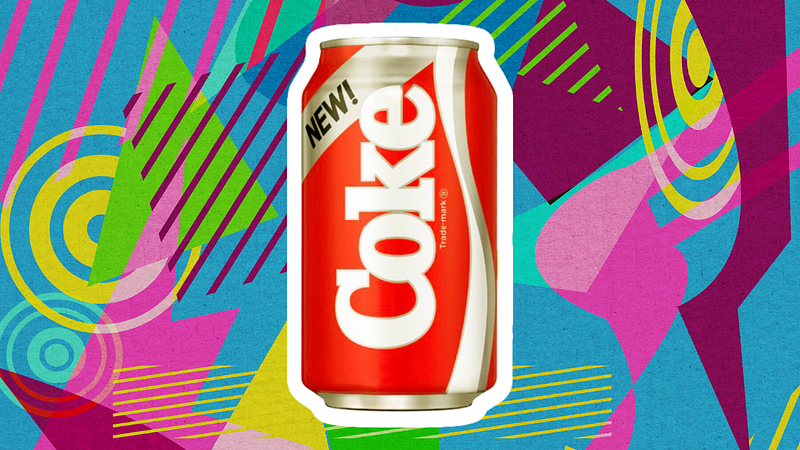
It's one of the biggest fails in business history — New Coke.
You might think you know the story. A classic brand foolishly replaces its classic product, and customers rebel.
But contrary to popular belief, New Coke was a great idea and a great product - even if it was a huge marketing disaster.
It's all down to five common psychology traps that Coke fell into (and you could, too).
1. The Cut-Throat Cola Wars
In the 1980s, Coca-Cola was at war.
They were duking it out with their biggest rival, Pepsi, who at the time was winning. And not by a little.
After World War II, Coca-Cola owned 60% of the cola market, but by 1983, it had less than 24%. All because of competitive pressure from Pepsi.
The brand launched a nationwide taste test called the Pepsi Challenge. People were blindfolded, given a sip of Coke and Pepsi, then asked which soda they preferred. And people, especially young people, overwhelmingly chose Pepsi.
It was clear that when it came to taste, Coke had a big problem. And they did something that any brand that was losing market share and under lots of competitive pressure would do. Coke created a new product.
Coke knew that Pepsi was winning on taste because it was sweeter than Coca-Cola. So, Coke launched a secret plan to create a sweeter version of its classic Coca-Cola. It was code-named Project Kansas, inspired by a famous picture of a journalist drinking a Coke at a soda fountain (below).
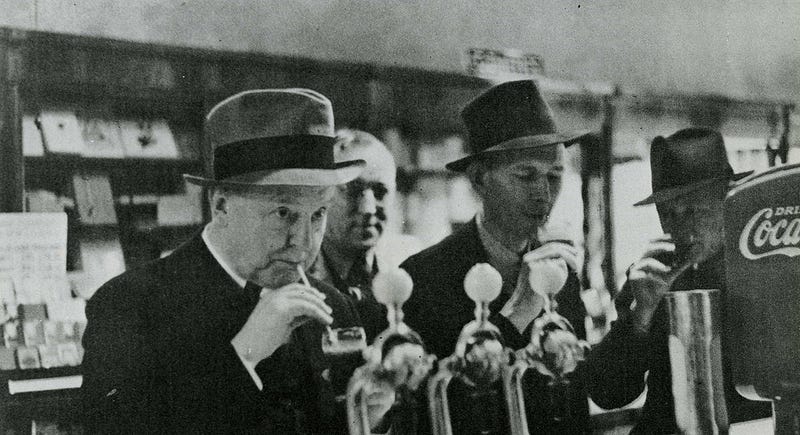
That’s where Coke made its first misstep. It didn’t introduce Project Kansas as a new product. Instead, they replaced their most important product, Coca-Cola, with this sweeter version. It was (unofficially) dubbed New Coke.
But why would Coke replace its most popular product? It’s down to a common psychological trap called Action Bias.
What is Action Bias?
Action Bias says that when facing a problem, our brains prefer to do something, anything, rather than waiting to see how things unfold. This cognitive bias is common in corporate America.
Because the Pepsi Challenge was putting direct pressure on Coke’s flagship product, they felt pressure to act and change that product.
Coke fell victim to Action Bias and took a legendary wrong turn.
2. 200k People Can’t Be Wrong… Right?
By 1984, Coke’s Project Kansas had their prototype for sweeter Coke, but they didn’t just throw it on the shelves. They did what any big, responsible company would do — they tested it with customers.
But that would turn out to be the biggest mistake of all.
Coca-Cola spent the equivalent of $12M today to get 200,000 people to try New Coke, using surveys and focus groups.
Did these customers hate New Coke? No — the opposite. The taste of New Coke beat both Pepsi and Coke Classic. The results of the research were so positive that one of Coke’s bottling partners threatened to sue if they didn’t release New Coke.
To Coke, it seemed like a no-brainer to release a product that hundreds of thousands of people preferred and that the bottlers were demanding.
But they didn’t realize that there was a flaw in how the surveys and focus groups were performed.
First, researchers only gave out a small amount of New Coke. These tiny samples didn’t reflect how people drank Coke in real life. Second, the research didn’t account for the psychological impact of changing the taste of Coke.
Executives ignored a psychological principle called Loss Aversion. That became their biggest mistake.
What is Loss Aversion?
Loss Aversion says that people hate to lose. In fact, losing something is about twice as painful as the happiness of gaining the same thing.
Loss Aversion: Losing something is about twice as painful as the happiness of gaining the same thing.
Coca-Cola was a part of people’s lives. The brand and the product stood for more than just quenching people’s thirst. When New Coke replaced classic Coke with little warning or explanation, it angered millions of people who felt like something they loved was taken away.
Donald Keough, the Chief Operating Officer and President of Coca-Cola at the time, put it this way:
“The simple fact is that all the time and money and skill poured into consumer research on the new Coca-Cola could not measure or reveal the deep and abiding emotional attachment to original Coca-Cola felt by so many people.”
3. The Man Who Spearheaded New Coke
The story of New Coke is really the story of one man, Coke CEO Roberto Goizueta. Born in Cuba before the rise of Fidel Castro, Goizueta’s family had made their money in sugar and real estate. After fleeing Casto’s regime, Roberto began working as a chemical engineer for Coke — first in Miami, then in the Bahamas.
By the time Goizueta became the CEO of Coca-Cola in 1980 (and later its CEO), the brand was in serious trouble. Goizueta did bear ultimate responsibility for the New Coke disaster.
But he was also a brilliant leader, successfully steering Coke through one of its most turbulent times.
Goizueta more than tripled Coca-Cola’s annual sales during his tenure. He launched Diet Coke and Cherry Coke to huge success and championed classic ad campaigns like Always Coca-Cola.
So how could such a smart guy make such a serious mistake?
Early in his career, Goizueta was in charge of Coke in the Bahamas. He had improved sales by tweaking the flavor of Coca-Cola in that market. Because of that past success, he mistakenly believed that he could do the same thing in Coke’s core market — the US.
Goizueta’s mind was already made up before New Coke went into testing. In his words, it was “New Coke or No Coke.” Coca-Cola’s internal documents of the time even compared the development of New Coke to World War II military maneuvers:
“In its size, scope and boldness, it is not unlike the Allied invasion of Europe in 1944.
This is not just another product improvement, not just a repositioning or new product introduction.
[Project] Kansas, quite simply, can not, must not fail.”
To put it simply, Goizueta was a victim of Confirmation Bias.
What is Confirmation Bias?
Coined by psychologist Peter Wason, Confirmation Bias describes peoples’ tendency to search for, interpret, favor, and remember information that confirms their choices and beliefs. As author Harper Lee put it,
“People generally see what they look for, and hear what they listen for.”
Goizueta believed that New Coke had to work, so he ignored information that contradicted that belief. Because he had already sold himself on the idea of New Coke, Goizueta spent millions in research and development to justify his decision. Determined to launch New Coke, he wasn’t going to let anything stand in his way.
4. The Media Was Thirsty for a Headline
When Pepsi found out about New Coke, their PR machine went into overdrive. During the press conference to launch New Coke, on what would become known as “Black Tuesday”, reporters asked loaded questions like:
“Are you sure this won’t bomb?”
The questions almost sounded like Pepsi had written them — which is pretty much what happened. In the days leading up to the press conference, Pepsi had called and prepped more than 200 reporters with tough questions and lines of attack. Pepsi then ran millions of dollars worth of advertising declaring they had won the Cola Wars.
After years of the Cola Wars raging, the media was ready for a new hook. So they grabbed onto the narrative that Coke had taken a massive misstep. They played up the failure and began spinning the facts to rile Coke’s most loyal fans.
Those bad headlines turned into demonstrations and letter-writing campaigns. In only a few months, there were more than 8,000 angry calls to Coke’s Atlanta headquarters every day.
Why did it work? Well, it’s because our brains love a story. It’s all down to an error in thinking called Narrative Bias.
What is Narrative Bias?
Narrative bias describes our tendency to make sense of the world through stories. We trust stories, become more emotionally invested in stories, and better remember information when it’s in a narrative. We even create stories out of thin air when presented with limited or random information.
Narrative Bias: People trust, remember, and become emotionally invested in stories.
When the media started spinning a plausible (if dubious) story that everyone hated New Coke, it was easy for people to accept. They could then double down on their belief that the product was a big mistake.
5. The Idea Failed, Not the Taste
It wasn’t the taste of the New Coke that failed. It was the “idea” of New Coke that failed. In fact, lots of people preferred the taste of New Coke. Roberto Goizueta himself drank New Coke for the rest of his life.
Coke hasn’t shied away from its mistake. Its website calls New Coke “one of the most memorable marketing blunders ever.” Coke made some miscalculations, sure. But the biggest one was not accounting for the psychological effect that “losing” Coke classic would have on its biggest fans.
A former Coca-Cola executive summed it up when he said,
“We did not know what we were selling.
We are not selling a soft drink.
We were selling a little tiny piece of people’s lives.”
This article was originally published on my site, Choice Hacking.


