
The Psyche: The Quest Of Meaning & Development Of The Psyche
The Quest For Meaning
Wherever you look, creation stories from around the world speak of a remarkably similiar pattern:
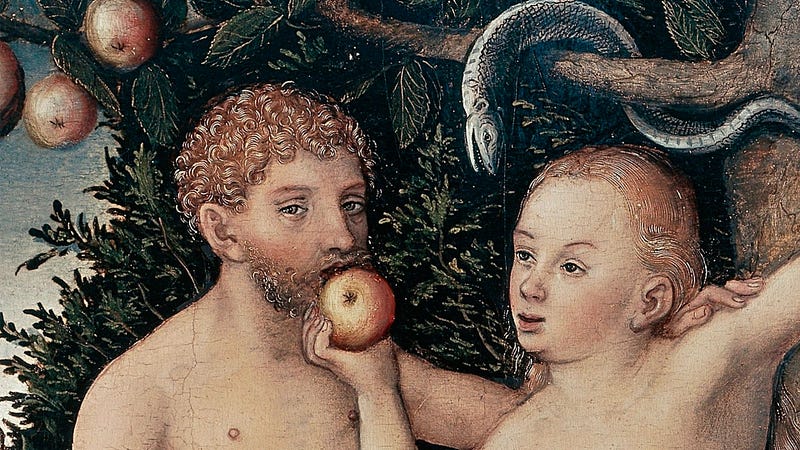
Adam eats the apple.
Bassari Man east the fruit.
Enkidu eats the bread.
Hercules drink from Hera’s breast, Pangu bites the head of King Fang, Pandora’s Box is opened…
And we god-like creatures fall from paradise into the world of pain and suffering.
In the beginning, it is said, humans lived in the realm of the gods and eternity.
At some point, we fell from this Garden and were born into time, space, and suffering. We became mortal and conscious, And for so long as we live, we aspire to return to paradise.
This is the universal Hero’s Journey, and it manifests in tales wherever you look:
Hercules performs the Twelve Labours.
Gilgamesh slays beasts.
Jesus, Buddha, and Rama battle demons in the wilderness.
Parzival quests for the Grail. Odysseus and Ahab chart the seas.
Cuchulainn and Sundiata defeat whol armies,
Frodo journeys to Mordor…
And man searches fro meaning — as you are, reading this now — journeying to the ends of the earth to find the elixir that might bring u back to paradise.
Regardless of your religious affiliation, I am sure the quest of the Hero resonates with your experience.
We are searching for something we feel we once had — call it Tao, God, happiness, Nirvana, or flow.
This is why we train, read books, live healthy lives, and grow stronger. We are seekers, all journeying towards — well, whatever you would like to call it.
I am not here to tell you that I have discovered the meaning of life. I haven’t.
I cannot tell you the way to your own truth.
But I can share some tools that have shaped me on my journey of growing stronger. And perhaps they may serve you as well.
On my journey, I have found the work of Carl Jung and a couple of his followers, namely Joseph Campbell and Robert Moore, to be quite helpful.
Individuation is the Jungian spiritual quest, and is the process of psychological integration.
In other words, conscious assimilation and acceptance of one’s entire psyche, or mind, which includes those parts of oneself that one may not even be aware of.
The way of individuation necessitates a journey inward to explore the unconscious.
It is within the dark and unexamined depths of our minds that we, whilst shining the flashlight of consciousnesses, discover the strongest versions of ourselves.
The key is to not go overboard in this exploration and drown in the depths of our own psyche.
In the next section, I will provide you with a roadmap of the psyche that may assist you on your journey towards self-discovery.
The Fall: Development Of The Ego
From a Neo-Jungian perspective, the creation stories from the beginning of this chapter symbolize the psychological stages of development.
As Adam and Eve did, we begin our lives in the Edenic womb. Nourishment, shelter, and love are all provided for us, and we -unaware of our nakedness — are content in the land of the unconscious.
Psychoanalytically, we still feel ourselves to be God’s children in our earliest moments.
Before the birth of consciousness, there is no separation between ourselves, the natural world, and the gods; no distinction between “I” and “it”; no sense of space and time, right and wrong, or duality in general. We are at one with everything. We are at one with God.
Here, pain and suffering do not exist because we are living in eternity, where there is no basis for wanting.
And before we know it, we are pulled out, wailing into the world like falling gods.
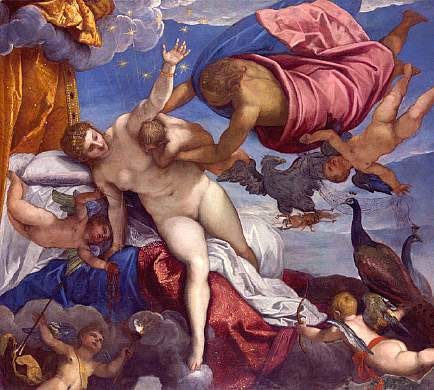
Like Hercules, we are ripped from Hera”s breast and cast down from Mount Olympus.
Like Adam, we eat the Apple of the Knowledge and are banished from Eden.
Just like that, the umbilical cord connecting us to paradise is snipped, and consciousness is born.
Forced into the world of opposites, we become aware of our nakedness; become awakened to our mortality and our suffering.
We quickly learn that we are no longer the gods we originally imagined ourselves to be.
Earth feels like afar cry from paradise.
Here, we must wear clothing, eat our vegetables, do as we are told, and develop boundaries between ourselves and the world around us.
The ego — or the “I” — is born, and along with it, the desire to return to the place from which we came form and once we stood in close proximity to God.
The Winter Of Alienation
The Fallen State of Man defines the consensus of human experience in the modern era. “God is dead,” famously spoke Nietzsche.
Most of us today feel alienated, in a sense, from God, the Universe, or whatever you want to call it.
We identify with Adam and Eve, and with all the other heroes seeking the restorative boon.
In certain ways, we feel as though we have been “wronged” by some greater force. Our lives do not feel quite full.
We all experience suffering to some extent, and we all seek a remedy to our pain.
“If there is a God,” we ask, “then why does suffering exist?”
This is the state of alienation.
I have been throwing around the term “God” rather loosely, so I feel it is time to explain what I mean when I use this word.
The imago Dei, or the image of God within the human psyche, is analogous to what Neo-Jungian thinker Robert Moore calls the ‘archetypal Self.” When I use the word “God,” I am talking about the archetypal Self.
What is the archetypal Self?
This Self is not you. The “you” I address is the ego.
The Self is the trans-personal force within and beyond us that is far greater and more complex than the “I” with which we identify.
It goes by as many different names as there are cultures: Zeus, The Father, Brahman, Tao, the Force, the inner Daimon, The Ring of Power, Richard Parker, Aslan, Moby Dick, and so on.
The Self is the Holy Grail of the unconscious — what we call the God within.
When one is in touch with it, one possess power.
But when one is alienated from the Self, one’s life lacks luster.
Many times, people who are in an alienated state ignore or reject their desire to reunite with the transpersonal.
They may experience suffering, but they may go about their business as usual. “That’s life,” they may tell themselves.
In order to numb his pain, the alienated individual might drink, party, and live an otherwise worldly life. He surrounds himself in the mundane, everyday activities of existence, including work, school, and all other duties. Maybe he becomes an atheist.
Mythologically, this man is trapped inside the “Matrix” — the constructed world that surrounds us — and wants to remain there, whether he knows it or not.
To put it another way, it is more comfortable for you to pretend that you are Joe. S., who lives in NYC in the 21st century and works a 9-to-5, than it is fro you to accept that you are actually an animal living on a tiny speck of rock that is hurling 1,000 miles per hour around a blazing ball of plasma in a universe that is infinitely large — without having a clue as to what any of this means.
There is another type of ego that recognizes his dissatisfaction and confusion with ordinary experience and knows that another state of being exists.
This person is aware that he has fallen into a constructed perspective and wants to return to the reality he once knew.
As he realizes his alienation, the world around this man grows increasingly more barren and unappealing. What once carried meaning now seems entirely profane.
School, work, sports, certain relationships, etc, — his whole world and everything he has done up until this point — suddenly becomes meaninglessness for him.
“What is the point?” he asks. “Who am I, and what on earth am I doing with my life? What is my purpose?”
“What is the meaning of life?”
On the surface, this person may appear to have a great life.
He may have a good job, make a lot of money, or do well in school. He may be talented and live a life that seemingly brings happiness, at least from an outside perspective.
In light of his disillusionment, others may rebuke him for being irrational or ungrateful.
“Can’t you just be happy with where you are and what you have?” they ask. “Come back to earth, let’s go out and have a good time, have a few beers. Stop being so serious.”
But there is no convincing this person. For him, life is becoming a wasteland and increasingly devoid of meaning.
Now to speak in terms of mythology, the alienated ego (or Adam) that is divorced from the unconscious (the Garden of Eden) — and is now are of having been fallen — grows apathetic to life. With this realization and the subsequent crumbling of the imperfectly constructed world he has always known, suffering, despair and oftentimes, an existential crisis ensue.
This ego is searching for the Grail that will redeem the world within and around him, whether or not he is conscious of it.
He knows a greater state of life is possible, but he just doesn’t know where to begin.
If you find yourself in this position, I bring good news.
Life, in my experience, moves in cycles. And it is during our lowest points, right when we hit rock bottom and almost lose hope, that God-the-Universe-the-archetypal-Self reaches out to us.
Springing Into Contact With The Self
Psychological spring follows the winter of alienation and the bitter nights of existential turmoil.
During the spring season of the individuation journey, we come into contact with the Self and are, in a way, reborn through the experience.
Often it is only when the alienated ego lies in the very trenches of an existential crisis, finally gives up, and repents, realizing its powerlessness, that the Self knocks on his door.
Just when we acknowledge that we are unable to do it alone, unseen hands come to help.
Time and again, we see this theme manifest both in myths and in historical accounts of personal transformation.
On the brink of giving up hope, a scientist has a dream, and the next morning, he invents something.
A woman’s life appears in shambles, and suddenly she experiences a miraculous breakthrough.
Victor Frankl starves in Auschwitz.
Arjuna face his fate on the battlefield.
Moses leads his people through the desert.
And so on.
Then voila, epiphany strikes!
The Self, moving from the depths of the unconscious, speaks to us not in words but for the language of feelings, dreams, and synchronous events.
When you turn a deaf ear to the Self’s knocking at your door — be it in the form of a gut feeling, a powerful dream, or a remarkable event of that carries great meaning for you — the Self will contact you in progressively more severe ways.
In religious terms, when you push God out, God sends his wrath. You keeping up with the metaphor?
If not, it is illustrated in the story of Jonah and the Whale. In it, God tells Jonah to preach to the people of Nineveh, to which Jonah says, “No thanks,” and flees.
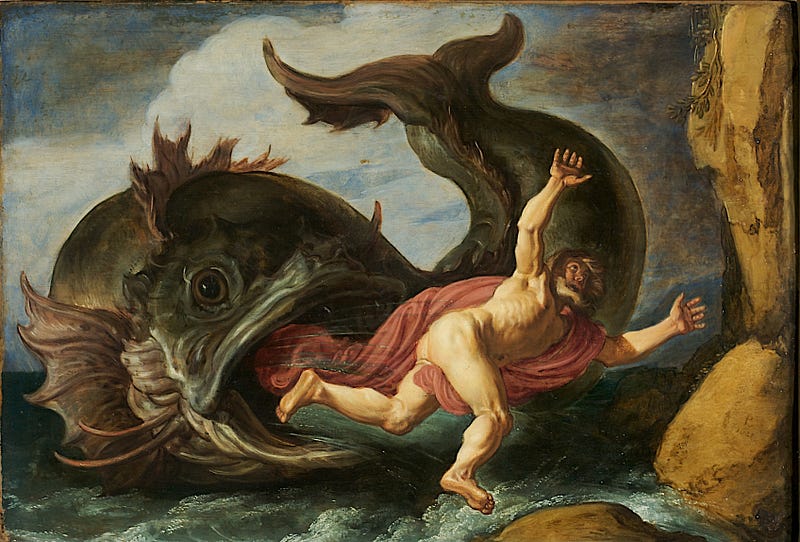
Well, you could predict what happens. Jonah is tossed about in stormy seas and swallowed by a whale. The lesson here is that it is impossible to run from that which is within you.
It is only after going through an ordeal of humiliation and being faced with his smallness and lack of genuine power that the battered and alienated ego can accept his dharma, or what the Universe wants to do through him. Only then is the ego’s existential turmoil eased.
Ignoring the promptings of the Self manifest in real life in the same way.
For instance, a woman feels that she is meant to be personal trainer or an artist, but she tells herself, “ oh, it doesn’t pay; it’s not respectable, and I am not talented enough.”
Instead, she gets a “respectable” job and ignores her true feelings.
And what do you know — she gets sick and depressed.
So long as we reject or ignore the voice of the body, we suffer. Thr more we resist, the more our suffering persists.
I challenge you to see that Zeus’ throwing down lightning and God flooding the earth are not to batter us down but the wake us up.
Our struggles are simply barbells that have been placed before us as invitations to grow stronger.
There is a great Lakota-Sioux saying I once heard, and the translation go something like: “Whatever Great Spirit gives us — good or bad — is what we need.”
When we become grateful for our struggles and pains, seeing them as opportunities to evolve; when we give up control on “our” life the way we saw it planned, or the way our parents wanted it; when we finally listen and pay attention to the inner voice we have for so long tried to squash out of fear and pride — when we do these things, we open ourselves up to a conscious relationship with the Self.
No relationship in the universe is more important than your relationship with the Self — all others stem from it.
When the ego submits to the Self and gives up on the idea that he can control life, he is assisted.
By contrast, the ego that continues to disrespect the Self — by repressing its promptings (i.e. your passion) in favor of more “secure” paths to “success” — is thrown back inside the Belly of the Whale, where chaos, existential turmoil, and suffering ensue.
What the heck am I talking about? What is the practical takeaway here?
That is up to you.
If you want to keep running away, no one is going to stop. You can keep attempting to exert your will over the Self, believing that you are smarter than that which created you, and that is fine.
Or, if you do recognize your powerlessness and genuinely seeking to work with the Self, then you must do one thing:
Do the things you are afraid of.
If there was one lesson in this post — it is this:
You must do the things that you are afraid to do.
Follow that golden thread of intuition whenever it appears, because we only get occasional glimpses of our passion, after all.
As Paulo Coelho has said in The Alchemist, pay attention to the omens and signs.
Summer: Inflation
Once we spring into contact with the Self by respecting Its wishes for our life, we experience a psychological summer of illumination and radiance.
We are filled with light; powerful hands work in our lives; and the wasteland that was once the world around us transforms into a paradise.
Life is great. Everything is blooming around us. “This is it. I’ve got it!” we think to ourselves.
So long as we remember to attribute this newfound radiance to the Self, we continue to reap the benefits of this relationship.
Of course, that’s easier said than done, especially the first time around.
Soon enough, we become drunk on the archetypal energy that fills us.
We then forget how small we once felt in the winter of our ego’s alienation.
Blinded by what we begin to believe is our own brilliance, we think that we are “It.”
This is the folly of ego inflation, or when the ego consciously identifies the Self.
And just as the Self punishes those eho reject It, the Self punishes those who commit identity theft, taking ownership for what is not ours.
Icarus, flies too close to the sun, falls.
The hero, who arrogantly approaches the dragon, gets burned.
It is important to realize that you are not the greatness that shines through you. You are simply a vessel — as replaceable as the lightbulbs through which that light shines.
In the summertime, it is a good idea to remember how deflated you felt in the winter.
In the winter, remember that spring is around the corner — look out for the signs.
To not get too high on our highs or too low on our lows is to realize that each season contributes to our growth and facilitates smoother evolution.
With time, the hope of individuation is that the ego dances it’s way to equilibrium, finding a balance between the forces of alienation and inflation.
Ancient cultures recognized the danger of identifying with the Self.
This is why humans created gods, totems, and sacred mountains.
Projecting the Self onto external objects like these enables us to more easily relate to It without identifying with It.
Working with the archetypes facilitates this process.


