
The Fake Religion Behind Trump’s Fake Presidency
And how not to weasel out of the reckoning for evangelicals
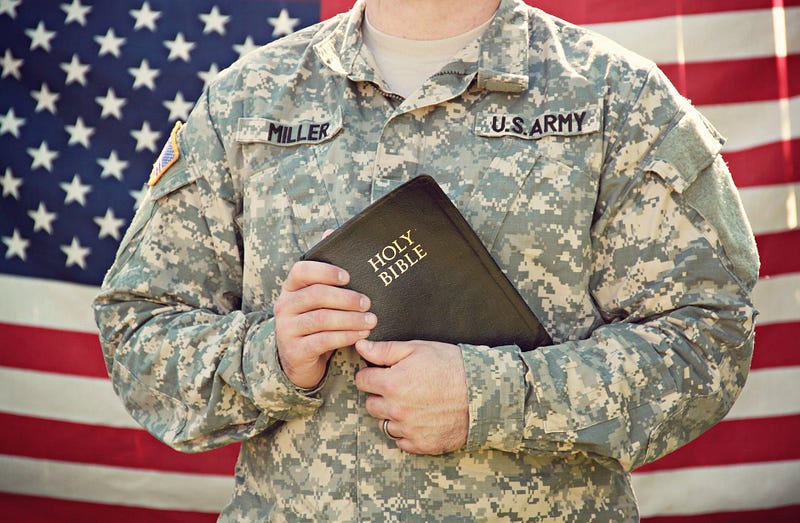
What does political reality look like in the US from the perspective of a white, conservative, American evangelical Christian who supported Donald Trump’s presidency against the Democrats? The writings of evangelical strategist Tom Gilson showcase the casuistry that saves face for his “religion” that’s nevertheless been caught red-handed.
After the storming of Capitol Hill, Gilson put out two articles in rapid succession, one warning about a coming holy war because of the equal validity of conflicting liberal and conservative perspectives in the US, the other arguing for unity between pro-Trump and NeverTrump evangelicals.
Let’s examine these articles to learn about the evangelical mindset that helped put Trump in the White House.
Downplaying Trump’s Treason
Gilson’s first article begins with an attempt to offer objective summaries of the liberal and conservative views of Trump in the US. His summary of the “view from the Left” is mostly fair and familiar, except that he downplays Trump’s treasonous conduct by saying, “They [liberals] believe conservatives tried to steal the election through fraud.”
That’s not just a matter of belief. Trump tried to undermine the legitimacy of the 2020 election at every turn, loudly and publicly, with no evidence to support his ad hoc conspiracy theories. He lost repeatedly in court, filing over sixty lawsuits in multiple states, all of which were immediately or eventually thrown out for being frivolous and without merit. None of that stopped Trump from spouting his self-serving lies and poisoning the nation.
If the courts are all in on the deep state conspiracy, why do the Trump supporters still love their country? Wouldn’t they have to believe the conspiracy has penetrated to the heart of American institutions, so that these “patriotic” Americans should think about leaving for a more thoroughly conservative place, somewhere like Saudi Arabia, Lebanon, or Pakistan?
Moreover, Trump put Amy Coney Barrett on the Supreme Court to help him overturn the election. We literally heard a recording of Trump’s phone call with Georgia election officials in which Trump asked them to find him eleven thousand votes to give him the state, after the state had certified its election as a win for Biden. Then Trump and his cronies incited a riot on Capitol Hill, possibly to harm Vice President Pence for declining to shake up Congress’s counting of the electoral votes in Trump’s favor.
Some Right-Wing Delusions about Trump
But things go off the rails when Gilson turns to summarizing the view from the Right. To be sure, I suspect his summary is accurate as a representation of the conservative perspective. It’s just that that perspective comes across as patently delusional.
According to Gilson, “Trump supporters, in contrast, think the Left stole the election by fraud, beginning long ago with a series of outrageous deep state actions undermining Trump throughout his entire four years.”
Alas, the only outrageous deep state allegations pertaining to Russiagate were the ones that gave Trump too much credit. Those are the ones that pictured Trump as a full-blown Russian agent, as an evil James Bond that “colluded” with Putin in a competent, knowing manner.
“Collusion” isn’t a legal term in that context, so the fact that Robert Mueller’s report didn’t speak of collusion is neither here nor there. The report said there may be evidence of a conspiracy between Russia and the Trump campaign, but Mueller’s team couldn’t prove it beyond a reasonable doubt, partly because of all the obstruction in which Trump engaged.
No, Trump couldn’t possibly have been a spy because he has no ideology and acts only transactionally in the service of his manifest mental disorders. Trump wasn’t competent or sane enough to have been a double agent.
Nevertheless, he was a useful idiot of Russia who effectively did Putin’s bidding throughout his time as president. Trump sowed chaos in his country, exploited social divisions to aggrandize himself, damaged neoliberalism and faith in Western democracy, undermined US relations with its allies, and went as far in Helsinki as to express publicly that he believed Russian intelligence over the American intelligence community’s assessment about whether Russia interfered in the 2016 election to help Trump win.
So the Russiagate doesn’t count as a hoax if Trump really did benefit from Putin’s help and furthered the interests of Russia at the expense of the US and its allies.
Gilson tries to have it both ways, saying that conservatives “recognize the same facts the Left reports concerning the courts” and then listing some conspiracy theories about the 2020 election as though the courts hadn’t thrown them out for lack of evidence.
Perhaps the silliest of those baseless, sour-grapes accusations about the 2020 election is that there was “one unbelievably unlikely statistical vote scenario after another.”
But saying that Trump won on statistical grounds is like saying the dinosaurs still exist because the comet that smashed into the planet was statistically unlikely. The entire 2020 election was unprecedented and statistically dubious because Donald Trump was an anomaly in US politics. His four years in office consisted of one act of overturning American norms after another. So why should the voters have reacted to his bid for re-election just like they’ve been voting for decades?
If we get to deny reality for being unusual, on the fallacious assumption that nothing new is possible, do we get to deny that Trump’s presidency ever happened because it, too, blew apart all statistical predictions about how US presidents behave? If only that inference would be sane.
Gilson adds that the Right views this alleged fraud on the part of the Democrats, the deep state, and the mass media as “undermining the very basis of democracy and America’s priceless liberty.”
And indeed, the Trump cultists that invaded the Capitol Building spoke highly of democracy, liberty, and other such American platitudes — as though their allegiance to those ideals weren’t vitiated by their zeal for a flagrant authoritarian who was trying to con them into stealing the election for him not because he cares about American values but because he’s a world-class narcissist who’s embarrassed about the prospect of losing.
Centrist Obfuscation and Saving Face for Evangelicals
Gilson takes the classic centrist stance of presuming that both sides have an equally valid case and are arguing in good faith: “Both sides are sure they are right. One side believes the other tried to steal the election, the other side believes the opposition actually did steal it. Each group suspects the other has been working to kill American democracy.”
The danger, for Gilson, is that “This is the stuff of which holy wars are made.” The solution to avert this disaster is that “Both sides need to slow down, to disengage for a while, even, to avoid making the other side angrier than they already are.”
And here Gilson’s agenda comes to the fore. The purpose of his centrist “objectivity” is to protect the American Right from the humiliation and the accountability that it richly deserves. After all, the Right’s perspective on Trump is allegedly valid; what’s more, runs Gilson’s veiled threat on behalf of his fellow “conservatives,” a holy war is in the offing so if only as a matter of self-preservation, the Biden Justice Department should lay off Trump and avoid antagonizing the home-grown terrorists who would thus effectively still be holding the country hostage.
Gilson is explicit: “Biden’s side could do that by refusing to push conservatives into a corner. For the sake of maintaining civil peace, therefore, I urge them not to over-exercise their power; to do all they can to avoid even the appearance of tyranny over their opponents.”
Translation: The Democrats should bend over backwards to avoid triggering the right-winger “snowflakes.” Well, Gilson’s in luck because the Democrats represent the more feminine side of the American psyche. American liberals are urbane, highly-educated, cosmopolitan, domesticated, and civil. By contrast, most Republican voters are rural, vulgar, boorish, low-informational, bigoted, and xenophobic.
The Democrats couldn’t bring swift justice to the Trump abomination if they tried; they’re not manly or heroic enough. As I wrote elsewhere, I could see Biden going as far as to pardon Trump for the sake of “unity” and “healing.” Consistent with his party’s hyperfeminine penchant for forgiveness and for ignoring moral hazard (see, for example, Barack Obama’s handling of the 2008 Wall Street crisis), Biden’s reportedly unhappy that the second impeachment of Trump will interfere with his early days in office.
If the situation were reversed and Trump had been a Democrat in office, right-wingers would have conducted hundreds of assassination attempts to stop Trump’s anti-American insanity, one attempt for each day of his desecration of the White House. As it stands, President Biden’s Secret Service will have to work overtime, to say the least. So much for Gilson’s obfuscatory centrism.
Gilson points out that “Biden’s side holds enormous power now, not just in every branch of federal government except perhaps the Supreme Court (which they could pack), but throughout all our culture’s major power structures, enough to allow them to move significantly toward a totalitarian government.”
He’s alluding to Cancel Culture, the Me Too movement, and the like. To be sure, those are overreaches that can be obnoxious and draconian, but they’re not essentially political phenomena. We know this because they happen on the right too.
Remember how, since the rise of Fox News, Rush Limbaugh, and televangelists, Republicans used to primary any of their politicians who stepped out of line? Remember how Trump turned the party into a cult of personal loyalty to him, so that anyone who crossed him or refused to break the law for him would be subject to the Twitter mob and to Trump’s campaigning against him or her? That’s how the moderate Republicans were purged from Congress and how employment at the Trump White House went through unprecedented turmoil, because the Republicans, too, are puritanical.
The main cause of this tribalism or political polarization is the prevalence of social media. This is a technological and a broader cultural phenomenon, not a political one. Both parties in the US are liable to purge their moderates because the culture at large is individualistic and thus more susceptible than other postindustrial societies to the fragmentation of information deepened by “advances” in communications technologies. Television, Twitter, Facebook, Fox News, and the internet are more to blame for American tribalism than are the mindsets of liberals and conservatives.
An Evangelical Defense of Trump’s “Presidency”
Gilson’s second article is a response to a USA Today opinion column by evangelical Christian professor Ed Stetzer, who argues there’s a reckoning due for evangelicals who supported Trump.
Stetzer says that as evangelicals, “we must acknowledge our failings but also understand the habits and idols that drew us to Trump in the first place.” Moreover, he says, “That we have failed and been fooled is disheartening but not surprising. The true test will be how we respond when our idols are revealed.”
Harsh stuff — and it’s also much closer to the truth than Gilson’s attempts to weasel out of the reckoning.
Gilson argues against Stetzer that there should be no such reckoning for the evangelicals’ idolatry which caused them to fall for the cult of Trump; on the contrary, Gilson says, conservative Christians, including NeverTrumpers and pro-Trumpers need to stick together to resist the reckoning from rabidly anti-Christian liberals in the Democratic Party who are now empowered in the US and who will impose their totalitarian atheistic morality on them.
To that end, Gilson takes up his cross to “show how a committed follower of Christ could have supported Donald Trump, and how it wasn’t necessarily the witness-killer some said it was. This isn’t for the purpose of politics anymore; it’s for the sake of Christian unity.”
Thus, Gilson denies that Trump is simply monstrous or that his behaviour was egregious. “It’s not that simple,” he says repeatedly. Gilson dismisses the sexism charge by saying Trump’s mistreatment of women “stopped years ago, as far as we know.” And as for racism, “That word has been badly overused in his [Trump’s] case.”
The tweets were “rude” and “unwise,” says Gilson, but they were just tweets, and when directed against the Democrats and the news media, “More often than not, that was Trump himself speaking truth to power.”
Gilson denies, further, that Trump lacks character or any virtue to speak of. On the contrary, he says, “Trump’s greatest strength and greatest weakness were flip sides of one trait. You could call it toughness; you could call it insensitivity. You could call it self-assurance; you could call it self-centeredness.”
Thus, there was virtue in Trump’s fortitude and tenacity in resisting the hostile media coverage and what Gilson calls the “corrupt allegations” of Russiagate. ‘What can you say about a man who (almost) never gave in, despite years of non-stop misrepresentation, opposition, even hatred from the supposedly “objective” major media?’
Indeed, “Through all that bitter opposition, he [Trump] made it in good spirits” — good spirits! Until, alas, Trump went too far, admits Gilson, when Trump incited a riot on the US Capitol. But that was just Trump folding from all the pressure from the deep state and the establishment.
Leadership requires character, Gilson agrees, “and let’s not act as if Trump had none!” he says. “Yes, his great strength came with great flaws. Such it is to be human.” The bottom line, for Gilson, is that when it comes to Trump, “the all-bad narrative is seriously overstated.”
Gilson goes on to argue that another reason for supporting Trump is that the alternative was worse, because the Democrats are more secular and anti-Christian than the Republicans.
And regarding anti-Trump evangelicals, Gilson says, “We came to different answers on a very complicated question, one fraught from the beginning with risks and unknowns, which arose in [the] context of almost unbelievable hostility against both conservatism and Christianity.”
Malignant Narcissism and the Devil’s Virtues
But Setzer’s right and Gilson’s wrong.
Specifically, the reason Gilson’s view of Trump is so warped is that he and most of his fellow evangelicals have been marinating for decades in idolatry and absurdity that are integral to Americanized conservative Christianity.
I want to be clear: Gilson’s defense of Trump is appalling and easily obliterated. Gilson only picks around the edges of Trump’s inhumanity when he talks about sexism and racism, and he belittles that inhumanity by calling it “toughness,” “insensitivity,” “self-assurance,” and “self-centeredness.”
There’s a more clinical term for what is obviously Trump’s main problem, that being “malignant narcissism.” That’s the essence of Trump’s character.
Gilson says it’s a mixed bag because Trump is “human” after all. But even that’s false. Psychologically speaking, Trump is very abnormal and therefore not human. Indeed, this mental disorder that’s been common to authoritarians and tyrants throughout history is the essence also of real evil or monstrousness, not of the imaginary kind that haunts folklore and theology, but that which has been responsible for enslaving or slaughtering multitudes of innocent people.
In Trump’s case, for example, this monstrousness reared its ugly head when he downplayed a deadly virus, muddied the waters, weakened the medical response, and allowed the virus to spread without working hard to organize the country’s defense. There’s also Trump’s killing spree via his otherwise inexplicable resort to federal executions in the deeply flawed US criminal justice system.
Gilson ignores this underlying problem to imply that, despite his Obama birther slander and tacit support for white supremacy, Trump can’t be racist because he’s not any kind of ideologue. Indeed, Trump doesn’t care about race. He cares only about himself because he’s a narcissist.
That means he’ll latch onto anything to magnify his ego, including sexism, racism, authoritarianism, and cons. To prove he’s the greatest, he’ll turn a political party into a cult, pander to evangelicals, kowtow to dictators who flatter him, and even undermine American institutions and recklessly overturn his country’s political traditions and civil religion. Trump would do so contrary to any form of conservativism and because he has perhaps the world’s worst case of sour grapes.
What’s so laughable about Gilson’s defense is that he doesn’t see how easily it can be parodied. If Trump showed great steadfastness against his implacable opposition, why couldn’t exactly the same be said about Satan and his fallen angels? Wouldn’t those agents of evil likewise have had to endure for billions of years in opposition to God, painstakingly conspiring against Heaven and foiling God’s overtures for peace? Wouldn’t Satan’s “insensitivity” entail such “virtues”?
Or take any serial killer. Are we supposed to admire the Night Stalker’s dogged perseverance in planning and carrying out his murders and rapes even while the police and the media were hunting him?
No, Gilson’s missing the forest for the trees. Fortitude is no longer a virtue when that strength is a means of bringing about primarily evil ends. Mere strength of conviction isn’t a virtue.
Trumpian Christianity: Staying with the Devil You Know
It would be futile, however, to bring to bear the plethora of instances of Trump’s egregious, palpable inhumanity. The real problem here is that most evangelicals have had their perspective so warped by their adherence to their authoritarian, anti-intellectual, unspiritual religion that their lack of critical thinking, crude evaluations, and habit of misreading texts can only surface in their politics too.
What kind of politics would you expect from a fundamentalist Christian who takes most of the Bible literally and who thinks there are eminently good reasons to believe that theological miracles occur or that God will torture everyone forever in an afterlife unless we believe that God’s son died on a cross two thousand years ago? Can we expect these Christians will suddenly learn how to think critically or to assess evidence when dealing with political issues?
Wouldn’t crude moral absolutists be forced to conclude that if Trump says he’ll support your Christian tribe, then the opposing side, the Democratic Party, must be evil? It could only be black or white after all, because morality would be about a war between God and demons.
Granted, some mental compartmentalization is possible, and perhaps evangelicals excel in that respect to fit into the modern world that’s superseded their religion. Moreover, some evangelicals call themselves liberal, not conservative — or rather, some liberal “Christians” call themselves “evangelicals.” But we are what we are, and if we’ve been immersed in the confusions, casuistries, and compromises of fundamentalist Christianity for decades, those same weaknesses could only hinder our judgment in all areas of life.
If you were born recently in Europe, chances are you’ll think like a secular humanist. If you were born in India, you’ll probably think like a Hindu. And if you were raised in the US as an evangelical Christian, chances are you’ll think like a fundamentalist.
That’s why roughly eighty percent of white evangelicals have been zealots for Trump. It wasn’t just that they made a cold calculation that Trump would deliver them conservative justices. The more visceral thrill for them must have been the prospect of initiating the apocalypse by empowering Trump as an agent of chaos who would tear down the establishment and at least dramatize the end of the world that these Christians have been so starved for (because it never arrived as prophesied, because their god doesn’t exist).
Indeed, then, support for Trump may not be a “witness-killer,” as Gilson says. But that’s for a reason Setzer gives, which is that evangelical Christianity has become corrupted and idolatrous at its core. If the religion is grotesque, Americanized, and Trumpian, then the Anti-President Trump becomes its avatar.
Evangelical Christianity stands at the end of a long line of Christian corruptions, going all the way back to when Rome co-opted the church and when Pauline Christianity won out over the more Jesus-centered, Jewish variety that fell first under the crucifixion of Jesus and then when Jerusalem and the Second Temple were destroyed in the first century CE.
Christendom has been corrupted and Trumpian for many centuries. Before the Christian exoteric literalists were making excuses for a malignant narcissist like Trump, they were doing so for the tyrannies of kings and emperors. They were making their peace with sexism, racism, slavery, war, torture, thought control, and social stagnation. Their religion became mere propaganda as opposed to an enlightened vision of a better way to live.
To be sure, not all Christians have been so corrupted. Some have even been saints or artistic geniuses. How could there not be variation in such a large population, spread out over so much time and in so many places? Shane Claiborne, for example, seems like an authentic Jesus-centered, evangelical Christian. And the Eastern church has been more intellectually sophisticated and mystical than the Western one.
But for all the good the churches have done in helping the poor and the needy, Christianity has crippled the minds of almost everyone it touched with its confusions and Orwellian dogmas, and that includes moral, monastic Christians like Claiborne.
Gilson’s writings provide a window into that crippled thinking. And the true reckoning for evangelicals is that the horror of Trump’s anti-presidency reflects the sickness of their religion.


