

The Productivity-Pay Gap and the Decline of Unions: A Closer Look at American Labor
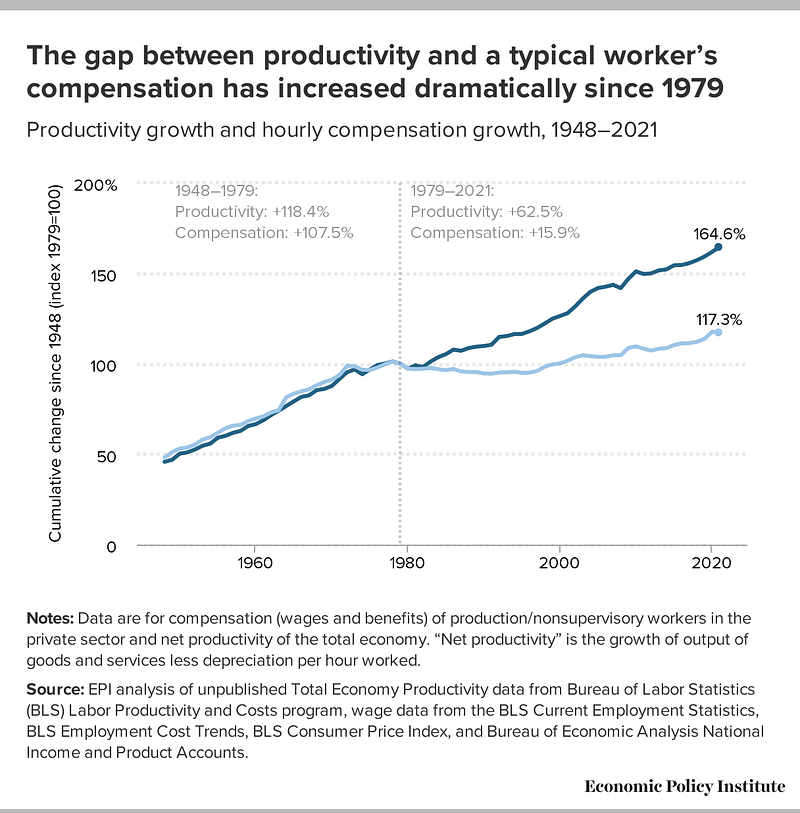
In the grand tapestry of American labor, two threads have woven a curious pattern over the past half-century. One thread, shimmering with the promise of progress, represents worker productivity. It has steadily lengthened, a testament to the relentless march of innovation and the indomitable spirit of the American worker. The other thread, once robust and vibrant, symbolizes worker compensation. It has frayed and thinned, struggling to keep pace with its counterpart.
Parallel to this, another thread has faded almost into obscurity — the thread of union membership. Once a strong, binding force in the fabric of American labor, it has steadily unwound, leaving a noticeable gap in the weave.
This pattern raises a question that I cannot ignore: Is there a correlation between the growing productivity-pay gap and the decline of unions? And if so, what does this mean for the American worker?
In this exploration, I will unravel these threads, examine their interplay, and seek to understand the larger picture they form. I will delve into the data, analyze the trends, and ponder the implications. As I embark on this journey, I invite you to keep an open mind, challenge your preconceptions, and engage with the material. After all, these threads are not just abstract concepts — they are the strands that shape our society, our economy, and our lives.
The Decline of Unions
Unions, once the bulwarks of worker rights and fair compensation, have seen their influence wane over the past few decades. Their story is a tale of triumph, struggle, and resilience, a narrative that is deeply intertwined with the broader saga of American labor.
In the mid-20th century, unions were a formidable force, championing the rights of workers and playing a pivotal role in shaping labor laws and workplace standards. They were the guardians of the worker, ensuring fair pay, safe working conditions, and a voice in the face of corporate power.
However, the landscape began to shift in the 1970s. Union membership, which had been robust and steady, started to decline. According to data from the Bureau of Labor Statistics, the union membership rate in 1983 was 20.1%. By 2020, it had dropped to 10.8%. This decline was not uniform across all sectors and regions, but the overall trend was clear: unions were losing ground.
Why this decline? The reasons are manifold and complex. A significant factor has been the strategic actions of corporations themselves. Over the past few decades, many companies have implemented practices designed to weaken unions, such as outsourcing, offshoring, and hiring contract workers. These practices often serve to fragment the workforce and make it more difficult for unions to organize and maintain solidarity.
Moreover, there has been a noticeable shift in corporate priorities. Increasingly, companies seem to be more focused on delivering value to shareholders, often at the expense of their workers. Stock prices, quarterly earnings, and market dominance have become the yardsticks of success, while worker compensation and well-being are often sidelined.
Legislation and court rulings have also played a role, making it more difficult for unions to organize and collect dues. The decline of unions, it seems, is not so much a natural evolution as it is a consequence of deliberate actions and policies. The voice of the worker, once amplified by the collective power of unions, has been gradually silenced, leaving many to navigate the labor market on their own.
As I pull on this thread, I must ask: What impact has this had on the productivity-pay gap? And how can we weave unions back into the tapestry, ensuring that all workers share in the fruits of their labor?
Next I will explore these questions, seeking to understand the intricate interplay of productivity, pay, and union membership.
Connecting the Dots: Productivity, Pay, and Unions
In this section, I delve into the potential correlations between the trends I’ve identified: the widening productivity-pay gap and the decline of unions. My exploration leads me to consider the role of economic policies, corporate practices, and societal shifts in shaping these trends.
One of the key factors to consider is the impact of economic policies. Over the past few decades, policies favoring deregulation and free-market capitalism have gained prominence. These policies have often led to a weakening of labor protections and a decline in union power, potentially contributing to the productivity-pay gap.
Corporate practices also play a significant role. Many corporations have adopted strategies that weaken unions and prioritize shareholder value. But there’s more to the story. The rise of automation and digital technology, for instance, has significantly boosted productivity. However, the benefits of these technological advancements have not been evenly distributed, often leading to job displacement and wage stagnation for many workers.
Societal shifts, such as changing attitudes towards work and the rise of the gig economy, also contribute to these trends. While these shifts offer new opportunities and flexibility, they also present challenges, such as job insecurity and lack of access to traditional labor protections.
Furthermore, the decline of unions has implications beyond wages and working conditions. Unions play a crucial role in advocating for policies that benefit workers, such as healthcare, retirement security, and fair labor standards. The weakening of unions, therefore, has broader implications for social and economic equality.
Next , I will dive into these implications, exploring how these trends impact not only individual workers, but also businesses, the economy, and society as a whole.
The Broader Implications
The trends I’ve explored — the widening productivity-pay gap and the decline of unions — are not just abstract economic phenomena. They have real, tangible impacts on individuals, businesses, and society as a whole.
For individual workers, the productivity-pay gap can lead to financial stress and economic insecurity. Despite working harder and producing more, many workers are not seeing a corresponding increase in their pay. This can make it difficult for them to meet their basic needs, save for the future, or invest in their education or skills development.
For businesses, these trends can have mixed effects. On one hand, higher productivity and lower labor costs can boost profits and competitiveness. On the other hand, wage stagnation can lead to lower consumer spending, which can hurt businesses in the long run. Furthermore, businesses may face higher turnover, lower employee morale, and increased labor disputes if workers feel that they are not being fairly compensated for their productivity.
At the societal level, the productivity-pay gap and the decline of unions can contribute to growing income inequality. When the benefits of increased productivity go primarily to shareholders and top executives, wealth becomes concentrated in the hands of a few. This can lead to social and economic disparities, which can in turn fuel social unrest and political polarization.
The decline of unions also has broader implications for democracy and social cohesion. Unions not only advocate for better wages and working conditions, but they also provide a platform for workers to voice their concerns and influence public policy. Without strong unions, workers may feel disempowered and disconnected from the political process.
What innovative approaches can we employ to ensure equal access and fair representation in the labor market, fostering a sustainable and inclusive economy?
Looking Ahead: Solutions and Opportunities
As I grapple with the challenges posed by the productivity-pay gap and the decline of unions, it’s important to also consider potential solutions and opportunities. While these issues are complex and multifaceted, there are several strategies that could help address them.
Strengthening labor protections and union rights could be a key part of the solution. This could involve implementing policies that make it easier for workers to form and join unions, as well as measures to prevent unfair labor practices. Stronger unions could help ensure that workers share more equitably in the fruits of their productivity.
Corporations could adopt more inclusive and sustainable business practices. This could include profit-sharing schemes, which allow workers to benefit directly from their productivity. It could also involve investing in employee development and well-being, which can boost productivity and morale in the long run.
For instance, consider the case of three major corporations: Amazon, Google, and Apple. These companies have seen significant growth over the past few decades. Amazon’s, Google’s, and Apple’s market capitalization is over a trillion dollars EACH. For perspective, there are 195 countries, and if any one of these three companies were ranked alongside this list of countries’ GDP, they would easily be in the top 15. However, despite their success, these companies have faced criticism for their labor practices, including the treatment of workers and their stance on unions. These companies will not change unless policies in America change.
Addressing the productivity-pay gap and the decline of unions will require broader societal shifts. This could involve changing attitudes towards work and wealth, promoting economic policies that prioritize worker well-being, and fostering a culture of corporate social responsibility.
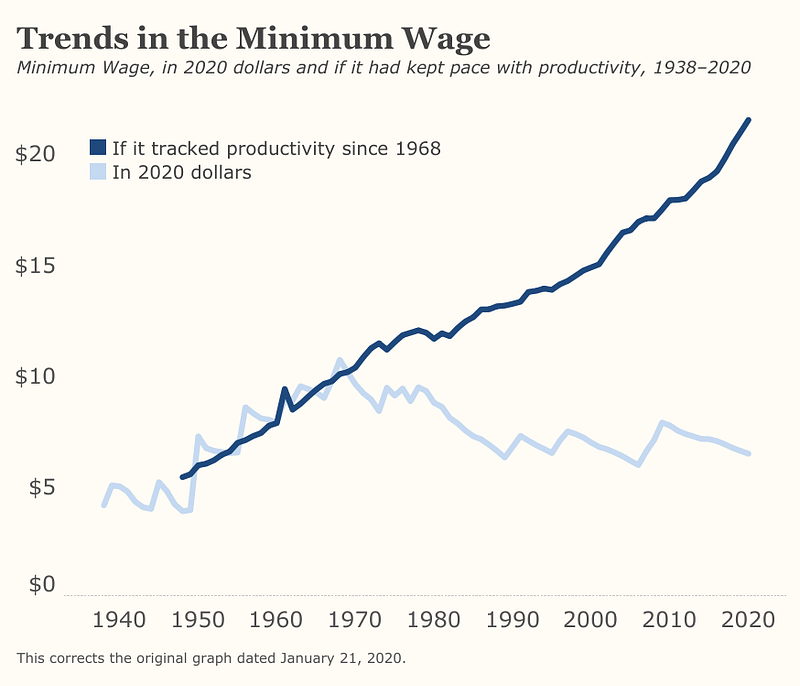
A significant data point to consider in this context is the relationship between the minimum wage and productivity growth. If the minimum wage had kept pace with productivity growth since 1968, it would be almost $21.50 an hour today [source: Center for Economic and Policy Research]. This suggests that workers are not reaping the full benefits of their increased productivity. Advocates argue that the minimum wage should be gradually increased to $21.25 per hour between now and 2027, a level that the $15 wage would have reached by then if it had kept up with inflation and worker productivity growth.
There are opportunities for further research and action in this area. For instance, researchers could delve deeper into the causes and impacts of these trends, while policymakers and activists could advocate for reforms. Workers, too, can play a role by organizing, advocating for their rights, and holding corporations and policymakers accountable.
By understanding the issues, exploring solutions, and taking action, we can work towards a more equitable and sustainable labor market.
As I reach the end of my exploration, I find myself standing at the crossroads of understanding and action. I have unraveled the threads of worker productivity, compensation, and union membership, and examined the intricate pattern they weave in the tapestry of American labor. I have delved into some of the data, pondered the implications, and considered potential solutions. Yet, as is often the case with complex issues, I am left with more questions than answers.
The productivity-pay gap and the decline of unions are not just economic phenomena. They are reflections of our values, our priorities, and our vision for the future. They are the echoes of decisions made, policies implemented, and actions taken. And they are the harbingers of what may come if we continue on our current path.
Is the widening productivity-pay gap a result of the decline of unions? Or is it a symptom of broader societal and economic shifts? Could stronger unions help bridge the gap, ensuring that workers reap the full benefits of their productivity? Or are there other factors at play that I need to consider?
These are not easy questions to answer. They require me to challenge my assumptions, scrutinize my beliefs, and confront the realities of our labor market. They compel me to look beyond the numbers and consider the human stories behind them — the struggles and triumphs, the hopes and fears, the dreams and disappointments of the American worker.
As I ponder these questions, I invite you to do the same. Reflect on the information presented, engage with the ideas, and form your own conclusions. Consider the role of unions in our society, the value of worker productivity, and the importance of fair compensation. And most importantly, think about what you can do to make a difference.
The threads of American labor are not set in stone. They are dynamic and evolving, shaped by our collective actions and decisions. By understanding the past and present, we can influence the future. We can weave a new pattern in the tapestry of American labor — one that reflects our commitment to fairness, equity, and the dignity of work.
Before leaving I’d like to ask you: What will your thread in the tapestry of American labor look like? How will you contribute to the story of the American worker? And how will you help shape the future of our labor market? The answers to these questions are not just about economics or policy — they are about us, our values, and the kind of society we want to create.
Thank you for reading all the way to the end! Your engagement is what makes this journey worthwhile for me, and I truly value your thoughts and opinions.
👉 Let’s Keep the Conversation Going:
- What was your biggest takeaway from this article?
- Is there a point you agree or disagree with? I’d love to hear your perspective.
- Do you have a personal experience that relates to the topic? Your stories make these discussions richer.
- Are there any questions or topics you’d like me to cover in future posts?
🙏 Your Voice Matters: By taking a moment to comment, you’re helping to elevate this conversation and make these discussions more dynamic and accessible to a broader audience.
So, let’s keep the dialogue alive and flowing! Your interaction is not just welcomed — it’s encouraged!
Thank you for being an integral part of this community. I’m eager to hear your thoughts!


