
The problems of vulnerability as a parent
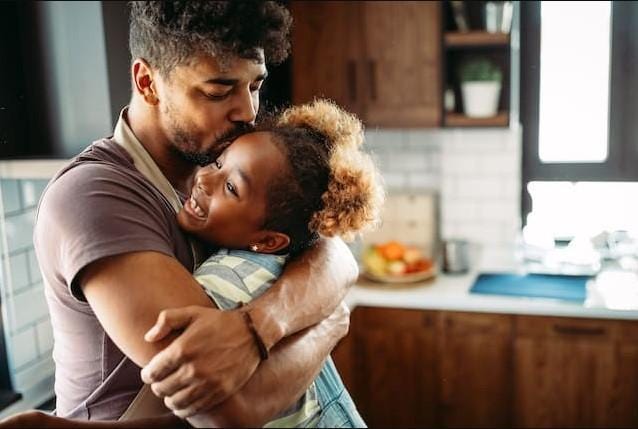
Should I pick my child up when they fall down? The way this question made me re-consider how I parent my children’s vulnerability.
We are genetically predisposed to love things with big eyes and round chubbiness: puppies, kittens and babies being top of the list. Presumably this is because, if we didn’t love our babies we would give up on them when they started hollering at 3AM and leave them in a trashcan somewhere. This is why our hearts open up to our little ones and they trick us with chemicals and the neurological wiring of our brains to love them.
When they are young we instinctively (some much more instinctively than me!) go to help our children. Their screams are somehow in kahoots with our eardrums to alert us to their every need and want. It is like God personally installed a doorbell in your brain that gives you intense pain whenever you do not answer it. If baby cries we react and we will jump through every hoop in the desire to placate it. It is like we are hardwired to go to the needs of the vulnerable.
“Evolution has endowed us with brain circuits that are effortlessly activated by the kind of babyish features that we find so appealing in pets. This is no accident; it is evolution’s way of enlisting our nurturing impulses in the service of the species.” The Emotional Life of Your Brain by Richard J. Davidson and Sharon Begley.
In the UK we consistently give a large proportion of charitable giving to animal rescue and shelter, often as much as we donate to medical research. Many households openly admit that they care more about animals than they do adults. If advertisers want to generate donations they are unlikely to post hard-nosed businesspeople in suits, they are likely to show those that cannot provide for themselves and who have been left without defence. The vulnerabilities of others pluck at our heartstrings and we feel guilt and shame that they are made to suffer. This is an essential part of humanity and something which is a cornerstone of our societies: we wish to help those in need.
In the same way, we react to the vulnerabilities of our children. If a child is crying we instinctively go to help. This means that, in my house, you are usually running to help a child every 2 to 3 minutes as they inevitably fall over, pull something onto themselves, hit themselves/each other or generally enter into something haphazardly.
What I find interesting is that age old scenario where a young child falls over, looks at the parent, then decides how to react? If the adult is looking sad the child will cry, if the adult is smiling then the child will pick themselves up and get on with it. Clearly this doesn’t always work, and I have ignored many an injury by pretending it will ‘all be ok’ but it does generally work. What it means is that we, as parents, can shape how our children react and our first instinct is to pick our children up and cuddle them.
OK, so the first thing that most parents learn much quicker than I did was that we need to control our own emotions. This is pretty much parenting 101. However, as a teacher I have never linked this to the way in which we treat older children.
For older children, teenagers are the extreme version of this, we often feel more strongly for those that express their vulnerabilities. We feel more sorry and give more of our time to the quiet child who can’t tie their shoelaces or offer extra sessions in school to the students that are trying hard but simply not ‘getting it’. We feel for the independent and head-strong children a lot less. Of course we care about our children, whatever their personalities, but as parents we often feel connected through helping them and therefore feel more connected to those that need more help, the more vulnerable.
One of my children is often vulnerable: she can fall over a flat road, trick over things that aren’t there and often needs help and guidance. One of my children is not vulnerable and bristles against any suggestion that she may be anything other than infinitely capable. If she falls over she is more upset about looking fallible than she is about the massive bruise that she will try to hide in the forthcoming days. Needless to say, we spend a lot more time helping one and feel much more connected to her as parents. We love them both the same, but some days it is certainly much easier to love the one who needs us more! This sounds selfish but, if two children fall over and one gives you a hug while the other screams at you ‘I don’t need your help’ you can see what I mean.
“Vulnerability is not winning or losing; it’s having the courage to show up and be seen when we have no control over the outcome.”- Brené Brown
There are two things that happen because of this. Firstly, children are the cleverest animal known to man, and they will exploit this vulnerability to the best of their advantage.They will develop clever tactics like using baby voices (‘oooo, dad-eee’) and learned helplessness (‘can’t you just please help me?’ with big doe eyes).They will find a way to seem vulnerable in order to get exactly what it is that they want. Again, this is classic parent-child exploitation and we can deal with this. Well, most people can, I however, am a sucker for it.
The other problem is one that is much more subtle and one we need to think about much more. Our children will grow up and some will seem vulnerable and some will present a hard exterior to the outside world. All young adults are vulnerable but they will express it in different ways. If I am teaching a group of teenagers I will get the full range of attitudes: from those that claim to need a teacher to do the smallest possible thing like breath in and out, to those that are so confident in their ability that they refuse to listen with more than 10% of their consciousness. Most of the time, I spend the majority of my lesson with those that are in the first half of that vulnerability range.
Through focussing on the students that are most vulnerable in lessons I am both rewarding students for not using their own independence and missing the students that need my help but do not show themselves to need it. As much as I am aware of this bias, as much as I push myself to help the students equally, there is a tendency to spend my time with those that obviously need it. It is like being put in a rescue centre with puppies and old scraggly dogs: our brain tells us that they all need help but our hearts will always lead us towards the vulnerable.
This isn’t just a problem for teachers in class. This ‘puppy and baby’ love seems to have a knock-on effect to the way in which we try and mould our children. If we saw a parent teaching their kid to be fiercely independent and ‘not need anything from anyone’ how would we feel? I think I’d feel like this person was some kind of sociopath, some miserable bastard who hated their child. How about if we saw someone running to pick up their child everytime they fell, we’d think they were a pretty bloody good parent wouldn’t we? Yet I’m beginning to wonder whether this is a problem.
We seem to train our children towards vulnerability and away from independence because we feel more rewarded for helping the vulnerable.
We seem to train our children away from independence as we get less of a reward from helping those that help themselves.
My younger daughter knows exactly what it is she wants. She knows what she wants and she knows exactly how to get it. She has absolutely no shame in anything she says or does in the way only a three year old can. She even takes on tones and accents when she feels they will give her declarations more effect. We could be sitting down for tea, a beautiful meal which could be one of her favourites, she will have sat down to eat tea perfectly fine and without any complaint for days, weeks or even months before this.Then, as if taken by the spirit, the kind of spirit that had previously been housed in a Disney princess who had never heard the word ‘no’, she will sit upright and declare:
My daughter: “I’m not eating this today. I want (insert random food she has never before demanded).”
Parent (trying not to get angry/give emotion to reward her behaviour: “OK, we’ve just made you this delicious food, if you don’t want it you can go any make yourself something”
And she bloody will. She will get up and without any issues she will make herself a sandwich or a wrap, or whatever else it is she wants, and she will eat it at the table without any flicker of regret. At times like this it is hard to know whether to be incredibly angry with her rudeness or proud of her temerity.
At other times she will demand a very specific item of clothing, it could be one worn years ago that you barely remember, but you know full well that she remembers. She remembers and she will not stop until she has found that piece of clothing or made you pay for not being able to find it within the darkest recesses of the wardrobe.
She will make up games and have her own rules which everyone must follow to the letter. If you play rock, paper, scissors you will be told, very assertively (aggressively and threateningly some might say) that you WILL be paper and she WILL be scissors.This does not dampen her delight when she wins. Oh my word, do not deviate from these rules or you will be in trouble.
I often look at my daughter from the outside and I can only imagine that people believe that she is spoiled rotten.They must see her willfulness and assume that it’s the product of spineless parents who give in and cannot say no to her.Yet, whilst we all give in and I am by far the worst parent for this, we battle.We are well aware that ‘negotiation’ and ‘compromise’ are two things that children need to learn to be successful in life and we have tried everything to get her to bend her will.
One day we tried to teach her about negotiation and how both sides need to say that they will accept less than they want in order to make everyone happy.We thought she’d taken this on board.Then a few days later we asked her what ‘negotiation’ meant and her interpretation was simply that ‘nobody gets what they want’. Negotiation was not something that naturally appealed to her.
Working with our daughter in this way was like coming up against a chess-supercomputer when you have only just learnt that ‘horsey piece’ and ‘castle man’ are not the real names of the chess pieces. It is like sitting in a university philosophy class when you have only just learned that ‘Socrates’ is more than just a name for a reasonably priced Greek lager.You have the sense that the problems presented could be solved with the right skillset, but you are also fairly certain that you yourself do not have that skill set. It is a similar feeling to when you get lost trekking, you know where you want to go, you also know that you just need to put in effort to get there. However, at times you have a vague notion that you might be going in the right direction and, at others you are sure that you are actually getting further away.
Yet there are also times of spontaneous vulnerability dotted about which open your heart and remind you that she is not a demented hell-child but just a beautiful three year old learning to live with emotions. She will come up to you and wrap you in a hug, kiss you on the cheek and then walk off leaving you shell-shocked, wondering if you had just dreamed what had happened. Sometimes she will demand you lie down with her to sleep and she will cocoon herself into your arms like a baby bear, all hair and sweetness, as if her forcefield has been deactivated after a hard day. During these times you wish for more, that she would be easier, that life would not be so hard.
At school we have been lucky to have some wonderful people who have worked with her and helped her a great deal.Yet I would not want to be her teacher and I feel sorry for what they have to face. Teachers have plenty enough to do within a classroom of children and having children flat-out refuse to comply is not what you need on a tired Wednesday afternoon.To make the classes go easier we need children to follow rules.
In this way I can see that we are all working to try and train this willfulness and energy out of my daughter: we do it so that we get an easier life, the teachers because they need their energy to be shared more equally amongst the class and, yes, because they want an easier life.
This desire for compliance and then our innate love of vulnerability work together.We are slowly giving her the consistent message that having strong feelings, wants and needs, are not desired by the world.
At the other end of this we have my oldest daughter who tells everyone that she is ‘shy’.This, as well, is universally heralded as a ‘bad’ behaviour trait to have as a young person. ‘Shy’ is the antonym to ‘confident’ and we all want our children to be confident.We want them to be able to try new things, be able to make new friends in different social circumstances and generally be successful in the world.
When my daughter came to China she was adored because many people had not seen white western children. People would stop us everywhere we went and make a big fuss of our daughters.They are incredibly kind people who compliment their eyes and their beauty and genuinely want them to feel welcome. However, strangers speaking to you loudly in a language you don’t understand can be incredibly daunting and you could see our daughter folding in on herself. One time we took our children to the zoo and at one point realised that every single person around us was ignoring the animals and were much more interested in our daughters!
Whether it was because of this, something in the way we brought her up or just her nature, our daughter became incredibly shy.We had to work on this with her school and not make it into a stigma. I am sure that almost every other parent would do the same.When parents come to our school I ask them what help they need and the answer very often involves something along the lines of ‘they are too shy, we need you to help us give them confidence’.
Yet my two children are victims of our drive for an easier life coupled with our love of vulnerability. Through looking to beat perceived defiance out of children, by asking them to listen instead of speak, to watch instead of act, we are also creating children who are taught to be shy; and then we are telling them that they have a problem! If we demonise students for having strong desires and following them then they will lose their confidence to know how to act and no amount of summer schools or extra classes will get this back.
As I dad I have to put up with the fact that one daughter is going to be a pain in the arse throughout her life, we must all learn to realise that parenting life is not all daisy chains and merry-go-rounds.We have to dig in when we feel we’re going in the wrong direction and persevere.We have to help her channel her energy so that she can still realise her own goals but compromise so that the whole household does not have to suffer when she does not.
If we can learn to sit in the discomfort of others judging us, learn to ignore the voice in our head that says we’re doing it wrong, then we may not end up with a vulnerable daughter that needs us, because we are much more likely to have a confident one. By doing this we are not only helping her, but also helping our ‘shier’ daughter to see that expressing herself is valued in our house. Slowly but surely we may get there and, at times, it will feel like we are not.
For school, all I can do is continue to buy her teachers nice Christmas presents and ignore them if they tell me that she needs to ‘listen’ and ‘be quiet’. For us, we just need to tell ourselves that we are raising a confident child next time she refuses to eat her tea or demands the replica Argentina shirt she last wore three years ago. If we want to see ‘vulnerable’ we can always watch videos of puppies on Youtube.