
The Problem with Cassey Ho’s Blogilates "Banana Test"
Most health and wellness influencers are not dieticians.
One of the worst things to come out of diet culture is our confusion about hunger cues. The first time I talked to my dietician about hunger, I told her how I was always second-guessing myself when I felt hungry, possibly because every diet has told me I don’t know the difference between genuine hunger and mere food cravings. She knew exactly what I was talking about because she sees this all of the time in her new clients.
At 38 years old, I am now relearning what hunger feels like. I’m learning how to listen to — and trust! — my body instead of making myself jump through hoops or get over arbitrary hurdles just to prove that my hunger is real.
Over the years, I’ve read hundreds of diet or “nutrition” books and I’ve tried countless diets guaranteed to help me lose weight and keep it off for good. Yet each one offered loaded messages about when it’s “okay” to eat.
Some diets say you can only eat your meals at set times. Others use an eating window. Many diets give you an eating curfew to help conquer evening snacking.
But what happens when you experience hunger outside of those prescribed times? Well, typical diet culture says you must not actually be hungry. Maybe you did something wrong because people who follow the diet correctly seem to banish their hunger. Perhaps your body is just playing tricks on you. Whatever happened, you’re encouraged to “beat” your hunger.
As if it’s your enemy.
Such so-called “healthy” weight loss diets don’t let you eat when you’re hungry if you happen to be hungry at the “wrong” time. Which means you get used to subduing and ignoring your body’s hunger signals.
Does that sound like a healthy relationship to you?
Other diets and “healthy eating plans” care less about when you eat, but they do micromanage what you eat. Some restrict entire food groups, like carbohydrates, or place food into categories like “good,” “bad,” “green light,” “red light,” and “yellow light.”
These sorts of diets come up with all sorts of other rules about hunger. Sometimes, that means counting calories. On a typical 1,200 calorie diet, you might get three 300 calorie meals and two 150 calorie snacks. If you wind up feeling hungrier, and you aren’t satisfied by those meals or snacks, you’re encouraged to wait it out.
Usually, such diets put certain foods off-limits, or at least, limit their portion sizes to help mitigate the “damage.” One common suggestion you’ll hear is to eat more “virtuous” foods like raw fruits and veggies, or to nosh on egg whites, since these have more volume and can “fill you up” on fewer calories. It’s the same mentality that says to eat cauliflower instead of pasta or potatoes, and lettuce wraps instead of bread.
If you find yourself unsatisfied by those virtuous swaps, the logic goes that you were never really hungry in the first place. That it’s emotional and in your head.
After all, a hungry person would eat anything. Right? Well, actually, no.
This brings me over to Cassey Ho’s banana test. Cassey is a wildly popular fitness and healthy living influencer with a large following on social media.
Ho is a pilates instructor, but it’s worth mentioning that she is not a dietician or expert in nutrition. Back in May, she posted a Tik Tok video introducing something she calls the banana test.
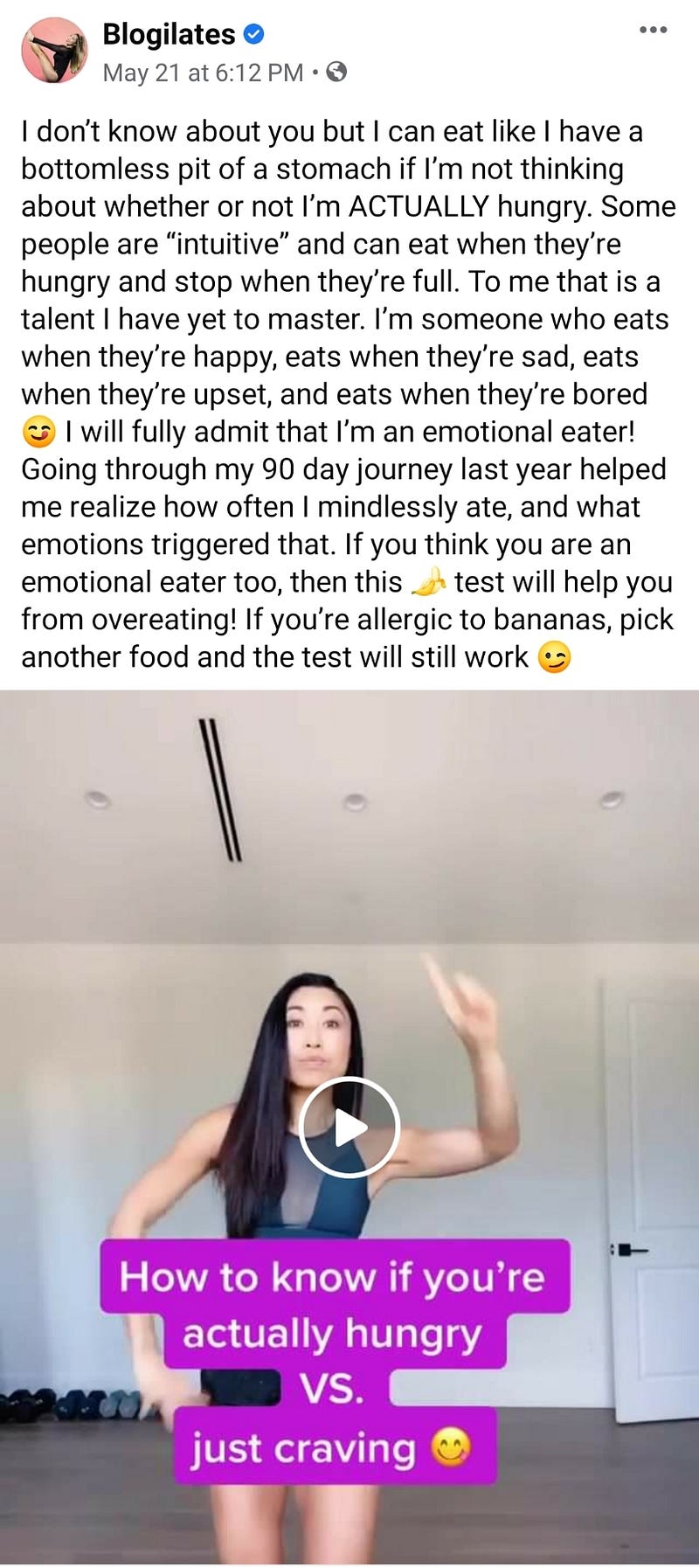
How to know if you’re actually hungry VS. just craving
Do the 🍌 test
Will a 🍌 satisfy you right now?
Or does only a 🍔 or 🍪 sound good?
If you choose 🍔 or 🍪, you’re not actually hungry!
If you choose 🍌 go eat!
It’s hard to know where to start unpacking the banana test, because there’s so much wrong with it. According to Cassey, we can easily distinguish between “true hunger” and emotional hunger by asking ourselves if we want to eat a banana (or another similarly “healthy” food if you can’t eat bananas). If our answer is yes, then we can eat that banana with the joy of true hunger. But if we don’t want that banana — and instead want something “unhealthy” like the burger or cookie — that means we’re not actually hungry, and we really shouldn’t eat.
From a diet culture standpoint, this “banana test” makes a lot of sense. Diet culture already tells us that we can’t trust our bodies or our hunger signals. It also says that emotional eating is always bad. Plus, diet culture is big on tricks, hacks, and formulas — anything to take the “guesswork” out of healthy living.
But what if that guesswork is something our bodies really need? What if these “hacks” only make our food and body relationships harder?
Something diet culture routinely overlooks is that our health goes far beyond what we eat or when we eat it. Our overall health is about our personal relationships with food, fitness, and our bodies.
Unfortunately, a lot of these food and eating rules do very little to improve those relationships. Worse yet, they take the joy out of eating and lead to more stress or anxiety. Even more obsession over food.
I have no doubt that Cassie shared her “banana test” with positive intentions. The problem is that in practice, this sort of food rule is not a positive experience for people.
On the contrary, this is disordered eating in action, and a prime example of how deeply diet culture is ingrained in the world of health and fitness. And these are the sorts of tips that wellness influencers share every single day with millions of social media users who are desperate to get the slim bodies they think they need.
Making yourself adhere to something like the banana test is a quick way to police your eating. Sure, you might save calories every time you decide you don’t want to eat a banana. But you’ll also make it harder for your body to identify hunger too.
That’s because hunger isn’t the state of willingness to eat anything — and only from an approved food list. If you’re hungry, your body will send you signals that it needs to be fed. Whatever food feels most satisfying to you in the moment depends upon a variety of factors.
Taste, feeling, temperature, amount, consistency, and nutrients all matter. If you ate nothing but bananas, your diet wouldn’t be very satisfying and you’d leave nutritional gaps all over the place. The same thing goes for eating broccoli, french fries, or pizza. Humans don’t function at their best without a varied diet.
That’s why it’s okay to have cravings. They help us eat a wider variety of foods — assuming we’re listening to our bodies, of course. And when we do listen to our bodies about those cravings, we often wind up having fewer cravings in the first place.
Funny how that works.
When we follow restrictive diet rules and attempt to banish our cravings, we actually make certain foods seem more desirable than they naturally would be. And we may find ourselves feeling obsessed about certain off-limits food choices.
“Means testing” our hunger with something like the banana test is ineffective and detrimental — not just because it teaches us to distrust our hunger signals. It’s also problematic because it does nothing to get to the root of our emotional eating, if that is in fact a problem.
Now, everyone is bound to eat emotionally from time to time. Everybody overeats sometimes too. That’s just human nature. Comfort food when we’re sick or heartbroken, Sunday dinners with family, birthday cake, holidays — none of these things are going to harm us if we are truly honoring our hunger and fullness cues.
Diet culture talks about emotional eating as this big bad monster waiting to pounce and destroy your life. In reality, emotional eating is only problematic when that’s your crutch for managing difficult emotions. Plus, you’re not a bad person if emotional eating is something that challenges you.
Emotional eaters — and I count myself among them — have the opportunity to heal. If we really want to get to the bottom of emotional eating, we need to deal with our feelings and triggers.
Saying yes or no to a banana can’t do that. It only numbs or delays self-awareness.
The thing is, intuitive eating is hard for those of us who’ve been wrapped up in diet culture. It’s not a quick fix, but a long-term journey.
Another problem with Cassey’s advice? Hunger isn’t black and white, off or on, banana or not. It’s more like a spectrum. That’s why intuitive eating uses the hunger scale.
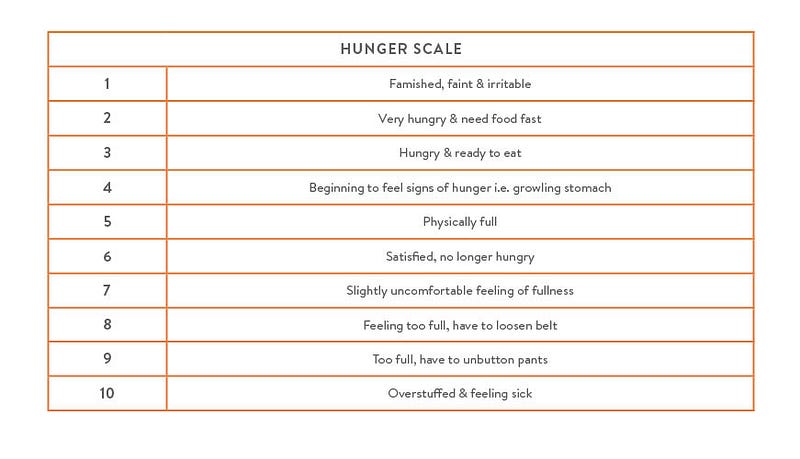
Those of us who feel like we’ve lost touch with our bodies and find hunger cues confusing can learn a lot from the hunger scale. It’s a helpful reminder that there are different degrees of hunger and fullness.
While there’s nothing wrong with a banana, it may not be the filling food we need. Or, it might be too much food. It’s not helpful to demonize the cheeseburger or cookie. But it is helpful to learn how to eat intuitively with food freedom. For most folks working on food freedom, the hunger scale is a big part of that.
The hunger scale also helps us contextualize our hunger. Using the scale, an individual might determine that they want a banana, or they might realize that pizza, a burger, or even a cookie sounds right for them. None of these choices are “wrong,” but we do get ourselves into murky waters every time we choose one food over another because we think that’s what we’re supposed to do.
Let’s take a popular swap like zucchini noodles. I happen to like zucchini noodles a lot, but I’ve learned to quit eating them when I’m craving real pasta. Why? Because it’s not satisfying to eat a “healthier” swap when I’m craving something in particular. And when I eat food that isn’t satisfying, I tend to overeat or binge eat just to compensate for the lack of satisfaction.
Among the various objections to Cassey’s banana test were these comments that people were “overly sensitive” and “triggered.” Many women in the comments section took it upon themselves to explain the banana test and defend it as healthy, or at least, benign tool.
In doing so, these folks attempted to shut down the validity of people recovering from eating disorders and their experiences within diet culture. Further, they failed to heed the warnings that arbitrary food rules like these can lead to more obsession and anxiety with food and eating.
This is a trap that many people within the health and fitness industry fall into. The idea that something “works” if it helps us reach our goals, and that it must be beneficial if it doesn’t obviously harm us. And then we recommend it to others, thinking it will help them too.
When somebody objects and explains how that thing we’re promoting is actually harmful, we have a hard time not seeing that objection as a personal attack. I’ve certainly fallen into this line of thinking with my own efforts to lose weight.
And I see it happening among Cassey’s fans.
But what do actual dieticians have to say about the banana test? Here’s what my dietician had to say, and you can see in the comments that plenty of other dieticians agree with her. The banana test is a terrible way to judge your hunger.
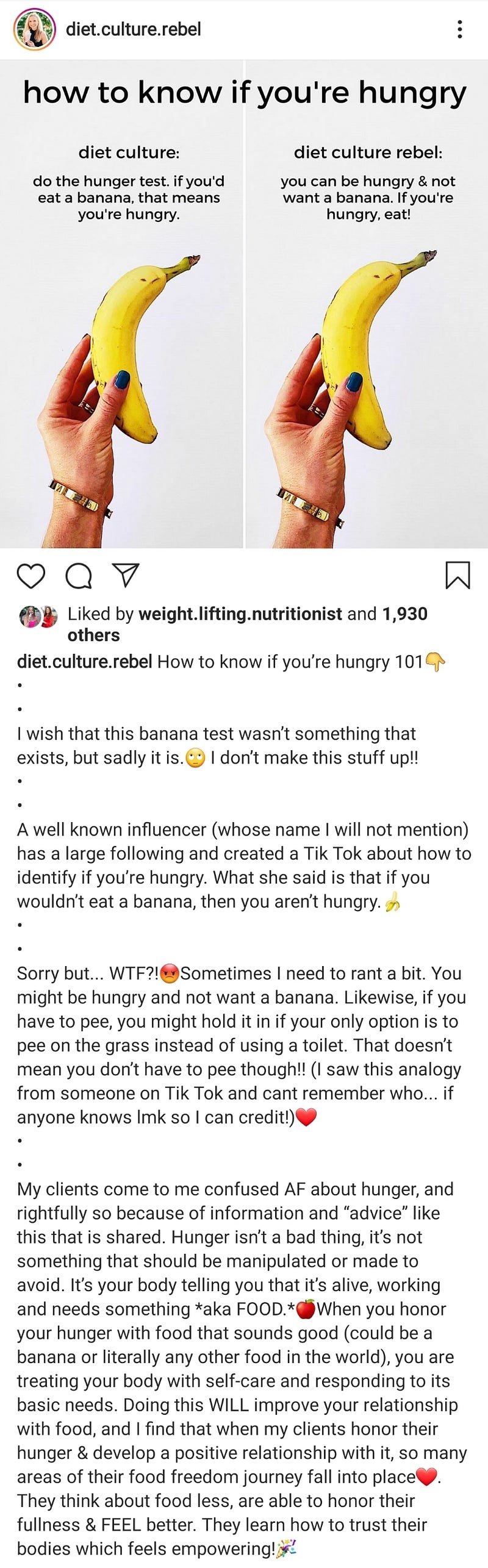
Honestly, eating advice like the banana test has infiltrated every aspect of social media to the point where it can be scary to object. People really do act like those of us who are using food freedom and intuitive eating to heal from our eating disorders are pitiful pansies who can’t take a hint of adversity.
That makes it nice to know that a growing number of experts (dieticians, not influencers are the experts here) are on our side.
I didn’t want to write this story as a typical “call out” because I actually really like Cassey Ho. She’s got a ton of personality on camera. She’s creative and funny. And I can really feel her pain when she talks about emotional eating or being the chubby Asian kid in school. In many ways, I feel like she’s made fitness more fun and accessible for a lot of people.
But that doesn’t mean I agree with the mixed messages she keeps sending out about food, eating, and body image. See, Cassey is an entrepreneur and fitness influencer first. Her experience with fitness and nutrition is valuable, but she’s not a nutrition expert. And she’s not a registered dietician — as in, a medical professional who’s been trained to identify eating disorders.
In fact, Cassie Ho has admitted to struggling with disordered eating in the past, and she frequently makes jokes about her inability to “get” intuitive eating — like it’s some impossible ideal. As much as she says the words “body positivity” or “love yourself,” and despite her history as the influencer who called out Target for photoshopping a thigh gap onto a model, her social media channels are disturbing. After all, years before she commented on Target’s photoshop, she created her own “How to get a thigh gap” printable.
As one Redditor mentioned last year, certain habits Cassey mentions are huge red flags, like:
- Weighing herself every day. Feeling big at 136. Announcing she’s doing a total body makeover because she gained 14 lbs.
- Announcing she works out hard 6 times a week.
- Announcing she wants to lose body fat percentage.
- Posting her measurements and pictures. She looks fit and thin.
- Giving herself 90 days to go back to her “old body”.
- Posting a strict list of foods and banned foods.
I’d say that much of the content Cassey produces under her Blogilates brand is problematic “thinspiration” with a heavy dose of orthorexia. That doesn’t make her a bad person — she’s human and flawed like the rest of us. What’s really troubling, however, is how many people seem to think this is all well and good.
Blogilates clearly reveals a deep problem in our culture and social media. It’s really no wonder that fatphobia is still so problematic when we cannot seem to understand that our obsession with food and “clean” eating isn’t actually doing us any favors.
That said, I am holding out some hope for Cassey over at Blogilates. Her voice could do wonders for the food freedom and Health At Every Size movements.
I hope she and her followers find their food freedom.
For further reading: