The Problem With Chidi is That He Hides the Cosmic Horrors of Whiteness
The subtext of Chidi and the Good Place hides a cosmic horror — that white people feel that Black people are damned by the very systems that enslaved their ancestors.
In The Good Place, four souls bound for Hell get dumped into a paradise afterlife. The first season revealed they were actually in the Bad Place. Demons designed it to torture them psychologically. Throughout the series, the four protagonists discover that all human souls were bound to Hell over the last 400 years as the West’s sins (slavery, colonialism, globalization) implicated every human born. Slave labor and exploited workers produced a cotton shirt worn in the mid-19th century; anyone who purchased and worn it took on those sins and added negative points to their cosmic ledger. In the example the series gave, a person who got flowers for their grandmother in the late 20th century also accrued negative points. Producing such flowers resulted in supporting exploited labor and policies that promote climate change.
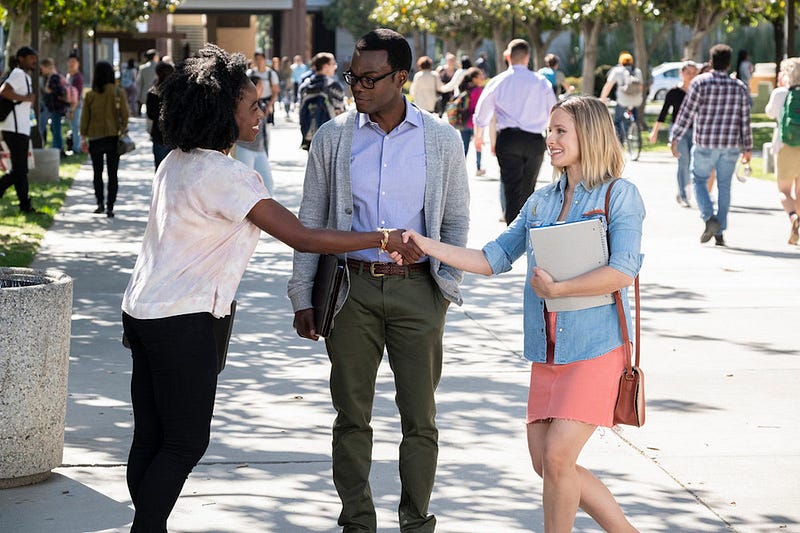
It took a Black man whose Blackness is rigorously ignored to revise the celestial morality of right and wrong. Chidi, one of the Four and an indecisive moral philosopher of Nigerian descent and Senegalese nationality, altered the afterlife judicial system where demons and angels created trials for humans who did not accrue enough points on Earth.
All it took for our nervous philosopher to arrive at such a design was 800 afterlives, with falling in love with a white woman being the universal constant. Through his tutelage with Eleanor on ethics, they grow to embrace each other and mediate their worst impulses. On Chidi’s part, he overcomes the indecisiveness that plagued his earthly life and, with confidence, redesigns the afterlife to give all humans a fair shot at Heaven.
I enjoyed The Good Place as a piece of speculative fiction. Yet, I also hate that it only superficially dealt with race. As with most sitcoms, race was the fuel of many jokes. Judge Gen (played by Maya Rudolph) noted that her physical form of a Black woman was not looked upon kindly by humans when she visited Earth. When she decides to destroy the universe, she raps Bone Thugs-In-Harmony’s “The Crossroads.” Most hilariously, and left on the table, is her attraction to Chidi.
Chidi pursued nothing but relationships with melaninated women during his time within the mortal coil. Before he died the first time, Chidi was in a relationship with Allesandra, a woman of color, before she broke it off due to his indecisiveness. In his interlude between his first and second deaths, Chidi enters into a relationship with Simone, a Black neuroscientist at the Australian university where he teaches philosophy. As Chidi, due to Eleanor’s influence, realize that he has died before, he breaks things off with Simone to protect her from his cosmic secret. Later in that season, Simone is one of the four participants, recently departed from Earth, to engage in a contest between demons Shawn (Hell’s manager) and Michael (who sought reform of the afterlife). Chidi sacrifices himself and his self-awareness again to support Simone, whose strict empiricism was sabotaging her ability to earn “good points.” They enter into a relationship again in the afterlife. Despite that, their romance is only supposed to be a ploy to help Eleanor’s Soul Squad achieve victory. The intent was to restore Chidi’s soulmate status with Eleanor upon their victory.
Chidi’s journey (I won’t give away how it ends; the final season is very much worth your time) is another example of the white conception of Blackness. Race is a political decision that eventually became imbued with demographic force. The Good Place implicitly argues that such demographic force means nothing when it comes to cosmic judgment; Blackness is simply painting on the cosmic vehicle instead of being the vehicle that drives almost all decisions on Earth. Chidi is African born, living an expatriate life, has Black friends and Black romances. He had loving and attentive parents. He had romantic partners who loved him. None of those relationships matter save as a path to Eleanor, the white woman who did for him what all of his Black relationships failed to accomplish. She cured him of indecisiveness that, because of the harm it caused others, became elevated to the level of sin. I do not think the folks in the show’s writer’s room thoroughly thought out the implications of their narrative decisions. They had loftier goals to accomplish regarding the redemption of the afterlife. But the ancestor Toni Morrison has always made the argument regarding the output of white authors that I extend to all-white creatives. What they say directly about race matters as much as what they do not, or what they feel they cannot, say about race.
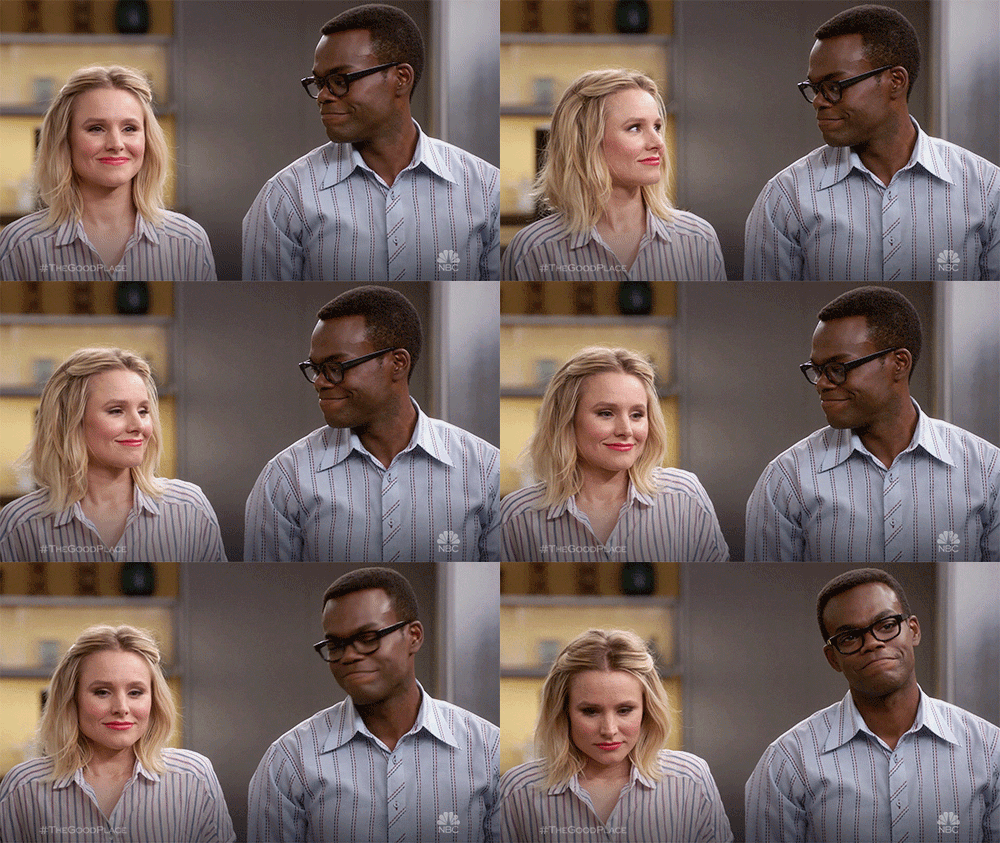
The problem of Chidi is silence. As I mentioned earlier, the Soul Squad eventually discovered that the world’s increasingly global nature ensnared the entire species in a web of unforgivable sin, regardless of the intent behind an individual’s decisions. It was slavery that inaugurated humanity into this age — the Triangle Trade of Black flesh, forced labor, and the bounty of the New World. The issue of racial silence in The Good Place reveals a horrifying cosmic abyss rooted in race. Among the first victims of an interconnected globe, Black people are still condemned to an afterlifetime of torture. The system that enslaved us will also damn our souls.
Honest fiction concerning the afterlife would take into account the histories that guide the planet. White creatives would have to confront the ancestral inheritance and guilt that belongs only to them. Such introspection would force them to flesh out characters such as Chidi further, a Black man forced to endure the consequences of their ancestor’s actions and can thus only secure their redemption through them.


