
The Privilege of Unpacking “White Privilege: Unpacking the Invisible Knapsack”
When I sat down to unpack “White Privilege: Unpacking the Invisible Knapsack”, I thought I would be unpacking the theory of whiteness that neoliberal Democrats love. To my surprise, I also began unpacking middle-class niceness.
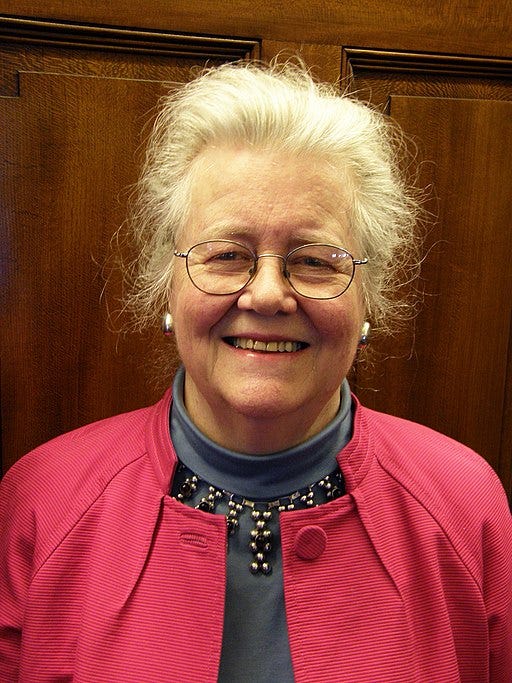
I knew this as soon as I found a clip of Peggy McIntosh talking about writing “Unpacking the Invisible Knapsack”. As soon as I saw her, I thought, “That’s a nice middle-class white woman.” Almost as soon as I thought it, I heard her use the word nice.
McIntosh said,
In 1980, I had read two essays by black women who had lined it out just like a given: white women are oppressive to work with. And I remembered reading those essays with astonishment. They were so factual about it. White women are oppressive to work with. And I had two thoughts in 1980, and I still remember them. One was, I don’t see how they can say that about us. I think we’re nice. And the second, which is outright racist, but this is where I was in 1980, I especially think we’re nice if we work with them. Then I thought, did we fill the reading list and the programs and women’s studies with white people’s stuff? And at first I said maybe, and then I said yes. And I asked myself, if I have anything I didn’t earn by contrast with my African-American friends in this building, show me. And I had to pray on it. And I asked my unconscious mind to answer my questions. And after three months, forty-six examples had swarmed up, most of them in the middle of the night. And if I didn’t flick on a light and write them down, they would be gone by morning, because I didn’t want to know them. They were messing up my view of myself as a person who had earned everything I had.
Two things immediately struck me:
- McIntosh created her list through prayer and dreams like a mystic.
- She was driven by the need to reconcile her belief that she was nice with her awareness that it was not nice to think she was nice because she worked with black people.
Maggie Koerth-Baker at BoingBoing made me think more about the link between niceness and whiteness when she wrote that McIntosh’s essay “completely changed the way I thought about what racism is, and the privileges I experience as an upper-middle class white person.” Koerth-Baker and I live in a state that values niceness so much that Wikipedia has an entry for “Minnesota nice.”
A great many nice upper-middle-class white people share Koerth-Baker’s reaction to McIntosh’s essay. I don’t. Since privilege theorists love personal stories, here’s a little about me:
My mother was the epitome of white middle-class niceness, a druggist’s daughter from northern Minnesota. My father grew up on a small farm, and while many people spoke of him with respect, no one called him middle-class or nice. My earliest awareness of whiteness is tangled up in the civil rights conflict in Florida when our family couldn’t get fire insurance because the Ku Klux Klan had threatened to burn down our home and I was bullied in school for being a “niggerlover”. So far as I was concerned, anyone who thought whiteness mattered was the enemy — which might be why Project Implicit’s test for race says I have “a slight automatic preference for African American compared to European American”.
Or maybe I’m among the millions of white Americans who show an implicit preference for African Americans because I grew up around black people and was never hurt by one. I don’t mean that I thought black people were better than whites. I agree with Malcolm X, who said after he left the Nation of Islam, “I believe in recognizing every human being as a human being, neither white, black, brown, or red.” I only mean that until I criticized whiteness studies, my experiences with black people were mostly good and my experiences with white people were very mixed.
When I began to argue that class matters more than race or gender in a capitalist country, I learned the limit of middle-class niceness. First came suggestions to read “Unpacking the Invisible Knapsack”. When I said I’d read it and agreed with some of its examples but not with its assumptions, niceness ended. McIntosh’s fans insisted I was denying the existence of racism, which baffled me — if criticizing an ideology about race is denying the existence of racism, then Malcolm X denied the existence of racism when he criticized the Nation of Islam.
So I began researching my critics’ belief system. At the time, there was little analysis of “Unpacking the Invisible Knapsack” online — people loved it or hated it. Adolph Reed Jr., who Katha Pollitt called “the smartest person of any race, class, or gender writing on race, class, and gender”, helped me see why.
In “The Limits of Anti-racism,” Reed wrote,
Yes, racism exists, as a conceptual condensation of practices and ideas that reproduce, or seek to reproduce, hierarchy along lines defined by race. Apostles of antiracism frequently can’t hear this sort of statement, because in their exceedingly simplistic version of the nexus of race and injustice there can be only the Manichean dichotomy of those who admit racism’s existence and those who deny it.
Reed’s comparison of anti-racism to a dualistic religion was reinforced when I found the Reverend Thandeka’s “Why Anti-Racism Will Fail”. Writing about anti-racism training in Unitarian-Universalist congregations, she said the “belief that all whites are racists is based explicitly on the Christian doctrine of original sin…”
McIntosh speaks persuasively to middle-class whites and graduates of expensive private schools because she’s one of them — she was the associate director of the Wellesley Centers for Women at Wellesley College, one of the private women’s schools that have been educating the daughters of America’s elite since the 19th century. Wellesley’s graduates include two secretaries of state. It’s among the nation’s most expensive schools — in 2013, a year there cost $57,042. Wellesley touts its diversity because less than half of its students are white and nearly a quarter are Asian, but that diversity doesn’t translate into class diversity — Asian Americans are richer than white Americans.
McIntosh effectively describes Critical Race Theory when she says,
I think whites are carefully taught not to recognize white privilege, as males are taught not to recognize male privilege. So I have begun in an untutored way to ask what it is like to have white privilege. I have come to see white privilege as an invisible package of unearned assets which I can count on cashing in each day, but about which I was ‘meant’ to remain oblivious. White privilege is like an invisible weightless knapsack of special provisions, maps, passports, codebooks, visas, clothes, tools and blank checks.
Whether she’s playing a rhetorical game when she says she asked in “an untutored way” or was so immersed in Critical Race Theory that she did not realize she had been tutored by her friends “in the building” and the reading they recommended, I don’t know. Though she never names CRT in her essay, she mentions “institutional racism”, a core belief of CRT.
Critical Race Theory gave her a way to reconcile her belief that she was nice with her awareness of her not-nice racist thoughts. Just as Saul the persecutor of Christians became Paul the Christian evangelist, the racist Peggy McIntosh became Peggy McIntosh the anti-racist evangelist. When she prayed to see the things she didn’t earn that were denied to her African-American friends, she ignored the things that she and her upper-class black friends didn’t earn that were denied to working class people of all hues. Her sole concern was with the forms of injustice that affected her privileged black peers.
Her 1989 version of “Unpacking the Invisible Knapsack” begins,
Through work to bring materials from women’s studies into the rest of the curriculum, I have often noticed men’s unwillingness to grant that they are overprivileged, even though they may grant that women are disadvantaged.
Her use of “overprivileged” instead of “privileged” reveals her belief that being privileged is fine — her complaint is that some people in the privileged class have more privileges than others. This lets her see all men as “overprivileged” and all women as “disadvantaged” even though when she wrote, Queen Elizabeth was the fourth richest person in the world, Maggie Thatcher had been Prime Minister of Britain for almost a decade, and Ronald Reagan’s cuts in social services had made over a million Americans of all races homeless, the majority of whom were men.
McIntosh says,
As we in women’s studies work to reveal male privilege and ask men to give up some of their power, so one who writes about having white privilege must ask, “having described it, what will I do to lessen or end it?”
It’s an excellent question. For her, acknowledging privilege is the whole of the answer. Once acknowledged, that privilege may be enjoyed — she never considers giving up her job so a less-privileged black woman could have it.
McIntosh says,
My schooling followed the pattern my colleague Elizabeth Minnich has pointed out: whites are taught to think of their lives as morally neutral, normative, and average, and also ideal, so that when we work to benefit others, this is seen as work that will allow “them” to be more like “us.”
Minnich is another white academic who worked at expensive schools. She’s right when she says, “when we work to benefit others, this is seen as work that will allow ‘them’ to be more like ‘us.’” But neither Minnich nor McIntosh have noticed that working-class white people also see middle-class do-gooders doing “work that will allow ‘them’ to be more like ‘us.’”. By focusing on people of color, McIntosh and Minnich make working-class whites invisible, and therefore they cannot see that what they call “morally neutral, normative, and average, and also ideal” has nothing to do with whiteness and everything to do with middle-class niceness.
McIntosh says at the end of her introductory comments,
I have chosen those conditions that I think in my case attach somewhat more to skin-color privilege than to class, religion, ethnic status, or geographic location, though of course all these other factors are intricately intertwined.
She mentions class, but you’ll find no class considerations in what she wrote after she began praying. Most of her points boil down to a simple truth that is implied in item #36 on her list:
If my day, week or year is going badly, I need not ask of each negative episode or situation whether it had racial overtones.
If she means she never has to wonder if a white person treated her badly because of her race, she’s right. But if she thinks white people never have to wonder if an unpleasant event had “racial overtones”, she should notice that people of color commit hate crimes too.
Talking about McIntosh’s list is difficult because she made no attempt to organize it. As noted in “McIntosh as Synecdoche: How Teacher Education’s Focus on White Privilege Undermines Antiracism”,
McIntosh suggests that the privileges might be divided into different categories, but she does not tell us how to categorize them. There is little about the order of the list to help us make sense of the key aspects or contours of white privilege.
Further, our confusion was also grounded in how McIntosh describes privilege. First, she seems to assume that lessening privilege for white people would also, in some direct way, lessen oppression for people of color. We found this especially puzzling since a number of privileges on McIntosh’s list seem better characterized as human rights, to which she refers as “what one would want for everyone in a just society”. In the case of such privileges, it seems that the struggle should be to guarantee them for everyone rather than lessen them for some.
Second, even as McIntosh gestures toward systemic oppression, her text focuses overwhelmingly on conceptualizing privilege as individual and seems to equate individual white people coming to understand their white privilege with overcoming systems of racial oppression. Stated differently, while reading and working with McIntosh’s piece might be a consciousness-raising exercise for individual white people, her text provides limited help with understanding and undermining systemic white supremacy. There is no call to activism, unless activism is conceived of as individual white people somehow lessening their own white privilege.
Because McIntosh’s list is very redundant, I’ll only address a few items.
1. I can if I wish arrange to be in the company of people of my race most of the time.
There’s an old joke realtors tell: “What are the three most important things when selling a property? Location, location, location.” McIntosh’s black colleagues at Wellesley would’ve had trouble avoiding white people — the 2007 Census Bureau estimated the town’s racial makeup was 84.6% white, 10% Asian, and only 2.2% black. If unequal racial distribution is a sign of racism, Wellesley, Massachusetts, is one of America’s most racist communities.
But the privilege of being in the company of people of your race depends entirely on where you are. Wikipedia’s list of U.S. communities with African-American majority populations includes two large cities, three small ones, and over 100 towns.
McIntosh does not say why she thinks voluntary racial segregation is desirable. Nor does she say whether voluntary segregation is a privilege that should be eliminated or a right we all should have.
3. If I should need to move, I can be pretty sure of renting or purchasing housing in an area which I can afford and in which I would want to live.
A 2013 HUD study found “African-American home buyers learned about the existence of 17 percent fewer homes and were shown 18 percent fewer properties. On the renters’ side, 11 percent fewer units were ‘advertised as available’ while they were shown 4 percent less units than Whites.”
Though McIntosh said she was considering class in her list, she overlooks it here. Despite the obstacles that middle-class black people face, they have an easier time finding a home “in an area they can afford and in which they would want to live” than any poor person of any color.
5. I can go shopping alone most of the time, pretty well assured that I will not be followed or harassed.
I’ve been a clerk, so I speak with authority here: Good clerks watch everyone to be helpful and reduce theft. Even the most racist clerks watch shoppers of their own race. White people do not get a shoplifting pass. Believing they do might explain why rich whites like Lindsay Lohan and Winona Ryder get caught, but I suspect they thought they had a wealth and fame pass.
Mcintosh’s “most of the time” means she thinks being harassed is the most common experience for black shoppers. I suspect another form of privilege applies: Middle-class white people like McIntosh have the privilege of not noticing the people who serve them. Working-class white people know clerks watch them.
6. I can turn on the television or open to the front page of the paper and see people of my race widely represented.
White people are disproportionately represented in the media because it’s run by the rich, and the rich continue to be disproportionately white because the US has little class mobility. The people who can afford the most prestigious drama, film, and journalism schools will be disproportionately white until there is, to use Martin Luther King’s term, “a radical redistribution of economic power”.
9. If I want to, I can be pretty sure of finding a publisher for this piece on white privilege.
She has forgotten the published essays by the black academics who helped her see her racism. Anyone working at Wellesley could be sure of publishing an essay because credits, not race, matter in publishing. A white teacher at a less-prestigious school would have a much more difficult time than any of McIntosh’s colleagues.
25. If a traffic cop pulls me over or if the IRS audits my tax return, I can be sure I haven’t been singled out because of my race.
If she thinks working class whites don’t get harassed by cops, I’ll happily tell her about cops harassing me when I was young and drove a used car. I haven’t been able to verify her claim that the IRS audited a disproportionate number of black people, but if the IRS was targeting people based on low income, the disproportionate number of poor blacks would make a class injustice look like a race injustice to people who think in terms of race instead of class.
After McIntosh lists 50 “white privileges”, she says,
Being of the main culture, I could also criticize it fairly freely.
In the 20th century, the people who were not free to criticize our culture were pacifists arrested in wartime and socialists denied employment during the Cold War. The most famous of those — Eugene Debs and the Hollywood Ten — were white men. Since Frederick Douglass’ day, black thinkers have been free to criticize this country, and all of them made good use of that freedom.
McIntosh says,
…the feeling that one belongs within the human circle, as Native Americans say, should not be seen as privilege for a few. Ideally it is an unearned entitlement. At present, since only a few have it, it is an unearned advantage for them.
The language of privilege theory has confused her here. When she says “only a few” have “the feeling that one belongs within the human circle”, she must think the US has a white minority like South Africa under apartheid. If you accept her premise, it’s not “the few” who have the feeling she describes — it’s the white majority.
McIntosh says,
Many, perhaps most, of our white students in the United States think that racism doesn’t affect them because they are not people of color; they do not see “whiteness” as a racial identity.
I’ve never met a white person who did not know society considered them white. Even the Rachel Dolezals and Jessica Krugs who try to pass as people of color know they’re supposed to be categorized as white. White racists are proud of their whiteness, but most white people today are not. McIntosh wants white people to be more aware of their racial identity for a reason she does not state. No one is more committed to perpetuating the importance of race in America today than privilege theorists.
McIntosh says,
Keeping most people unaware that freedom of confident action is there for just a small number of people props up those in power and serves to keep power in the hands of the same groups that have most of it already.
She still can’t decide if she’s talking about a majority or a minority. White people in the US are not “just a small number of people”. If her “small number of people in power” referred to the rich, she would be perfectly accurate.
In “Why Anti-racism Will Fail”, Rev. Thandeka notes,
80 percent of the wealth in this country is owned by 20 percent of the population. The top 1 percent owns 47% of this wealth. These facts describe an American oligarchy that rules not as a right of race but as a right of class. One historical counterpart to this contemporary story of extreme economic imbalance is found in the fact that at the beginning of the Civil War, seven per cent of the total white population in the South owned almost three quarters (three million) of all the slaves in this country. In other words, in 1860, an oligarchy of 8,000 persons actually ruled the South. This small planter class ruled over the slaves and controlled the five million whites too poor to own slaves. To make sense of this class fact, we must remember that the core motivation for slavery was not race but economics, which is why at its inception, both blacks and whites were enslaved.
McIntosh says,
Although systemic change takes many decades, there are pressing questions for me and, I imagine, for some others like me if we raise our daily consciousness on the perquisites of being light-skinned. What will we do with such knowledge? As we know from watching men, it is an open question whether we will choose to use unearned advantage, and whether we will use any of our arbitrarily awarded power to try to reconstruct power systems on a broader base.
What we know from watching men is that when they understand inequality in terms of rights, they extend those rights — women and people of color got the vote when white men saw that participating in democracy is a human right.
PS: Amber A’Lee Frost has a good short takedown of privilege theory: The Sad Song of Privilege | The Baffler
Related: Middle-class POC have more White Privilege than Poor Whites — or, BLM Logic on Police Killings