
The Privilege of Not Having to Reflect on My Identity
Checking one’s privileges is about acknowledging and confronting societal and institutional discrimination.

I started reflecting on my own identity upon arriving in the U.S. when I was about 28 years old. Yes, a bit later in life than you would expect.
For most of my life, my identity hadn’t been challenged in any way. This is a huge privilege on its own.
I was born and raised in Italy, I am white, cisgender, able-bodied; I had easy access to food, healthcare, education, etc. No questions asked. I was going about my life, and my identity was never questioned.
This changed when I immigrated to the United States. Since living here, I have been reflecting on my own identity and the ways that I fit in American society, a self-work process that has helped me through decoding and deconstructing my own biases.
I arrived and I was put in a box, or better I started having to check the racial box in various applications and forms ✔️
But why do they want to know? The answers to this question are various and I am still researching.
I have never had to identify my own race and check my privilege before. I knew it unconsciously but I would have never said, “I am a white woman” before coming to the U.S.
My identity journey started when my flight from Italy landed on the West Coast of the United States.
Parallel to my own identity journey, I started another lifetime journey since I live here, far more important, the anti-racist journey. I believe these two go together, they are like a train railway. The train couldn’t go forward if both rail tracks were not going together facing each other along the way.

When I speak of my own racial identity, it is impossible not to speak of my ethnic identity as well. When I talk about it, I am not just talking about the color of my skin but also the fact that I don’t belong to the white, Anglo-Saxon dominant group in the states. I am southern European. I speak English as a second language, accent included.
Of course, I have never had to feel like an outsider during my life as an Italian in Italy. Then, I became an immigrant, a foreigner and that changed me forever, as you will see if you continue reading my article.
October is fast approaching and is Italian Heritage Month. Most of Italian-Americans are very attached to Columbus Day. They are because the first wave of Italians, who came to N.Y.C was marginalized. New immigrants wanted to belong, and in order to achieve that, they quickly had to understand they needed to be close to the dominant group (white Americans) or caste as Isabelle Wilkerson calls the dominant group in her book ‘Caste’, which I encourage you to read here.
On the cusp of the nineteenth century, Italians were discriminated against while they were trying to fit in the white box. We bought into the oppressors’ game. We attached ourselves and our identity to Columbus, a colonizer, who committed heinous crimes, enslaved people, tortured human beings, and ultimately committed genocide. I ask the Italian-Americans, who might be reading this, is this what we want to celebrate about Italian heritage?
Italy wasn’t even a thing in 1492, modern Italy became a nation-state more than 300 years later, during the Risorgimento on March 17, 1861. And Columbus’s nationality has been debated by historians. Was he Portuguese? Spanish? Italian? Nobody can be sure. (Read more about his nationality here)
Thinking about the first Italian immigrants prompted me to go look for my great, grand-father on the Ellis Island website
Here is where I discovered that he arrived in the spring of 1909 from Naples. He was 21 years old and sailed together with another 1,449 people on a ship called: ‘Italia’. When he arrived at Ellis Island, he was labeled “Southern Italian”. That was his “race” according to those years’ labeling practices. Italians were divided between the Italian north and the Italian south.
I recognize how privileged I am to come here to the U.S. with a plane ticket. Sixteen hours instead of thirty days or more on a boat in the middle of the Atlantic ocean, not being able to see land for days and days.
Speaking of privilege, I hold privilege through most of my identities. I have white privilege and that is the biggest privilege you can hold in the U.S. Although, as a non-Anglo-Saxon and English non-native speaker, (to learn more read my other article on Language Bias) I can be stereotyped through some of my identities. We all have biases about everything and everybody. When I am talking about identities, I am talking about intersectionality.
Intersectionality is a theory that explores how individuals can face multiple categories of privilege and discrimination when they belong to more than one dominant or marginalized group. Everyone possesses multiple identities, and these identities work together to shape each person’s societal and cultural experiences.
The concept of intersectionality was theorized by the Feminist movement, as BIWOC (Black, Indigenous, Women of color) critiqued the movement for not acknowledging that the oppression they experienced was different than the oppression experienced by white women.
BIWOC experience greater and more complex levels of oppression.
“Complexity is an important hallmark of intersectionality. Every individual is a woven tapestry of identities, including, but not limited to, race, ethnicity, gender, sexuality, disability, class, and religion.” — Everyday-Democracy.org
When my identity was questioned, upon my arrival to America, through other people’s eyes, thoughts, stereotypes, biases, and jokes, I have become Italian for the first time, I have become Italian when I immigrated to the U.S.
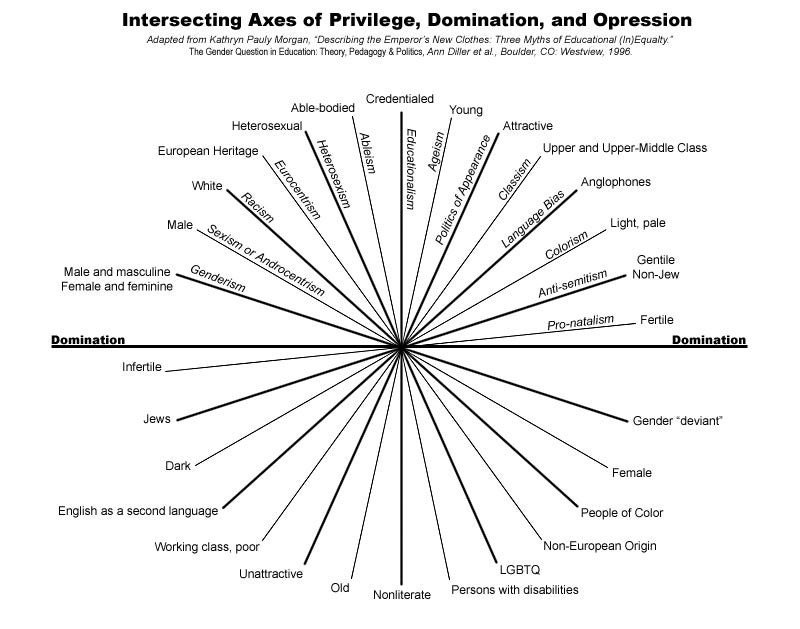
Since I landed I have been thinking about where I fit in the American ‘bipolar system” (Caste by Isabelle Wilkerson) at least this is how I feel.
People are always trying to label you to place you in a hierarchy and see where you fit and how to treat you.
Recognizing the multiple dimensions of privilege and oppression in our society and the many systems that reinforce them is no easy process. It takes time to understand that many of these systems reinforce the multiple dimensions of privilege and oppression in society.
This is a great tool to self reflect on one’s white privilege. Here is a white privilege checklist by Peggy McIntosh
The types of individual privileges that can be granted to a person include access to education, healthcare, employment, social security, housing, etc.
Being white in the U.S.A. means taking away many of the unearned benefits that are simply granted to us.
The origin of the term “privilege” can be traced back to the 1930s when WEB DuBois wrote about “psychological wages” that allowed white people to feel superior to Black people. We can define privileges as the unearned benefits granted to people who fit into a particular social group. When I explained this to a friend at a dinner, she became defensive… Maybe I will write about this in a different article.
Some aspects of a person’s identity can include race, ethnicity, gender, sexual orientation, religion, age, and gender identity to name a few. Some identities are things that people can easily recognize, such as race or assumed gender, while other identities are ‘hidden.’
Although it is crucial to understand the complexity of the whole self, it is useful to focus on individual aspects of identity in order to develop a greater awareness of one’s social position. While self-exploration can be difficult, exploring privileged identities is particularly difficult for many people.
I feel like in the U.S. and probably everywhere else, we construct our identity, consciously or subconsciously, comparing them to the dominant caste.
Checking my own privileges means recognizing and confronting social and institutional discrimination, but it also reminds me of the importance of self-awareness.
This is a lifetime journey. I will leave you with some prompts to further reflect on this:
How often do you go into a social environment where the majority of people look like you?
How likely is it that you see a show whose characters reflect your own identity?
What are your identities?
To further reflect on these topics please read Biased by Jennifer L. Eberhardt also, watch her videos on YouTube — How racial bias works — and how to disrupt it | Jennifer L. Eberhardt
Thank you for reading my article. I believe in a fair and inclusive world where we can encourage discussion and accept one another. You can find me on Twitter, Instagram, and Linkedin.