
The Price You Pay: Martin Scorsese’s ‘The Irishman’
An old man sits in a wheelchair. He’s in a nursing home. There’s no one else around him. He looks at us and talks to us. “When I was young, I thought house painters painted houses,” he says.
For three and a half hours, we are a captive audience, listening closely as this soft-spoken man reflects on his life as a hitman for the mafia. His name is Frank Sheeran (Robert De Niro), and he’s about to tell us how he murdered famous union boss Jimmy Hoffa (Al Pacino).
As Frank remembers it, he was once Hoffa’s trusted friend, a charismatic leader who at the time “was as big as The Beatles.” Frank was a loyal worker and whacked many of the most notorious mobsters, including Crazy Joe Gallo at Umberto’s Clam House in Little Italy. As a sign of respect, fellow mobster Russell Bufalino (Joe Pesci) gifted him a special gold ring that only two other people had. He was the only Irishman to get one.
Alas, none of that matters now. Those who revered Frank, like Bufalino, are long dead. Those still alive, like his daughters, choose not to see him. To pass the time, he prays with a priest, and on a good day, gets a laugh out of one of the young nurses. He still wears the gold ring on his finger.
His life is quieter now. His days of killing are behind him. He’s already paid for his sins in the eyes of the law, having served a 13-year prison sentence. In the eyes of his family, he’s still paying. To the rest of the world, he’s just another invisible old man in a nursing home, counting down the days before he’s put out to pasture.
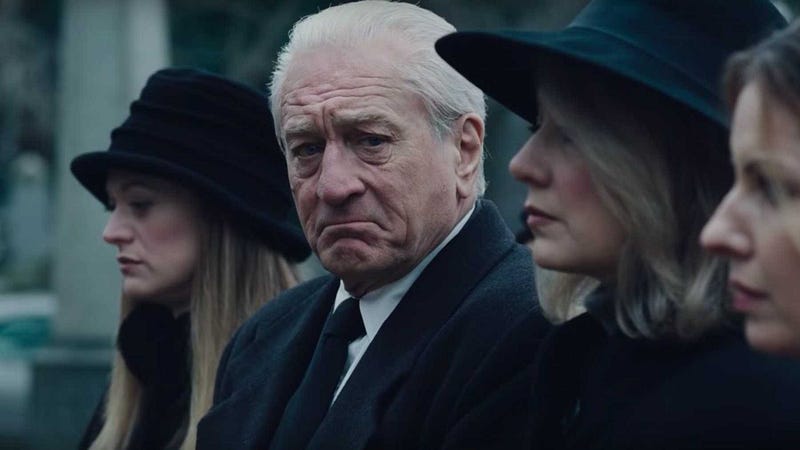
When you realize what director Martin Scorsese is doing with The Irishman (2019), it’s impossible not to be in awe of his ambition. He lets us follow one man for his entire life, bearing witness to what he prioritizes and what he pushes aside, until his final moment of death when it dawns on him that he got it wrong. Instead of trying to impress his mob bosses, he wishes instead that he spent more time with his family. He works to make amends, but after decades of killing, his daughters are having none of it. It’s just too late. All he has to show for himself are the gold ring Russell gave him and a few worn-out photos of him and Hoffa, souvenirs from the past that do little to make the present more bearable.
The Irishman is another one of Scorsese’s savage indictments of the mafia lifestyle, but it’s also so much more than that. It’s an indictment of anyone who waits too long to do the proper introspective work that’s required to become a whole person. Scorsese, a deeply spiritual man, is often interested in characters who lack the moral strength to achieve enlightenment. Frank’s inability to look inward for most of his life becomes his ultimate downfall. In old age, when the weight of his sins becomes too heavy, he tries to repent, but by then, the only one willing to hear him out is a priest.
What’s so powerful is how Scorsese illustrates this through the little moments. I think of the silence at the breakfast table between Frank and his daughter Peggy, or Frank’s sneaking out in the middle of the night to do a job while Peggy watches from her window, or perhaps most heartbreaking of all, Frank’s glances from afar as he observes Peggy bond more lovingly with Hoffa over ice cream. It’s these small, seemingly insignificant moments that add up to an entire life of selfish choices. These choices are felt by others, Scorsese shows us, and they can come back to haunt us when we least expect it.
After I watched The Irishman, I thought of all the lonely old men in nursing homes. Who among them is filled with regret, longing for another go-around to get it right? Talking to themselves, trying to elevate the importance of their stories to anyone who will listen, and doing everything they can to avoid the unbearable darkness that comes with a life poorly lived.