
WRITING
The Price of Being a ‘Snitch’ — I mean, a Writer
Because some people think they are one in the same
There’s a phrase here in the South that I absolutely despise: “Snitches get stitches.” It seems that whenever I hear these words, it’s typically someone who is trying to stay out of trouble with the police or doesn’t particularly care for police involvement.
But the concept goes far beyond this phrase.
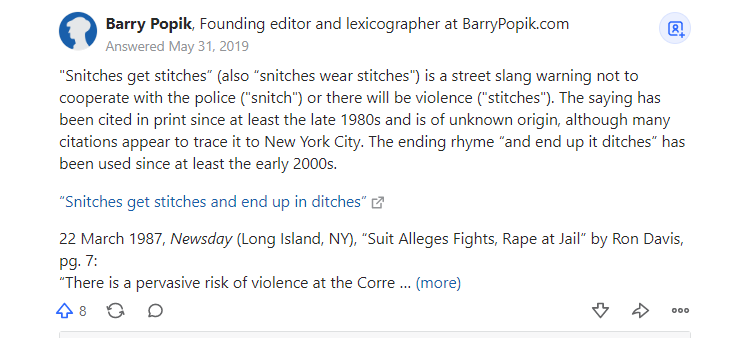
One Quora member gave this analysis of the phrase:
People simply do not like a “tattletale.” I’ve been told this since I was a small child, and now, as a writer, those voices from my past creep into my mind when I try to be vulnerable in my writing.
The fact is, people don’t like it when you write negative things about them.
For example, I recently released an article that was very personal to me and somewhat risky for me to write, because I didn’t want to expose the nasty behavior of others. Here is the article if you’d like to catch up.

The blowback on that article in my real life has been costly.
It has damaged or cost me multiple close relationships and damaged others.
Perhaps those relationships can be mended at some later date, but as of now, I am paying the price for revealing less-than-flattering information about other people.
I am reminded of a quote.
“You own everything that happened to you. Tell your stories. If people wanted you to write warmly about them, they should have behaved better.”
― Anne Lamott, Bird by Bird: Some Instructions on Writing and Life
(Author note: I have never read Bird by Bird — but this quote alone has me hooked.)
Writers walk this very uncomfortable line of trying to tell their personal story without offending and alienating every human being within their circle of reach. This concept of snitching, or tattling, is deeply rooted in modern American society. It is juxtaposed heavily with my own ethical perception of being authentic, truthful, honest, and open in my relationships and with my writing.
It is a great burden to figure out how to be authentic and careful at the same time.
So how do we balance this as writers?
Do we avoid being a ‘snitch’ in our work? (Again, I think this term is crap, but people seem to carry this notion in their hearts — without mercy!)
Or do we find ways to generalize and anonymize our statements to protect other people? The latter is how I tend to do it, but for those who know I am writing about them, it is still difficult to manage their reactions along with my need to be authentic.
At what point of success do we have permission to be fully authentic?
I read a book when I was in college called “All Over but the Shoutin’” by Rick Bragg. I met the author at an author event held at Catawba College and found particularly memorable his ability to tell the absolute truth about his life in his books. He spoke of the enormity of having to explain to family members that he had to be honest in his writing.
“Every life deserves a certain amount of dignity, no matter how poor or damaged the shell that carries it.” ― Rick Bragg, All Over But the Shoutin’
“I know I grew up in the time when a young man in a baggy suit and slicked-down hair stood spraddle-legged in the crossroads of history and talked hot and mean about the colored, giving my poor and desperate people a reason to feel superior to somebody, to anybody. I know that even as the words of George Wallace rang through my Alabama, the black family who lived down the dirt road from our house sent fresh-picked corn and other food to the poor white lady and her three sons, because they knew their daddy had run off, because hungry does not have a color.” ― Rick Bragg, All Over But the Shoutin’
This is also a way we can conduct ourselves as writers; simply ask permission from those people in our lives that we would like to write about. (If you are in contact with them and care about their response.)
It’s a whole lot easier if you are not on good terms with the people you want to write about. This is likely why you see so many personal essays addressing the bad behavior of ex-boyfriends or the manipulative behavior of family members who caused torment for years.
At what point of success do we have permission to be fully authentic?
When you love your family and you love your friends and you have good relationships with them it is hard to write about things that may or may not shed them in a bad light. Though there are such deep life lessons to be had in our everyday interactions with other people.
So, we anonymize and we pretend we are writing about our friend or we pretend the scenario we just gave is fictitious. We find really sneaky ways to write about the things that we need to express and need to explore without exposing the inner turmoils or external mishaps of the lives of those around us.
Here is a good example of anonomizing your story yet addressing what you are going through:
It is a great burden to figure out how to be authentic and careful at the same time.
So, if you, as a writer, are currently wearing some “stitches” that you have earned with your writing, I encourage you to press on with whatever ethically sits right in your soul. Ultimately this is your work and your creativity. The price you are willing to pay for it… now, that is up to you. Bear those scars as the roadmap to vulnerability and honesty. True supporters of your gift will be honest with you about how they feel — but understanding as well.
If the last few weeks have been a lesson to me as a writer, it is that I must take ownership of my work and my creativity and how I express that. I know that I honor others the best I can. I know that I am careful with my work not to embarrass or upset them, so when people still take offense — I have to release that. I can apologize for their pain but I cannot apologize anymore for my own work.
I certainly cannot apologize anymore for my own truth.
And neither should you.
Thank you for reading this article. Many blessings to you, dear writer. Ours is a heavy, yet powerful gift. Use it wisely.
Christina M. Ward is new to writing for Illumination but has been warmly welcomed. She is thankful for this community of readers and writers.