
The Presence of Your Absence
We met at a Christmas Eve Party. He walked in wearing a multi-colored beanie with a small propeller on the top, and the man I was talking with asked: “Now what sort of person would come to a party wearing that?” I said “Probably a shrink.”
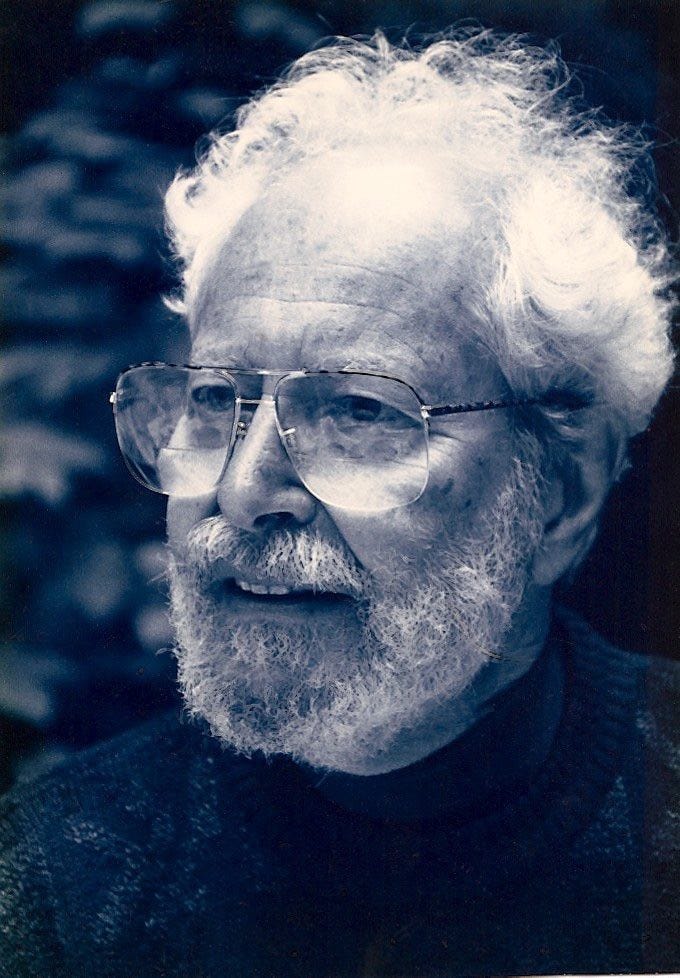
It was a good guess, since I was in the Carmel home of a woman I had worked with in therapy. It wasn’t even that much of a guess, since I had caught a glimpse of him at her office, which was part of a suite of offices she and her husband shared with him: he was older, white hair, white beard. Looked remarkably like Freud.
I remember sitting next to his son, Michael, at dinner, talking about jazz. Miles Davis. Sketches of Spain. Ed was on the other side of Michael, and he said a few things, but not much because he didn’t know anything about jazz. I later found out that his musical area of expertise was like mine in classical music.
Christmas Day was on a Saturday that year, 1983. Alone and content, for me it was quiet enough, having ended a 5-year relationship the year before. Before that relationship I had emerged from an 18-year marriage that had left me feeling raw and guilty and scared.
It came as a surprise when a few days after that Christmas Eve party, Ed called me and asked me if I’d like to have lunch. I was intrigued , but initially didn’t see him as a potential partner as there was quite an age difference. That difference was 20 years, but it was to be inconsequential after that first lunch. I was impressed by his shyness, intelligence and sensitivity. It was a couple of days before New Year’s Eve, and I invited him to my place for New Year’s where I was going to have some friends over — a pretty rambunctious group. I wondered if we would scare him off. However, at the stroke of midnight, near the piano, Ed picked me up off the floor, hugging me enthusiastically. We made a date to go to the movies several nights after that, and from then on we were together for the next 27 years.
I never imagined myself with a man like Ed. As I mentioned, at 65 he was 20 years my senior, looked it, was definitely not the life of the party at social gatherings, and was somewhat withdrawn and shy. He had what I considered weird dietary habits ... along the lines of the Pritikin low fat diet . . . and seemed somewhat eccentric. Later I was to think of him as being like ET: child-like and naïve in many ways, but incredibly wise in others. I had always pictured myself with and had been drawn to men who were authoritarian, socially at ease and in control. Not that I liked that particular model, but it was what I expected. Early on, I realized that I felt protective of Ed, that it was too easy to ride roughshod over his sensitivities and sensibilities. I sometimes felt like the guide of this ET-like creature, a kind and innocent being who seemed ill at ease or not conversant in the “ways of the world.” I was someone who was showing him around this particular reality. He talked a lot when we were alone together, something he definitely did not do when we were in a social situation. (One of my good friends said that he was “difficult to get to know.” Ultimately, putting in the effort to get to know him proved to be worth it, and she became one of his most enthusiastic fans.) He discussed things that were fascinating to me, like the forces of the Universe being to come together and separate, his experiences at conferences of Transpersonal Psychology that suggested the paranormal, his deep friendship with a woman who spoke with angels. He had been classically trained in psychoanalysis in New York. Finding this training too constricting after many years in practice, he came to California drawn by the allure of Gestalt Therapy and other less limiting therapy modalities. He was an interesting mixture of “woo-woo” and a product of legitimate academic training and had impeccable credentials. He was not like anyone I’d ever known.
From New Year’s Eve until Valentine’s Day, we grew closer, although becoming intimate was somewhat awkward as Ed was quite obviously not a “player.” We fell in love, became intimate after he essentially proposed that we do so (and I agreed), and when he told me he loved me on Valentine’s Day 1984, he added “Just in time!” I assumed he meant for Valentine’s Day, but I could read so many things into it, for example that we’re running out of time to get this “relationship thing” right. He had been married twice before, and I’d had pretty much the equivalent of two marriages.
The first couple of years were fraught with battles as we fought to each get past the obstacles that had affected previous relationships, and we struggled to navigate this Scylla and Charybdis of trying to maintain our autonomy and not lose ourselves in the “urge to merge.” When emotional intimacy threatened the developmental gain of autonomy we would use conflict to maintain our hard-won individuality by creating distance, not the best way to maintain those gains of independence but one that is often used by couples. There were endless hours of discussions and “processing,” and my tolerance for “working through” definitely increased. Over time, I learned to open my heart and mind enough so that we were able to resolve conflict more and more efficiently — simply by having the trust that we weren’t out to get each other! Ed’s willingness to apologize and to look closely at his part in creating conflict was certainly a model for me to learn from. We both developed a tolerance for increased emotional intimacy.
After a year, I moved in with Ed, into a spacious house on the edge of a bird sanctuary at the mouth of the Carmel River. Some mornings we would wake up to look out at the marsh and Ed would recite Yeats to me:
I will arise and go now, and go to Innisfree And a small cabin build there, of clay and wattles Made: Nine bean-rows will I have there, a hive for the Honey-bee; And live alone in the bee-loud glade.”
It was in this house that we got married on March 29, 1986. My daughters and Ed’s son were there, a friend officiated. We went out for Chinese food afterward.
I went back to school, got my Masters’ and became a psychotherapist myself. I sometimes said that I became a therapist “in self defence.” Our lives were intertwined, we lived harmoniously, loving being together, enjoying the same things . . . long talks, movies, dinners out, conferences and new ideas. Ed was committed to his own personal growth, and was always open and curious to learn new theories, new things about himself. He used language in a unique and special way: once when I was consulting with him about a client of mine, he said: “He has a deficiency of wanting.” This assessment said so much in few words. He could quote not only Yeats but Shakespeare and many others, in addition to quite a few raunchy limericks which always made me laugh because they seemed to be so out-of-character, Ed being not only a proper gentleman but the product of a rigorous classical education and someone who was very well versed in all things literary, philosophical and musical. He was a very cultured gentleman, knowledgeable about art: modern, impressionist and renaissance, ever curious and interested in history, astrophysics, human motivation and politics (he was addicted to the New York Times). I respected and admired him. And he became my most ardent supporter, expressing appreciation for any new idea I might have. He was encouraging and acknowledging when I went to graduate school to join him in his chosen field.
As he grew older, there were some medical issues: a couple of cardiovascular stents, some surgery for his back. Once he said “My body is no longer a welcoming host.”
And when his mind started to fail, my heart broke, over and over again, hope giving way to acceptance and anticipatory grief.
During this time I often found myself in unchartered territory without a map. I had no experience with how to handle a “slow death,” death by increments with confusing moments of lucidity.
I guess the signs started showing up around 2001. Ed was 82. He had always been the one to pay the bills, but I realized that he was having trouble keeping track of payment due dates, and I suggested that I take over. He agreed without argument. Repeatedly, when it came time for Ed to give up something, whether it was having control over bill paying, eventually seeing clients, or driving, he would give it up without complaint or having to be nudged. Ed continued getting the New York Times daily, and although I doubt that he read much of it but he would settle himself on the couch holding the newspaper as though intently reading it. We got a little Bichon puppy, Millie, who became a source of great comfort for both of us. Ed’s conversation became more repetitive, vocabulary sparse, his voice softer. He would repeat to me, over and over again, “I just love you. I just love you so much.” I relished hearing him say this, until it started becoming an irritant and I realized that it was because his repetition was an indication of the progressive impoverishment of his vocabulary, of his inability to have a conversation, and I didn’t want to accept that he was disappearing slowly before my eyes.
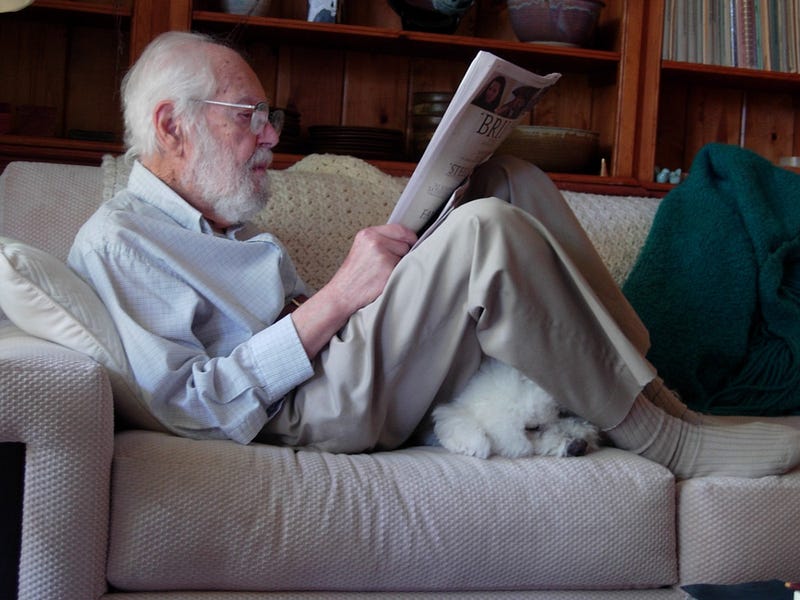
The days seemed interminable with Ed’s ability to follow thoughts or have conversations decreasing. But occasionally a flash of insight or logical thought would come through. Then, in the middle of one night, he fell in the bathroom, and I couldn’t pick him up. With much difficulty, eventually he was able, with my help, to drag himself back to bed. In addition to the tragic loss of self, the humiliation of loss of control of bodily functions were an added insult. It was then that I decided that I needed to find an alternative to keeping him at home. I started looking for assisted living situations, and found a facility, nearby — a place that I took him to for his approval while he still felt like he had a say in what happened to him. We decided that he would move there and have his own private room. There would be help available 24 hours a day, and there would be communal living and dining. He agreed to the move without objecting, saying that he understood why we’d come to this point and why it was necessary. There were about 20 other residents, most of them at various stages of dementia.
The day Ed moved into assisted living was probably the most painful day of my life. Even though we hooked up the TV in Ed’s room, he had forgotten how to use the remote. When I left him there and went home, I immediately wanted to go pick him up and bring him back to be with me. I kept telling myself that I had done the right thing, both for me and for Ed. But I kept wondering if perhaps I had given up too soon. The next day when I went to see him, I lay on his bed with him, both of us crying, asking him to forgive me for placing him in this home away from me and Millie, and he said, holding me: “Of course. Of course I forgive you.”
Somehow life proceeded. I went to work and would visit Ed afterward. He occasionally was delusional, one time imagining that there was a gas leak, another that one of the female residents, about 95, was pregnant and needed immediate help. Once I brought him home, thinking that he’d be happy to have a meal with me and be “home,” but he was restless and said that he needed to get back because he’d told “some of the women” that he’d give them massages. I felt like laughing and crying simultaneously. I never felt jealous. Infrequently, he would have moments of lucidity, and I would tell him some of the things he’d said, and we’d laugh together. Then suddenly he’d be gone again. I missed him terribly. The one thing his gradual decline taught me was that I didn’t need to have my love reciprocated. It became unconditional.
Eventually Ed needed a higher level of care, and I found a skilled nursing facility nearby.
Ed was only to be in the facility for two months however, and in May, 2011, I was called by the nursing staff telling me that he’d been taken to Marin General Hospital because of an infection or pneumonia. When I arrived at the ER, Ed tried to tell me something, but his voice was so weak I couldn’t make out what he was trying to say. The doctor asked me if I wanted him to “treat” Ed. I said no. I had no trouble making this decision; treat for what? To return to an existence of meaningless routine in an institution where they would line up the wheelchaired patients, most of them catatonic and drooling, in the hallways until mealtime, or bathroom time, or bedtime? No. Just days before, I’d sat with Ed at dinner at the institution and couldn’t hold back the tears as I watched him sit uncomprehendingly in front of food he didn’t touch, his eyes blank, not responding to me in any way. Just before that horrible evening, he’d looked me straight in the eye and said: “You’re knocking yourself out for someone who no longer exists.”
From the evening of May 3rd, Ed lay in a coma on the 5th floor of Marin General Hospital. I was with him most of the time, with Millie who would snuggle next to him. Some friends and family came and went, and we played Bach cello suites and spoke softly. It was peaceful. He was in no pain.
A little past midnight, after a day in which his room was filled with love, light, laughter, tears and people and an occasional dog, Millie and I were alone with Ed. At 12:45, I heard his breathing change, got on the bed with him and took him in my arms while Millie curled up next to his leg. I held him while he took his last breaths, and I felt that it was a joyful, intimate, wonderful experience: no pain, no resistance, just the loving miracle of being present for one of the great mysteries of life. It was instantly clear that he no longer inhabited his body, what he had called “a host.” I sat with him for a couple of hours after the nurses came in and gently washed him, a ritual that was respectful and felt sacred. And after his body was taken from the room, I left the the hospital at about 5 a.m., feeling relief, awe and grief along with the exhaustion that I had kept at bay while keeping watch at Ed’s bedside for the previous 4 days.
The long “goodbye” was over. Ed and I walked out of the hospital together into the warm Spring dawn.
You don’t survive in me Because of memories; Nor are you mine because Of a lovely longing’s strength.
What does make you present Is the ardent detour That a slow tenderness Traces in my blood.
I do not need to See you appear; Being born sufficed for me To lose you a little less.
R.M. Rilke
Join Medium with my referral link — https://medium.com/@patriciaross_63026/membership