
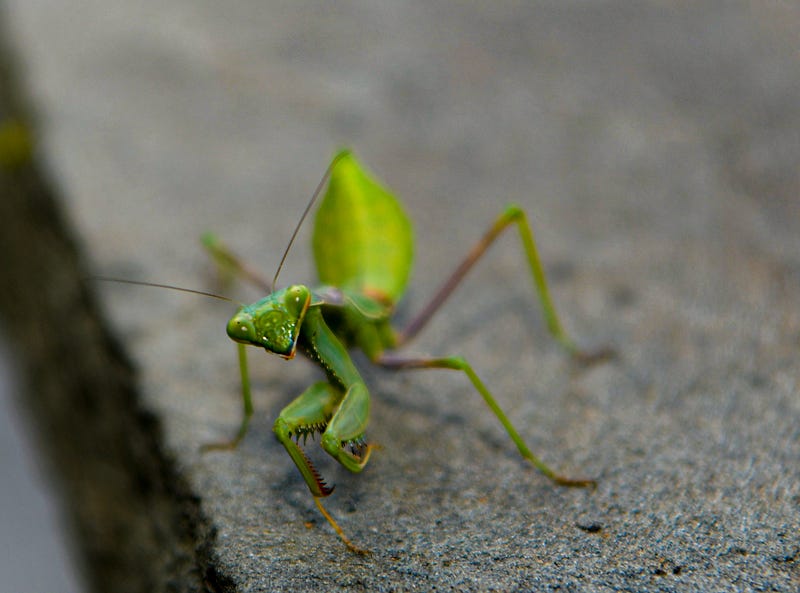
The Praying Mantis Totem
Tiny ninja warriors
Praying Mantises, named for the seemingly-devotional gesture they make when they fold their front legs in, appear to be soulful little creatures. But, in reality, they are ambush predators with martial artist-type skills.
Their vision is acute. They see in 3-D, and their two large compound eyes each have a concentrated area, called a fovea, which enables them to focus in on and track their prey with great accuracy. They also have three spare simple eyes in between the two main eyes.
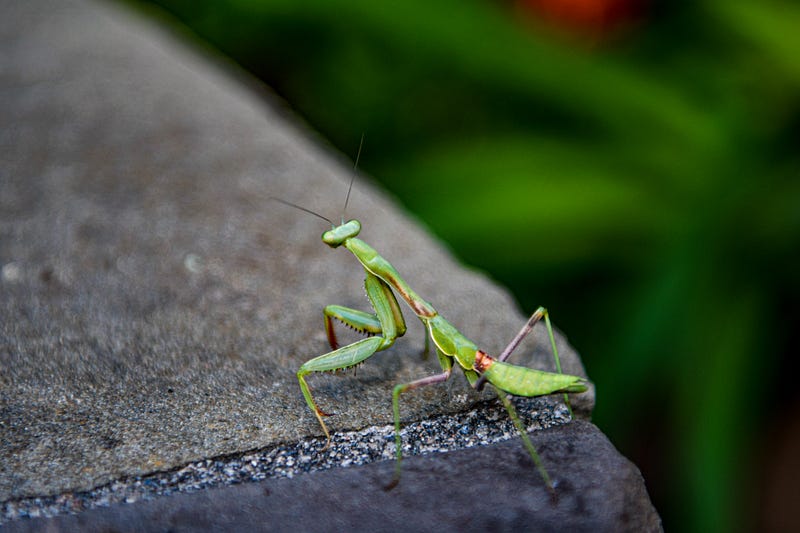
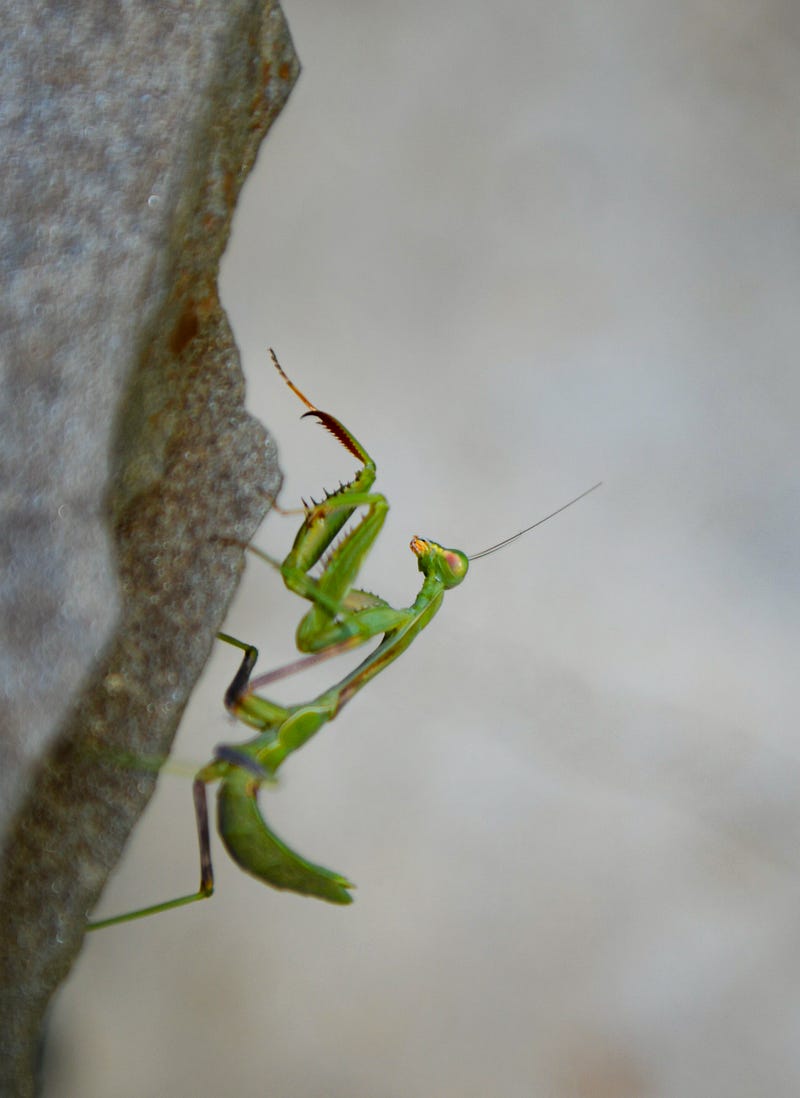
Praying mantises will wait, patiently, while stalking their prey. But when they are ready to ambush, they are like little ninja warriors, attacking with those big front legs so quickly that it’s hard to see the action with the naked eye. They have spikes on those legs too, which they use to skewer and pin their victims down.
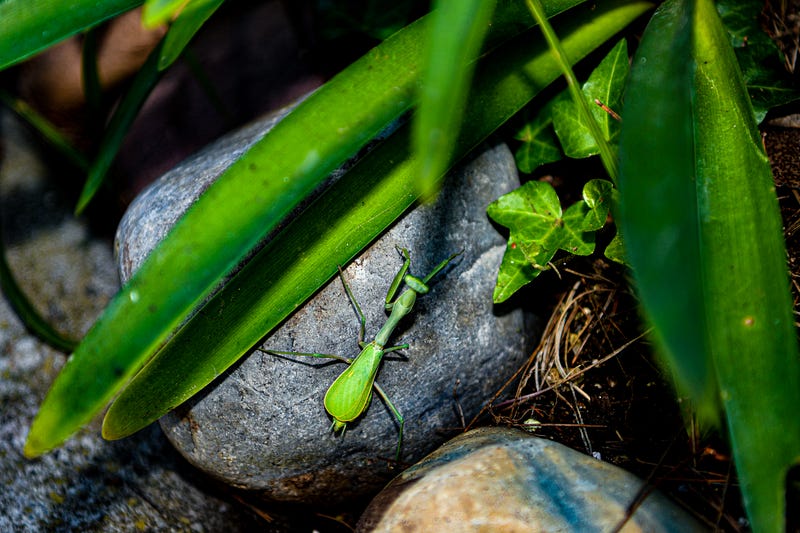
They are also amazingly talented at camouflaging themselves. This green one, below, was nearly invisible to me, until I caught its movement out of the corner of my eye.
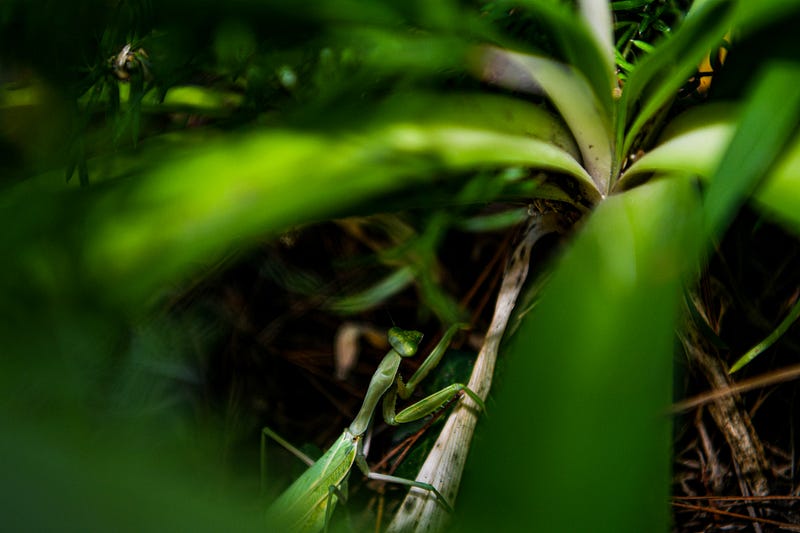
And this brown-toned mantis, lurking in my tomato bush, blended in so well with the drying leaves that I didn’t even see him until I reached in to pluck a cherry tomato.
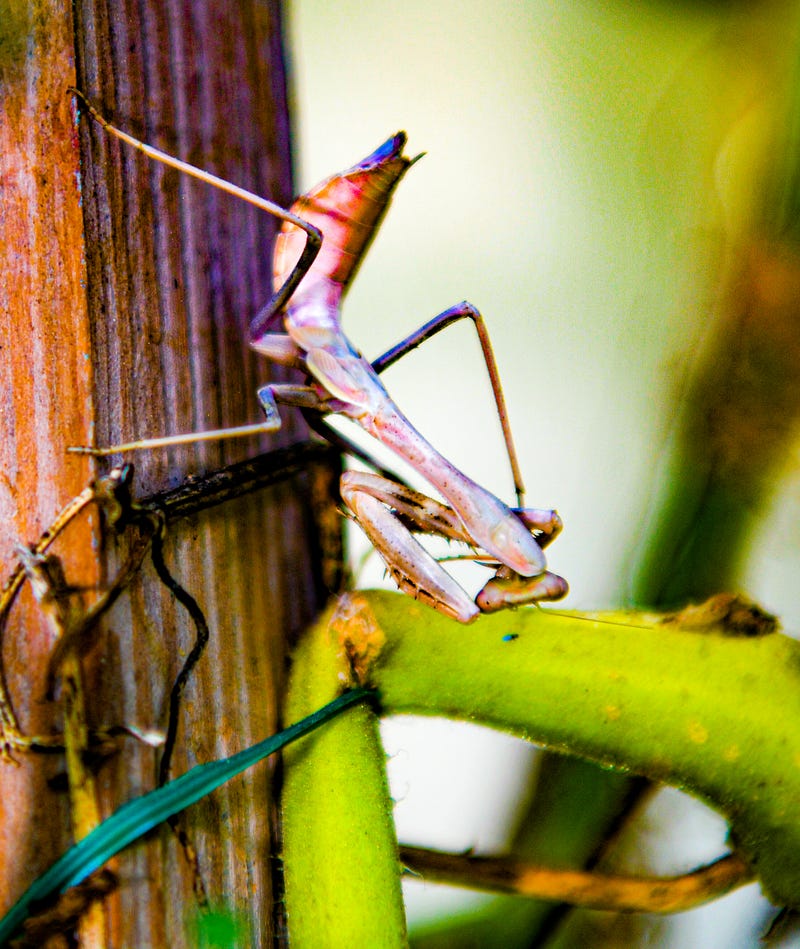
They dine on all sorts of creatures, including grasshoppers and crickets. They tend to prefer food which is in motion when they catch it. They have even been spotted targeting hummingbirds! They also attack warblers, sunbirds, honeyeaters, flycatchers, vireos and European robins, in addition to frogs and lizards.
Sort of like zombies, they go straight for the birds’ brains in their attacks.
They, in turn, are preyed upon by frogs, lizards, birds, spiders (they better watch out for Carlotta and her descendents!). They are amazingly dextrous at avoiding being caught by bats. They can hear the bats’ echolocation sounds and will dive to the ground to avoid them, sometimes performing acrobatic flips and twists on the way down.
Mama mantises lay large bunches of eggs and require a LOT of food. Unfortunately for their partners, these girls are “femme fatales” and may literally bite their mates’ heads off and then devour them — even sometimes doing this during the course of their three-hour mating session.
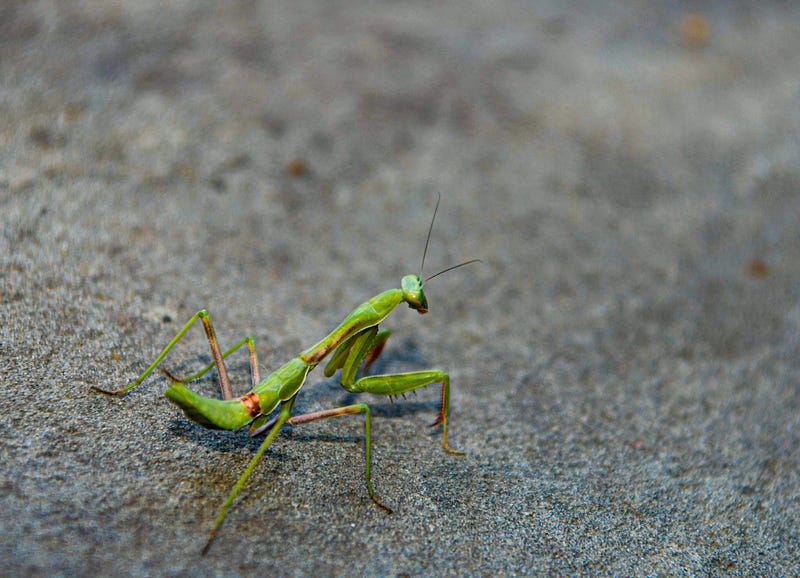
Despite the Praying Mantis’ deadly skills, in most cultures they are associated with balance in our lives, as well as with calmness, patience, intuition, awareness, creativity and mindfulness.
Since they are masters of stillness and camouflage, and wait in perfect stillness until they are completely ready to make their move, this association makes a little sense. I think the duality they present — the embodiment of mindful movement paired with lethal abilities — is an interesting metaphor for being patient and calm, but then being able to step into our power when necessary.
Erika Burkhalter is a yogi, cat-mom, photographer, and lover of travel and nature, spreading her love and amazement for Mother Earth’s glories, one photo, poem or story at a time. (MS Neuropsychology, MA Yoga Studies).
If you enjoyed this, you might also like:
And this is the story of Charlotte, Carlotta and the other sweet spiders of my garden:
And this one is a little sad, but, in my opinion, vey important:
Photos and story ©Erika Burkhalter. All rights reserved.


