
The 4 Practical Steps I Used to Discover My Life Purpose
How to use this secret Japanese tool.
Were you ever given a map or tool to help you decide what you wanted to do after high school? How about University?

How my high school guided me (NOT)
In the last year of high school, we took an online test to find out what field of work you were best suited for.
Overall it was pretty engaging, and it produced some nice graphs which I went over with a counselor.
The issue was that it was basically an IQ exam sprinkled with a few questions about preferences based on the current opportunities of 2014.
Now that’s already quite comprehensive, as the system tries to show you where you might be the most valuable; but it doesn’t really take into consideration if you’d enjoy the job/path that the test suggested for you. (Don’t get me wrong, I’m privileged to have been able to take such a test. But I think there’s a better way of helping students find career paths).
In any case, I didn’t follow the test’s advice of studying hospitality management/business; and it was the best decision ever.
Did University help me find life purpose?
After high school I took a gap year, working in jobs that I realized I then didn’t want to pursue long term. So that kind of narrowed down my career choices, and definitely made my decision easier about what I wanted to study.
Fast forward to last year, I finished university and had some vague ideas and goals about what I wanted to do.
Mainly, I was considering starting my own business related to my field of study, psychology, and more specifically in positive psychology where I would be helping people to realize their potential as I had been interested in this topic and wanted to know how I could help others live more fulfilling lives.
This was the general plan. So at least I knew what I was curious about, and that’s important.
However, when I left University in July 2019, I didn’t know what or how I would do this.
The training event that changed my reality.

Right after graduation, a friend of mine told me about a training course she was organizing about life purpose (called the purpose project), and I thought this was perfect, as not only would I learn about what my life purpose could be and how I would refine it, I would also learn about some awesome tools to help others do so as well.
When I got to Poland to learn about life purpose, I was instantly mind blown as the 10-day event took place in the middle of a forest, and the concept to change my perception was introduced:
Ikigai: A Japanese concept meaning “Reason for Being”
Getting straight into the juicy part: it’s basically a really cool diagram that separates life into four beautiful Venn diagram circles.
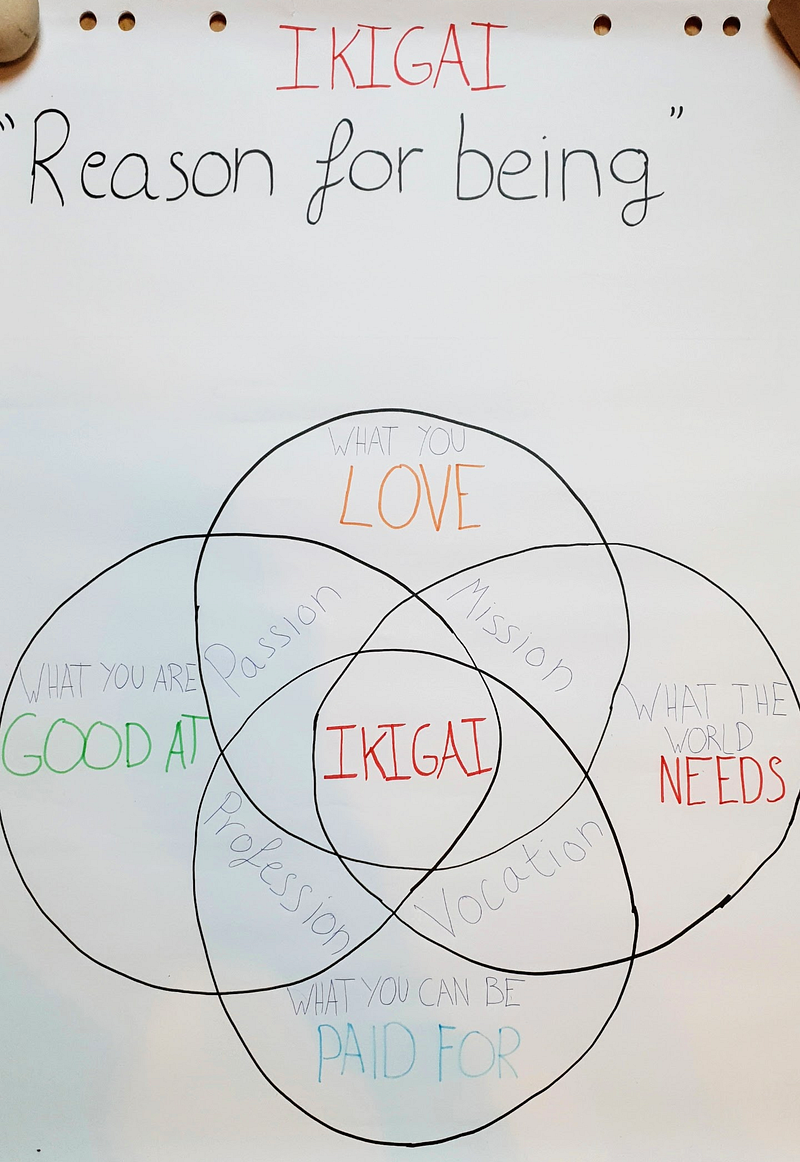
The beauty of this theory is that it can be made into a training event, allowing you to teach others how to find life purpose.
The way that it was laid out, meant that you would explore each of the 4 circles, one by one.
What you LOVE
First I got to look at what do I like to do. This was done through exercises about creativity, and self-exploration, where I had to search inside myself about what I enjoy doing. Exploring my current reality, how I was as a kid, and possibly in the future.
This is most likely one of the easier circles to explore for everyone as you can probably determine what you’d like to do or not based on what you’ve already lived and want to try.
Although the tricky thing is that there’s always something that you haven’t tried yet and might adore. Nonetheless, I was told to focus on “what is” instead of “what could be”; this makes the exercise a lot more manageable. However, that fact also shows that there’s always room for reiteration of what you enjoy in life.
What you are GOOD AT
The second circle that we explored was what you’re good at. This one was quite tricky because people don’t necessarily know what they’re good at, and this is where a lot of limited mental barriers come into play.
Especially if you’re humble, or if you were not praised or encouraged for trying or being good at new things as a kid, then you don’t necessarily know what your skills are beyond simply looking at the activities you perform in your current job.
During the training event, we explored different theories that could help us to understand what we might be good at, such as Howard Gardner’s theory of multiple intelligences. To summarize briefly, the theory talks about different areas of life where you can be skillful. The 9 agreed-upon skills (or “intelligences”) are:
- Naturalist (nature smart)
- Musical (sound smart)
- Logical-mathematical (number/reasoning smart)
- Existential (life smart)
- Interpersonal (people smart)
- Intra-personal (self smart)
- Bodily-kinesthetic (body smart)
- Linguistic (word smart)
Looking at these, you can understand what skills can come out of these different areas.
What the WORLD NEEDS
Then we explored what the world needs. This was done in groups as this is something less personal and more outwardly focused.
What do we see around ourselves that needs improvement?
When reflecting on this circle, it’s important that you not only take a global view about what’s happening in the world and its issues but also zoom in on your daily life. Focusing on your community level, and what improvement you see every day as you step outside; because that’s something that’s more manageable.
Some examples that came up when exploring the community level were around the global issue of sustainability. For example, if your community or your neighbors don’t recycle, then one improvement you can think to make is to raise awareness about recycling. Starting by simply telling them. Or if you think that there’s too much bullying in your school, then how can you raise awareness about that?
Think about the examples in your local community because that’s where you have an impact the most.
Combining 3 circles to form the 4th.
Lastly, this is where the magic happened.
We didn’t directly focus on what we could be paid for, instead, we combined all of the answers from the previous three circles to find opportunities, which would be paid for.
Combining what we’re good at, what we like to do, and what the world needs, you can find something that you can be paid for; and that might manifest in the form of new ideas for projects or career directions.
We did this final exercise by basically writing out all the different possibilities on little circles, of the 3 aforementioned ones, and then physically combining these pieces of paper to make up different opportunities, about how we could be paid.
The Ikigai I Found
In the end, we had combined all the different circles to see what they created for us, alternative different options of the Ikigai circles to find something that we would be satisfied with.
The circles that ended up creating the most fulfilling idea for myself came out of this:
Something that I like to do is dancing. Something that I’m good at is organizing events. And something that the world needs is more mental well being and positivity.
Through combining those three possibilities I created the idea that I could be paid for creating a dancing event where we spread positivity and uplift others.
Even if this may seem insignificant to you, this example makes my heart jump with excitement because it would be very fulfilling to create. And even though this is a very simple thing, it’s something that I’ve seen occur. And thus know it can work.
So my question to you is:
When was the last time you checked up on your Ikigai?
And are you currently moving towards it?
And which of these circles do you feel the least satisfied with? And most satisfied with? Which one may need some improvement?
In the end, everybody has their own life purpose and there is no right or wrong answer.
For me, it’s a continuous process of refocusing and aiming for something that is somewhat in the center of these four pillars of life. As long as we are filled with meaning and connecting with people who create joy around us, then for me, I have a great life.
Originally published at https://www.oskarwoehr.com on January 17, 2020.
To learn more about the Purpose Project, comment below and I can direct you to the amazing trainers who made a difference in my life.