
The Practical Guide to Idea Management for Writers
5 simple steps to sort out the creative mess in your mind

“You can’t use up creativity. The more you use, the more you have.” — Maya Angelou
In every writer’s life, there comes a time when they need to start managing their ideas more effectively.
When you first start writing, you may feel anxious about not having enough ideas. What if I run out of topics? What if one day I wake up with nothing else to say? These seemed like serious worries when I was still new to publishing online.
But if you keep at it for long enough, you realize that the more you write, the more ideas come to you. Creative work trains creative muscle. The effect is often having more ideas than you can handle
This is due to the natural design of the human mind. Our brains are wired to look for links between experiences, thoughts, and facts. When you create a lot, these links multiply so fast they start manifesting as creative overwhelm.
If you can relate to this, it’s probably time to start managing your ideas more deliberately. This will not just help you separate the average from the good from the brilliant ones. It can also bring more structure and ease to your work.
The latter may be necessary if you find yourself unable to stop thinking about your writing. Sometimes, your mind just needs a break. You can make those breaks happen by learning the art of idea management.
Ready? Then let’s jump right into it.
Step 1. Define Your Standards Instead of Comparing Yourself to Others
“Creativity is allowing yourself to make mistakes. Art is knowing which ones to keep.” — Scott Adams
All creatives do it to some extent. It’s natural. We compare ourselves to others in our field because this provides benchmarks for performance.
In certain contexts, this is helpful or even necessary. For example, it can give you an idea of what quality writing in your niche looks like, or what topics readers resonate with. Looking at other writers’ work may be invaluable for this.
But when comes to handling writing ideas, I believe in honouring my standards in a non-negotiable way. Why? Because whenever I tried to copy a model advocated by another writer, it never worked for me in the long run.
Recently, I’ve been discovering that my writing benefits from more variety than some other writers would recommend. For a long time, I thought that consistency was everything. I guided my writing by making simple commitments and trying hard to stick to them.
For example: Once I wrote on Medium daily for 30 days straight because publishing every day was recommended by many successful bloggers.
These days, I’m realizing that an overly repetitive schedule doesn’t serve my creativity. I become bored easily. I lose motivation. Sure, I might be able to pull off a daily writing commitment — but when I do it for too long and become disheartened, writing becomes too much of a chore.
That’s why I need to mix things up once in a while. Take an unexpected day off. Pitch an article to a new publication. Take three days to write a piece, instead of one. Experiment with a new voice or style. Break the consistency, even if other writers picture it as a Holy Grail.
This doesn’t mean I’m not committed to writing. I have simply found that sometimes the benefits of abandoning the plan and feeding my curiosity are much greater than stubbornly following the schedule. So I do it for the sake of levelling up the long game.
I encourage you to keep exploring your creativity in similar ways and identify what benefits your writing the most. Once you’re aware of what fuels you and your ideas, it’s much easier to adhere to your standards, rather than somebody else’s.
Step 2. Make Time for Ideation and Execution in Your Creative Routine
“Ideation without execution is delusion.” — Robin S. Sharma
I would add a second sentence to what Robin Sharma said: Execution without ideation is a pain. How can you put out quality writing without allowing yourself sufficient time to think about your ideas?
Both ideation and execution are vital to good writing. And it helps to have dedicated time slots for each.
I get the impression that many writers try to think and write at the same time. While this is certainly possible and works for many, I found that separating ideation from execution helps me crystallize my ideas first. Then, it’s easier to bring them to life because I already know what they are.
To put this into practice, it helps to intentionally divide your working day (or week) to the ideation and execution part. This division doesn’t have to be linear in the sense that once you come up with an idea, you execute it without looking back. Again, you can mix things up and move back and forth between the two processes. But knowing which one you’re currently at helps a lot.
That’s because the two phases of creation have different qualities to them. You can foster these qualities by putting your mind and body in contexts that serve ideation or execution. Here’s how it works for me.
The ideation phase has a soft, unrestrained, and spontaneous yin quality. It works best when my mind is at ease and my attention is only slightly biased towards the topic at hand. My perfect conditions for ideation are either taking a walk in the forest or sitting in a busy cafe. Both setups encourage my mind to wander.
If I can pair this mind-wandering mode with a baseline intention to brainstorm topics for my writing, it usually works like a charm. It allows me to combine the kind of creativity that famously happens in the shower (when the mind is left to its own devices) with gently directing my mind towards the theme I want to explore.
The execution phase has a sharp, focused, and deliberate yang quality to it. To facilitate it, it helps me to pick a single idea I’ll be working on. Finding a distraction-free, quiet, and clean environment supports the process of transforming this one idea into a piece of writing.
Because I’m already past the ideation phase when I sit down to execute, I’m usually pumped about the topic at hand. Since I invested some time in brainstorming, I’m not creating in complete darkness. This provides me with the sense that I know what I’m doing, which helps to stay focused.
Having a sense of agency and competency in writing is one of the most helpful factors in my creative process. To experience it, the sure pathway is to ideate first, and only then start executing.
Step 3. Record As Many Ideas As You Can
“The mind is meant for having ideas, not holding on to them.” — David Allen
The ideation phase may be planned very deliberately. In this case, you’ll probably be prepared with a pen and paper or a note-taking app.
But the tricky thing is to record ideas when they arise spontaneously as you’re doing something else. The more you write, the more this is likely to happen. When you train your mind to look for ideas, it eventually starts finding them in everyday situations, even when you’re not actively looking.
To record such unexpected ideas, you may keep a little notebook with you or simply use your phone. This sounds easy but can get complicated when your ideas are too elaborate to record them briefly. Many times, I stopped in the middle of the street, pulling out a notebook and ineffectually trying to write down the nuanced thoughts running through my mind.
This can be pretty daunting — especially in situations when you don’t have a physical possibility to record your ideas. On such occasions, I learned to take mental notes to memorize them in a condensed form. For this, I use one or both of these two systems:
- Keyword-based system. Whenever the idea I have is too complex to remember, I try to boil it down to a few basic words. Ideally, I tie them to the location where the idea came to me. Reminding myself of those few keywords + the place later helps my mind recreate the details around them.
- Feeling-based system. Some ideas derive from emotions rather than intellectual concepts. These are usually ones that build heavily on some personal story. Whenever I have a writing idea like that, I focus on how it makes me feel. Later, I find a way to recreate that feeling (for example by listening to music). This helps me to touch upon the core of the idea I was having.
It’s important to acknowledge that even the best system won’t prevent some ideas from escaping your memory. That’s okay. I made peace with the fact that I won’t remember everything I came up with. It’s just part of the game.
Notice that this step is called Record as many ideas as you can, not Record your every idea. I think the latter is simply not realistic. That’s why a part of the idea management is also learning how to let them go. We’ll talk about it more in Step 5.
Step 4. Distinguish the Ideas Ready for Execution From Those That Need to Ripen
“The way to get good ideas is to get lots of ideas and throw the bad ones away.” — Linus Pauling
An important skill for every creative is the ability to assess their ideas. This means taking a critical look at what you came up with and honestly answering to yourself: Is this idea any good?
But this isn’t just about dividing ideas into the ‘good’ and ‘bad’ piles. Some ideas may simply not be suitable for you at this point. This doesn’t make them inherently useless. It may only indicate that they need to be put aside and left to ripen.
I often come up with writing ideas that I know have potential. However, I sometimes need to acknowledge that I’m not ready to execute them yet. This could be due to various reasons.
Some ideas demand extensive research before I can responsibly take them on. Others involve concepts that I don’t have the language to convey yet. It also happens that I have a personal story worth sharing, but the emotional baggage attached to it is too much for me to bear.
There may be many reasons why some of your ideas aren’t ready for execution just yet. Whatever they are, you can learn to discern which ideas to take care of immediately, and which need to wait for a better time. A good way to make the discernment is using an adapted Eisenhower matrix:
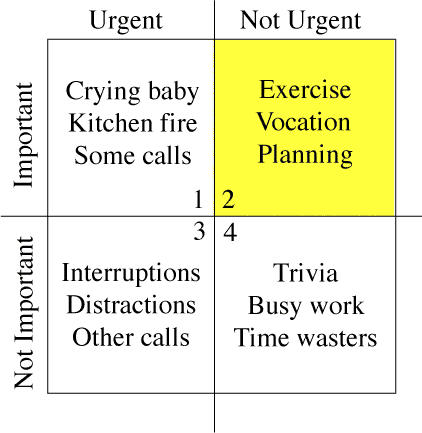
In its classic form, the matrix above helps you prioritize tasks based on their urgency and importance. However, depending on what kind of writer you are, you may want to select your ideas according to other metrics.
Think about what are the two most important factors for directing your work. These will depend on what kind of writer you are. Do you have your own writing business, write commissioned pieces for publications or content for other people’s blogs?
To help you get started on what your key factors may be, here’s a bunch of ideas:
- Personal importance
- Relevance to your audience
- Selling potential
- Your level of confidence on the topic
- Your level of motivation
- Current trends in your niche
- SEO potential
When you’ve picked two factors that are most relevant for you, use them to replace the Important and Urgent labels in the matrix above. You can also stick with the original ones or go for your own that are not on the list above. Just make sure it’s clear what they mean to you.
Then, categorize your ideas into four groups based on those labels. This will help you decide which ideas you should focus on right now — and which will benefit from some extra time to ripen.
Step 5. Be Ready to Let Go of Your Greatest Ideas
“The air is full of ideas. They are knocking you in the head all the time. You only have to know what you want, then forget it, and go about your business. Suddenly, the idea will come through. It was there all the time.” — Henry Ford
Letting go of your best ideas sounds scary, doesn’t it? The more you like what you came up with, the more attached you become. But if we accept what Henry Ford said, such attachment isn’t necessary.
Ideas are around all the time. We live in a world that’s abundant with ideas. That’s why there’s no hazard in letting some of them go.
Whenever I start clinging to any one idea, this creates unhealthy attachment and tension. I start relying on this ‘chosen one’ too much. I desperately don’t want to forget it. I start obsessing about executing it as well as humanly possible.
In this way, I’ve ruined many good ideas. I tried too hard to make them more awesome then they were. At the same time, by making the stakes so high, I attached my sense of worth as a writer to whether a particular idea would take off.
When it didn’t, this created a lot of disappointment. And I know I could’ve avoided it if only I wasn’t so attached.
That’s how I came to believe that the most important principle of idea management may be to let them go. Even if I consider an idea brilliant, in the end, it’s up to the readers to decide whether it is. So now, I always try to be prepared for all the possible outcomes of any given idea.
For this, learning to let go is the most helpful thing.
Try to see your ideas for what they are — just ideas. They don’t constitute you as a writer. They’re just one expression of your work. Remember that even the best writer can have less-than-great ideas and even the worst writer can come up with a masterpiece. The performance of any given idea doesn’t say anything about the creator directly.
Regardless of whether your idea flops or takes off, learn how to let it go and move on to the next one. Letting go and moving on are two abilities you must have if you want to stay in this writing game for longer.
To Manage Your Ideas, Learn to Honour Yourself
“The difficulty lies not so much in developing new ideas as in escaping from old ones.” — John Maynard Keynes
All great creatives share one common trait: They don’t allow themselves to get stuck in one way of thinking.
Whenever you learn something, the challenge isn’t so much in acquiring new information. It is in letting go of the old beliefs or chunks of knowledge that no longer serve you.
It works the same with ideas. You don’t have to fret about actively looking for new ones. Your mind is wired in a way that ensures you’ll never run out of ideas, as long as you’re breathing and thinking.
Instead, your job as a writer is to create space for these new ideas that are worth focusing on. This means that, sometimes, you’ll have to let go of your old ways.
A big part of a creative life is the ability to adapt. To the circumstances, to changing platforms, to audience preferences — but also, to who you have become. In the end, it’s the person behind the words who gets to ideate, execute, and manage the whole writing process.
Honour yourself and honour your journey as a writer before anything else. Without you, all the ideas we just talked about don’t even stand a chance.


