

The Powerful Investment Strategy You Didn’t Know You Need — Portfolio Rebalancing
Breaking down what Portfolio Rebalancing is; the power of this strategy; and how you can start using it too!
If later you find this article valuable, throw me some Medium love! 🥰 What you can do to support me: Claps up to 50, leave a message, highlight some text if you see fit & be sure to follow. 💌
My friend Justin has always been saving and investing. He is actually a pretty good investor: he has good investment thesis and does the necessary research before investing, his portfolio is fairly diversified, and most importantly, he is a long-term investor (aka ‘hodler’).
His investments have been doing fairly well but… not well enough to retire from his stock/crypto portfolio. What if, his portfolio could be bringing thousands of dollars more with very little additional effort?
🤔 What can Justin do?!
Most investors including Justin, and perhaps you as well, don’t do any portfolio rebalancing… but I am here to tell you that rebalancing is one of the most important investment strategies to become profitable!
First, rebalancing implies that investors have some degree of diversification. Diversification will give you exposure to assets that have different levels of return on investment and different levels of volatility.
The assets in your portfolio will not move all in tandem. Rebalancing your portfolio will allow you to capture positive volatility and profit from uptrends without the need to sell your investments entirely.
Rebalancing will not only reduce the risk of your portfolio but also help you locking in gains!
By the way, if you want to learn more about crypto investment strategies and how to build a profitable crypto portfolio, check out the Crypto Investing Expert Masterclass.
⚖️ But first, what is portfolio rebalancing?
The goal of portfolio rebalancing is to adjust the weight of the assets in the portfolio.
Let’s say we start our portfolio with 70% Bitcoin and 30% Ethereum. However, over time, one of these assets will grow more than the other, resulting in a different allocation. For example:
If Ethereum increases in price more than Bitcoin, the portfolio weight is now 50% Bitcoin and 50% Ethereum. This is a good time to rebalance!
In this article, I’m giving the “Bitcoin and Ethereum” example, but the same would apply to a portfolio composed of other cryptocurrencies, stocks, ETFs, and pretty much any other investable assets.
⚖️ So how to rebalance?
As you will soon see in this article, rebalancing your portfolio will, in most cases, improve the returns on your investment. But how can we do it?
First, select a time rebalancing time frame. You can, for example, rebalance every 3 months, 6 months or every year. We are doing annual rebalancing in our simulation, although I advise most people to rebalance more frequently.
— Initial allocation:
Let’s say that your initial allocation is 70% Bitcoin and 30% Ethereum. Say $7 000 for BTC and $3 000 for ETH. You have decided to have this allocation because of your investment thesis.
— 1 year after:
Ethereum's price went up significantly more than the Bitcoin price, and now Ethereum represents 50% of your portfolio.
— Rebalancing process:
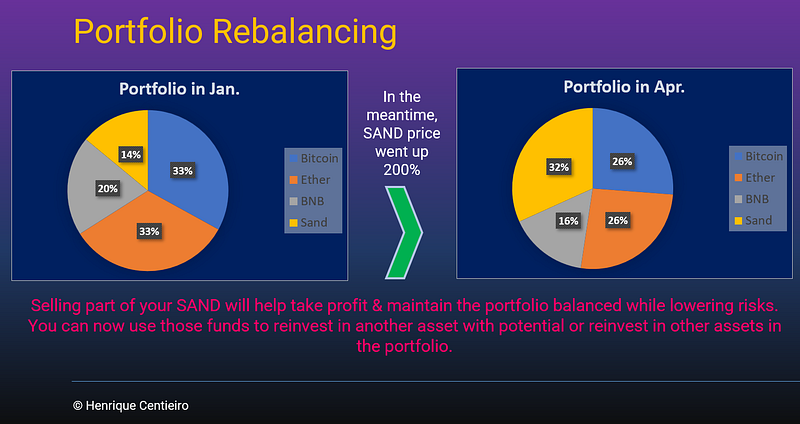
Sell some Ethereum to bring down its weight to 30%. You can use this cash either to make new investments, save, or spend.
⚖️ Why does rebalancing improve portfolio performance?
Rebalancing can be seen as a way of taking profit and locking in gains while bringing the portfolio back to your desired risk level.
In our Bitcoin and Ethereum portfolio, Ethereum is more volatile than Bitcoin, and the price appreciated faster. We will take advantage of that volatility by selling part of it to bring it down to 30%. So we lock in the profits and manage the risk. Win-win! Yay!
Another advantage of rebalancing, is the opportunity to buy low if one of the assets drops below the desired allocation. In this case, we could also sell ETH and buy BTC to bring up BTC.
📈 The TOP 50 Wisdom for Successful Investors — FREE to download 📈
⚖️ What are the practical results of rebalancing?
The results are pretty interesting!
A portfolio with annual rebalancing starting in 2017 with Bitcoin and Ethereum, would outperform the portfolio with no rebalancing for every single year!
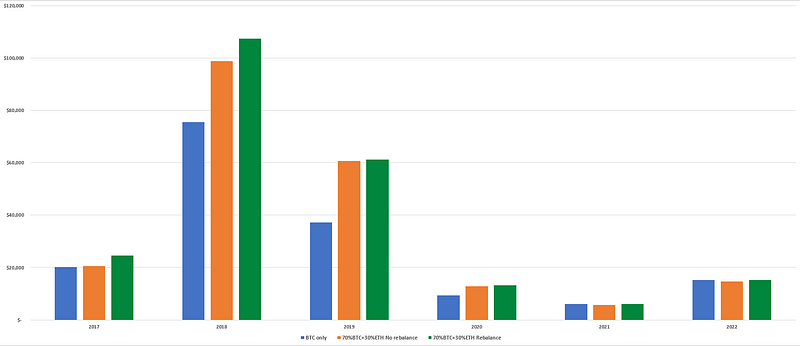
In this chart, it shows the investment performances of a $10 000 invested in 2017 until now, 2018 until now, 2019 until now, and so on.
Blue: BTC only Orange: 70% BTC + 30% ETH — No rebalancing Green: 70% BTC + 30% ETH — Rebalancing
In the 6 years that we have studied all of them, the rebalancing portfolio (Green) would be the most profitable.
Again, the reason for the rebalancing portfolio to be the most profitable is that when ETH or BTC went up, we would have to sell some, locking in gains and re-allocating the assets.
In this case, our portfolio was $7000 BTC and $3000 ETH, and you can see the final net balance for investments started in January 2017, 2018, 2019, 2020, 2021, 2022 and 2023:
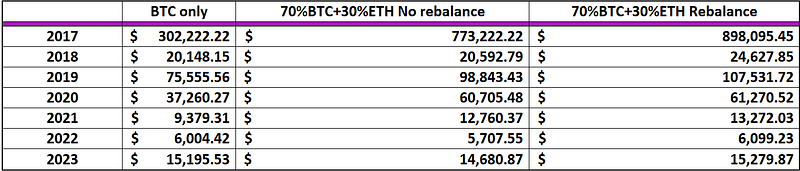
In our experiment, the rebalancing portfolio ALWAYS beats the no-rebalancing portfolio. So, did I convince you about portfolio rebalancing already? 😉
If you want to learn more crypto investment techniques, check out my Crypto Investing Expert Masterclass.
📈 The TOP 50 Wisdom for Successful Investors — FREE to download 📈
✨ Conclusion
There you have it! The magic of portfolio rebalancing isn’t just about maintaining your desired risk level, but it’s also a practical way to lock in gains and take advantage of market volatility.
By regularly adjusting your asset allocation, you’re not just passively riding the market waves — you’re actively surfing them, capturing the ups and buying low during the downs.
Our Bitcoin and Ethereum example has shown that rebalancing your portfolio can lead to improved performance year after year. It’s not just a theory, but a proven strategy backed by data.
So, are you ready to give your portfolio the rebalancing power boost it deserves? Remember: in the investment world, staying agile and adaptable isn’t just a nice-to-have — it’s a MUST-have! 🏆
If you found this article valuable, why not throw me some Medium love? 🥰 What you can do to support me: Claps up to 50, leave a message, highlight some text if you see fit & be sure to follow. 💌
🌞 Stay in touch with me:


