
The Powerful Effect of Using “Words That Work”
Subtle changes, BIG meaning
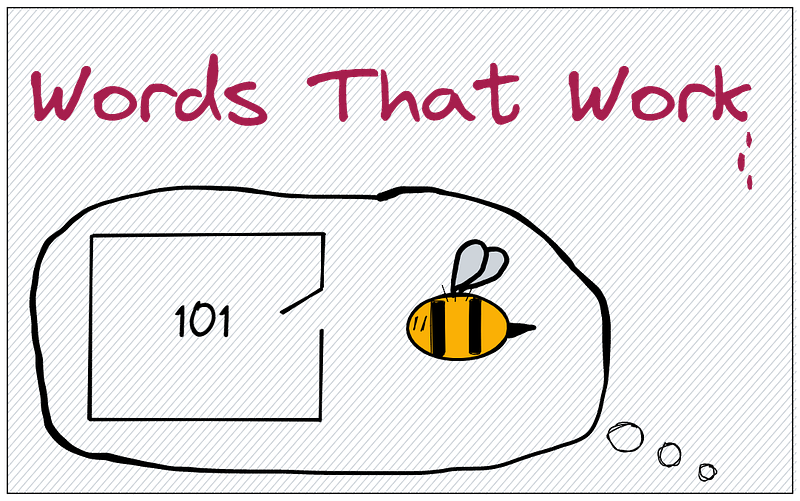
What’s your worst nightmare?
In George Orwell’s novel Nineteen Eighty-Four (1984), he introduces the brilliantly dark premise of Room 101 — AKA your literal worst nightmare. It’s described as the place where your most personal, individual horrors come true. If your greatest fear is the loss of a loved one, you might open the door to the excruciating scene of a family member or friend dying. If your fear is spiders, your Room 101 is crawling with spiders.
It’s a torture chamber is what it is. When I imagine Room 101, it starts with a faint ‘bzzt’, growing louder and louder, until yellowjackets swarm every inch of the room. I’ve got goosebumps right now just thinking about it. I can’t even imagine the terror I’d be feeling deep in my bones if it were real. And yet when you or anyone else reads 1984, you imagine an entirely different Room 101.
The idea of Room 101 has been said to be one of the most horrifying and imaginative concepts ever put on paper, mainly because it encourages you to visualize your own Room 101. Interestingly enough, the movie version of 1984 fails to deliver the same emotional impact as the written version. Any guesses why? It’s because it denies the audience the most powerful element of Room 101 — your own imagination. Once you physically see the room, it’s no longer your fantasy. It’s someone else’s.
As a writer, I’m always striving to make an impact with my words. Impact is the single, most important indicator of “good” writing. A well-written piece always leaves some sort of impact — whether emotional, motivational, or other — on its reader. Even if you hate or disagree with what the author is trying to say, if his or her words left a lasting impact on you, give credit where it’s due.
In my neverending quest to improve my ability to make an impact, I came across Dr. Frank Luntz’s book, Words That Work. Luntz believes that words, when chosen carefully and tactfully, have the power to affect things like what you buy, who you vote for, and even what you believe in.
His favorite example of “words that work”, as you might’ve guessed, is George Orwell’s literary usage of Room 101. On paper, it’s shocking how impactful it is to the reader. The words just work. But change the medium to film and much of that impact is lost.
“Words that work, whether fiction or reality, not only explain but also motivate. They cause you to think as well as act. They trigger emotion as well as understanding. Just as a fictional work’s meaning may transcend authorial intention, so every message that you bring into the world is subject to the interpretations and emotions of the people who receive it. Once the words leave your lips, they no longer belong to you.
We have a monopoly only on our own thoughts. The act of speaking is not a conquest, but a surrender. When we open our mouths, we are sharing with the world — and the world inevitably interprets, indeed sometimes shifts and distorts, our original meaning.” — Dr. Frank Luntz
Luntz is now the proud owner of my new favorite quote of all time. “The act of speaking is not a conquest, but a surrender.” And it touches on a key concept that all writers (and communicators) should intimately understand. What this means is that no matter what you THINK you’re trying to say through your writing, the only message that actually matters is the one that the reader extracts.
In the case of Room 101, the message is meant to be a worst-case, self-generated figment of your own imagination. It’s meant to spark disambiguation*. But no amount of disambiguation (the word is quite fun to say) zeroes in on one clear interpretation, which is precisely what Orwell intended. The impact comes in the individualization of the concept.
But most writing and communication isn’t meant to be ambiguous. At least in most of the non-fiction writing that I do, I as the author have a clear, intended message that I want to convey — ergo the impact that I’m going for is largely dependent upon the specific words that I choose. One misstep or oversight and the message could be refracted.
Of course, I can’t control how my writing is perceived 100% of the time, but it helps to take a step back and put myself into my reader’s shoes, which is what I’ve been trying to do more of lately in order to create the desired impact. Basically, I’m aiming for fewer cases of, “hey, that’s not what I was trying to say!”
In Luntz-speak, “use words that work”.
*For those like myself who had no idea what ‘disambiguation’ meant before this article, it’s defined as the act of interpreting an author’s intended use of a word that has multiple meanings or spellings.


