
The Power of Science to Take Us From Fear to Joy: Part II
How The Field of Epigenetics Empowers Us To Change Our Thinking For The Better
In Part 1 of this article series on using science to rid ourselves of our fears and move towards more joyful lives, I highlighted the key ways that understanding Neuroscience can empower us.
Now we are onto the field of Epigenetics. This is a slightly revised and shortened version of an article I wrote on this topic previously.
EPI-WHAT? The field of epigenetics (literally meaning “beyond/above” the gene) studies how chemical reactions alter the expression of our genes.
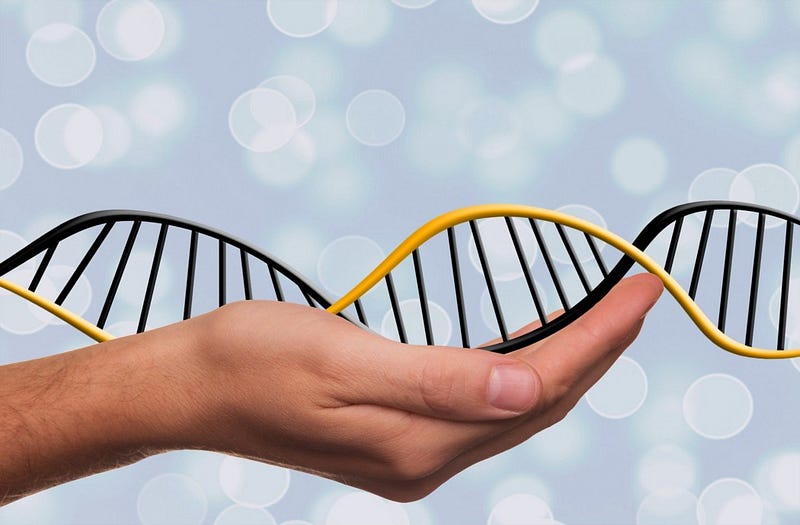
The human genome is estimated to have between 20,000–25,000 genes. Genes are the building block of proteins, which are the building block of our cells. Even though our genes were passed down to us by our ancestors, the effect they have on our health is not fixed. The expression of one particular gene can vary enormously. A gene that is active can be deactivated and deactivated genes can become active.
How does this happen? Through the interactions of our cells and our environment. The outsides of our cell membranes contain receptor proteins that provide an awareness of environmental signals. Information coming in from the environment is passed from the receptor proteins to effector proteins which convert the incoming signal into the behavioral language of biology.
The environment of the cells reaches beyond just our external environment (nutrition, exercise, physical surroundings). What we could call our “internal environment (thoughts, beliefs, emotions)” is still an external environment for our cells! This highlights the power we have over our lives, including our health.
The main finding of epigenetics is that our health is determined not only by our genetics and external environment but also our internal environment.
FROM EMOTION TO PHYSICAL WELL-BEING
Chemical reactions alter the expression of our genes. Emotions are chemical reactions. Whether negative or positive, we feel the unique concoction of these chemicals flow through our system and thus experience their affect on our mental and physical well-being.
The energetic imprint of our thoughts results in emotions that trigger a cascade of physical sensations at all levels of the body’s systems. I hypothesize that this could be explained on a deeper level if science further investigates the correlation between the electric charge present during certain emotional states and the effect of that electric charge on the production of proteins within a cell. Electrons make up the atoms that make up the protein molecules which then make up our cells. It is from the subatomic level that chemical reactions ultimately spring forth.
Since the chemical reactions we know as emotions “become” our experience and since emotions are driven by where we place our mental focus, we can work backwards to change our experience by changing where we focus our attention.
UNLEARNING UNNECESSARY & IRRATIONAL FEAR RESPONSES
Our conditioning affects our physiology — even through generations. Our nurture thus eventually becomes our nature.
Genes are the physical memories of our learned experiences.
If we are continually exposed to a certain stimulus (through experience or information), it will become engrained in our long-term memory. If the memory is strong enough, the brain may deem it to be important enough to get passed down to future generations.
“In a study performed at Emory University in 2014, researchers used fear conditioning to study the impact it had on future generations. The study trained male mice to fear a particular scent called acetophenone by exposing them to the smell before introducing small electric shocks. The animals soon learned to associate the smell with pain and exhibited fear responses even without the electroshock. This reaction was passed down to the mice’s children and even their grandchildren despite those generations never being exposed to the electroshock.” https://www.whatisepigenetics.com/scarred-for-life-the-epigenetics-of-fear/
The conditioned learning process strengthens neural pathways between a stimulus and a response to ensure a repetitive pattern. In lower animals, the entire brain is designed to engage in purely habitual responses to stimuli. The most primal energy flow is the survival instinct — thus our learned fears cause us to habitually engage in limiting behaviors!
Even if we, ourselves have never been exposed to the particular situation that initially evoked a fear in our ancestors, we nevertheless feel the fear as if it was our own.
Our cells naturally exhibit the behavior of gravitating towards nutrients and away from threats. When we live in a protective “survival” mode, we reduce the energy available for growth. Reducing life’s stressors is important, but it is just as essential to actively create joyful, loving, and fulfilling lifestyles that stimulate growth processes.
But we have the power to change this by changing how we condition ourselves — we can reprogram our thinking and thus reprogram our genes!
REPROGRAMING OUR THINKING
When we believe that we do not have control over our health, we indeed become victims to our heredity and our external environment.
We are not yet used to using the power of our minds to control our internal environment and positively affect our health.
Many people are not conscious of the fact that their feelings about themselves and the world around them affect their daily actions and habits. We often attempt to change our actions and habits on the external level without changing the thoughts that caused them in the first place. But if we don’t address the root cause of those disempowering habits and behaviors, we find ourselves facing the same blocks as before.
The more we continue to learn about the effect of our thinking on the expression of our genes, the more we can keep empowering one another to see the abundance and beauty of life even as we learn to let go of our fears.
Dr. Bruce Lipton offers a wonderful and more detailed explanation of how thoughts affect our cells in his book “Biology of Belief.”
“Less than 1% of disease is associated with genetics. Over 90% of disease is a total reflection of environment and especially our programming: the disempowering, self-sabotaging behaviors that we acquired in the first 7 years. Since those disempowering programs are based on our environment and our perception, and since we can change the environment and our perception, we have the power to free ourselves from disease and to start living that happily-ever-after honeymoon of life experiences that we all believe that we can have.”
— Dr. Bruce Lipton
Our thought, beliefs, and perceptions matter — literally. Down to the physical scale of our cells, we have the power to change our thinking and thus our experience for the better!


