
The Power Of Product Opportunity Trees
A core part of the Product Manager role is to be the central intake of information.
You are constantly talking to:
- Customers — what do they need and want
- Stakeholders — Where can you best help reach their goals
- Leadership — What’s coming down the pipe
- Your Team — How can we best scale the product to solve problems
And so many more!
This can become extremely overwhelming if you don’t have a good way to collect that information. All too often, the loudest issue becomes the highest priority, even when it may not be the most valuable or important to the business.
You need a way to cut through the noise and clearly outline what you know, what you don’t know and what next steps look like.
One way is with Product Opportunity Trees. This is a practice created by Teresa Torres that focuses your team on delivering a desired outcome and then listing out the opportunities that can drive to delivering it.
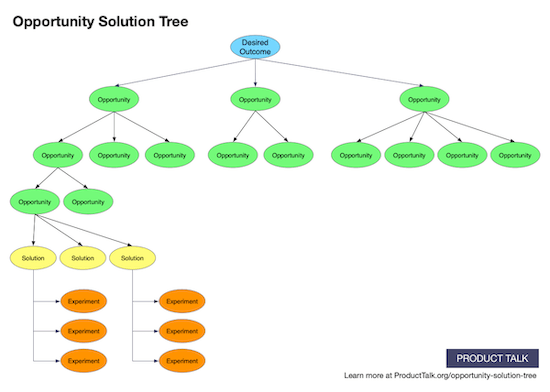
I am far from an expert at Opportunity Trees, it’s certainly a skill that you have to practice to master. But it has some tremendous benefits to you and your team.
When to Use a Product Opportunity Tree
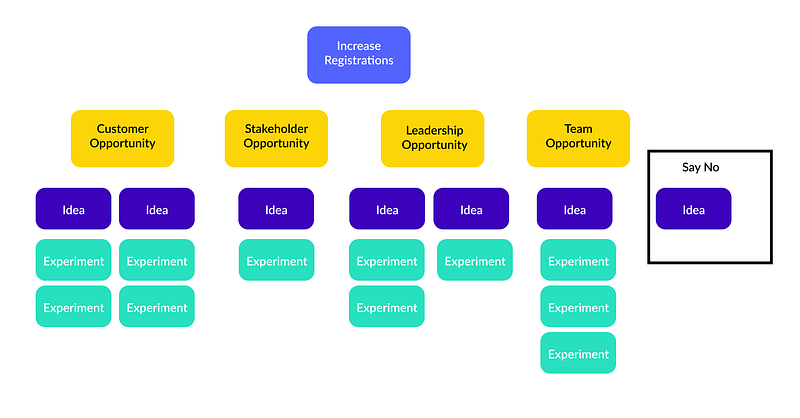
I’ve found it extremely helpful to use opportunity trees when moving into a new problem space.
Whenever you’re tackling a new problem, you’re in heavy discovery mode and learning faster than ever.
For example, imagine your desired outcome is to Increase Registrations to your product. You’ll start talking to multiple users and stakeholders to uncover opportunities to drive this outcome. And believe me, everyone will have ideas!
It can be hard to put all that learning into notes or a Miro board in a way that makes sense to anyone other than yourself.
Using an opportunity tree can help you to categorize what you are learning, who are you learning it from and how it rolls up to your desired outcome.
It can also highlight opportunities or ideas that are great to note, but don’t contribute to your outcome. These are the places where you can say “no” or prioritize at a later time.
You can also use opportunity trees to evaluate an existing product. Is it still solving the right problems and driving towards your desired outcome?
Going through and outlining the opportunities still left to solve can be a great motivator for your product team and get them excited about pushing more on an established product or workflow.
Benefits of a Product Opportunity Tree
There are a lot of benefits to using an opportunity tree. Here are a few I’ve found:
- Clear your brain — You’ll burn out if you try to keep all this information in your head. Putting everything into fun, colorful boxes gives your head a break, makes you feel super productive and helps you see where you need to focus your time to drive towards the desired outcome.
- Realize where you can say “No” — This is a tough part of Product Management but vital to keep you and your team from spiraling out of control. When you organize your opportunities and connect the ones that lead to your desired outcome, you’ll also notice quite a few that don’t connect. Those are the ones you can easily say “no” and clearly explain why.
- Focus on opportunities — One of the core lessons of using an opportunity tree is focusing less on solutions. We all LOVE to talk about solutions, come on we’re problem solvers right? But when you focus on the solution, it’s easy to fall in love with it. By focusing on opportunities, you force yourself to come up with multiple solutions and then put them into tests to find the very best one.
- It’s great for communication — You ever wonder if you’re doing a good job communicating out all the amazing things you’re learning each day? Use an opportunity tree. This is a great tool to show all the different parts of your problem space, where your team is spending time and why.
- It’s helpful for prioritization — If your manager or stakeholders want to weigh in on what your team should be focused on, show them the opportunity tree. Let them help you organize it based on what will bring in the most value and how you can structure experiments to prove it. It can also back up why you aren’t focused on something that may be ‘loud' at the time.
Have you ever tried using Product Opportunity Trees to organize your discovery and team’s work? How did it go?