
The Power of Print: magazines in my hands
Will we get the same sense of wonder from an iPad or iPhone?

I saw the titles JP Magazine and Petersen’s Four Wheel and Off Road, and all of a sudden, I was 11 years old again. My eyes stuck on my phone, thinking about the countless hours spent daydreaming in my bedroom on Weaver Road about all the important issues of adolescence — sports, four-wheel drives, and girls. My favorite things growing up came to me either weekly or monthly in a magazine and, staring at my phone, I was forced to remember.
My Dad had his own dental practice and always had magazines for people to read in his waiting room. Every day after school, if I was trapped inside by the Western Oregon Omnipresent Rainfall, I would sit in his waiting room and read his magazines until he was off work and we could go home. When new ones showed up, I would take the old magazines home and memorize every page. We lived way out in the country at the end of five miles of dirt road and I only had three TV channels my entire life, if the weather was clear and conditions were good. I stayed up-to-date with Jeeps and sports from Peterson’s 4 Wheel and Off Road, Four Wheeler, JP, and Sports Illustrated. Instead of watching MTV like most kids I knew, I read magazines. Instead of reading novels like my teachers pushed me to, I read magazines. Instead of pretty much anything else, I read magazines. I remember reading magazines for most of my childhood and I’m pretty sure I wouldn’t be the same person I am now without them.

I always read the last page of Sports Illustrated first: “The Life of Reilly” by Rick Reilly. Reilly is still one of my favorite authors and I credit him with creating a love for non-fiction in me that I didn’t know was possible. Dreaming about being featured in Sports Illustrated took up most of my day-dreaming time. I loved reading the background and history of athletes and what they had to overcome to be at the top of their games.
I would daydream my future story, laying out my prep accomplishments at South Umpqua High School and my college successes at Penn State before excelling in the NFL, MLB, and NBA for many a year. I didn’t know it at the time, but my career as a high school English teacher and football coach was being laid out for me, brick by brick and touchdown after touchdown. I cannot imagine my childhood without these magazines in it and am in awe at the debt I owe my Mom and Dad for always keeping those subscriptions. They saw early on how much I enjoyed them and every year I could count on a Sports Illustrated or Four Wheeler subscription as a birthday or Christmas present. I vividly remember the odd paradox of how uncool — but totally cool — it was when the subscription started showing up in my name.
After the last page of Sports Illustrated, I loved “Reader’s Rigs” in the off-road magazines. The rest of my daydreaming time would be spent dreaming about my “talk about Jeeps” being in a magazine someday. A “talk about Jeep” was — and still is — the Jeep I am currently building in my head. It consists of winning the lottery, using all the daydreaming and actual working-on-rig experiences I have wasted, and creating the coolest rig possible. My dad and I still discuss our “talk about rigs.” My friends and I also spend a lot of our adult daydreaming time engaged with “talk about rigs.” However, growing up, I dreamed of having a rig on the cover of the magazine. Now that I’m older, I have had friends with rigs in magazines, including my buddy Howard’s Jeep, which was even a cover rig on Four Wheel and Off Road. I remember when that edition came out, and Howard went to several stores and bought every magazine they had. He still has about 20 copies of that magazine. My Dad has had several Jeeps in magazines, but I still have to sustain myself with daydreaming as, alas, I still haven’t got a rig in a magazine.
And now, as I stared into the Twittersphere on my phone, I realized I was to blame for what I saw. MotorTrend President and General Manager Alex Warren sent a memo on December 9th, 2019, that TEN Publishing would no longer publish 19 different magazine publications. As I looked at the list, 4-Wheel and Off Road and JP seemed to be highlighted. I couldn’t move my eyes past them. How was it possible that something so vivid, so much a part of my life growing up, wouldn’t be available for others?
I noticed other titles that I can remember seeing while standing in front of the wooden magazine stands in supermarkets. A niche publication for every little niche car group: Car Craft, Diesel Power, Low Rider, Mopar Muscle, Street Rider, Truckin. I thought back to the early 90s, and my generation’s desire for low riders and street performance rigs. I can remember teachers’ exasperated looks at my friend Luke when being told once again to put away the magazine and pay attention in class. Once my eyes were able to move past the names on the list, I began reading the entire article for context. Warren, the Motor Trend President, stated that the magazines would still be available in a digital format. As I read this, I had a horrifying moment of clarity from Christmas a couple of years ago.
I had been given a new iPad for Christmas from my family. It was shiny and new and had lots of flashing lights, and as I learned about it, I found that JP Magazine had a free online subscription. I installed it on the iPad and spent many an evening looking at shiny Jeeps on my shiny, new iPad. Soon, the magazines stopped coming because I hadn’t renewed my print subscription. To tell the truth, I’m not even sure when this happened. It just happened. Soon, like lots of shiny, new toys that lose their Christmas luster in the glow of Valentine’s candy, I didn’t really use my iPad anymore. And now, the magazines won’t come to anyone’s house anymore.
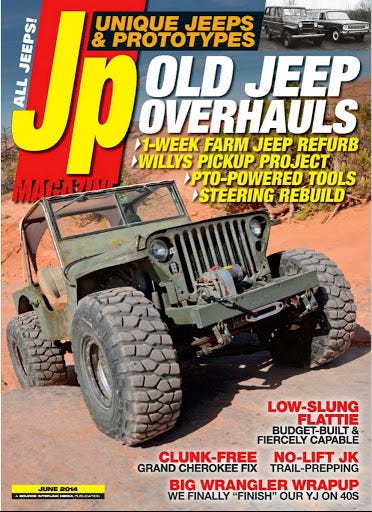
Even if I don’t know when the magazines stopped coming to my house, I can look up when they started. JP Magazine lists 1996 as its birthday and Rick Pewe, the original editor and someone who has been involved with the magazine for its 25-year history, addressed the end of an era in his article “The End of an Era: Jp Magazine Ceases Print Publication.” Pewe states that the last print edition is the March 2020 edition, but even I am too late getting to that deadline for submitting this essay: the March 2020 issue went on sale before Christmas. It’s too bad, because one of his lines in the article resonates with me about why I am even writing this essay in the first place. Pewe asks “As a youngster, did you flip through dad’s or grandpa’s well-worn issues of Jp Magazine?” That question haunts me, since I won’t be able to flip through them again, and more importantly, neither will my son or my grandson or anyone else’s sons or grandsons.
Again, the VCR in my mind starts playing. Rick Pewe is a guy I kind of know. I didn’t meet him, but he was in Idaho in 2006 during the 4-Wheel and Off-Road Ultimate Adventure. The UA’s first stop that year was in Boise, Idaho, and Pewe paired with Idaho Off Road, a local 4-Wheel Drive club and ran a trail. (Side note: on the video, IOR lied about the name of the trail and called it Rattlesnake Alley to keep people from finding that trail. It is one of my favorite trails and I think about the video every time I run it. You can Google 2006 Ultimate Adventure and watch the Youtube video of that day. But I digress, because this is an essay about print publications.) My now-friend, Howard, who’s Jeep was on the cover of the magazine, was the President of Idaho Off Road. I read the publication of the story in 4 Wheel and Off-Road, and watched the show air on TV, and in 2007 became a member of Idaho Off Road. Without this magazine, I wouldn’t be sitting here, 13 years later, as a current friend with Howard and a former President myself of Idaho Off Road.
I turn off the VCR and return to the digital research at hand: 4-Wheel and Off Road. The history of this magazine is deeper and longer than Jp Magazine, and one piece of evidence jumps out at me: 4 Wheel and Off Road started in 1977. I started in 1976. In the article “1977–2007 Timeline 4 Wheel and Off-Road magazine- Our First 3 Decades,” the first line mentions Star Wars and Smokey and the Bandit. I love Star Wars and Smokey and the Bandit and this essay is playing my song! I am the same age as this magazine. When I state that I grew up with it, I mean it! I have been reading it for all my 43 years, even if I probably just looked at pictures for the first 10 or 20 years.
Lee Kelley, the director of the Hot Rod group that created 4 Wheel and Off-Road, is to blame for the rather descriptive but understated and clunky magazine title. He was filling out the paperwork for the company and the magazine didn’t have a name yet. As he filled out that proforma paperwork, he “described it as ‘a Petersen 4-Wheel and Off-Road magazine’ with a title to be suggested later. The legal folks ran with the proforma and trademarked the name. It was awkward, but descriptive, and so we were off.” As much as I write “Boring Title” on students’ English essays, maybe I better rethink this tactic. It seems like this boring, clunky title has worked for the last 44 years.
I did actually read the articles, but I spent a lot of time looking at the pictures in magazines, too. As I researched this topic, I realized that sometimes the pictures in a magazine are what an issue focuses on. SI’s first issue was August 16, 1954. SI’s first swimsuit issue was February 1964. My Mom and I’s first fight about the Swimsuit issue was February 1986 or thereabouts, and I didn’t know it at the time, but it was the basis of a fight that has been happening since 1964 and continues today. I don’t fight with my Mom as much about it now, but I’m sure she would if I brought up the subject (or if she reads this essay).
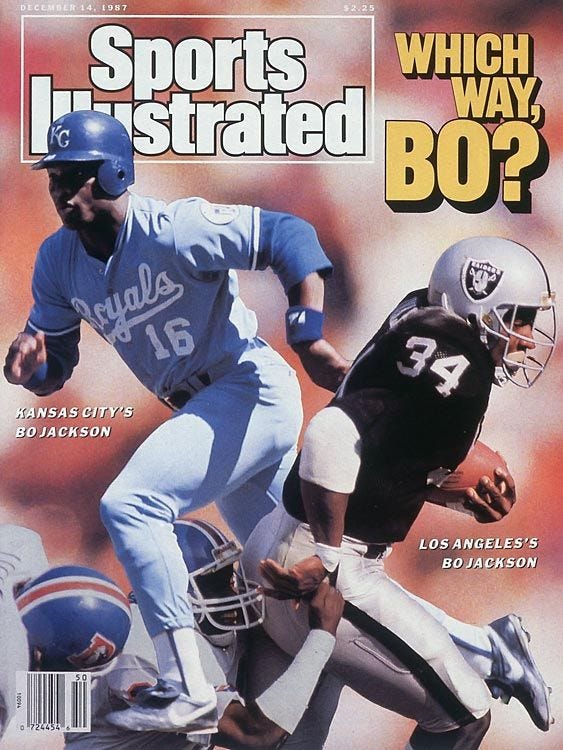
Sports Illustrated is still available in a print edition today. Henry Luce is the person credited as the driving force behind the magazine, even though he wasn’t a sports fan. He did, however, see an incredible opportunistic void in the media — he did not feel that America’s growing love of sports was being taken advantage of. He was right. However, the staff at Time magazine, where Luce came from, hated this new idea and “nicknamed the magazine ‘Jockstrap’ and ‘Sweat Socks’ — and they tried to talk him out of it.”
The magazine lost money for six years, but in 1960 hired Andre Laguerre as managing editor. Laguerre did three things that cemented Sports Illustrated into popular American lexicon, according to Bruce Kauffman, a syndicated columnist: He hired Frank Deford and Dan Jenkins as writers and was “among the first to understand the potential popularity of football.” As I write this on the Friday before the Super Bowl, I think about Laguerre’s foresight to see the money and the marketing of football before anyone else did.
But my Mom’s protesting to my Dad about my Sports Illustrated subscription, and the fight about “you know EXACTLY what I’m talking about,” returns me to the past and present. According to Kauffman, the swimsuit edition is SI’s most popular issue. Every year. It is also its most controversial for exploiting women. Every year, thousands of readers cancel their subscription due to the swimsuits. SI now offers an answer for people — you can skip the swimsuit edition and get a one issue credit. My Mom had her own pre-teen and teenager answer and it didn’t involve a one issue credit. She intercepted the SI swimsuit issue until I was old enough — which reminds me, I need to ask her when that is.
And after 2000 words, I am right back where I started: I feel guilty that I let my subscriptions lapse. I am telling myself that I am going to get off my digital butt and order a print version of Sports Illustrated and Four Wheeler since they are still available. No, not just for that ONE issue. I’m feeling nostalgic thinking about all the awesome magazine reading I did, but I feel afraid as I watch my students grab their phones at the end of class and bury their faces in them. I wonder what they will remember about their daydreams and their goals and ambitions from their childhood bedrooms. In 30 years, will they remember the power of the Youtube video or Netflix show they just watched?