
CONNECTING ORGANIZATIONAL VISION TO PRODUCT STORIES WITH
The Power Of Outcomes
Power of a solution lies in the outcomes and not the outputs.

Beauty of the dream lies in the eyes of the believer. A vision is just that — a dream. A dream with a believer!

As a believer, I am there in my dream and play a role. That role is my mission.

I want to win in my role but how? That’s the strategy — all about winning.

I have a role and know how to win but what to accomplish? Put other way, what are my goals? We call them objectives.

Those claps along the way show me the path to my goals/objectives. They build the nerves and are called key results.

Next step in the build chain is for the leaders to launch activities in order to describe what is needed to achieve the key results. These activities are termed as initiatives.
Product managers — there you go! Make the vision a reality. Product managers break the initiatives into smaller features (tangible or intangible benefits) while talking to the customers (outside-in product development). Desirability and feasibility analysis are performed in collaboration with user experience/design and technology leads.

Finally comes the entire team who is so screaming to build. Team break down the features into smaller chunks that are called user stories. Team get them all, few at a time, in time-boxed increments, called a sprint or iteration.
We just navigated through the entire chain above all the way from vision to the product stories level. I call this chain as ‘Organization build chain’.
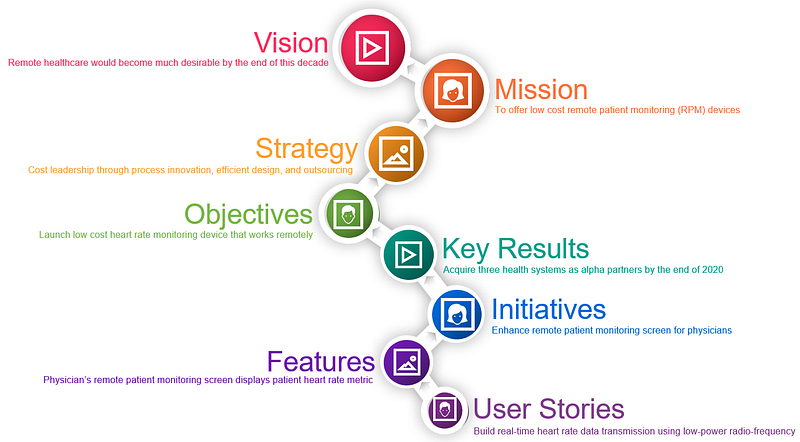
An application of the organization build chain is shown below. I packaged it in a healthcare setting as couldn’t think of any bigger /better priority now a days.
Early in my career, I often used to think why does it take so long to build anything of real value in an organization. I had a limited visibility during that time and so I didn’t understand the importance of alignment towards the ultimate mission. As an organization becomes bigger, the alignment becomes harder. This is where ‘values’ or ‘core values’ come to the rescue.

Core values guide our character and shape the culture of the company. One of my favorite core values is ‘Act like an owner’. Culture can make or break things and are vital for running a business. To summarize, core values keep everything glued to the organization build chain.
At last…

Story inspired by ‘Strategize: Product Strategy and Product Roadmap Practices for the Digital Age’, Roman Pichler, Pichler Consulting
Thank you very much for your valuable time reading this!
If the above story format was helpful, please let me know via the comments section below.


