
The power of making mistakes
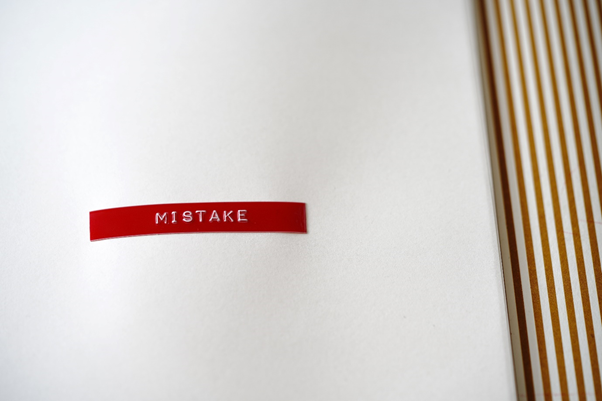
Do you ever admit to your mistakes?
I must admit the only reason I thought about this subject was upon rereading an already published article of mine. To my shock and horror, I found a myriad of mistakes peppered throughout. I felt embarrassed. “How could I be so stupid! These are such basic errors.” I could hear my inner voice shouting at me. All I wanted to do was to take it down, fix it and then hind, but something stopped me from doing that. I remembered watching a video (it might have been a Ted talk) with an ex-navy SEAL as the speaker. Throughout his talk, one phrase jumped out at me “own your mistakes”.
Our mistakes are lessons through which we can learn. And that got me thinking, how often do we make mistakes and never own up to them, whether be that to someone else or to ourselves? It feels so unnatural to admit to our mistakes. It is so much easier to hide from them and tell no one. What a missed opportunity.
“The only real mistake is the one from which we learn nothing.”–John Powell.
After the initial shock wore off, I thought “how can I own this mistake?” Which led me to ask myself three questions; what causes us to make mistakes? Why are we afraid of making mistakes? And what is there to gain from our mistakes? All the answers to these questions are relative within the context of the mistake.
What causes us to make mistakes?
What I found self-examining is; I make mistakes when either one or all three of the following factors are in play: Speed, overconfidence, and the level of understanding present.
Speed, and I not talking about the drug, (though I’m sure that would be a cause of many mistakes). The speed that I’m referring to is in the context of being in a hurry. I’m sure we all have moments when pressure was piled on us; a looming deadline or meeting a quota. Or the pressures of life; having to be in two places at once, doing the shopping or meeting up with friends or whatever else might be scratching at our doors. The quicker we are asked to process information and decide the greater the probability of a mistake. There is only so much that our brain can process within a given period. It is better to take your time doing one thing and doing it well, then to try to do many quick and make many mistakes.
Overconfidence, the “I know what I’m doing” cliché. This phrase need not be a false statement. Overconfidence goes hand in hand with a loss of focus. When you keep your eye off the ball… you tend to drop it! No matter how good of a baseball player you are. It’s difficult to see yourself being overconfident when complacency sets in.
Imagine the route you take to and from work, day in day out, you know that route like the back of your hand. You become complacent; you pay less attention to the road; you speed up. You take the next corner and BAM! Suddenly! A dog jumps in the road. You have milliseconds to react! Whatever happens is a direct consequence of your overconfidence in predicting the route.
Overconfidence leads to complacency which, leads to loss of focus resulting in a mistake. And that’s exactly what happened with my article, I got complacent. You are never too good to make a mistake, use more humility and reduce your complacency.
The level of understanding, it does not matter whether you know a lot or know a little. Mistakes take place at any level of understanding, be it novice or master, none are safe from mistakes. Novice makes mistakes as a result of knowing too little and masters make mistakes as a result of knowing too much. The more you know the less you remember, the less you remember, the more likely you are to make a mistake. Mistakes are inevitable, no matter the level of understanding. Here repetition is key for all, always go back to the fundamentals.
I left out ‘pressure’ as a factor. The reason being pressure is more of a sensation derived from the three factors, then a factor in of itself. Some people work very well in high-pressure environments, rather than making mistakes their focus increases. All of this being said and done, it would rarely be a single factor that causes you to make a misstep, it’ll most likely be a mixture of all the factors (plus more).
Why do we fear making mistakes?
The answer is very extensive and complicated. A simple way I like to look at it is that our fear is rooted in rational and irrational thoughts. The rational fear of mistakes tends to be linked to high-risk situations (commanding soldiers in a battlefield or high-stake investment broker). Under high-risk situations the impact of making a mistake curries high psychological and sociological impact. If a stockbroker makes a mistake with the investor’s funds the consequences could be disastrous (a ruined career or worse). The fear would be rational under these circumstances.
Irrational fear of mistakes tends to be linked to safer situations, where the impact of the mistake curry limited consequences such as a classroom or website (though this is relative to the context). Under these conditions, the consequences of a mistake impact you more than anyone else. It’s irrational as you have ‘control’ over our mistake. For example, in a classroom of students, a student might be afraid to answer a question due to the fear of making a mistake and being ridiculed by his/her peers. However, the fear is irrational as the mistake happened in a ‘safe’ environment wherein the consequences of the mistake would lead to gains in knowledge. So, it would be irrational to fear the mistake as the gain surpass the consequences.
That being said, there is a story that I would like to share, that somewhat adds empathy into the irrational argument. (I’m paraphrasing from a video I once saw)
A math teacher starts his class by running the students through their times’ tables. The teacher begins with the 1 times table goes all the way to 12 and then move to the 2 and so on… as the class moves through the equations; they spot a mistake and immediately make noise. Some students start to laugh, others try to get the teacher’s attention, however, he continued till he reached the end. After he had finished, he turns around and asked the students to tell him what they can see. As you can imagine all the students point at the one mistake on the board. He smiled at the class and spoke: “from all of my correct answers, you can only see my mistake”. The class fell silent, and the teacher continued; “in life, people rarely praise us for our achievements as much as they point out our mistakes.”
Even though I’ve argued that irrational fear of mistakes, is irrational due to the benefits you can gain. There is still a psychological and sociological impact invoked by the mistake (peer ridicule, the feeling of inadequacy, a sense of humiliation). Our natural response to making mistakes; is to fear them, to avoid them, to hide from them. We do this in an attempt to reduce their impact. What we often cannot see; fear is only present inside us and thus up to us to overcome it. ‘own your mistake’, accept them and sociality will tend to do the same.
“Mistakes are always forgivable if one has the courage to admit them,” — Bruce Lee
What can we get from our mistakes?
All mistakes hold lessons from which we can learn. In my case, I learn four lessons.
Don’t rush! Slow and steady wins the race, take the time to stay focus on the take at hand. Though it may seem like nothing is being done (in the short-term) in the long-term you gain a lot.
Read through what you write and that does not mean read it once; read it over and over. Walk away and come back (let your mind clear) and if possible, get someone else to read it.
Go over the fundamentals, in my case go over the fundaments of grammar, don’t think you are too good or that it’s beneath you. If you go over the basics, you will improve the advance.
Don’t be afraid of making a mistake, ‘own it’ learn from it. You always have something to gain from a mistake whether it is a small gain or a large gain.
“The greatest mistakes a man can ever make is to be afraid of making one.” -Elbert Hubbard
All of this was just my thought progress, it wasn’t back by any research or study. Please feel free to give me your feedback, your thought on this subject.


