
Food for thought
The Power of Letting Go
These Simple Words Can Change How You Think About The Past — Nietzsche
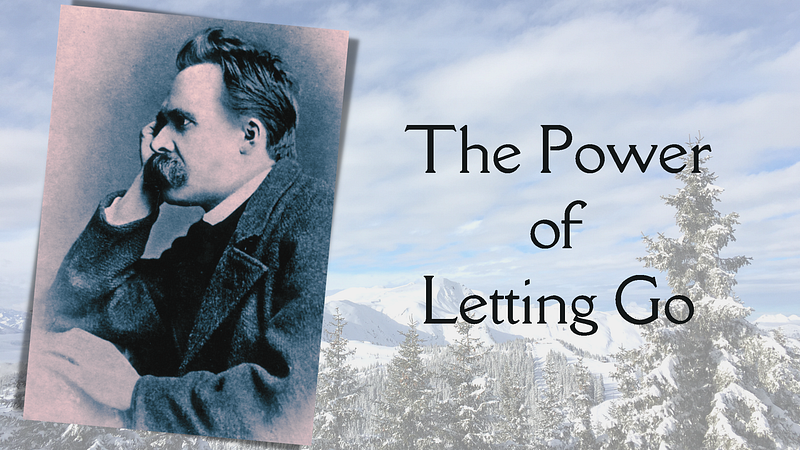
If right now you were told that you would relive this life exactly how it has gone and exactly how it will go, with all its ups and downs, fortunes and tragedies, pleasures and pains, over and over for eternity, what would you think? Would you be terrified? Would you want to change it? Or, would you be emboldened by the knowledge that there’s no way out?
In ‘Thus Spoke Zarathustra’, a fictionalized embodiment of Nietzsche’s work on the subject of eternal recurrence, the protagonist finds himself in a unique situation. After walking up a mountain and finding a large stone with the words “God is dead” carved into it, he has a vision. In this vision, he sees everything that has happened and everything that will happen and soon realizes that every action he takes will be repeated over and over again in an endless cycle of cause and effect. There is no purpose or meaning to life: every action is played out for all eternity.
This unique, personal revelation is spread throughout the work to create a sense of impending doom and foreboding. But how are we supposed to react? What will we do when we realize that the future is predetermined and our circumstances are completely out of our control?
-“Who would want to experience all this endless repetition?” the protagonist asks. -“Man, who could bear it,” Zarathustra replies.
It’s difficult to imagine what a person would do with this knowledge. The only answer Nietzsche offers is that we must accept this as an “eternal return”, as death has no meaning and every action in life takes place in a pre-determined and unchangeable pattern. This is difficult to accept but it’s the only answer Nietzsche offers. We must learn to adapt and overcome.
Despite the unique and frightening nature of this idea, part of Nietzsche’s point is that it creates a sense of calm. As long as the individual is aware that their life is predetermined, there is no reason to fight against the current of destiny. Instead, one can focus on what they want to achieve in life and eliminate those things that do not lead to the fulfillment of their own personal desires.
By accepting one’s past mistakes and failures as preordained phenomena, one can eliminate the fear of failure that results from worrying about an unpredictable future. This allows for a serene mind free from distress and worry.
By accepting our past we become empowered by it as well. We can use the lessons we’ve learned to make decisions for our future. Acceptance is what allows us to appreciate life, take action and learn from our past to improve the future.
Amor fati is an incredibly positive gift that Nietzsche offers. By accepting the past and the future, we can make the most of our lives by focusing on what we can control while letting go of what we can’t. Nietzsche’s beloved idea encourages us to take advantage of our lives without worrying about things that are out of our control. It’s a relief to know that our destiny is already inscribed.
This simple idea can change how you think about the future, the past, and everything in between.
When one isn't afraid of the future, the past and present are so much more tangible. With the knowledge that all actions are predetermined, one is able to calm their anxiety and appreciate what they have done. Knowing that nothing can be changed eliminates the regret that comes with knowing how your life could have turned out differently. One cannot resist this feeling because it cannot be resisted; it is inevitable just as every action you take will be inevitable too. This can create a sense of serenity and tranquility in anyone who has accepted this truth while simultaneously inspiring one to make the most of their lives by living in accordance with their own desires and ideals instead of those imposed on them by others.
There is nothing left for me to say that Nietzsche hasn’t already said himself: “One repays a teacher badly if one remains only a pupil. What does our gratitude mean if it is not the aspiration to remove their landmarks.”
If you enjoy reading stories like these and want to support me as a writer, consider signing up to become a Medium member. It’s $5 a month, giving you unlimited access to stories on Medium. If you sign up using my link, I’ll earn a small commission. Click here


