
The Power of Keeping Things Stupidly Simple
And how you can simplify 5 areas of your life.

Humans love overcomplicating things. We find it much easier to treat simple problems like they’re complicated. Somebody could go to the doctor’s office worried that there’s some obscure disease making them exhausted, ignoring the fact that they only sleep 4 hours per night. Or they might be frustrated that they don’t have time to work out and eat a healthy diet, but they’re also spending 2 hours per day scrolling through social media.
“Life is really simple, but we insist on making it complicated.”
— Confucius
When you’re complicating situations like this, you’re wasting boatloads of energy. You could spend that energy in much more enjoyable ways — doing a handstand, petting a dog, waving at your neighbour — if you just let go of all the fluff and complexities and just take life as it is; simple.
I’m also guilty of overcomplicating life. Just the other day, my brain was just flooded with different kinds of ideas. Article ideas, project ideas, business ideas, new habit ideas, lifestyle changes I wanted to try. There were so many thoughts flying around my brain that it was nearly impossible to get a grip on even a single idea. Completely paralyzed by all the possible things to progress on, I let it all slide and wasted time on my phone instead. This is a prime example of how overcomplicating your life can be a major obstacle in moving forward. Had I just kept it simple, just picked something and started, I’d have at least an article to show for that day.
I’ve committed to not let unnecessary complexities rule my life anymore. Here are five areas of your life that you can easily simplify, starting today.
Problems
In reality, problems don’t even really exist. Our ‘problems’ are usually merely facts, that we turn into problems in our minds.
An easy way to strip your problems of all the self-created complications is to sum up the facts of the problem and look at it objectively. Here’s an example:
Problem: I’m so tired. My son was up crying all night and just after I got myself ready for my 8 am meeting after that hell night, it started pouring outside just when I had to get out of the house.
The negative way of framing that situation makes it look like a problem, but really, it’s just a collection of facts:
- Son was crying
- It’s raining outside
Does that look like a problem if you look at it objectively like that? Not so much. 99% of the time, we create problems ourselves in our subjective reality. Take away all the emotion and take problems as they are; simple.
Major Life Decisions
For the sake of clarity: I’d consider moving abroad or quitting your job major life decisions. Deciding which pasta sauce you want to use — not so much. You know what, actually, this works for dinner choices too.
You can make pros and cons lists and decision matrices all you want, but deep down you already know what you want. Ask yourself a simple question:
Which option brings me the greatest sense of happiness, lightness, or relief?
There’s your answer.
If you’re still caught up in the mush of details, another way to simplify your analytical thought process is to toss a coin. Assign heads and tails to your life decision, toss the coin, and see if you feel relieved or disappointed when it lands.
Starting New Projects
You’re probably thinking of something right now, and whatever it is — just start. It sounds so simple that it’s silly, but that’s really all there is to it. When starting new projects, we can get so caught up in all the details when 99% of the time those details aren’t relevant until a much later stage of the process. Don’t sweat the irrelevant stuff.
Starting may take any shape or form. For now, it might just be doing research, writing one paragraph, buying materials, setting up a domain. Anything that gets the momentum going to take bigger steps later on.
Don’t overthink it — you’ll figure it all out as you go.
Feelings
Feelings are complicated. As a kid, we’d usually feel either happy, sad, or angry. As we grow into adulthood, we come to learn that these are just the tiny tip of the iceberg that is being alive.
I recently stumbled upon this chart here below, and it blew my mind realizing just how complicated being human is. Feeling sad isn’t just feeling sad — it’s feeling isolated, abandoned, victimized, fragile, grief, powerless, ashamed or so much more.
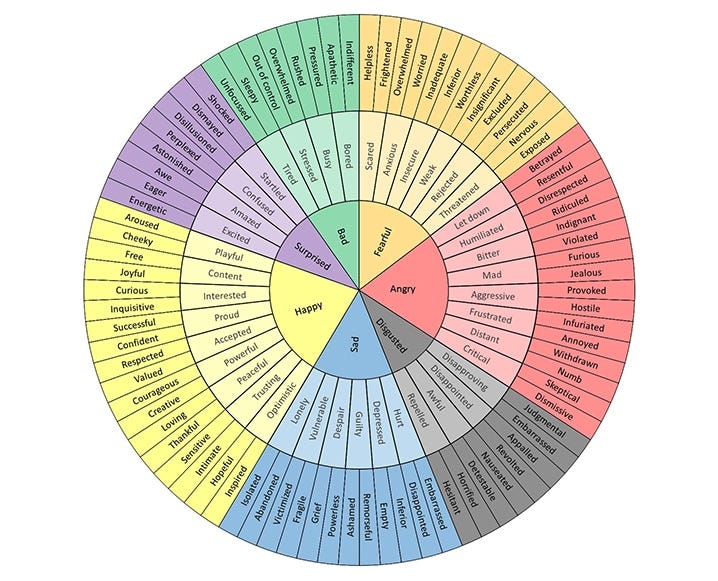
This chart has helped me to understand myself many times, and I’m sure it can do the same for you.
Having said that, feelings are complicated, but feeling the feelings is not. Just feel. Feeling sad? Turn up some Moonlight Senata, get in a child’s pose, and cry about it. Feeling excited? Great —let everyone else enjoy your happiness too. Do a happy dance. Feeling cranky? Let it all out. Lock yourself in your room if you need to.
The point is this: feelings get complicated because we bottle them up, mixing all kinds of emotions like a messy cocktail. Feel what you feel, let it out and remember that feelings aren’t facts — they’re just responses that your body makes up.
Goals and Vision
In today’s hustle culture, it’s easy to get caught up in all the gazillion goals you could set. Start a blog, write a book, start a YouTube channel, run an ultramarathon, start a business, lose 50 pounds, finish a course. The opportunities are endless.
But oftentimes, when we set 10 tiny goals, we spread ourselves way too thin.
Success is taking 20 steps in one direction, while most people set one step in 20 directions. — Unknown
Success doesn’t need to be complicated or difficult. It only requires perseverance and focus. So how do you decide which direction you want to take steps in?
If you visualize yourself 6 months from now, what would make you happiest if you had it in your life? Which addition to your life would make you feel the most fulfilled and satisfied?
Take note of your answer, operationalize it into actionable steps you can take, and start working on it.
Simplicity Does Not Mean Easy
A paradox that I’d like to debunk is that simplicity does not mean easy. To me, it just means a clearer life with more abundance and less fluff. Fluff — distractions, pointless problems, insignificant things— is the most pointless energy waster we can have in life. Do you think you’ll look back in contentment when you’re on your death bed reminiscing about that time you’ve made life so unnecessarily complicated for yourself?
Probably not.
‘’Simplicity is about subtracting the obvious and adding the meaningful.’’ — John Maeda
A simple life is so much more than cutting out distractions but if you start easily by stripping down your problems, major life decisions, projects, feelings, and goals, you’ve already come a long way.