
The Power of Compounding: 8th Wonder of the World.
Discover how the magic of compounding can be harnessed to build wealth and improve your life.

Compound Interest is the 8th wonder of the world. He who understands it earns it…he who doesn’t…pays it
— Albert Einstein
Who hasn’t heard the age-old adage — “Time is Money” and dismissed it as just another aphorism?
I’m sure we are all guilty of doing that.
Well turns out it’s literally true as proved by our friend Compound Interest — One of the famous examples of the magic of compounding.
Compound Interest is, ahem, pretty interesting. To see why, let’s take a walk down memory lane to a math class in middle school. Let’s go over a few terms first.
Failed miserably at being punny
Interest and Inflation.
Let us digress for a bit and talk about err tender coconut water.
“A lot of water and fleshy meat preferably”, I tell the coconut seller as he sharpens his hand sickle and deftly scours the expanse of coconuts to find the right one.
The familiar thwack-thwack of the sickle, a small gush of water, and the next moment, I am sipping on the cool liquid.
“That will be ₹30”, he says.
I remember how the price was ₹25 up until a few months ago, ₹18 2 years ago, and only ₹8 a couple of years ago.

Clearly, the amount of money necessary to purchase the same coconut has gone over the years.
The point I wanted to drive home was that the value or the Purchasing Power of money tends to reduce with time. This is called Inflation. The yearly rate at which this happens is called the Rate of Inflation.
This means that ₹100 today is more valuable than ₹100 a few years down the line!
Enough Coconuts! Back to Interest.
You lend someone money say ₹1000 for a period of 5 years.
By the end of 5 years, due to inflation, say ₹1.25 is equal in value to ₹1 at the time you lent the money, so you are paid back ₹1250 or even higher!
This extra money paid to make up for inflation is called Interest.
Simple Interest (SI) vs Compound Interest (CI):
Suppose you lent ₹1000 rupees (Principal) at 5% yearly interest. In the case of Simple Interest, you would get ₹50. So in 3 years, you would earn 3 times ₹50 or ₹150 as Interest.
With Compound Interest, the Interest you earn will earn Interest!
First Year → 5% of 1000 = 50 Rupees. New principal = ₹1050
Second Year → 5% of 1050 = ₹52.5. New principal = ₹1102.5
Third Year → 5% of 1102.5 = ₹55.125. New principal = ₹1157.625
With CI, you earned ₹157.625 or ₹7.625 more than with SI.
Not much of a difference eh?
Here’s where things start to get crazy.
Now suppose the time period in the above example is 20 years. I will skip the math but this is what the CI and SI come out to:
SI = ₹1000 or 100% of the principal.
CI = A whopping ₹2653.3 or 265% of the principal.
The CI is 2.65 times the SI here!
Now suppose the time period is 40 years.
SI = ₹2000 or a 200% Increase.
CI = A mind-boggling ₹7039 or 703.9% of the principal.
The CI is 3.5 times the SI !
Something crazier:
In 40 years, at 5% Compound Interest compounded quarterly, ₹1000 would multiply 2457 times in value to become a little over ₹24 Lakh!
Let that sink in!
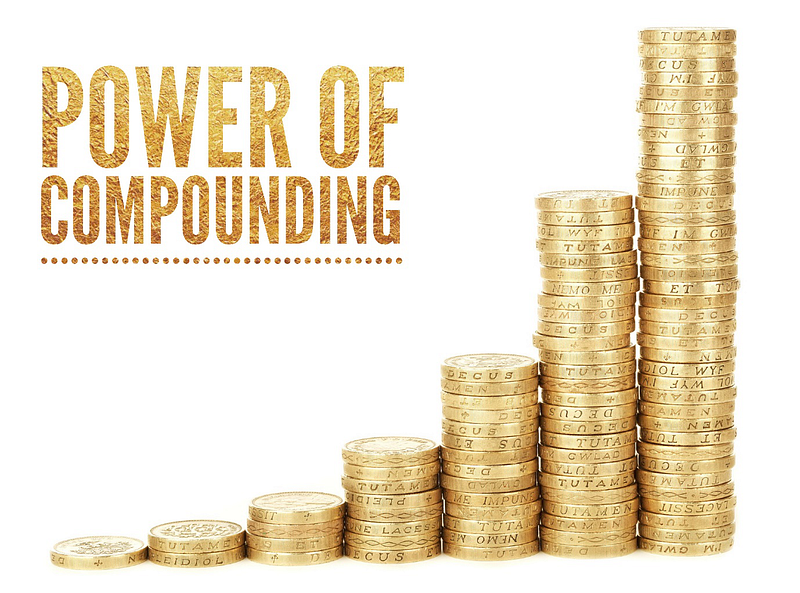
This is the power of Compound Interest — Wealth grows exponentially!
How to leverage the Power of Compounding?
As the quote says, it’s up to you to choose to EARN or PAY Interest.
Let’s walk through a simple example.
Raj and Ram are both interested in buying a certain car. The car costs ₹7,00,000.

Raj knows the power of compounding and has saved enough money to buy his dream car by depositing ₹10,000 per month in a Recurring Deposit (RD) which pays him 10% Interest yearly for the past five years. At maturity, he receives ₹779,079. He gets to keep ₹79,079 while being able to buy the car. He invested only ₹6,00,000 in total. So he’s spent only ₹6,00,000 minus ₹79,079 or ₹5,20,921 in total.
Ram on the other side buys the car on a 5 year EMI plan at 10% yearly interest. He has to pay ₹14,873 per month for the next 5 years. He ends up paying ₹8,92,376 in total.
Notice how Ram pays ₹3,71,455 more than Raj for the same car.
Well, you could say Ram paid the price of being ignorant of the 8th wonder.
EMIs, Loans, Credit Cards etc. make you PAY Interest.
FDs, RDs, Govt Bonds, SIPs, Mutual Funds, and other Investments EARN you Interest.
Compounding in Life.
Compound Interest is just the tip of the iceberg that is Compounding. Read on to find out how compounding can be applied in life to achieve miraculous results.

Self-Improvement:
So here’s the trick, aim to improve yourself by 1% every day.
How much better do you think you would have become in a year?
Any guesses?
1.2X, 1.5X, or even 2X?
Read till the end. You are in for a massive surprise
So how do you become 1% better every day?
You could do one of these every day.
- Cut your smartphone usage by 5 minutes.
- Set your morning alarm 5 minutes earlier.
- Swap out one unhealthy food item with a healthier alternative.
- Spend 5 more minutes on reading.
- Add a small serving of veggies to one meal.
- Start exercising every day. Start with 10 minutes and build up.
- Drink one more glass of water.
- Get to bed 5 minutes earlier.
- Smile a little more.
- If you have a bad habit, say you smoke 5 cigarettes a day for instance. Smoke one less cigarette.
- Add 5 minutes to your productive time.
- Spend 5 more minutes listening to podcasts.
- Walk 10 more steps.
- Save a few more bucks by spending lesser.
- Spend one more minute on Introspection.
- Think a few seconds more before blurting out anything.
- Do one more thing off your ToDo list.
- Make more eye contact the next time you talk to someone.
- Squash one negative thought.
- Have one more positive thought.
- Do a kind deed.
- Connect with a new person.
- Spend 5 more minutes with your family.
Get creative and find more ways to achieve that elusive 1%.
Coming back to how much better you would have become in a year.
It’s a whopping (1.01)³⁶⁵ ie. a bit more than 37 times!

Habits
Making good habits and breaking bad ones can be quite cumbersome. One really efficient way to go about doing this is through small consistent steps.
Breaking a bad habit
Let’s say you are a chain smoker that wants to quit smoking, here’s how it can be done:

- Reduce the number of cigarettes smoked in a chain gradually, maybe reduce one each time you start a chain.
- Reduce the number of cigarettes you smoke in a day by buying one less pack.
- Reduce the number of times a chain is started by distancing the cue. Maybe place the pack of cigarettes in a hard to access place.
4. Rinse and repeat.
The changes will be slow and almost insignificant but as time passes, they will compound and before you know it, the habit is broken.
Inculcating a good habit
Let’s say you are a couch potato that wants to adopt a healthy lifestyle. Directly jumping onto a severe diet and overexercising is a recipe for burnout and relapse.

Here’s a better way to go about it:
- Start by reducing your screen time by say 10 mins, and replacing one junk food item with a healthy one every few days.
- Start exercising 5 mins and increase this duration by 5 mins every day or every few days.
- Get to bed a few minutes earlier and wake up a few minutes earlier.
- Rinse and repeat.
Over time, you will be bamboozled by how much your lifestyle would have changed.

Thanks for reading, hope you get to take away something from this.
Happy Living!


