The Potala Palace Is in My Dining Room — And My Heart
Priceless pearls are also abundant
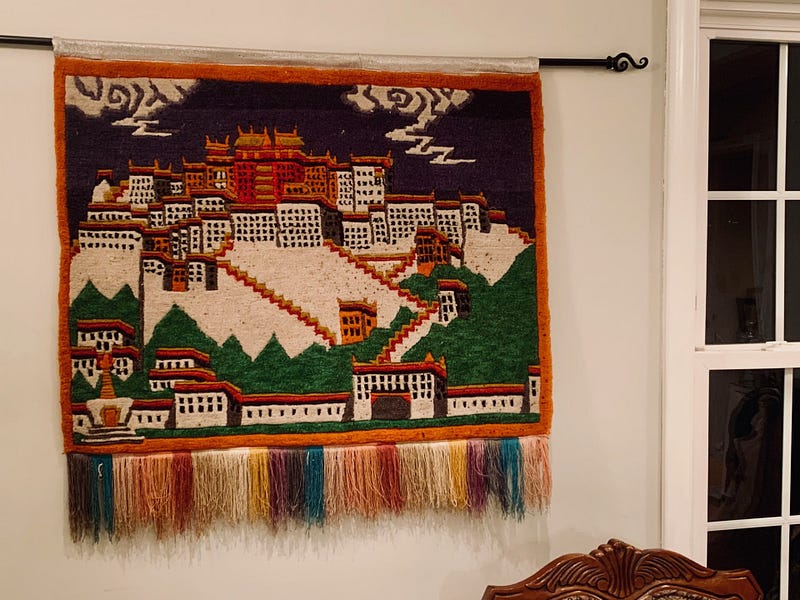
Rising imperiously and mysteriously above our dining room table is a large, hand-woven woolen tapestry of the Potala Palace in Lhasa, Tibet. The style and the colors don’t really complement anything else in the room or the house, but there is nothing else that better represents the spirit of our home.
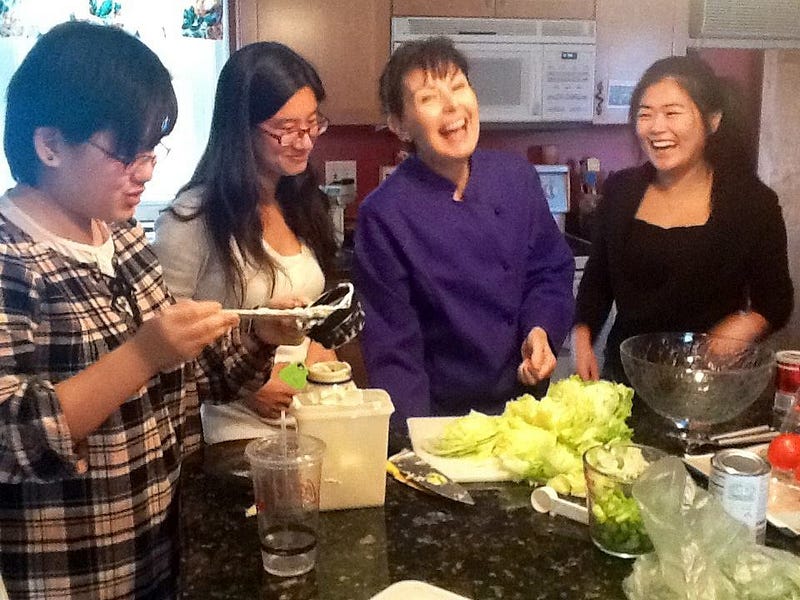
Several years ago, my wife Marjorie and I hosted a series of Chinese students arriving for their Master’s program at our nearby university. Every semester we’d get one or two, usually women. We’d pick them up at the airport, provide a room in our house, some meals, and Marjorie would even drive them around to look at apartments if housing wasn’t already arranged.
Most of our guests quickly filtered into campus life, and since the Chinese student culture was very insular, we often didn’t see them again. Some, however, would really connect with Marjorie and me and wanted a greater sense of American life or just a comfy place to hang out amidst the stresses of their grueling studies.
Lynx was the first (the students typically Westernize their names or pick a new name they like the sound of when they arrive) and became like another daughter to us. When she was graduating, she brought her roommate, Tanya, to the going away party we threw for her. Tanya said Lynx had told her so much about us and what we’d done for her, and wanted to know: would we “adopt” her too, please?
Of course!
Tanya was an undergrad then, so we had several years with her and have stayed close as she’s since taken data science jobs in the U.S. and Canada. Others have followed, including Ivy, who took a job teaching elementary school locally after she finished her Masters.
This brings me to the tapestry. Ivy’s residency was tied to her employment, and when she wanted to take a better job, her employer raised a fuss that threatened her visa status. Mature and well-educated, Ivy still felt at a loss in dealing with the corporate world. I was a savvy corporate veteran, and like any “father” would, I diagnosed the problem and wrote a couple of letters to her employers that reframed the discussion and resulted in a happy resolution.
When Ivy traveled home to China for a visit she told her parents how I helped. They were so grateful they took a tapestry off of their wall and insisted she bring it to us. It had been in their family for 40 years and is at least 100 years old. We were so honored. Ivy told us that if we were ever to have financial difficulty, the tapestry was worth a lot. As far as we’re concerned, however, it is priceless.
Similarly, when Tanya’s mother came from China for her daughter’s graduation, she also brought a gift in appreciation for our years of “parenting.” She had traveled 850 miles by train each way to Jengdezhen, famous for its porcelain, and had carried the box with a tea set on her lap all the way home and again throughout the flight to America. Literally, that is traveling thousands of miles with a box on your lap. When Customs asked her what was in the box, she said, “China”. Indeed.
I don’t know what the tea set cost or what it is worth, but when we brought it out for tea at a gathering of some of our Chinese daughters, there was a collective gasp as we lifted it out of the gold-wrapped box. Again, though, the value is found not in the dollars but in what the relationship meant to us and what it meant to the givers.
We love all our Chinese daughters who have chosen to share their lives with us over the years. In addition to Lynx, Tanya, and Ivy, we have Irene and Shiloh.
We also currently claim (and are claimed by) Beaula, from India, and Diana, originally from El Salvador, who (like our grandkids) call us Mim and Poppi. We are also close with Salome, who came from Colombia and now lives in France. Each has come into our lives in different ways and for different reasons, and all have given us many delightful things — but most importantly, a part of themselves.
Each woman is a pearl of great price that we wouldn’t trade for anything because we know that they have made as much of a difference in our lives — and more — than we ever could have made in theirs.
As we eventually, inevitably, downsize our home, these treasures and relationships will be going with us in our hearts and in places of honor. I daresay they will also be living in our family for generations.