
The Poltergeist and the Dictator
(This article is the short version of “Actualization of the Shadow Archetype in the Figure of the Nazi Dictator” published in the volume of the International Conference 2400 Aristotle, Bucharest, 2016)

I wrote a few articles about the shadow archetype but I only referred to the personal shadow and since the shadows of us all form the collective shadow; Jung also called this form of the archetype the jester, the trickster or the poltergeist. Here we’ll have to also discuss the psychology of the masses. I’ll give an example of a dictator so that everyone is able to see what can happen and how to prevent this. We need to see how this type of shadow forms and here I’ll tell you about Jung’s theory and only after I’ll show you how this can be expanded to the figure of the dictator and why the psychology of the masses is very important and useful tool.
Introduction to the Archetypes
According to the psychoanalyst there are two psychic systems. The conscience that has a personal nature; here we find the actualization of the personal shadow that until thus moment resides in the personal unconscious, a sort of appendix of the first. The second physic system is the collective unconscious that contains all the archetypes as a type of a priori forms that are inherited. This means that we have a historical aspect of the unconscious through which the future is shaped. I mentioned this because I want to show you that, according to the father of all archetypes, the collective shadow is also a condition that we pass and the fall of past dictators doesn’t guarantee that history will not repeat itself.
A Few Details About the Shadow
Jung even mentions in the The Archetypes and the Collective Unconscious that archetypes are a reality in a potential form. We pass along the archetype through the ancestral line and we actualize it in the form of an image that we can access; this is the level at which we do the shadow work: identification, confrontation and integration. The shadow is a possessive and an aggressive archetype that gives birth to obsessive tendencies and this is the reason for which it is the most easily characterized from an empirical point of view. While it takes a great moral effort to integrate it we should undergo the process especially because we can identify it so well (not easy). If we analyze our shadow and we select various elements from it that belong to important events in our life, we see that they all have an emotional trait and this is why the archetype is responsible for the obsessive tendencies mentioned before.
This emotional characteristic allows the archetype to actualize in our conscious, but it also predisposes the individual to pathological manifestations. The problem here is that when the shadow is ignored for a long time, the pathological side of it takes the place of the self. We have here an isolation of the self in the imaginary, a development of another type of reality, a subjective, upside-down world, one that negates the exterior, the true reality. You can free yourself of such a situation, but the effort will be greater and it’s better to avoid it. You can escape this situation because this type of actualization is in the form of a neurosis, not a psychosis where Jung tells us that the unity of the personality is forever deteriorated; I’ll go into details about this phenomena in another article, because the main subject here is the collective shadow as the dictator.
The Poltergeist From Our Mirrors
The confrontation of this archetype is primarily an ethical problem because all forms of the actualization of it diminish the individual’s responsibility. The situation is intriguing when it comes to the collective shadow: only the other (in a rather vague sense) can be guilty or responsible for negative (real or not) deeds. I said a rather vague sense, because you can interpret it and apply it in many situations, like protesters, their leader, the person(s) or the actions of a institution against which the protest is. I mentioned neurosis as a form of actualization at a personal level. Neurosis can have its roots in the collective unconscious, in the archetype that corresponds to the situation at hand, only when it stems from a general incompatibility, in this case being a social neurosis. Such a collective dimension also appears in the case of the shadow when individuals form groups, especially because in such cases the moral and intellectual levels decrease (see The Archetypes and the Collective Unconscious).
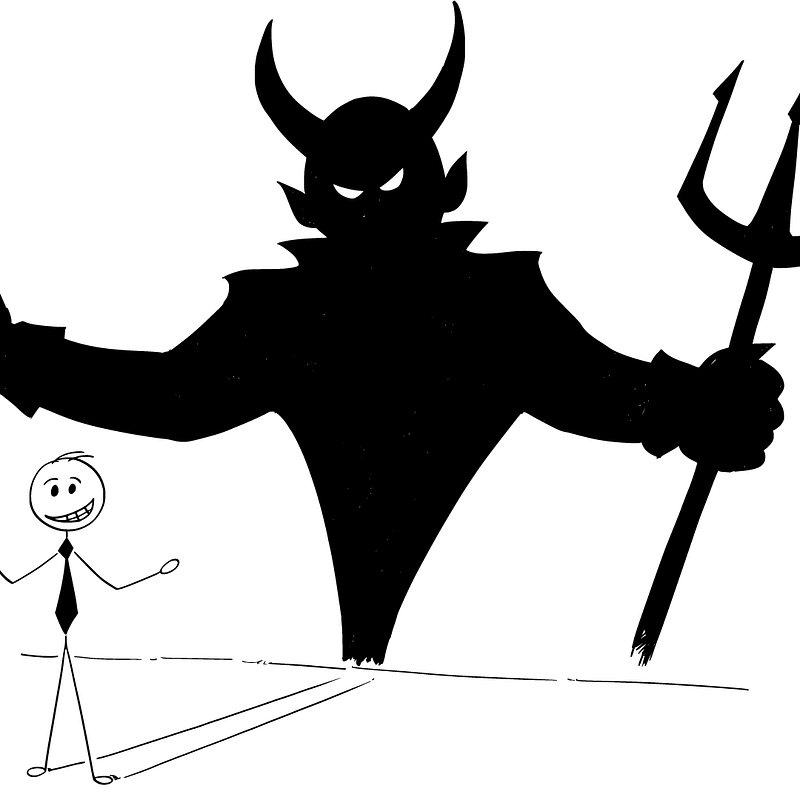
If the personal shadow is the sum of a person’s negative traits of character, the collective shadow is the sum of all the unconfronted and unintegrated shadows in a group, usually a society. If we take into account our history, we observe that the collective shadow can take a very peculiar form, namely that of the dictator. I argue that the social neurosis that led to the creation and perpetuation of Nazism has its roots, similarly to the poltergeist or trickster figure, in each individual’s shadow, that brought together led to the ascension of Hitler and to the creation of Nazism. To explain this phenomena we also have to take into account the psychology of the masses and the reactions that are triggered at an individual level when being part of a group.
The Shadow in the Crowd
A few details about the psychology of the masses are essential for this subject and since I don’t want to make this article very long I’ll refer here to Gustave Le Bon’s The Crowd. A Study of the Popular Mind. According to Gustave Le Bon a psychological crowd is different from a regular one in that it has a set of specific characteristics. Such a crowd is moving in a well-defined direction, crucial to this movement being the feelings and thoughts of the individuals whose personality vanishes in the collective mind.
The existence of a clear objective towards which the group is heading is the very element that distinguishes a psychological crowd from a mere accidental one. The psychological dimension of a mass of people is the effect of strong emotions, such as those resulting from a national event. Similar to Jung, Le Bon states that the intellectual and the moral levels of individuals decrease when forming a crowd, the individual acting in ways that are not in accordance with his personality. The melting of the personality into the collective mind, as well as the emotional impact of being part of a crowd, can make the individual act in ways very different from his habits and his way of being.
It is true that this aspect can take both a positive and a negative form, the crowd thus becoming heroic or criminal, but the lowering of the intellectual and the moral levels contribute to a negative type of the crowd, the individual losing his responsibility, due to the feeling of security given by the great number of people and to the anonymity status that the individual has in such cases. If certain ideas arise or take the form of an act only when being part of a crowd, we can say that up until such a point they had the status of a potentiality, for if they take the form of an act only in a crowd, they had the form of a thought, an idea, and if they become an idea only in a collective situation, they existed in the unconscious, as Jung tells us and they had to be actualized at some point in the individual’s life (here we remember the archetypes passed along the ancestral line). The collective mind that Le Bon talks about is also dominated by unconscious elements and the conscious acts that take place in a crowd are the result of an unconscious hereditary substratum that is made up of numerous characteristics passed on from generation to generation.
This hereditary structure mentioned is the one responsible for the weakening and vanishing of the personality in favor of the collective mind and the instincts towards which the unconscious signals are responsible for the often primitive behavior of the individuals who become aggressive, spontaneous, easy to impress by means of simple images, lacking the ability to judge. This impressionability goes hand in hand with the exaggeration of the feelings that move the crowd, making it an easy target for manipulation. The lack of critical judgement enables the crowd to think in a very simple manner that defies all logic: by associating images that have no connection between them whatsoever. Being unable to distinguish between the subjective and the objective, the crowd accepts these images that stem form a very powerful faculty of imagination. The absence of a personality is the key element to self-sacrifice: the individual sacrifices himself in favor of the crowd. This is often the explanation for committing atrocious acts in wars or for the preservation of political regimes and ideologies elaborated or enacted by peculiar individuals, often plagued by mental illness. In such cases the individual loses self-awareness and acts as if being hypnotized. It is noteworthy here that the individuals are able to form a psychological crowd even if they are in different places: all that is required is a strong emotion.
The Dictator as the Poltergeist
I had to make a large introduction to be able to speak about the Nazi dictator as the collective shadow; I did this to make my theory make sense and to be understood. It has been observed that the mere gathering of any living beings arises in them an instinctual need to place themselves under the authority of a leader. Similar to an irrational being, the individual that is part of the crowd (we remember that the member of the crowd is intellectually and morally diminished) automatically bows his head to a leader whose will becomes his own; the German people became passionate and animated by an illusory but invincible force (See Denis de Rougemont, The Devil’s Part).
This obedience and self-sacrifice of the individual are not a result only of the influence the crowd can have on him, but also of the authority and prestige of the leader. The authority of the leader is the result of his imposing personality, of his will that becomes the will of the crowd. As history has shown us, these requirements were met by the Nazi dictator and the German nation that he ruled. We remember that the phenomena of contagion that takes place in the crowd and which animates the individuals, was present in Hitler’s speeches through which he was able to mesmerize the people. If one of the requirements that a crowd has to meet to be a psychological one is the absence of moral responsibility and culpability on behalf of the individuals, Hitler’s repetitive rhetoric was able to do just that, and thus preserve the collective mind; we remember that in the case of the crowd, the collective mind has only a transitory existence, but the situation is different in the case of the leader.
As Le Bon tells us, the leader was usually a member of the crowd, and as such he was hypnotized and enslaved, but more so than the others, up until the point his personality completely vanished and was replaced by the collective mind. As the individual of the crowd sacrifices himself, so does the leader, but his convictions are so strong, that his reason overshadowed and left behind. While reason was left behind, Hitler was able to pin a series of elements crucial to leading the masses: exploiting the crowd’s beliefs and feelings (this being an entity lacking in intellectuals), acknowledging that it is more difficult to ignore beliefs than knowledge, but also the force of fanaticism and hysteria along with the need for a strong-willed leader (See Adolf Hitler, Mein Kampf); alongside these requirements there were some specific ones for the German nation, namely removing the illusion of internationalism and influencing the young people.
The crowd leader is not a thinker, he is a person of action who usually belongs to a certain category, namely that of the highly energetic, plagued by neurosis and on the border of madness. This theory regarding mental illness has been subject of numerous studies concerning Adolf Hitler. Among these studies there is a report made during The Second World War by Henry A. Murray for the United States Office of Strategic Services. Murray was one of the many who considered Hitler a schizophrenic. He identified elements from his speeches (acknowledging his oratorical power over the masses), some of them being typical for a crowd leader, others for the leader adequate in the context of war where a criminal crowd is required. Hitler’s strategy of manipulation was represented by the ideal he created and for which the entire nation had to strive. As we know, this ideal (at a physical as well as at a psychological level) was very different from himself, yet this did not represent an obstacle.
Hitler was fanatic when it came to his ideal and this was a perfect tool for hypnotizing the masses. He was an upholder of power, glory, dictatorship, brutality and nationalism (completely eradicating the idea of other nations from the minds of the people) and purity of blood, while repudiating any type of weakness, indecision, though being plagued by it (See Erich Fromm, The Anatomy of Human Destructiveness), tolerance, peace and of course, the Jewish race (See Murray). We remember here the collective shadow, a mythological figure bearing much resemblance to the poltergeist, a malicious and rather stupid spirit that has the ability to change its appearance and describes itself as being in hell. Hitler was more evil than malicious, not stupid, but refusing to acknowledge reality, if we look at his life history prior to the Nazi regime, but he did have the capacity to change his appearance, similar to a multiple personality disorder, he could be expressionless (at parades), yet he had moments when he was able to gaze hypnotically at his interlocutor, sentimental (when crying over a dead canary), awkward (in front of individuals belonging to aristocracy), mystical (when foretelling the future of the thousand years Reich), hysterical (when waking up from one his many nightmares), possessed (when a screaming his speech at a hypnotized crowd) and many times a victim of apathy (See Murray).
Upon meeting the Nazi dictator in Berlin, Jung described him as having an expression of ”inhumanly single-minded purposiveness, with no sense of humor” (R. F. C. Hull, C. G. Jung Speaking: Interviews and Encounters). While Hitler did not describe himself as a resident of hell, the sufferings of the poltergeist, as those of the madman were present; he was frequently plagued by agitated depressions, nightmares from which he would wake up screaming, hypochondriac states in which he feared of poisoning or stomach cancer (See Murray). While it was clear Hitler suffered of paranoia, his ability to shift from one masque to another would indicate a multiple personality disorder, possibly in an early stage, all these being characteristic of schizophrenia. If Hitler is a perfect candidate for dominating a criminal crowd, he is also a perfect candidate for the collective shadow — Jung states that when individuals form a crowd, thus becoming anonymous, the mythological figure of the shadow, the poltergeist is called forth and incarnated, as history has shown us many times before.
I wrote this article to make people realize how important it is to identify, confront and integrate their shadows, even if takes times and it is an unpleasant process. We have to learn from history and avoid at all costs the birth of another dictator and remember that once in a dictatorship individuals doing their shadow work weaken the poltergeist.
CHANGE STARTS WITH YOU!