
The Politics of Investing Today
Democrats and Republicans view companies and entire industries differently today based on political perspectives. Here’s a look at what this means for investing going forward in our highly polarized political environment.

Introduction: The “Red Team” versus the “Blue Team”
We are a country divided today. We seem to be almost hopelessly divided into two camps — the “Red Team” (the Republicans) and the “Blue Team” (the Democrats). And the members of the “Red Team” and the “Blue Team” are divided over politics and, because of that, just about everything else.
Heck, we can’t even agree on how to view the budding romance between Taylor Swift and Travis Kelce due to the couple’s outspoken political and vaccine positions! Can’t we just love love anymore? Apparently not! So now, we even pick the team to pull for in the Super Bowl based on our politics.

Political Views on Industries
Well, if we choose between the San Francisco 49ers and the Kansas City Chiefs based on our political perspective, is it any surprise that politics influences how we feel about entire industries and sectors of our economy today?
YouGov recently surveyed Americans on just this question of how politics influences how we view different industries today. The question posed by the YouGov researchers in regard to each of the 39 industries under examination was simply this:
“Generally speaking, do you have a favorable or unfavorable opinion of the following industry?”
What they found was an extremely divided America on many industries and sectors of the economy. Pallavi Rao, a data journalist with Visual Capitalist, created the infographic shown in Figure 1 (Democrats and Republicans — Divided Opinions on U.S. Industries). As you can see, from higher education to the media to technology and more, people of differing political perspectives have highly different views on various sectors of our economy today.
Figure 1: Democrats and Republicans — Divided Opinions on U.S. Industries
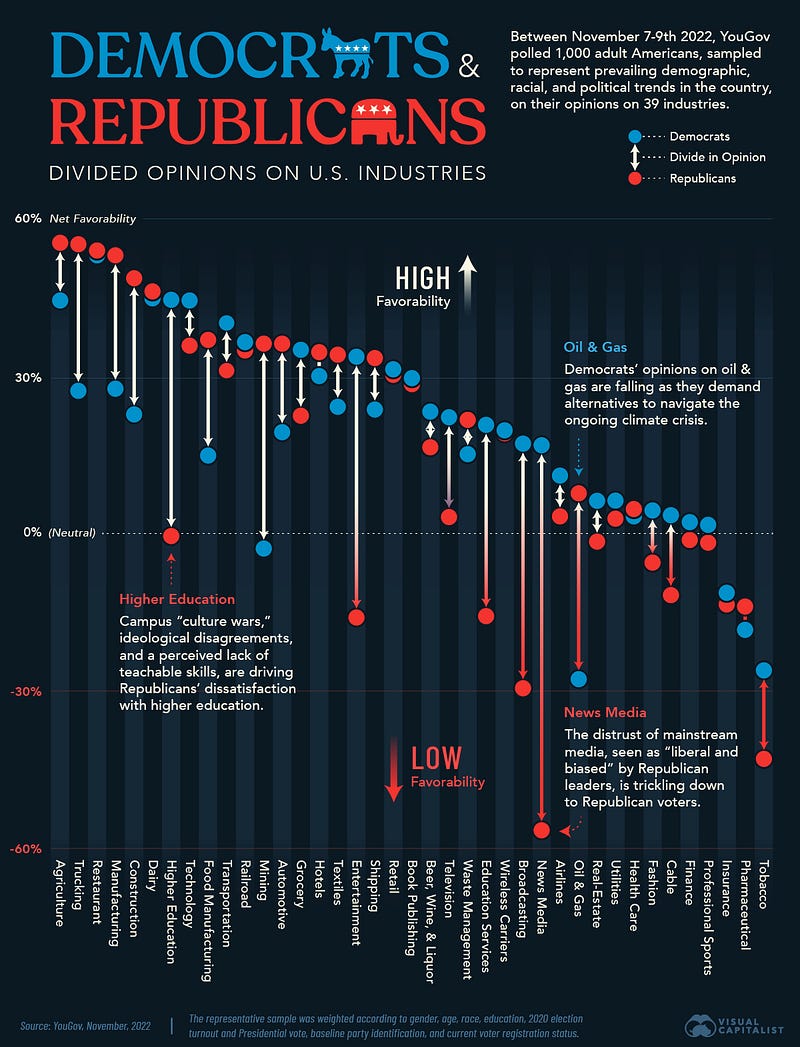
Source: Visual Capitalist, “How Do Democrats and Republicans Feel About Certain U.S. Industries?”, February 2024 (Used with permission).
Breaking down the numbers, there are industries that are more favorably viewed by Republicans than Democrats, and vice versa. The complete list of 39 industries/sectors included in this study is broken down in Table 1 (Democratic vs. Republican Favorability of Industries and the “Net Favorability Gap” in Each).
Table 1: Democratic vs. Republican Favorability of Industries and the “Net Favorability Gap” in Each
- Agriculture
Democratic Favorability: 44%
Republican Favorability: 55%
Net Favorability Gap: 11%
- Airlines
Democratic Favorability: 11%
Republican Favorability: 3%
Net Favorability Gap: 8%
- Alcohol
Democratic Favorability: 23%
Republican Favorability: 16%
Net Favorability Gap: 7%
- Automotive
Democratic Favorability: 19%
Republican Favorability: 36%
Net Favorability Gap: 17%
- Book publishing
Democratic Favorability: 30%
Republican Favorability: 29%
Net Favorability Gap: 1%
- Broadcasting
Democratic Favorability: 17%
Republican Favorability: -30%
Net Favorability Gap: 47%
- Cable
Democratic Favorability: -12%
Republican Favorability: 3%
Net Favorability Gap: 15%
- Construction
Democratic Favorability: 23%
Republican Favorability: 49%
Net Favorability Gap: 26%
- Dairy
Democratic Favorability: 45%
Republican Favorability: 46%
Net Favorability Gap: 1%
- Education services
Democratic Favorability: 21%
Republican Favorability: -16%
Net Favorability Gap: 37%
- Entertainment
Democratic Favorability: 34%
Republican Favorability: -17%
Net Favorability Gap: 51%
- Fashion
Democratic Favorability: 4%
Republican Favorability: -6%
Net Favorability Gap: 10%
- Finance
Democratic Favorability: 2%
Republican Favorability: -2%
Net Favorability Gap: 4%
- Food manufacturing
Democratic Favorability: 15%
Republican Favorability: 37%
Net Favorability Gap: 22%
- Grocery
Democratic Favorability: 35%
Republican Favorability: 22%
Net Favorability Gap: 13%
- Health care
Democratic Favorability: 3%
Republican Favorability: 4%
Net Favorability Gap: 1%
- Higher education
Democratic Favorability: 45%
Republican Favorability: 0%
Net Favorability Gap: 45%
- Hotels
Democratic Favorability: 30%
Republican Favorability: 35%
Net Favorability Gap: 5%
- Insurance
Democratic Favorability: -12%
Republican Favorability: -14%
Net Favorability Gap: 2%
- Manufacturing
Democratic Favorability: 27%
Republican Favorability: 53%
Net Favorability Gap: 26%
- Mining
Democratic Favorability: -3%
Republican Favorability: 36%
Net Favorability Gap: 39%
- News media
Democratic Favorability: 17%
Republican Favorability: -57%
Net Favorability Gap: 74%
- Oil and gas
Democratic Favorability: -28%
Republican Favorability: 7%
Net Favorability Gap: 35%
- Pharmaceutical
Democratic Favorability: -18%
Republican Favorability: -14%
Net Favorability Gap: -32%
- Professional sports
Democratic Favorability: 1%
Republican Favorability: -2%
Net Favorability Gap: 3%
- Railroads
Democratic Favorability: 37%
Republican Favorability: 35%
Net Favorability Gap: 2%
- Real Estate
Democratic Favorability: -2%
Republican Favorability: 6%
Net Favorability Gap: 8%
- Restaurant
Democratic Favorability: 53%
Republican Favorability: 54%
Net Favorability Gap: 1%
- Retail
Democratic Favorability: 31%
Republican Favorability: 31%
Net Favorability Gap: 0%
- Shipping
Democratic Favorability: 24%
Republican Favorability: 33%
Net Favorability Gap: 11%
- Technology
Democratic Favorability: 44%
Republican Favorability: 36%
Net Favorability Gap: 8%
- Television
Democratic Favorability: 22%
Republican Favorability: 3%
Net Favorability Gap: 19%
- Textiles
Democratic Favorability: 24%
Republican Favorability: 34%
Net Favorability Gap: 10%
- Tobacco
Democratic Favorability: -44%
Republican Favorability: -27%
Net Favorability Gap: 17%
- Transportation
Democratic Favorability: 27%
Republican Favorability: 37%
Net Favorability Gap: 10%
- Trucking
Democratic Favorability: 27%
Republican Favorability: 55%
Net Favorability Gap: 28%
- Utilities
Democratic Favorability: 2%
Republican Favorability: 6%
Net Favorability Gap: 4%
- Waste management
Democratic Favorability: 15%
Republican Favorability: 22%
Net Favorability Gap: 7%
- Wireless carriers
Democratic Favorability: 19%
Republican Favorability: 19%
Net Favorability Gap: 0%
Quite amazingly, only two industries/sectors — retail and wireless carriers — were viewed similarly by Democrats and Republicans alike. In all, 16 of the industries/sectors under review were more favorably viewed by Democrats. These were:
- Airlines
- Alcohol
- Book publishing
- Broadcasting
- Education services
- Entertainment
- Fashion
- Finance
- Grocery
- Higher education
- Insurance
- News media
- Professional sports
- Railroads
- Technology
- Television
On the other hand, 21 of the industries/sectors were more favorably viewed by Republicans. These were:
- Agriculture
- Automotive
- Cable
- Construction
- Dairy
- Food manufacturing
- Health care
- Hotels
- Manufacturing
- Mining
- Oil and gas
- Pharmaceutical
- Real estate
- Restaurant
- Shipping
- Textiles
- Tobacco
- Transportation
- Trucking
- Utilities
- Waste management

Analysis and Discussion
To me, as a strategic management professor and consultant, the divisions we see today between Democrats and Republicans in their views on entire companies and industries are much more than an academic concern. They have real-world consequences for companies, both large and small alike. Indeed, the way we spend, how much we spend, and where we spend may be significantly influenced by our political outlooks today. And when it comes to investing, the companies and sectors we invest in may indeed be guided — consciously or even unconsciously — by our political philosophy.
The famous Michael Jordan quote why he didn’t speak out politically was, “Republicans buy sneakers, too!” Today, however, that may not be a practical and effective guiding philosophy for companies to follow. Our political stances seem to be hardening, and with that, the way we view companies and entire industries is hardening at the same time. It is going to become more and more difficult for companies to balance their approaches to cater to people of all political stripes. Indeed, they are more likely to be painted with a “broad brush” as being a company in the news media that Republicans dislike or a mining company that Democrats distrust, no matter what they individually do. Thus, investments may well become more and more politicized as well, with even industry mutual funds that would cater more to Democratic or Republican interests.
So yes, perceptions do matter — and matter a great deal — today. Companies and their top executives thus need to be keenly aware of just how much political differences can lead to differing perceptions about their firms and their industries today, leading to bottom-line impacts in terms of sales, profits, and investments.

About David Wyld
David C. Wyld is a Professor of Strategic Management at Southeastern Louisiana University in Hammond, Louisiana. He is a management consultant, researcher/writer, publisher, executive educator, and experienced expert witness. You can view all of his work at https://authory.com/DavidWyld. You can subscribe to his Medium article feed at https://davidwyld.medium.com/subscribe.
Social Media Links to David Wyld:
- on Facebook
- on LinkedIn
- on Threads
- on Twitter (X)
- on Post
Visit us at DataDrivenInvestor.com
Subscribe to DDIntel here.
Have a unique story to share? Submit to DDIntel here.
Join our creator ecosystem here.
DDIntel captures the more notable pieces from our main site and our popular DDI Medium publication. Check us out for more insightful work from our community.
DDI Official Telegram Channel: https://t.me/+tafUp6ecEys4YjQ1


