
The political side of science
The field of Alzheimer’s disease research has been an utter failure from a therapeutic standpoint. To this date, only one of several dozen clinical trials testing drugs against the currently understood pathological hallmarks of the disease has shown any sign of success. Unfortunately, even that one study that showed possible improvement with the test drug was dubious at best. This fact is likely not well known to the general public, except for the intellectually curious or those that might have an invested interest, like a family history or close friend or loved one with the disease. As a researcher previously in the field, lately I have wondered if it would be more visible had a politician made some comment about publicly funding the struggling theory — the amyloid cascade hypothesis — behind most of the research. To tie the issue to something that a voter might care about, the hypothetical politician might say something like “the monetary and emotional cost of caring for Alzheimer’s patients is so large that we must at least do something to treat these people. Therefore, we should use the current scientific evidence to make it the official policy that we fund and implement any available therapeutic modality, even if efficacy has not been proven.” Given the failures of currently available Alzheimer’s drugs, it should be obvious that this would be a bad, if not harmful, policy. Yet, I have gotten the creeping feeling that this scenario is playing out in the current environment of the COVID-19 pandemic.
The analogy to Alzheimer’s disease, while not perfect given there are no negative externalities directly related to the disease on anyone else and given my biases, still seems accurate to our current stuation. It blatantly points out the problems with politicians making lifechanging policy on the best available science. Mind you, I am a scientist, with two real scientific degrees and going on twelve years of my life dedicated solely to science and medicine. I am neither a science denier nor a conspiracy theorist masquerading as a scientist. In fact, I revere science and the process used to elucidate its truths. The second half of the last sentence is the real sticking point today — the process used to elucidate [scientific] truths.
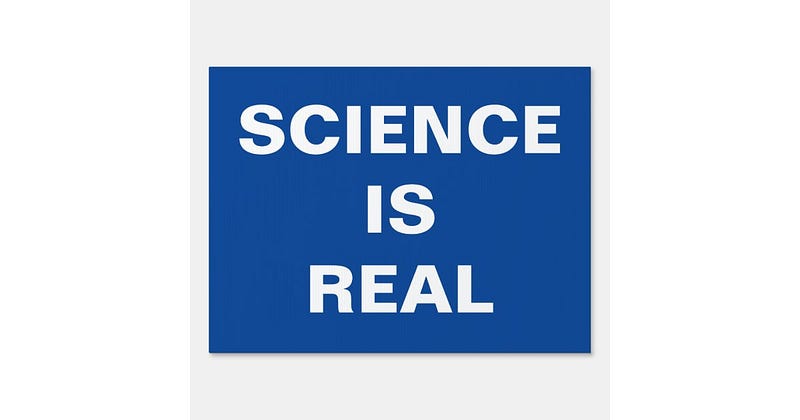
The COVID-19 pandemic has made the public misunderstanding of how science works painfully obvious and this is only made worse by a politicized media (including social) and politics itself. The most jarring example is the front lawn sign that says “science is real!”. Proclaiming that “science is real” is like like saying learning a new language is real. Science is not a tangible thing or a specific result; it is not even The Truth. That may shock some people. But here is the essence: science is a process. It is a way to tangibly (but not always) test a guess (or a question) about how the world actually works. Whatever result you get from the test may or may not be the real workings of nature. So, you test it again, and again, and again. And other people test the same guess, maybe in subtly different ways and perhaps framing the question a bit differently. Not until enough tests are done by enough people, the results of which more-or-less aligning, do we get anywhere near reality. I emphasize near for a reason. Take for instance Einstein’s theory of relativity: despite its near unanimous acceptance, scientists continue to test it. In other words, scientists are never certain (at least they shouldn’t be), and all it would take is one big result against the theory to call its validity into question, and thus require even more testing. But until then scientists accept it as reality. And this is what it should mean to “follow the science”, as so many people are now wont to say while a virus ravages our communities.
The problem is, those yelling “follow the science” or “science is real” or “trust the scientists”, while not wrong in their assertions per say, miss this point about how science works. Take for instance my Alzheimer’s disease example. By just trusting the scientists, the field has been stuck in an infinite loop trying to prove that the amyloid beta protein is the de facto cause of the disease, and spending millions of tax payer dollars to do so without any clinically meaningful results to show for it. Science and the scientists who implement it can be wrong.
This brings me to our current dilemma. The COVID-19 pandemic has tested our ability to have a public discussion about how to handle policy implications of scientific discovery. On one side there are those that support more restrictions on the public, including lockdowns, mask mandates and forced social distancing. On the other, those that support an opening of the economy and voluntary masking and social distancing. Which faction is right?
To paraphrase the annoying trope: science is real, and complicated. The truth is obviously somewhere in between the poles. I think masks serve their purpose inside confined, closed spaces and around large groups of people in close proximity, say at an open door concert. I think that if you are feeling ill, you should socially distance. I think shutting down the economy is not such a good idea. These are the simple answers.
Does closing of “nonessential” businesses outweigh the benefit of forced social distancing? Or to make it even more controversial, does restricting elective, but necessary surgeries and procedures outweigh the risk of morbidity or mortality from catching SARS-CoV-2?
These are not questions that can be addressed by science as they are mostly subjective and mainly about personal preference. Science can tell us what is probably real, but it can not tell us what we should do about it. Yet, I see our politicians and the media making these life-altering decisions based on even tenuous science. For example, a study in JAMA Internal Medicine back in July found that only 29% of trials registered at ClinicalTrials.gov were placebo-controlled and would meet a high enough level of evidence to warrant implementation.
Of particular concern, a problem that seems to have stemmed from the pandemic (or we just never noticed its impact before) is the increasing role of preprint servers. These scientific manuscript farms are where scientists upload their studies for public viewing prior to being fully vetted by peer review. While imperfect, peer review is the gold standard to judging the validity of a study before it can be published. The current tally of pre-print manuscripts on BioRxiv/medRxiv is at 9,762 studies as of this writing. What annoys me is that I have actually seen news outlets prematurely report on these studies!
Maybe the right question is why has science become so much more politicized since the start of the pandemic. I know that the right and the left have been fighting over other big scientific conundrums for a long time (i.e. climate change and at what age a fetus is conscious). While the former is unequivocally real, the question is again about cost/benefit of certain policies; the latter will eventually be deciphered by science, I hope. But why has a pandemic, which in terms of the science is pretty straight forward in theory if not in practice: find the causal organism, test for it, find a drug to treat it and a vaccine to prevent it. There’s no religion involved. There’s no profit at stake (pharmaceutical companies do not make much off vaccines and antibiotics).
So what is so different? When Barack Obama was president, there was no politicization of either the Ebola outbreak or the H1N1 swine flu, which was also bungled by the administration and any success was, according some, pure luck. That is not a critique since dealing with a new virus is tough. Of note, the 2009 swine flu was a similar H1N1 virus to several influenza viruses in prior pandemics, including 1967 and 1918. So to be fair we did have a head-start.
That is not to say that the Trump administration has handled this crisis well. Trump did close the borders, but about two weeks too late and not before letting a lot of Americans back into the country from hard hit Europe. The CDC and FDA got a test for the virus out quickly, but when it was found to be faulty, they would not let private companies disperse their own working tests. There were mixed messages on masking, personal protective equipment, reversals on how the virus was transmitted and the incorrect assumption that this was just like the flu. We were in such a panic not to repeat a 1918 or 2009 that the scientists got ahead of themselves portraying the certainty of available data and then politicians and the media went even further out over their skis with speculation and blame. To be quite honest though, I doubt a Clinton or Biden or even Obama presidency would have kept the over 200,000 who have died alive. Why? Because science is hard. The virus would have arrived here either way and because of its virulence, it likely would have had the same tragic end. And it gets even harder when you have little time to act and don’t even know against what you are acting.
Thus, my answer to the question in the previous paragraph: it’s Trump. Or the corollary: it’s the left’s pure hatred of him. The left’s and most of the media’s vitriol for the man is palpable, which I think drives the majority of the polarization. His trolling of them does not help.
Even scientific publications, which do take certain policy positions, but not necessarily sides, have become unhinged in their disapproval of Trump. For the first time ever, scientific journal and magazine editorial staff have endorsed a particular presidential candidate. I am beginning to lose count of how many now. While they are within their right to do so, it leaves a bad taste in my mouth. In my opinion it sets a bad precedent for the future of science. Politics are inherently biased. By making this move, the major scientific publications and the scientists who write for and support them could be putting themselves on the wrong side of future issues.
Additionally, scientists are human too; we are biased. If the broad culture of science, which is portrayed in and influenced by scientific journals, leans toward a certain political party, are we not inviting that bias to be reflected in the science itself? I am concerned this will lead to the accumulation and cherry picking of data that fits into that particular political narrative. I am equally concerned it will lead to the continued silencing (or worse, shaming) of disparate interpretations of data, leading to cloistered sects of scientists that no longer debate their findings. Science can not function without discovery and refutation and revision.
The more practical and tangible reason this concerns me is that future Biden administration’s policies are essentially the same as the Trump administration’s, but possibly more draconian. For example, he would “shutdown the country if scientists advised him to”, although he later walked that back imploring people to wear masks when outside. While one peer-reviewed study suggests the initial shutdowns might have been effective at decreasing death rates in European countries, there is less definitive data for the US. In fact, one analysis suggests the infection rate was already on the downslope by the time some state governments began their respective lockdowns and these rates seemed to plateau thereafter despite openings and re-closings, all the while people were wearing masks. We’re still waiting for controlled studies on the efficacy of mask wearing, which I doubt we will get due to technical issues of controlling those kinds of studies. I frankly do not see how Biden or many on the left, despite their cries of Science! are following the science any more than the right.
Take stricter restrictions on opening businesses— which seem to be more favored by the left compared to the right — as we had at the beginning of the pandemic. While they might have been necessary given all of the unknowns at the beginning, does the science now support this method for stopping viral spread? Well, it’s more complicated than yes or no of course. New data just reported by the CDC showed the excess number of deaths since January are estimated to be about 300,000, two-thirds of which can be attributed to COVID-19. The percentage change from the expected number of deaths in previous years was highest in the age group 25–44 at 26.5%. Now, these are important data that should be debated for the next best course of action. When I read the New York Times article that reported this, the author made it seem that this 26.5% increase in excess deaths was due to COVID-19. If the number of excess deaths due to COVID-19 is similar in each age group, then the best we could surmise is that two-thirds of deaths in that age group are due to the virus. But that’s unlikely since we know that not every age group is equally as vulnerable. Sure enough, a closer look at the CDC data does not parse out the main cause of that 26.5% increase. Given that we know the vulnerable age groups, and 25–44 is not one of them, but instead a group in the prime of their working lives and already under immense stress pre-pandemic, it’s much more likely that the increase is due to deaths of dispair. This would not support a justification to sweep the jobs right out from under the feet of this age group. Yet, some states are threatening more broad lockdowns if cases (positive tests) remain high and other countries are already re-implementing them.
Disconcertingly, if you point this out, you are likely to be called a eugenics sympathizer (what?) or a COVID-19 denier (seriously?) or be compared to Nazis (oh yah, of course). Luckily, I am a nobody, so it’s likely that I will dodge these accusations. Either way, these examples are a reason in themselves to move away from the politicization of science. Again, the process does not work by shutting up the other side with spurious accusations and questioning of morals.
This conversation is not over and nor should it ever end. This virus will be with us likely for the rest of humanity’s stint on Earth. My previous postdoctoral supervisor always said “don’t let perfect be the enemy of the good”. Keep your distance from others, especially the elderly; wear a mask when you can’t. The number of deaths are falling. Older drugs are showing promise for more severe cases of the disease. A vaccine is on the way. Only with rigorous science will we get to a point of containing it and relegating it to the list of other bugs that taunt us, but which we have tamed.