
The Pitfalls Of Google Translate
And some things you can do to avoid them
“Make stock from one liter water and a nut.”
I just spoke to my youngest daughter in Abu Dhabi. She was about to make dinner for her dad and herself.
“What are you cooking?” I inquired.
“Just some packaged risotto I got at Carrefour,” she said. Then she added, “But the instructions are weird. It says to make stock from one liter water and a nut. What could they mean?”
“A walnut or a hazelnut? Or one from the hardware store?” I laughed. “I’m sure that’s a mistranslation. What you need is a stock cube, obviously. But now I have to figure this out! Where was the product imported from?
“Milano.”
Of course. The UAE imports all the best foods from the best sources.
So I have to look it up…
I’ll admit my Italian is more than a little bit rusty, and I’ve never needed to shop for stock cubes in Italy, so I have to look it up.
First stop Google. Because I’m in a hurry, I just do my search right there, in the browser. I have two questions.
Question One: What is the Italian word for “stock cube”?
The immediate, main, result that comes up is: cubo di scorta.
Please forget immediately that you have ever seen this translation!
Because it is 100% wrong!
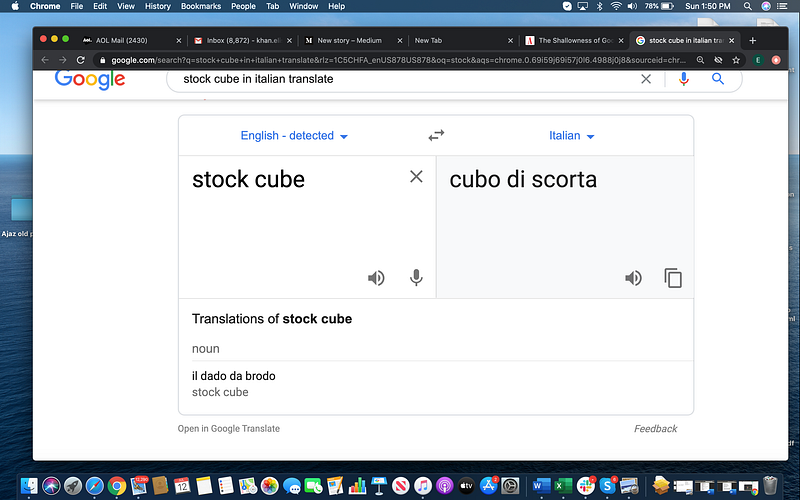
Rusty or not, I know that for sure. Because stock, in this case, means a decoction of meat and/or veggies, which I do recall is il brodo (cognate to broth) in Italian, and nothing to do with la scorta (cognate to escort, also meaning stock, spare, supply, stockpile, convoy). And cubo is cube, yes, but somehow this “spare cube” doesn’t sound right to my ear.
Good luck picking the right translation, folks!
The correct translation is the one that appears in the small print under the main translation: il dado da brodo, in common kitchen parlance often shortened to simply, un dado. Dado meaning, in the first place, a die (singular of dice), or something shaped like it, i.e. a cube.
Question Two: Could “nut” ever be used for “cube” or vice versa?
The first Italian translation that comes up for “nut” in Google is noce, i.e., walnut. And then, below the main language-to-language frame (or is it called a pane?), an improvement that I had never seen before: three more possible translations, complete with synonyms and… pictures! In this order:
il dado: nut, die, dice, dado
la noce: walnut, nut
la nocciola: hazelnut, hazel, nut, light brown
And when you click on one of these, the word in question moves up to the main translation area, and instead of one picture, you now see multiple, slightly larger ones for each translation. Wow! This is a big improvement!
If you wanted to translate the word “nut” into Italian, or vice versa, you would now have a better chance of getting it right. (I have no idea why this picture option didn’t appear with my previous attempt, just minutes earlier.)
The picture for dado, however, only shows dice. Not a nut in sight.
But wait a minute! When I click on the reverse-translation arrows to translate my result back to English, suddenly the pictures are gone and the only definition left is for nocciola, hazelnut.
Let’s try this again, shall we?
I type in noce and this time I get:
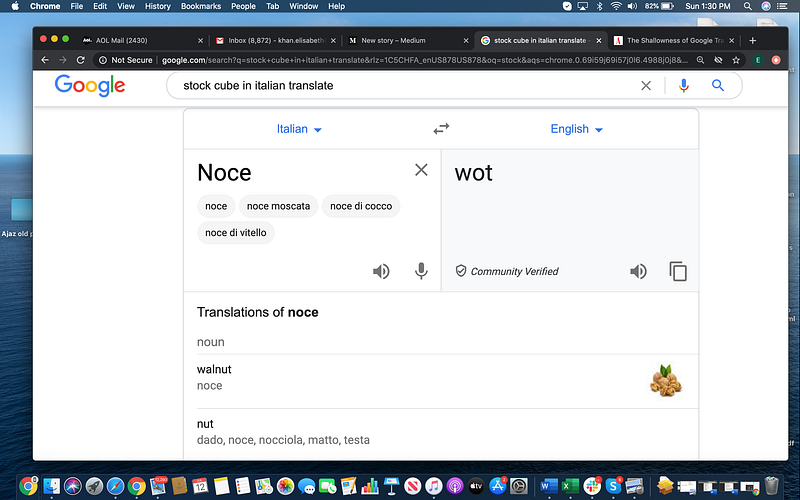
“Wot indeed?” Community verified, too. I scratch my head.
Followed by some more translation options at the bottom, including matto (crazy) and testa (head). If that ain’t nuts! Good luck picking the right one, folks!
And good luck cooking your soup with this one!
In case you were wondering, the dado/nut is the one from the hardware store, as in “nuts and bolts.”
But this is the funniest part. When I do the reverse translation of il dado da brodo I get:
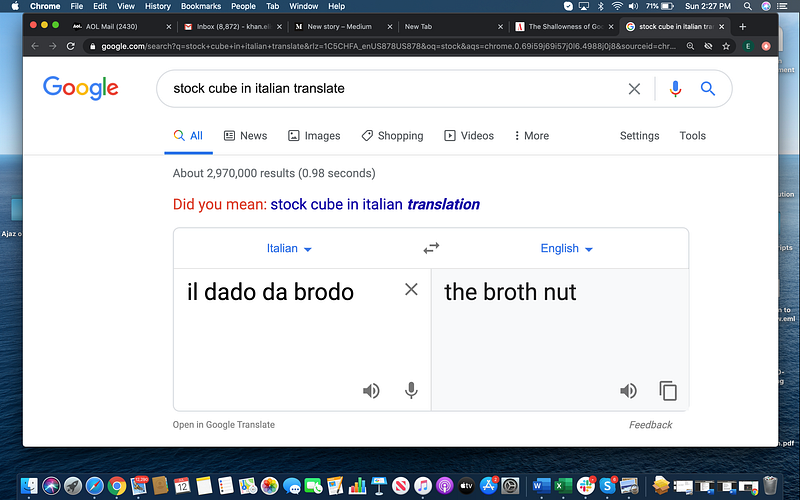
Good luck cooking your soup with this “nut”!
Experienced users have always known that Google Translate, despite being a very useful tool, is less than reliable, as is all translating software. Like it or not, Artificial Intelligence (AI) still has some catching up to do where translating is concerned.
So what can you do to minimize the risks?
- Do not blindly trust Google Translate. Be ready to question the results.
- Look for the small print at the bottom. Click on it and examine further.
- Be aware that the more words, the more chance of errors. AI sometimes grasps the context, but not always, especially when idiom is involved.
- Do a reverse translation by clicking on the arrows between the languages.
- Use a search engine like Reverso (reverso.net) for more clarity. It can be added to Chrome for free. However, be aware that even useful sites like Reverso Context often contain badly translated sample sentences.
- Prepare to be amused.
- If you have the slightest doubt, consult an actual (online or paper) dictionary. Or ask an expert of the human kind.


