
The Pied Piper Was Real: 130 Children Disappeared and Never Came Back
It took over 700 years to figure out what happened to them
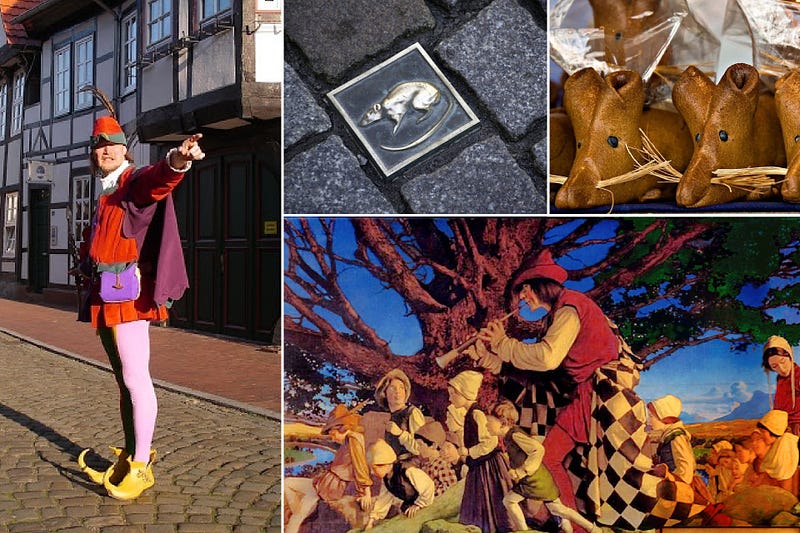
Hamelin is a charming and picturesque little town. Even today, the town is all 16th Century manors with Gothic gables and elaborate scrollwork. Quaint buildings in the flamboyant Weser-Renaissance style, with gargoyles and painted wooded sculptures that look like children’s toys.
The town looks like something out of a fairy tale, but what happened there was no fairy tale. It was more of a nightmare, with no happily ever after for the people who lived it. At least, not for the parents.
Just as Americans will never forget the day the twin towers fell, people in Hamelin never forgot what happened that June day, so long ago.

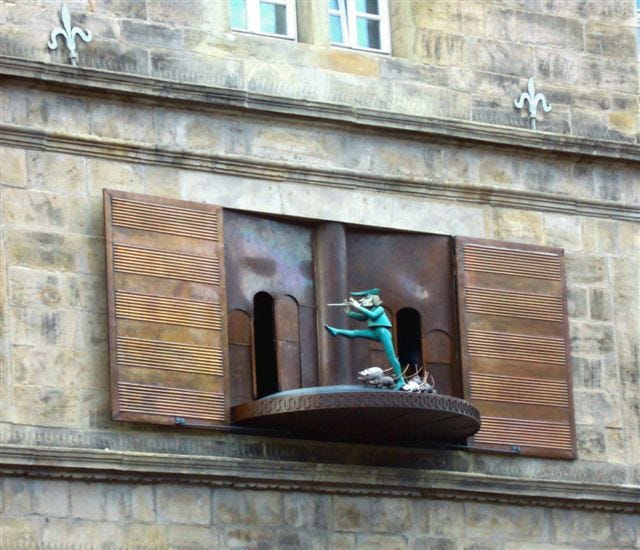
Here’s the story you probably know…
The story that goes back to the Medieval era all started with the rats. There was no sanitation in 1284, and the rats were so bad they terrorized the town. They were everywhere.
People were at wit’s end. Rats in the food. Rats in the pantry, rats chewing their bedding while they slept. No matter what they did, they couldn’t get rid of the rats. There were too many. They were out of control.
Until the pied piper showed up.
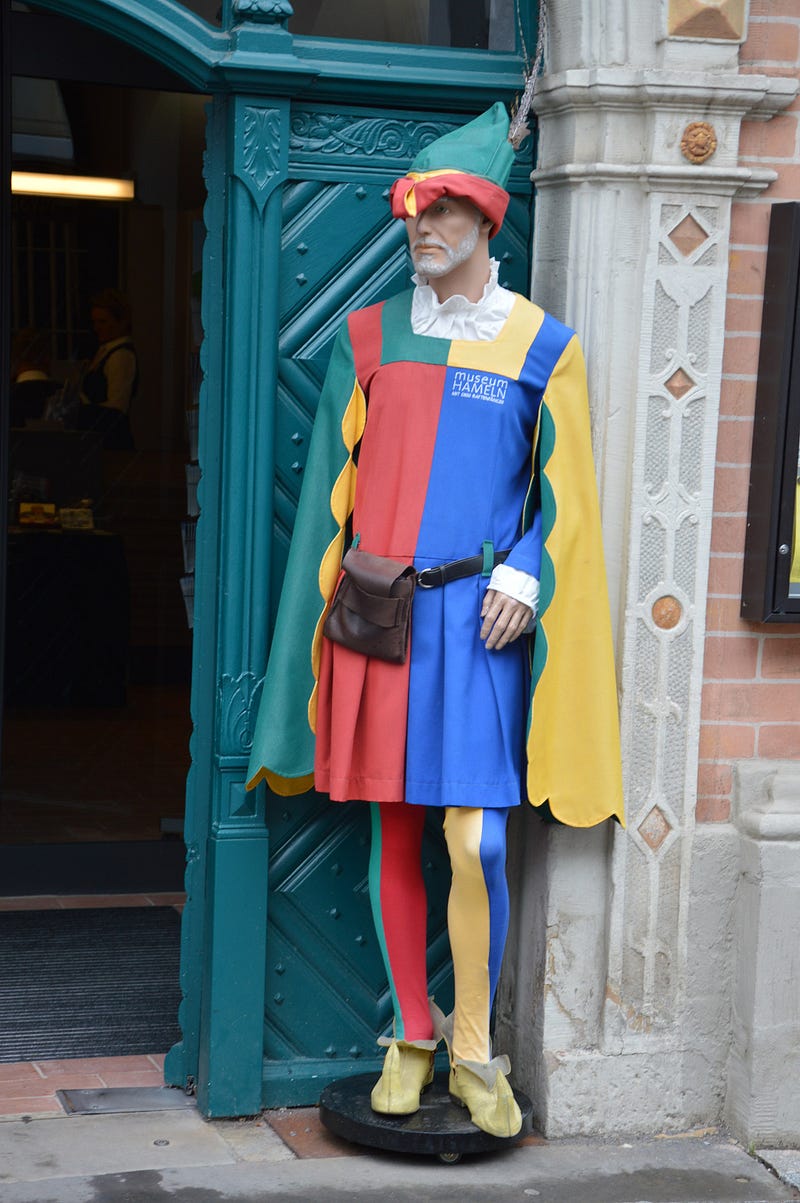
If you didn’t know, pied means “many colors”
Maybe he was a successful troubadour in elaborate clothing. Perhaps he was just a poor musician, patched together like Dolly Parton’s coat of many colors. We’ll never know. We don’t know much about the man at all.
We only know what he did.
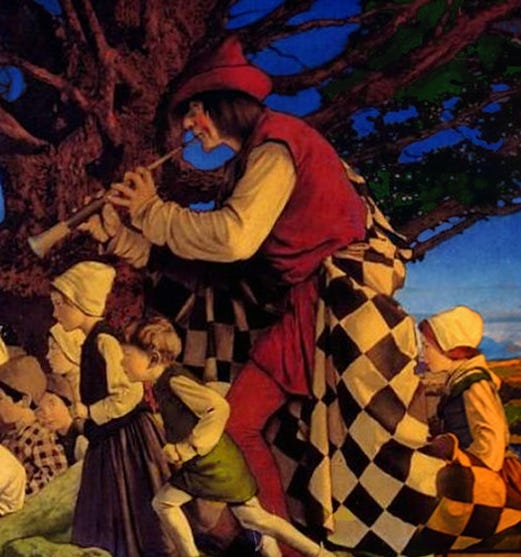
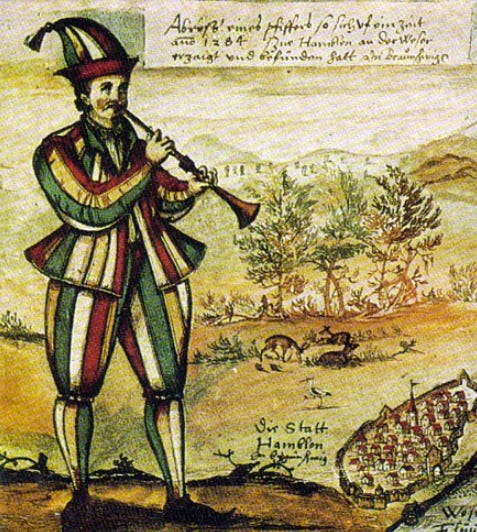
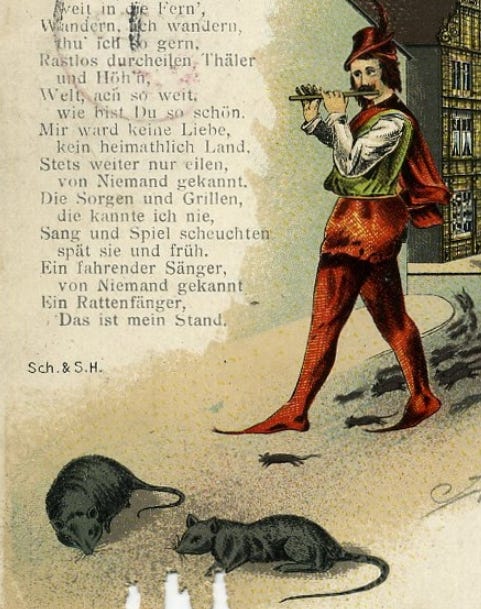
The story became legend. It was told by Jacob and Wilhelm Grimm in 1812, written as a children’s book by Robert Browning in 1888 and even Johann Wolfgang von Goethe wrote his version.
The key telling was by the Grimm brothers because they weren’t storytellers. They didn’t make up fairy tales. They were historians, doing their best to write down oral history passed from one generation to another.
According to their version, the Pied Piper showed up in Hamelin one day and said he could rid the town of rats. Desperate, the mayor offered 1000 guilders if he could deliver on that promise.
He did, of course. Led the rats to the water and drowned them.
Then the mayor had the gall to pay him a mere 50 guilders and laughed at the idea of giving him more. “For playing music?” he laughed. The piper left, feeling cheated and angry.
On June 26, the day of St John and St Paul, the piper returned. Standing in the center of town, he raised his pipe and began to play. And the children ran to follow.
Robert Browning re-wrote the Grimm Brother’s story in 1888. In his version, he says the parents just stood and watched as their children danced and skipped away. Remember that, okay? It’s an important detail.
Browning’s book had charming illustrations drawn by artist Kate Greenaway and quickly became a beloved classic.
But make no mistake. It was no fairy tale.
The story was based on a historical incident that traumatized a small town for centuries. 130 children disappeared that day and never came back.
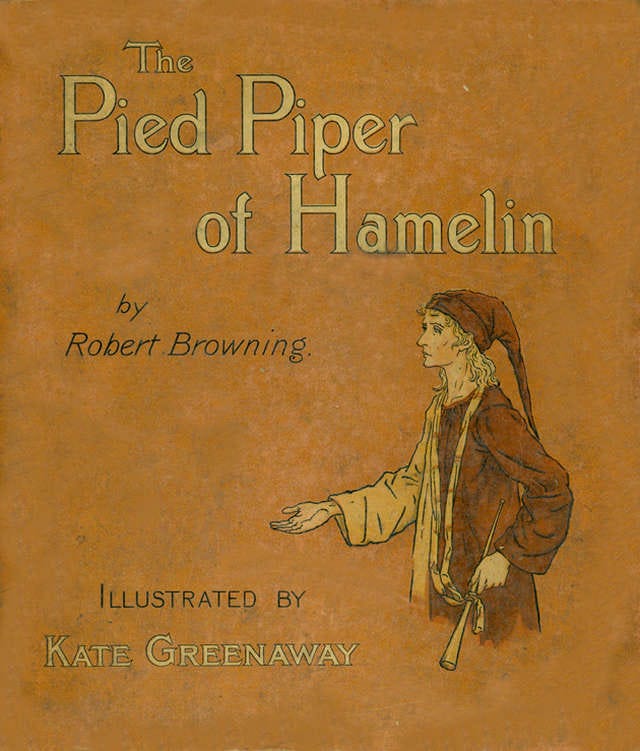
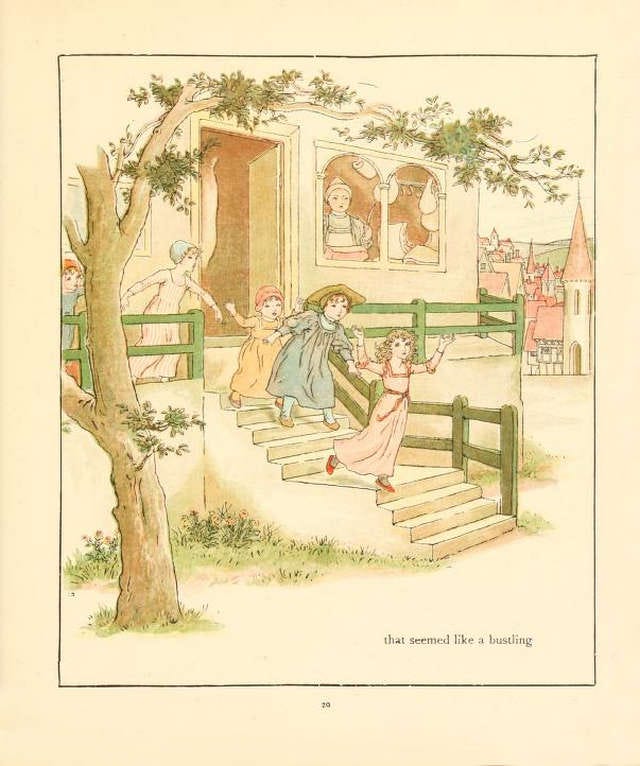
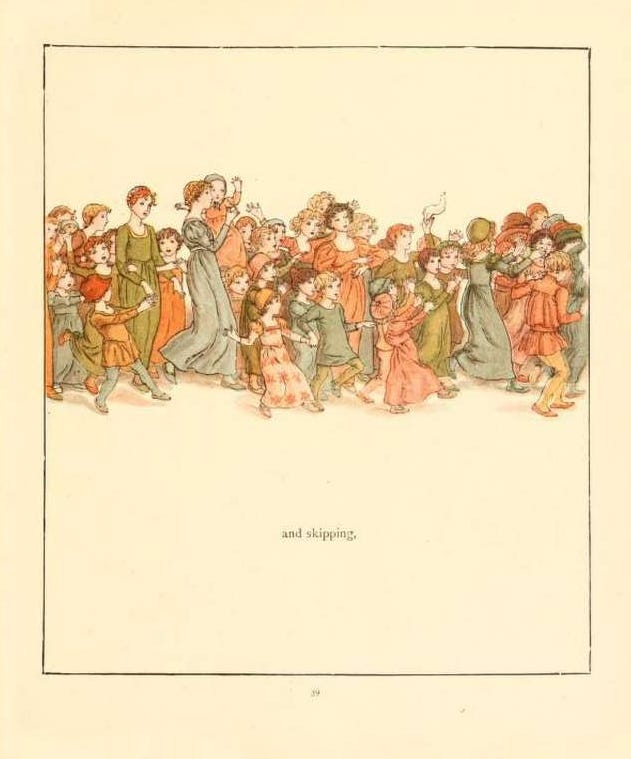
It was no fairy tale…
The proof is etched all over the little town of Hamelin. Quite literally. First, there was the inscription on the wall of the Town Hall. It read:
“In the year 1284 after the birth of Christ From Hamelin were led away One hundred thirty children, born at this place Led away by a piper into a mountain.”
Looking through historical records, there’s a message, written in elegant handwriting in the town hall records, dated June 26, 1384. It reads:
“It is 100 years since our children left.”
The story was memorialized in a stained glass window in the town church. The original church was destroyed in 1660, and the window with it. But while the original stained glass window is long gone, written accounts of it still exist. A painting of the stained glass window still exists, too.
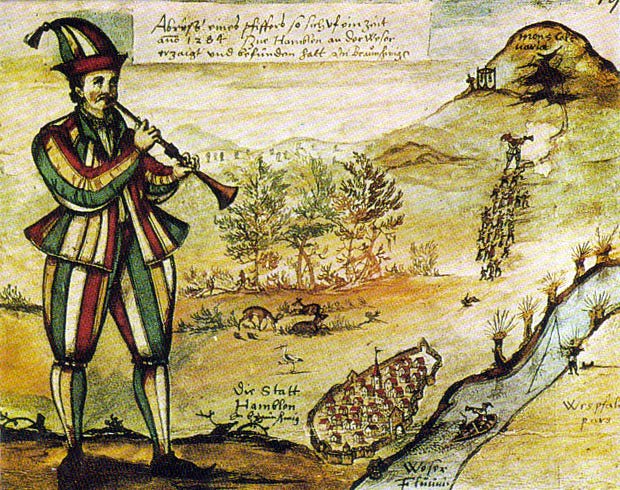
The inscription on the stained glass church window read:
“On the day of John and Paul 130 children in Hameln went to Calvary and were brought through all kinds of danger to the Koppen mountain and lost.”
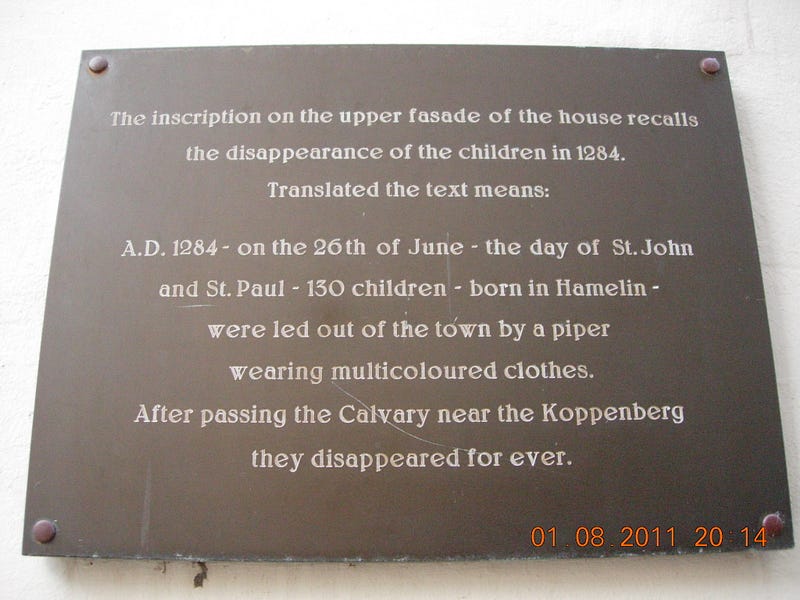
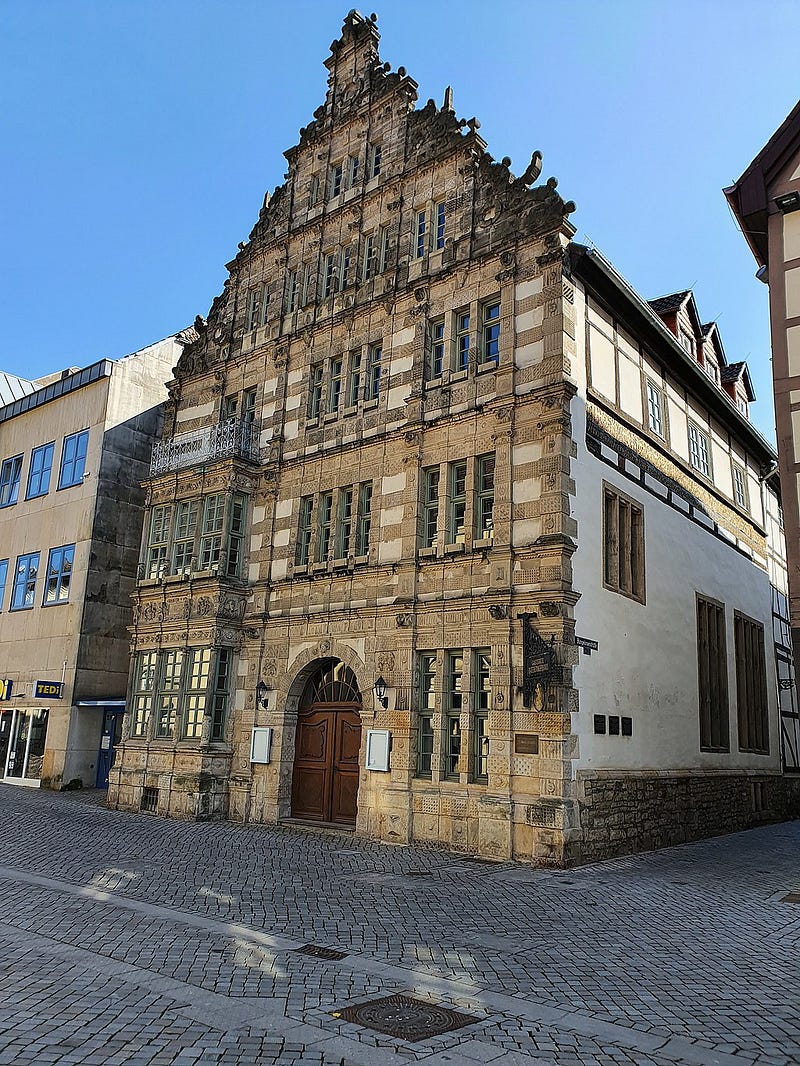
Last, but not least, an inscribed plaque on the stone façade of the building that would become Pied Piper house reads:
“A.D. 1284 on the 26th of June — the day of St John and St Paul — 130 children born in Hamelin were led out of the town by a piper wearing multicoloured clothes. After passing the Calvary near the Koppenberg they disappeared forever.” — plaque at Pied Piper House
They were never forgotten…
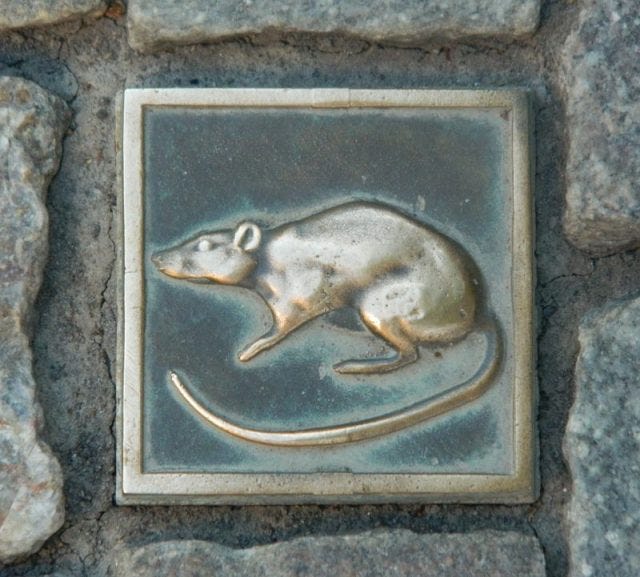
Over 700 years later, the people of Hamelin (now Hameln) have never forgotten the children that disappeared that day. A plaque still honors their memory and through the streets, bronze “rat plaques” mark important historical spots in the story.


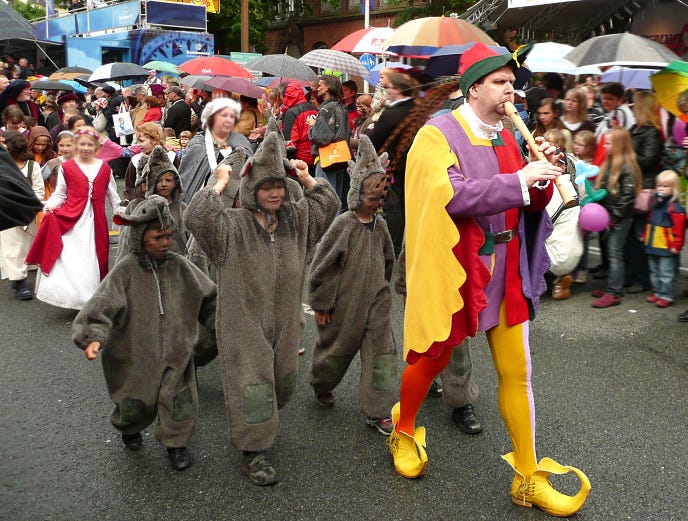
Every year, they have a Pied Piper parade on June 26, the date the children went missing. A pied piper leads the parade and bakeries make little rat-shaped sweet buns that will quickly “disappear” from the town.
The Legend of the Pied Piper is so famous and important to the region that it’s even protected by UNESCO.

But wait… what happened to the children?
For years, historians didn’t really know. There were many hypotheses, but one by one, research would prove them wrong.
Some historians thought the children died of the plague and the Pied Piper was a reference to death. Problem was, the dates didn’t add up. And there were no adult deaths of the plague at that time, either.
Another suggested the piper was a pedophile who murdered them, but that was ruled out, too. No bodies were found. And how would one man subdue 130 children at the same time? Nope. That wasn’t it.
So many theories, I could write an entire story about them. But they were all proven wrong, one after another.
Truth is stranger than fiction…
Turns out June 26 wasn’t just the day the children disappeared. It was also the day of a pagan midsummer celebration. A piper would show up and merrily lead people into the hills (koppen) for a midsummer fire-lighting ceremony.
Interesting, right?
But wait. It gets better.
Fairy tale scholar Jack David Zipes found evidence that someone came to Hamelin that summer, looking for people to colonize parts of Eastern Europe.
Recruiting people to migrate was a common practice, especially in times of hardship. No different than the way people migrated to California, the “land of opportunity” during the Dirty 30s and the great depression.
In medieval Germany, recruiters wore colorful (pied) clothing and played a flute, so people who wanted to migrate could hear them and follow along in the merry procession.
Entire families who were struggling would join into the festive parade and dance away, into the hills. Never to be seen again.
A German linguist named Jürgen Udolph wondered if the children of Hamlin had followed a flutist — not to a midsummer fire lighting ceremony — but as part of a migration.
Can you even imagine that possibility? That maybe, just maybe, they followed the wrong piper?
That instead of following the piper leading them to the midsummer fire ceremony, they followed the piper leading a migration? The recruiter, seeing adults and children following, would have thought nothing of it.
And the children’s parents just watched, thinking their kids were off to a midsummer celebration in the hills.
It’s almost beyond belief, isn’t it?
Surely, this theory must be as crazy as all the others. Surely, the research would prove it to be wrong.
And yet, his hunch seems to check out. According to place-name evidence, the most common surnames in Hamelin at the time the children disappeared appear with shocking frequency in the areas of Uckermark and Prignitz, near Berlin. They were the destinations of the migration tour.
And the rats? No one led them away…
There were rats, of course. But no one played a pipe and led the rats away. They just kept on making life miserable until sanitation became a thing.
According to historians who were trying to figure out what happened to the children, the rats were added to the Pied Piper story in 1559.
The rats didn’t even appear in earlier versions of the Pied Piper story. They were added 275 years after the children disappeared.
Why? Who knows? Maybe it was an easier story to believe or tell if the town was being punished for not “paying the piper” so to speak.
Maybe it was just too harsh to think that a piper showed up and their children followed him into the hills and never came back. Even though that’s exactly what happened, as it turns out.
No one led the rats out of town and took the children as punishment. That’s not how it happened.
But if those rats hadn’t been added to the story, it’s possible there’d be no annual Pied Piper Parade and no one telling the story of those children still today. They’d have been forgotten hundreds of years ago.
