avatarZia Steele

Free AI web copilot to create summaries, insights and extended knowledge, download it at here

11272

Abstract

led or attracted in just one direction by applying an electric field. Here’s a video demonstrating that effect:</p> <figure id="1a02"> <div> <div> <img class="ratio" src="http://placehold.it/16x9"> <iframe class="" src="https://cdn.embedly.com/widgets/media.html?src=https%3A%2F%2Fwww.youtube.com%2Fembed%2FlF0M-Tr640E%3Ffeature%3Doembed&amp;display_name=YouTube&amp;url=https%3A%2F%2Fwww.youtube.com%2Fwatch%3Fv%3DlF0M-Tr640E&amp;image=https%3A%2F%2Fi.ytimg.com%2Fvi%2FlF0M-Tr640E%2Fhqdefault.jpg&amp;key=a19fcc184b9711e1b4764040d3dc5c07&amp;type=text%2Fhtml&amp;schema=youtube" allowfullscreen="" frameborder="0" height="480" width="854"> </div> </div> </figure></iframe></div></div></figure><p id="babd">Using these processes precisely enough, a firebender with control over the flow of electricity could move flames in pretty much anyway they wanted. This goes for the flames they produce themselves, but also flames occurring naturally or being produced by other benders.</p><figure id="592d"><img src="https://cdn-images-1.readmedium.com/v2/resize:fit:800/1*0rxJqquzweGdO74sSA0B4w.gif"><figcaption>Image Credit: <a href="https://imgur.com/gallery/JWkLR4m">Nickelodeon</a></figcaption></figure><figure id="2e93"><img src="https://cdn-images-1.readmedium.com/v2/resize:fit:800/1*sB1Zj7OV0y52G5bGrMxIlQ.gif"><figcaption>Image Credit: <a href="https://www.douxreviews.com/2019/05/avatar-last-airbender-season-3.html">Nickelodeon</a></figcaption></figure><p id="d43b">A common image we see in fights between firebenders is the flames produced by one bender pushing against the flames of the other. I suspect that what would really be happening here is firebenders changing the direction in which the electric currents they’re creating flow. They do this to change the alignment of the magnetic fields created by each circuit so they’re the same as most of the nearby circuits being created by the other firebender in their flames. The circuits’ magnetic fields would then mostly repel each other, moving apart and dragging the flames with them. This effect would result in the flames appearing to push on one another.</p><figure id="1fb2"><img src="https://cdn-images-1.readmedium.com/v2/resize:fit:800/1*0AeKwBQ3_AXjeFlVK9Qs1Q.gif"><figcaption>Image Credit: <a href="https://steamcommunity.com/sharedfiles/filedetails/?id=787460745">Nickelodeon</a></figcaption></figure><p id="8d66">Strong enough electric currents can actually extinguish flames, so firebenders would be able to put out existing fires. The atoms from the flames remain ionized even after the flame goes out, so firebenders would also be able to control the motion of smoke.</p><h1 id="bf0c">Combustionbending</h1><figure id="7632"><img src="https://cdn-images-1.readmedium.com/v2/resize:fit:800/1*rrtD9skgTAIrUqflROvsCQ.png"><figcaption>Image Credit: Nickelodeon</figcaption></figure><p id="2b81">Now that we know how regular firebending works, we can get into advanced techniques. One such technique is combustionbending, which is somewhat misleadingly named since all nearly all firebending would be a form of combustion. Regardless, combustionbenders appear to be firing a beam of either heat, hot gas or plasma directly to a concentrated point for it to expand all at once. My hypothesis is that this beam is actually hydrogen fire, which burns less brightly than other fires and is harder to see. But if the fire is less hot, how can it be creating such big explosions? Well, I think what’s happening is that so much hydrogen fire is being produced so fast and then moved so quickly that the small volume it ends up in before exploding has an extremely high pressure and thermal energy. The fire is kept corralled into tight spaces with firebending, so tight the pressure differential between the compact flames and surrounding air produces a powerful shock wave when the flames are released.</p><figure id="c254"><img src="https://cdn-images-1.readmedium.com/v2/resize:fit:800/1*s4-8SROZIJemVqltk2giWA.gif"><figcaption>Image Credit: <a href="https://comicvine.gamespot.com/forums/battles-7/voting-open-cav-aang-korra-bumi-arcus1-vs-ozai-zuk-1788457/">Nickelodeon</a></figcaption></figure><p id="4b43">The rings we see pop out of the beam as it travels could be fire escaping into the lower pressure air. Perhaps combustionbenders have to let some fire out or else the explosion happens too early.</p><h1 id="d17c">Fire Propulsion</h1><figure id="90ed"><img src="https://cdn-images-1.readmedium.com/v2/resize:fit:800/1*2nolCPnaTrgR5-YJlWBWCg.gif"><figcaption>Image Credit: Nickelodeon</figcaption></figure><p id="a801">Fire propulsion works a bit differently from the way I described water propulsion working in an earlier post. First, a firebender produces flames. Then, they create electric fields in their bodies that repel electrons away from their body in the opposite of the direction they want to move. These electrons attract the positively charged ions in the flames, so the flames get pulled along with the electrons. As the fire shoots off in one direction, the firebender is pushed the other way thanks to Newton’s 3rd law of motion. I’m especially glad I was able to think of an explanation for this move because it’s a very common trope for pyrokinetics, and it’s awesome!</p><figure id="ef65"><img src="https://cdn-images-1.readmedium.com/v2/resize:fit:800/1*M_mlGKRCYKzjoZbwxtFjJA.gif"><figcaption>Really Awesome…</figcaption></figure><figure id="4571"><img src="https://cdn-images-1.readmedium.com/v2/resize:fit:800/1*mTPrn1hgSlmWCX1QpnpkbA.png"><figcaption>Image Credits: Nickelodeon</figcaption></figure><h1 id="bc34">Fire Whirls</h1><figure id="302c"><img src="https://cdn-images-1.readmedium.com/v2/resize:fit:800/1*FmZIDv9g34qG01WhAc6dqA.gif"><figcaption>Image Credit: <a href="http://rebloggy.com/post/1k-aang-avatar-avatar-the-last-airbender-gif-set-firebending-ozai-airbending-wa/43496750559">Nickelodeon</a></figcaption></figure><p id="abb1">Fire whirls are real events that usually occur during forest fires. They happen because hot air rising from the fire moves so rapidly it creates a strong wind. More air rushes into the rising column and adds angular momentum which gets the fire spinning. This is what they look like in real life:</p><figure id="c454"><img src="https://cdn-images-1.readmedium.com/v2/resize:fit:800/1*_JJcdxW6gRxkTuxLt4Gjpw.gif"><figcaption>Image Credit: <a href="https://giphy.com/gifs/digg-slowmotion-fire-tornado-eocHVeNTdsyxG">Digg</a></figcaption></figure><p id="9630">Fire whirls burn hotter than normal fires because they suck in more oxygen. Firebenders creating fire whirls like these would unleash a lot of energy. Not only that, the attacks would carry more momentum because they would be drawing in more mass and expanding rapidly along the axis of rotation.</p><figure id="6c0c"><img src="https://cdn-images-1.readmedium.com/v2/resize:fit:800/1*Hfa2WtO4rfCJeKavX0P3mQ.gif"><figcaption>Image Credit: <a href="https://weheartit.com/entry/289136392">Nickelodeon</a></figcaption></figure><p id="9764">However, fire whirls could also be used to attack opponents indirectly by creating strong gusts of hot wind. A firebender may choose to do this in order to increase the area that gets caught in their attack or to push an opponent back without having to burn them. We see this happen in the episode <i>Zuko Alone</i>, where Zuko creates a fire whirl that pushes his opponent back without burning him. He later uses a similar move in a training fight with Aang.</p><figure id="5d35"><img src="https://cdn-images-1.readmedium.com/v2/resize:fit:800/1*3G7aaTlW9OQEpZCQZ_ftfw.png"><figcaption>Image Credit: Nickelodeon</figcaption></figure><h1 id="2e01">Lighting Generation and Redirection</h1><figure id="d762"><img src="https://cdn-images-1.readmedium.com/v2/resize:fit:800/1*vjSwcE3Crl7FVJm3V0yXwQ.gif"><figcaption>Image Credit: <a href="https://blacknerdproblems.com/legend-of-korra-recap-the-last-stand-series-finale/">Nickelodeon</a></figcaption></figure><p id="3b40">We’ve already mentioned that firebenders need to generate electric currents to firebend. Since lightning happens as a result of electricity moving through air, producing lightning would mean producing a high enough voltage to overcome the electrical resistance of air. However, firebenders could do this much more easily by sending lighting through their flames. Since flames are partially ionized, it’s actually easier to send electricity through a flame than through air. This video demonstrates the effect:</p> <figure id="ba14"> <div> <div> <img class="ratio" src="http://placehold.it/16x9"> <iframe class="" src="https://cdn.embedly.com/widgets/media.html?src=https%3A%2F%2Fwww.youtube.com%2Fembed%2Fa7_8Gc_Llr8%3Ffeature%3Doembed&amp;display_name=YouTube&amp;url=https%3A%2F%2Fwww.youtube.com%2Fwatch%3Fv%3Da7_8Gc_Llr8&amp;image=https%3A%2F%2Fi.ytimg.com%2Fvi%2Fa7_8Gc_Llr8%2Fhqdefault.jpg&amp;key=a19fcc184b9711e1b4764040d3dc5c07&amp;type=text%2Fhtml&amp;schema=youtube" allowfullscreen="" frameborder="0" height="480" width="854"> </div> </div> </figure></iframe></div></div></figure><p id="e3eb">If firebenders send electricity through flames to produce lightning, it explains how they’re able to control its motion through the air and redirect it. Redirecting lightning just means creating a path of flames for the electricity to travel through. This also explains why it’s possible for characters in the show to react to lighting at all. Lightning in nature moves at 200,000 miles per hour(way too fast to dodge or see coming). Firebender lightning seems to move much slower than natural lightning, which is likely because the flames the lightning is traveling through don’t move as fast. The lightning attacks we see in the show aren’t single lightning strikes, but repeated bolts of lightning, each one travelling as far as it can before it runs out of fire to move through. The lightning only reaches its target once the flames reach their target. This concept also explains why lightning in the show appears fluid and tangible. We’re actually seeing flames which conduct great amounts of electricity.</p><figure id="018d"><img src="https://cdn-images-1.readmedium.com/v2/resize:fit:800/1*ybw3JWvlo-Hh-1bVqW-_sQ.gif"><figcaption>Image Credit: <a href="https://www.pinterest.com/pin/839569555505897166/">Nickelodeon</a></figcaption></figure><p id="09fc">Perhaps we don't see the flames themselves because they’re not particularly bright. A dim flame like the one from a hydrogen fire would still be better at conducting electricity than air. Hydrogen fires involve fewer atoms than other types of combustion, so they’d take less energy to create. Firebenders would want to use weaker flames for lighting direction so they could save energy for generating the lightning itself. Any light the hydrogen fire did give off would be drowned out by the brightness of the lightning moving through it.</p><h1 id="fdb4">Creating Different Colors of Fire</h1><figure id="08ab"><img src="https://cdn-images-1.readmedium.com/v2/resize:fit:800/1*jeBer9KquG4oWjIyMHpmsQ.pn

Options

g"><figcaption>Image Credit: Nickelodeon</figcaption></figure><p id="b957">I already talked about the four main colors of fire in the show —yellow, orange, red-orange and blue — and wouldn’t have even included this section if not for this seen:</p><figure id="4cad"><img src="https://cdn-images-1.readmedium.com/v2/resize:fit:800/1*DV-R79lg0D6vXAESXE6lpQ.png"><figcaption>Image Credit: Nickelodeon</figcaption></figure><p id="b22b">Here, we see the original firebenders producing red, yellow, orange, green and purple flames. Usually flames take on unusual colors because of the material being burnt. The simplest explanation is that the dragons are expelling chemicals that give the fire these colors. However, Zuko later goes on to create the same colors of fire in the canon comic book <i>Smoke and Shadow. </i>So this coloring of fire must have something to do with how the fire is being bent and not what is being burned. I can think of two ways this is happening.</p><ol><li>The dragons are controlling the temperature of the flames so well using electromagnetic fields that they can create regions in fire that burn at different temperatures without heat flowing between them. These different sections of flame would emit different frequencies of light similar to the red, blue and green pixels on a computer screen. In this case, the <b>pixel flames </b>would be emitting blue, red, orange and yellow light. There wouldn’t be any green or purple light being emitted. Anyone looking would just see a mix of blue and red or blue and yellow and their brains would interpret it as purple or green respectively. This is the less likely scenario as it would likely require a much more insane amount of energy to pull off.</li><li>The dragons use electromagnetic forces to control the energy levels of free-floating electrons in the flames. Different materials produce flames of different colors because their atomic structure only allows electrons to change in energy by certain amounts. The amount of energy lost by electrons determines the frequency of light emitted. When electrons are unbound from atoms, they gain access to a far greater number of energy levels and can emit more distinct frequencies of light. If firebenders could directly affect the energy of electrons when unbounded using electromagnetism, they could control the exact frequency of light emitted, possibly including colors like green and violet. This is the more straightforward and likely option.</li></ol><h1 id="39d2">Drawing Energy from the Sun</h1><figure id="2269"><img src="https://cdn-images-1.readmedium.com/v2/resize:fit:800/1*HhNkShcOl4k6XCR1oMI6mw.png"><figcaption>Image Credit: Nickelodeon</figcaption></figure><p id="e369">Firebenders supposedly harness energy directly from sunlight. If the quasiparticles emitted by benders interact with photons of light, they could gain energy. That energy could then be transferred to a firebender via electromagnetic induction. The excited quasiparticles would produce changing magnetic fields, which would then produce electric currents carrying useful energy. This would make firebenders sort of like photovoltaic cells, which convert energy from light into electrical energy. Firebenders must be able to store this energy over time, otherwise they wouldn’t be able to bend at night. As for them losing their bending during a solar eclipse, that makes no sense because it suggests they should also lose their bending at night when the Earth is between them and the Sun. Let’s just chock that up to spirit magic.</p><figure id="837c"><img src="https://cdn-images-1.readmedium.com/v2/resize:fit:800/1*uTqkRq16mmDJ_tZWryfnHg.gif"><figcaption>Image Credit: <a href="https://www.pinterest.com/pin/406520303836656615/">Nickelodeon</a></figcaption></figure><p id="5ff2">That concludes our look at the physics of firebending.</p><figure id="2d7d"><img src="https://cdn-images-1.readmedium.com/v2/resize:fit:800/1*NmcyQ3zxg9_a-Jx2uuIk_Q.gif"><figcaption>Image Credit: <a href="https://funnyjunk.com/channel/Tumblr-Content/Avatar/xgTsLkt/40">Nickelodeon</a></figcaption></figure><p id="26ad">In my next post, I’ll look into the physics of airbending. As always, let me know anyways I could improve my hypotheses from this post or better explain them. See you next time.</p><p id="dc9d"><i>Works Cited</i></p><p id="297b">DiMartino, M. D., & Konietzko, B. (Writers). (2010, June 30). <i>Avatar: The Last Airbender</i> [Television series]. Nickelodeon.</p><p id="6a1a">DiMartino, M. D., & Konietzko, B. (Writers). (2012, April 14). <i>The Legend of Korra</i> [Television series]. Nickelodeon.</p><p id="e903">Konietzko, B., & Yang, G. L. (n.d.). <i>Avatar: The Last Airbender: Smoke and Shadow Part One</i>. Dark Horse Comics.</p><p id="d554">Steele, Z. (2020, August 05). The Physics of Avatar: The Last Airbender and The Legend of Korra. Retrieved August 05, 2020, from <a href="https://readmedium.com/the-physics-of-avatar-the-last-airbender-and-the-legend-of-korra-1c212efb4b9a">https://readmedium.com/the-physics-of-avatar-the-last-airbender-and-the-legend-of-korra-1c212efb4b9a</a></p><p id="3c4b">Steele, Z. (2020, August 05). The Physics of Avatar: The Last Airbender and The Legend of Korra. Retrieved August 05, 2020, from <a href="https://readmedium.com/the-physics-of-avatar-the-last-airbender-and-the-legend-of-korra-1c212efb4b9a">https://readmedium.com/the-physics-of-avatar-the-last-airbender-and-the-legend-of-korra-1c212efb4b9a</a></p><p id="26e6">Reich, H. (Producer). (2011, September 11). <i>What is fire?</i> [Video file]. Retrieved August 5, 2020, from <a href="https://www.youtube.com/watch?v=1pfqIcSydgE">https://www.youtube.com/watch?v=1pfqIcSydgE</a></p><p id="de88">Hahn, E. (n.d.). Eric Hahn. Retrieved August 05, 2020, from <a href="https://www.elgas.com.au/blog/1585-why-does-a-gas-flame-burn-blue-lpg-gas-natural-propane-methane">https://www.elgas.com.au/blog/1585-why-does-a-gas-flame-burn-blue-lpg-gas-natural-propane-methane</a></p><p id="95d6">Alkanes. (2020, July 14). Retrieved August 05, 2020, from <a href="https://chem.libretexts.org/Bookshelves/Organic_Chemistry/Supplemental_Modules_(Organic_Chemistry)/Hydrocarbons/Alkanes">https://chem.libretexts.org/Bookshelves/Organic_Chemistry/Supplemental_Modules_(Organic_Chemistry)/Hydrocarbons/Alkanes</a></p><p id="5aea">Alkanes. (n.d.). Retrieved August 05, 2020, from <a href="https://ef.engr.utk.edu/hyperphysics/hbase/Organic/alkane.html">https://ef.engr.utk.edu/hyperphysics/hbase/Organic/alkane.html</a></p><p id="2707">Chemical Recombination. (2020, June 26). Retrieved August 05, 2020, from <a href="https://www.nrc.gov/reading-rm/basic-ref/glossary/chemical-recombination.html">https://www.nrc.gov/reading-rm/basic-ref/glossary/chemical-recombination.html</a></p><p id="a640">Muller, D. (Producer). (2012, September 11). <i>What’s In A Candle Flame?</i> [Video file]. Retrieved August 5, 2020, from <a href="https://www.youtube.com/watch?v=a7_8Gc_Llr8&amp;feature=share">https://www.youtube.com/watch?v=a7_8Gc_Llr8&amp;feature=share</a></p><p id="cd0b"><i>Controlling Fire With My Hands Using a Wimshurst Machine</i> [Video file]. (2019, December 22). Retrieved August 5, 2020, from <a href="https://www.youtube.com/watch?v=lF0M-Tr640E&amp;feature=share">https://www.youtube.com/watch?v=lF0M-Tr640E&amp;feature=share</a></p><p id="2371">How Does a Photovoltaic Cell Work? (n.d.). Retrieved August 06, 2020, from <a href="https://www.planete-energies.com/en/medias/close/how-does-photovoltaic-cell-work">https://www.planete-energies.com/en/medias/close/how-does-photovoltaic-cell-work</a></p><p id="152b">Zawischa, D. (n.d.). Fire and glow — the black body. Retrieved August 06, 2020, from <a href="https://www.itp.uni-hannover.de/fileadmin/arbeitsgruppen/zawischa/static_html/blackbody.html">https://www.itp.uni-hannover.de/fileadmin/arbeitsgruppen/zawischa/static_html/blackbody.html</a></p><p id="efbd">Muller, D. (Producer). (2013, June 24). <i>Can We Really Touch Anything?</i> [Video file]. Retrieved August 5, 2020, from <a href="https://www.youtube.com/watch?v=bKldI-XGHIw&amp;feature=share">https://www.youtube.com/watch?v=bKldI-XGHIw&amp;feature=share</a></p><p id="2f01">The Action Lab (Producer). (2019, May 6). <i>How to Make a Cold Fire Torch That You Can Touch and Not Get Burned!</i>[Video file]. Retrieved August 5, 2020, from <a href="https://www.youtube.com/watch?v=DnSRbnvm798">https://www.youtube.com/watch?v=DnSRbnvm798</a></p><p id="b7fc">Afework, B., Campbell, A., Fedechko, R., Hanania, J., Heffernan, B., Jenden, J., . . . Donev, J. (2020, January 31). Hydrocarbon combustion. Retrieved August 06, 2020, from <a href="https://energyeducation.ca/encyclopedia/Hydrocarbon_combustion">https://energyeducation.ca/encyclopedia/Hydrocarbon_combustion</a></p><p id="8e03">Hanania, J., Jenden, J., Stenhouse, K., & Donev, J. (2019, February 24). Petroleum. Retrieved August 06, 2020, from <a href="https://energyeducation.ca/encyclopedia/Petroleum">https://energyeducation.ca/encyclopedia/Petroleum</a></p><p id="0d83">Types of Fires. (n.d.). Retrieved August 06, 2020, from <a href="https://www.femalifesafety.org/types-of-fires.html">https://www.femalifesafety.org/types-of-fires.html</a></p><p id="9439">Hydrogen Flames: Hydrogen Tools. (n.d.). Retrieved August 06, 2020, from <a href="https://h2tools.org/bestpractices/hydrogen-flames">https://h2tools.org/bestpractices/hydrogen-flames</a></p><p id="5763">The Editors of Encyclopaedia Britannica. (2018, July 27). Shock wave. Retrieved August 06, 2020, from <a href="https://www.britannica.com/science/shock-wave">https://www.britannica.com/science/shock-wave</a></p><p id="6976">Patrick, M. (Producer). (2017, July 11). <i>Game Theory: POKEMON — The TERRIFYING TRUTH of Fire Pokemon</i> [Video file]. Retrieved August 5, 2020, from <a href="https://www.youtube.com/watch?v=fBn6uh-GYwQ&amp;list=LLwXdnmrGRxRWfUtXZRqbUXg&amp;index=134">https://www.youtube.com/watch?v=fBn6uh-GYwQ&amp;list=LLwXdnmrGRxRWfUtXZRqbUXg&amp;index=134</a></p><p id="e378">Fire Whirl. (2020, April 6). Retrieved August 06, 2020, from <a href="https://www.skybrary.aero/index.php/Fire_whirl">https://www.skybrary.aero/index.php/Fire_whirl</a></p><p id="beef">Lallanilla, M. (2014, May 16). Whirling Flames: How Fire Tornadoes Work. Retrieved August 06, 2020, from <a href="https://www.livescience.com/45676-what-is-a-firenado.html">https://www.livescience.com/45676-what-is-a-firenado.html</a></p><p id="d5bd">National Geographic. (2009, October 09). Lightning Facts and Information. Retrieved August 06, 2020, from <a href="https://www.nationalgeographic.com/environment/natural-disasters/lightning/">https://www.nationalgeographic.com/environment/natural-disasters/lightning/</a></p><p id="1059">Dunbar, Brian. “Water Vapor Confirmed as Major Player in Climate Change.” <i>NASA</i>, NASA, 17 Nov. 2008, <a href="http://www.nasa.gov/topics/earth/features/vapor_warming.html.">www.nasa.gov/topics/earth/features/vapor_warming.html.</a></p><p id="bf09">Science Buddies. “Splitting Water.” <i>Scientific American</i>, Scientific American, 7 Apr. 2016, <a href="http://www.scientificamerican.com/article/splitting-water/.">www.scientificamerican.com/article/splitting-water/.</a></p></article></body>

The Physics of Firebending

The Physics of Avatar: The Last Airbender and The Legend of Korra

Spoiler Warning for Avatar: The Last Airbender and The Legend of Korra (Image Credit: Nickelodeon)

Let’s continue our journey into the physics of bending with the element of power, fire.

I recommend you read my first three posts on the physics of Avatar and Korra if you haven’t already. It will be important for understanding the rest of this series.

Heating without Fire
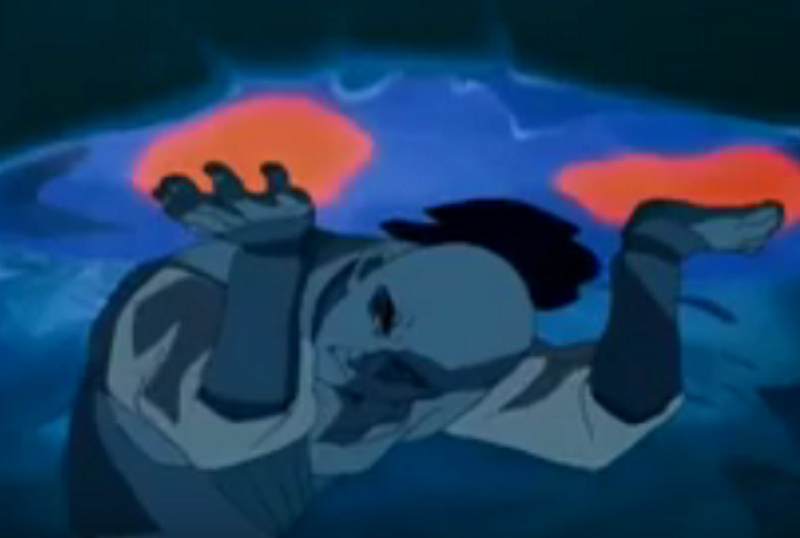
Image Credit: Nickelodeon

The simplest thing firebenders can do is to heat things up. They have even been shown doing this without producing flames. Under our running hypothesis that benders utilize electricity and magnetism, we can deduce that firebenders do this simply by running an electric current through the material they’re heating. Since electricity doesn’t move through most materials with perfect efficiency, some of the electrical energy from a current becomes thermal energy that heats up its surroundings.

Heat Absorption and Redirection
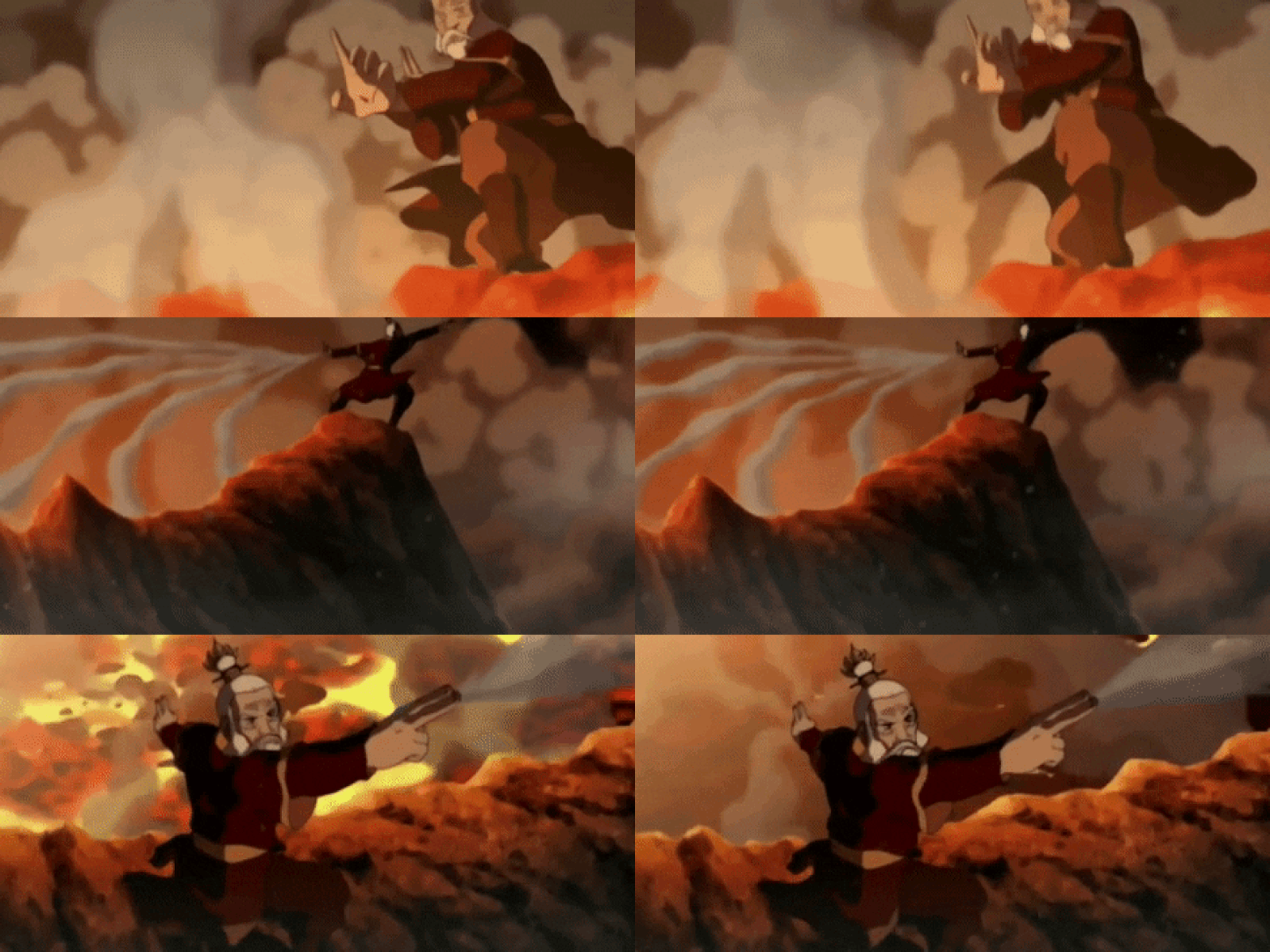
Image Credit: Nickelodeon

In addition to heating up objects, firebenders can also cool them down. They likely do this by applying electric charges at the atomic level that slow down the motion of a substance’s particles. This would be very similar to the way waterbenders freeze water into ice. The energy from the atoms beign cooled down would need to go somewhere, so it would be converted into kinetic energy of the particles creating the electric fields. The firebenders could then move these charge particles away from the material being cooled, carrying away heat with them. For the particles of the material being cooled to be affected by electric fields, the benders would first need to charge them through ionization.

Firebenders would be able to use this technique to cool their own flames. Many of the atoms in flames are already ionized and would already be susceptible to electric fields. Since atomic nuclei are more massive than electrons, properly positioned electric fields may slow them down while pushing electrons faster and in new directions. Slowing down the nuclei would cool the flames but leave the tiny electrons moving very fast. Since thermal energy is proportional to mass, the electrons being at a high temperature wouldn’t necessarily make the flame hot. It would remain a flame though because its state of matter would still be what’s known as a partial plasma. Firebenders may wish to cool their flames when training so as not to burn their opponents. Here is a video about creating cold partial plasmas:

Creating, Sustaining and Intensifying Fire
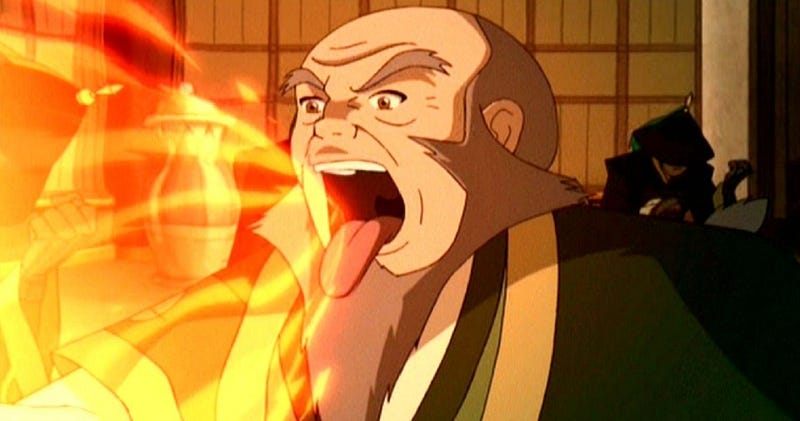
Image Credit: Nickelodeon

Firebending is unique because fire isn’t so much a physical substance as it is an ongoing chemical reaction. The actual flames you see are the products of the reaction between some fuel source and oxygen. The flame is hot and visible because some of the energy that was stored in the chemical bonds of the reactants is released as heat, light and sound. Understanding what fire is, we can deduce that firebenders create fire in three steps. First, they use precisely controlled electric currents to ionize carbon dioxide, hydrogen and oxygen molecules in air. They then use electric fields to recombine the ionized atoms with the free electrons and form new molecules. The collisions between the particles that form these molecules leave them with a high kinetic energy, meaning they have the necessary energy to spontaneously combust. Finally, the molecules formed from the ions spontaneously combust and become carbon dioxide and water vapor. These reactants are what you see in the flames. The molecules that the firebenders form for combustion are likely alkanes, such as methane and propane, as well as other hydrocarbons, like petroleum, plus oxygen and water as a waste product. This explanation means that firebenders literally make the fuel for their fire out of thin air. Here’s an example of one of the possible reactions firebenders could be casuing:


E1 is the energy to ionize the initial molecules and E2 is the energy to force the ions to recombine into high temperature reactants for combustion.
Image Credit: Nickelodeon

Now it’s important we talk about the type of combustion going on. Based on the colors of fire we see in Avatar, it seems that most firebenders are using incomplete combustion. This is combustion where the reaction doesn’t receive enough oxygen and burns yellow or red. These flames are less hot than those of complete combustion, which is when fire can get enough oxygen and burns blue. So blue firebending is achieved with complete combustion and releases more heat than regular firebending. The yellow or red color of incomplete combustion is the result of fine particles of the substance being burned rising up without reacting and glowing due to incandescence. Incandescence is when an object radiates away heat energy in the form of visible light. For this to give us the yellow, orange and red-orange colors of fire we see across Avatar and Korra, the firebenders would need to be creating a lot of hydrocarbons capable of reaching incandescent temperatures without combusting during incomplete combustion.

The problem with incomplete combustion is that it produces carbon monoxide, which is dangerous for humans in large enough amounts. Firebenders might get around this by using their precise control of electromagnetism to force oxygen and carbon monoxide to react and form carbon dioxide. The type of complete combustion used by blue firebenders would produce water vapor. Water vapor is a greenhouse gas, which would help the flames transfer heat, but be bad for the environment. Firebenders could get around this by running an electric current through the water vapor they create. That would break it up into hydrogen and oxygen molecules via a process called electrolysis.

Moving, Shaping and Deflecting Fire
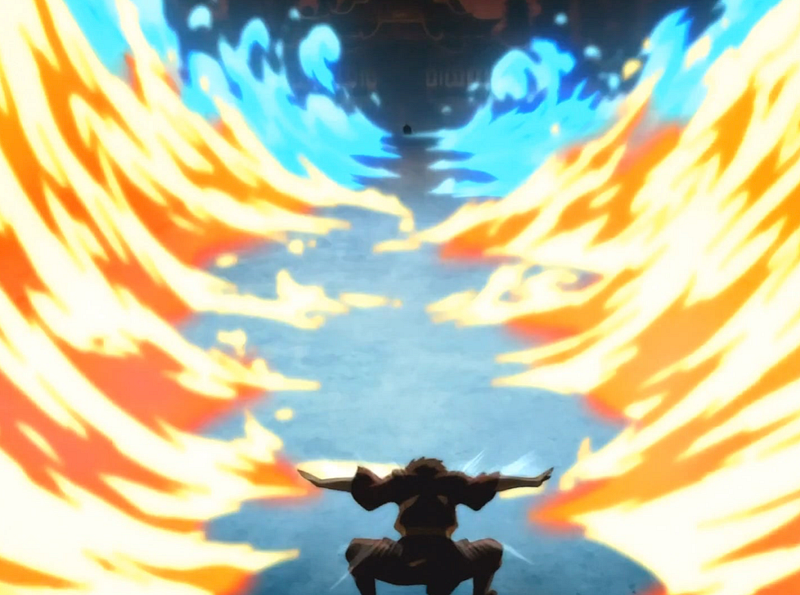
Image Credit: Nickelodeon

Now we know how firebenders make fire, but how are they able to control its shape and motion? The answer is actually fairly simple and has to do with the nature of flames. Flames are partial plasmas, meaning some of the atoms in them have been ionized as a result of the energy released by combustion. Because flames contain ions, they can be affected by electric currents. When an electric current runs through a flame, the positive ions in the flame moves toward the incoming current and the negative ions move toward the outgoing current. This produces a sort of butterfly shape in the flame:
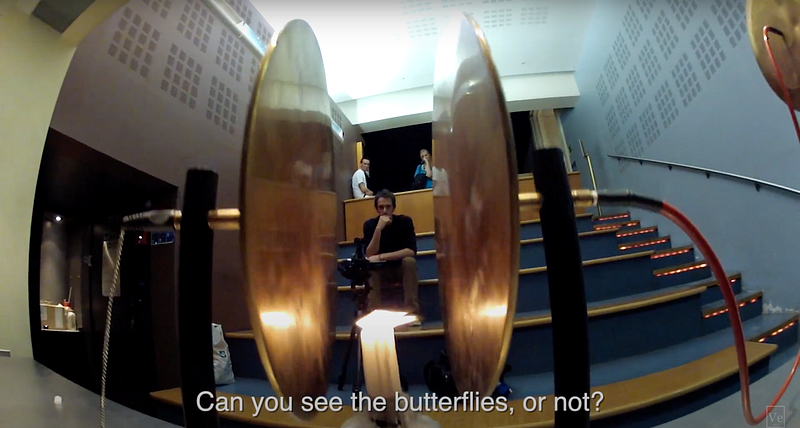
Image Credit: Veritasium

Using this property of flames, we can imagine that a moving circuit would drag along a flame, and as the flame moves the firebender continuously changes the location where they create combustion so the flame isn’t spread thin. Firebending like this can be visualized using this diagram:
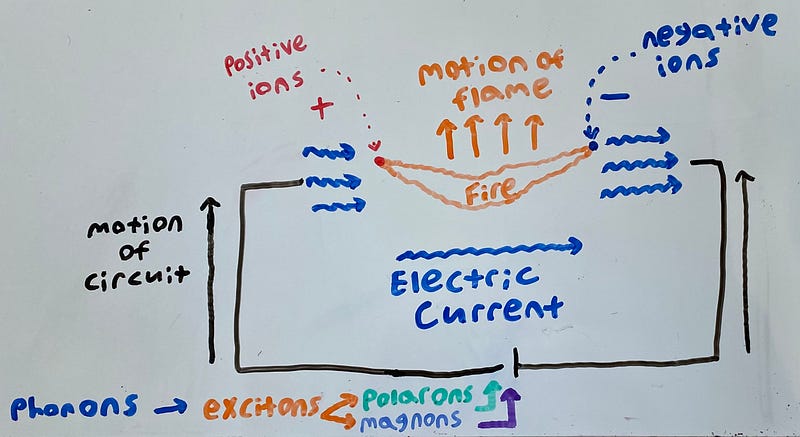
Flames can also be repelled or attracted in just one direction by applying an electric field. Here’s a video demonstrating that effect:

Using these processes precisely enough, a firebender with control over the flow of electricity could move flames in pretty much anyway they wanted. This goes for the flames they produce themselves, but also flames occurring naturally or being produced by other benders.
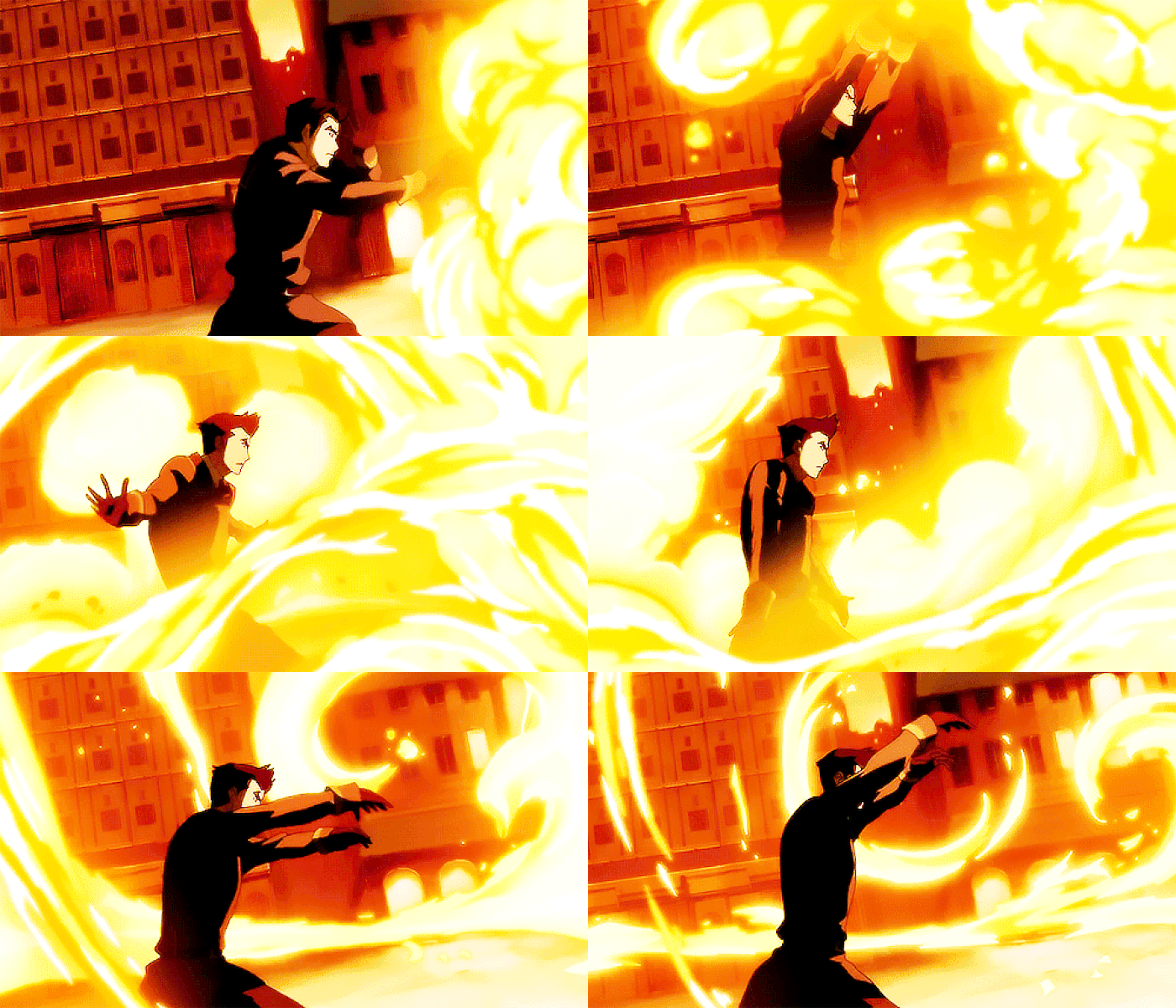
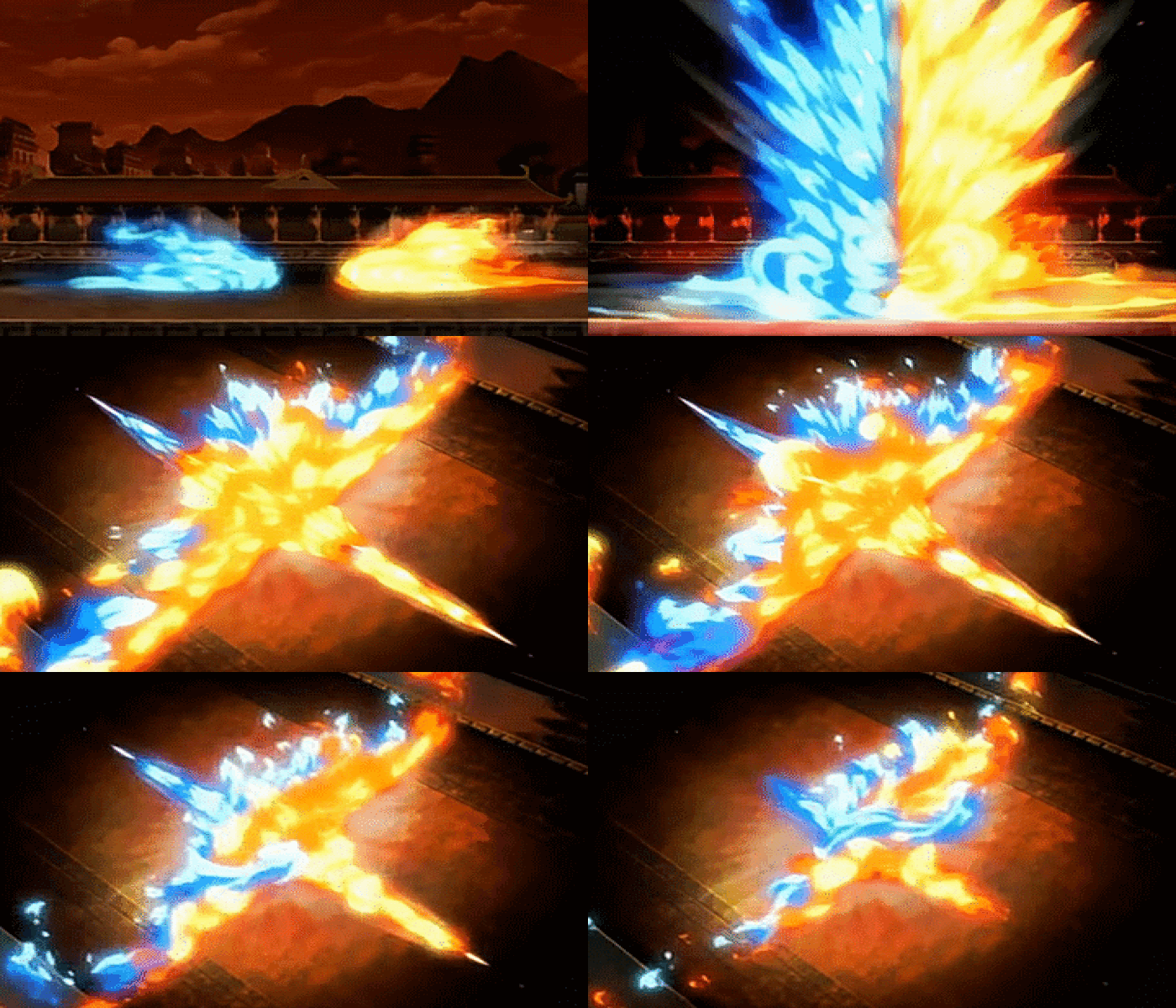
Image Credit: Nickelodeon

A common image we see in fights between firebenders is the flames produced by one bender pushing against the flames of the other. I suspect that what would really be happening here is firebenders changing the direction in which the electric currents they’re creating flow. They do this to change the alignment of the magnetic fields created by each circuit so they’re the same as most of the nearby circuits being created by the other firebender in their flames. The circuits’ magnetic fields would then mostly repel each other, moving apart and dragging the flames with them. This effect would result in the flames appearing to push on one another.
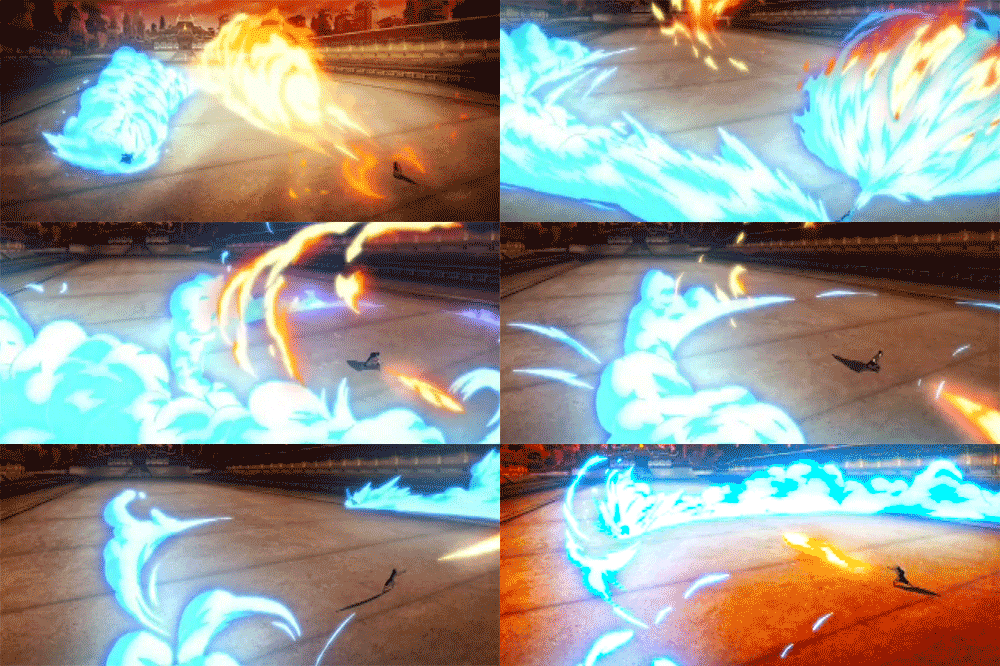
Image Credit: Nickelodeon

Strong enough electric currents can actually extinguish flames, so firebenders would be able to put out existing fires. The atoms from the flames remain ionized even after the flame goes out, so firebenders would also be able to control the motion of smoke.

Combustionbending
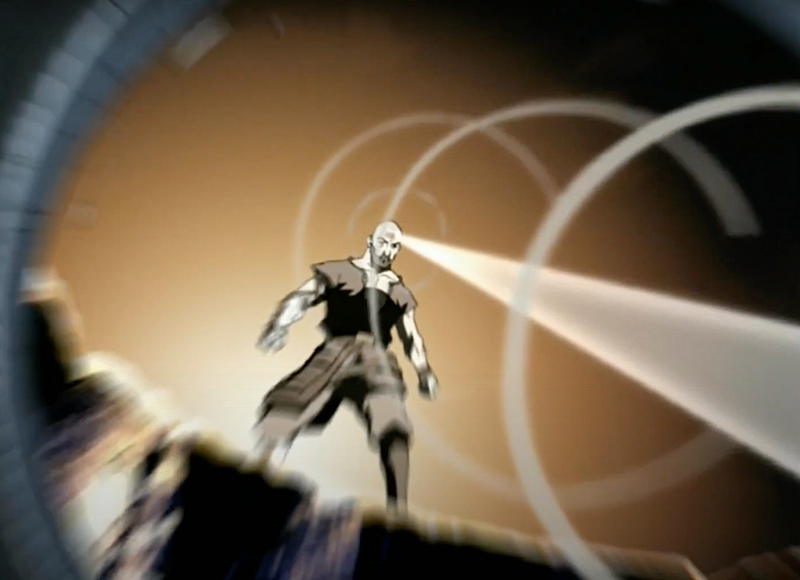
Image Credit: Nickelodeon

Now that we know how regular firebending works, we can get into advanced techniques. One such technique is combustionbending, which is somewhat misleadingly named since all nearly all firebending would be a form of combustion. Regardless, combustionbenders appear to be firing a beam of either heat, hot gas or plasma directly to a concentrated point for it to expand all at once. My hypothesis is that this beam is actually hydrogen fire, which burns less brightly than other fires and is harder to see. But if the fire is less hot, how can it be creating such big explosions? Well, I think what’s happening is that so much hydrogen fire is being produced so fast and then moved so quickly that the small volume it ends up in before exploding has an extremely high pressure and thermal energy. The fire is kept corralled into tight spaces with firebending, so tight the pressure differential between the compact flames and surrounding air produces a powerful shock wave when the flames are released.
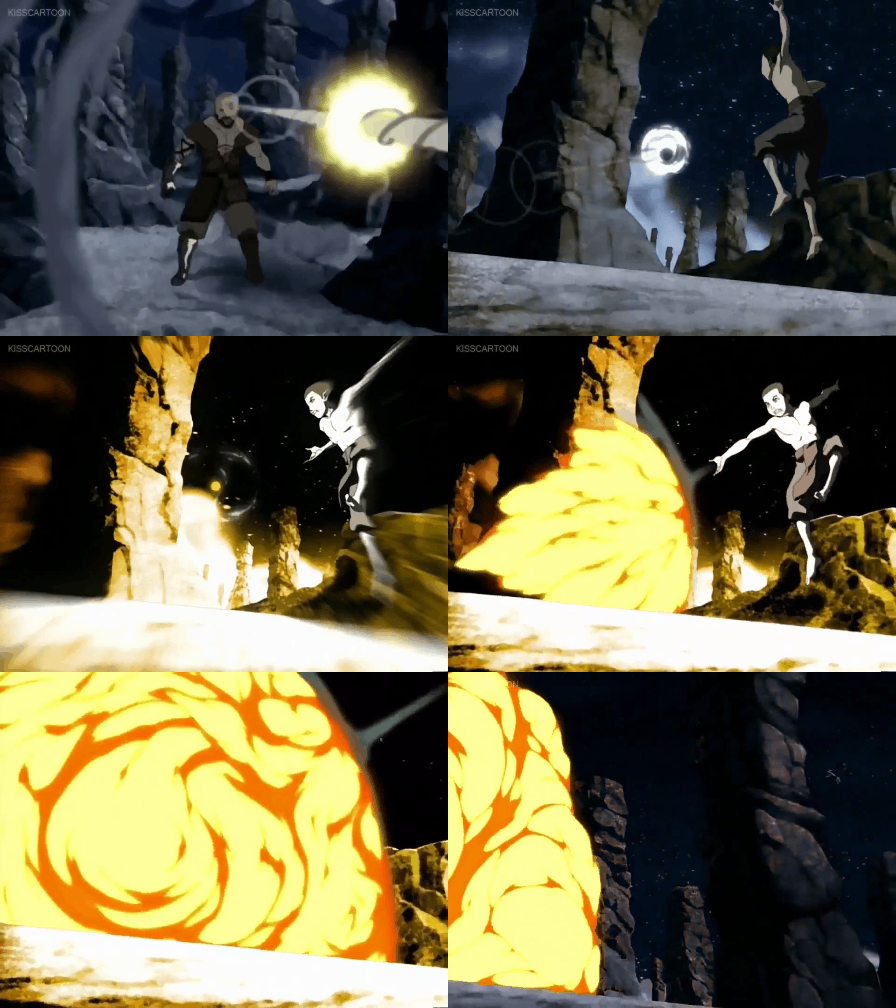
Image Credit: Nickelodeon

The rings we see pop out of the beam as it travels could be fire escaping into the lower pressure air. Perhaps combustionbenders have to let some fire out or else the explosion happens too early.

Fire Propulsion
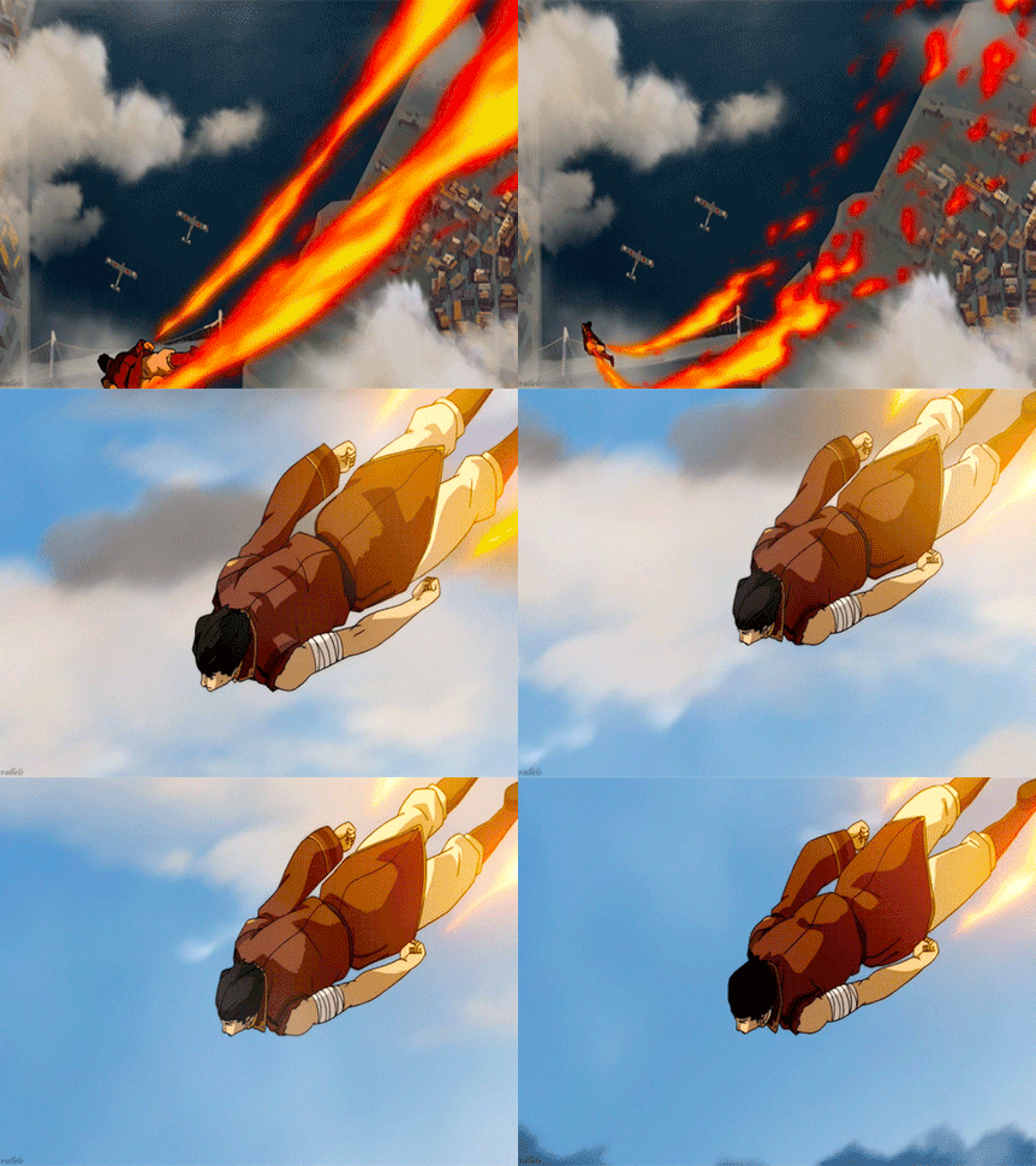
Image Credit: Nickelodeon

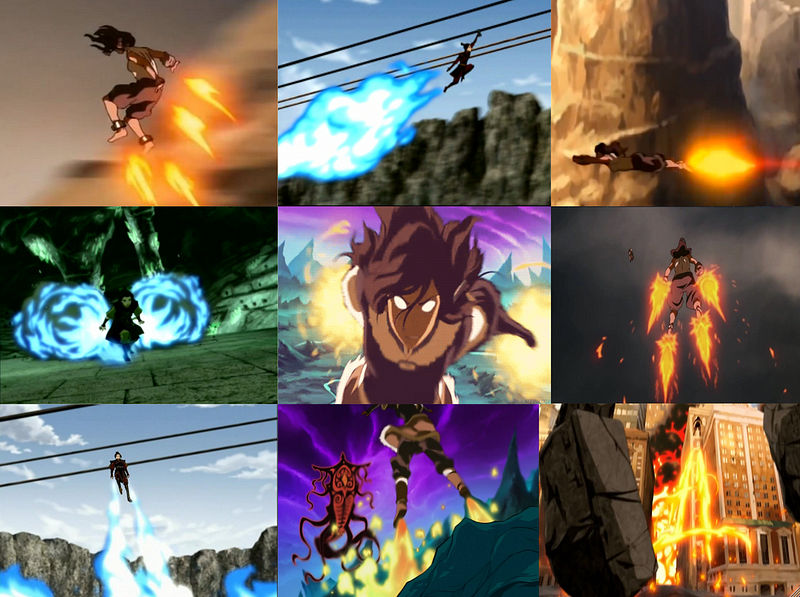
Fire propulsion works a bit differently from the way I described water propulsion working in an earlier post. First, a firebender produces flames. Then, they create electric fields in their bodies that repel electrons away from their body in the opposite of the direction they want to move. These electrons attract the positively charged ions in the flames, so the flames get pulled along with the electrons. As the fire shoots off in one direction, the firebender is pushed the other way thanks to Newton’s 3rd law of motion. I’m especially glad I was able to think of an explanation for this move because it’s a very common trope for pyrokinetics, and it’s awesome!
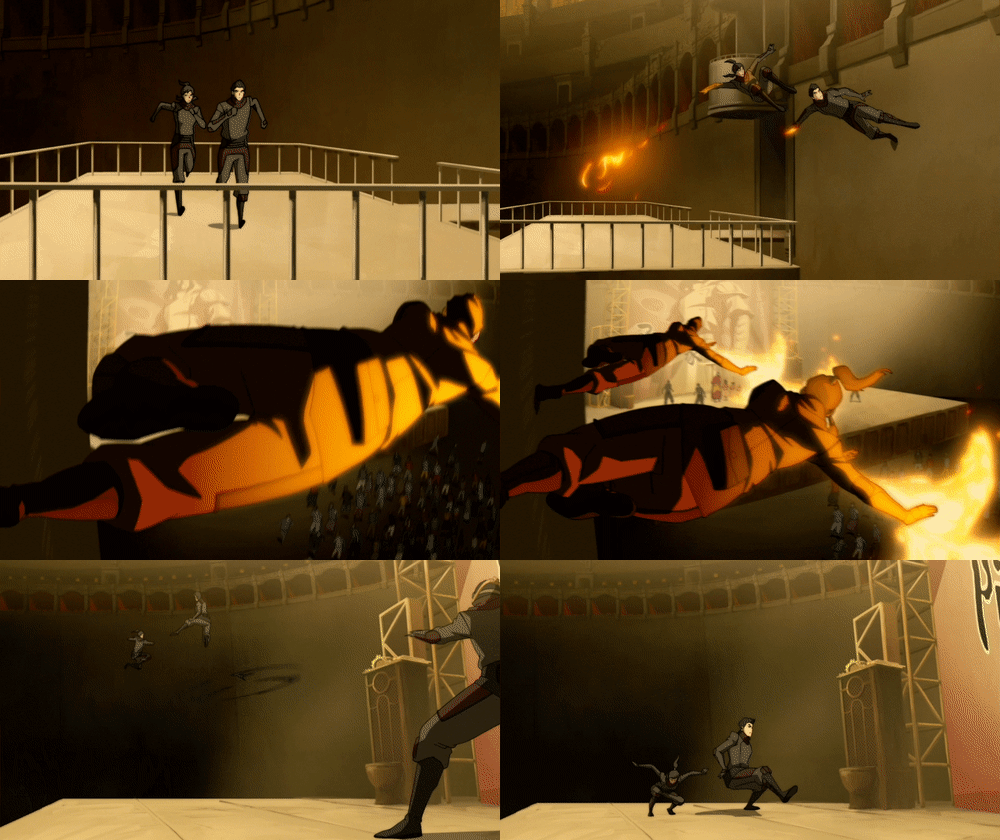
Really Awesome…
Image Credits: Nickelodeon

Fire Whirls

Image Credit: Nickelodeon

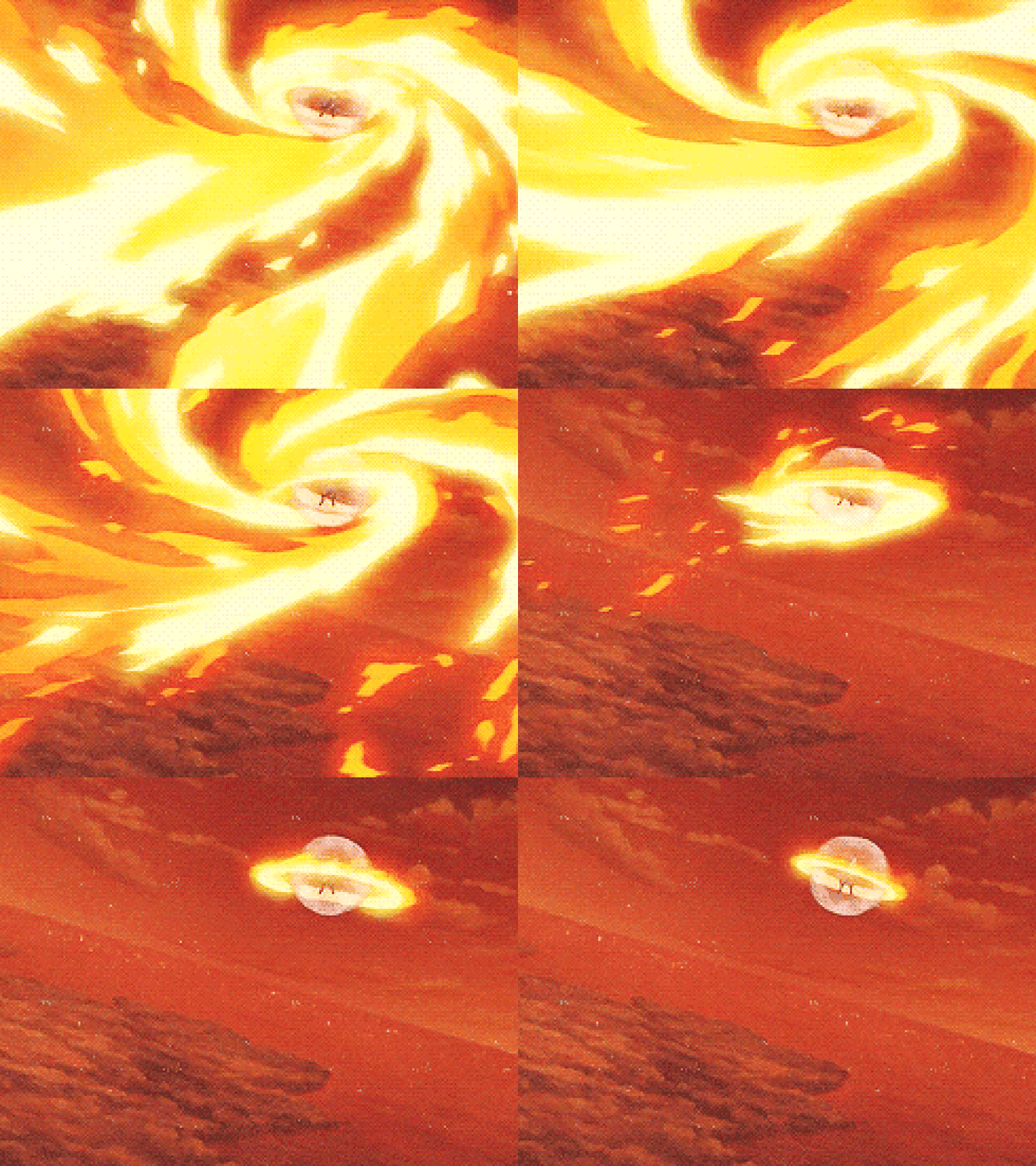
Fire whirls are real events that usually occur during forest fires. They happen because hot air rising from the fire moves so rapidly it creates a strong wind. More air rushes into the rising column and adds angular momentum which gets the fire spinning. This is what they look like in real life:
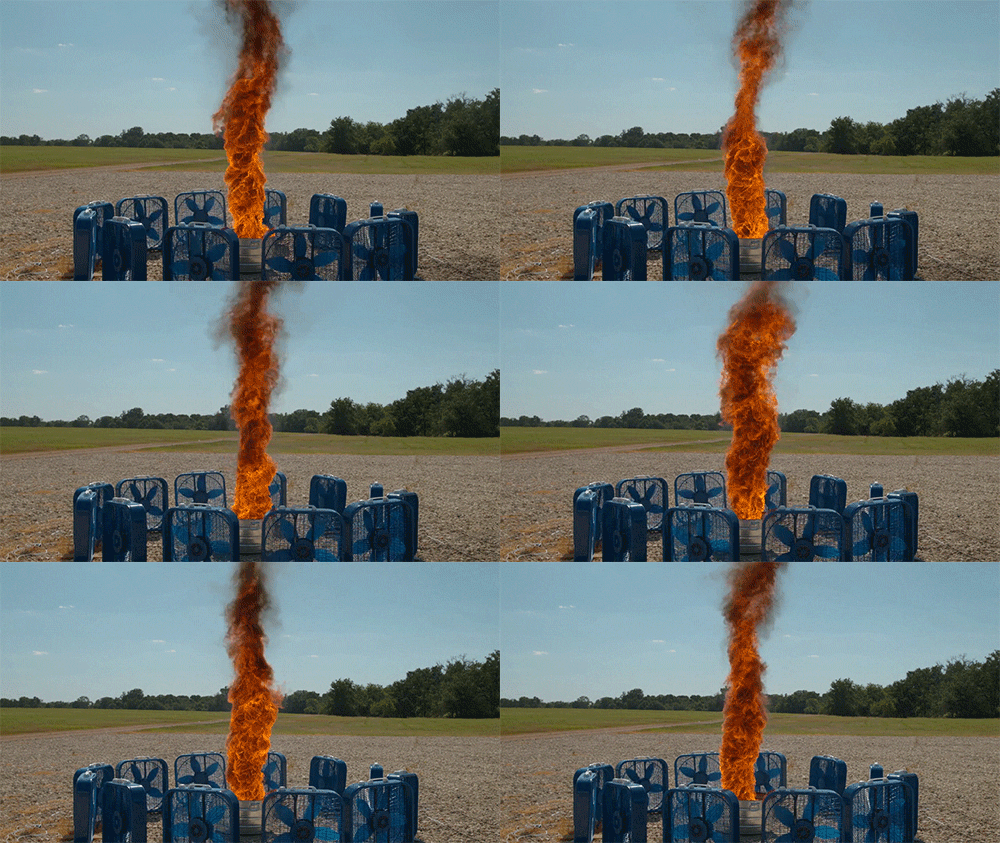
Image Credit: Digg

Fire whirls burn hotter than normal fires because they suck in more oxygen. Firebenders creating fire whirls like these would unleash a lot of energy. Not only that, the attacks would carry more momentum because they would be drawing in more mass and expanding rapidly along the axis of rotation.
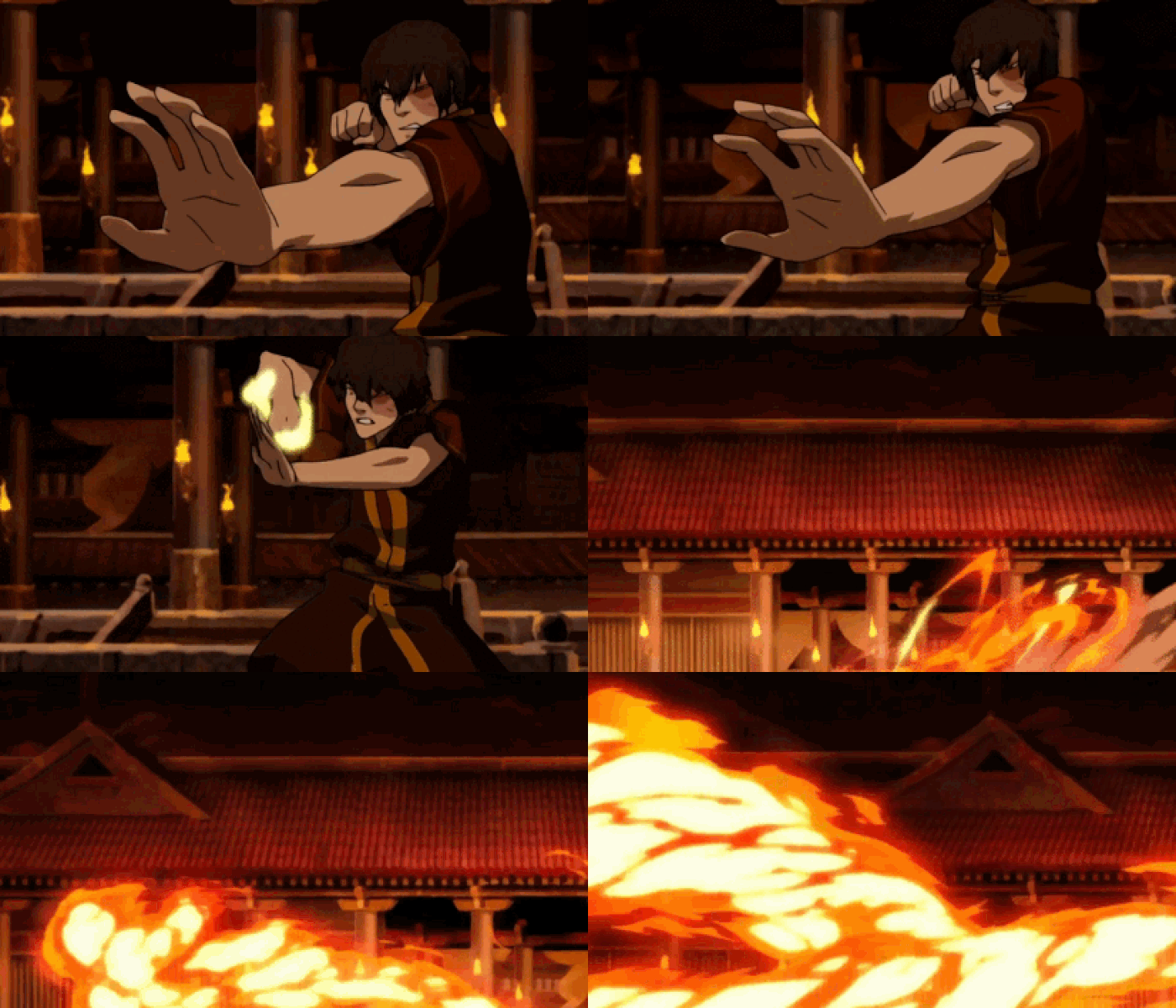
Image Credit: Nickelodeon

However, fire whirls could also be used to attack opponents indirectly by creating strong gusts of hot wind. A firebender may choose to do this in order to increase the area that gets caught in their attack or to push an opponent back without having to burn them. We see this happen in the episode Zuko Alone, where Zuko creates a fire whirl that pushes his opponent back without burning him. He later uses a similar move in a training fight with Aang.
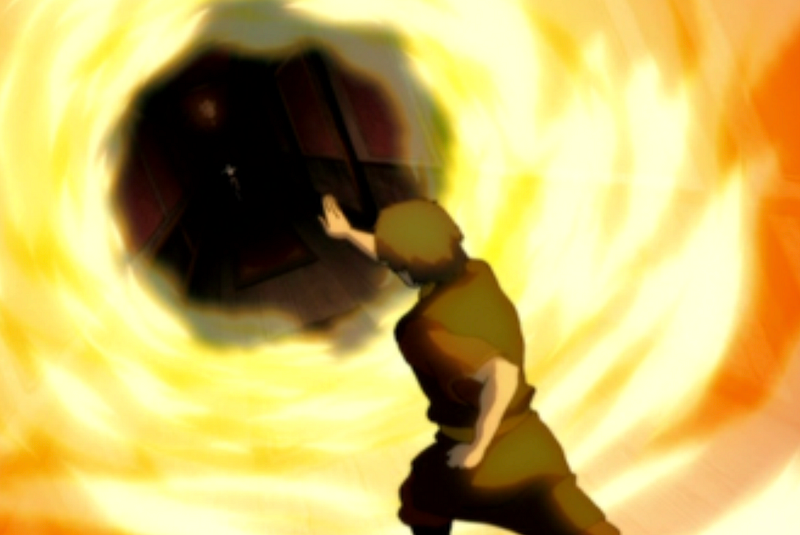
Image Credit: Nickelodeon

Lighting Generation and Redirection

Image Credit: Nickelodeon

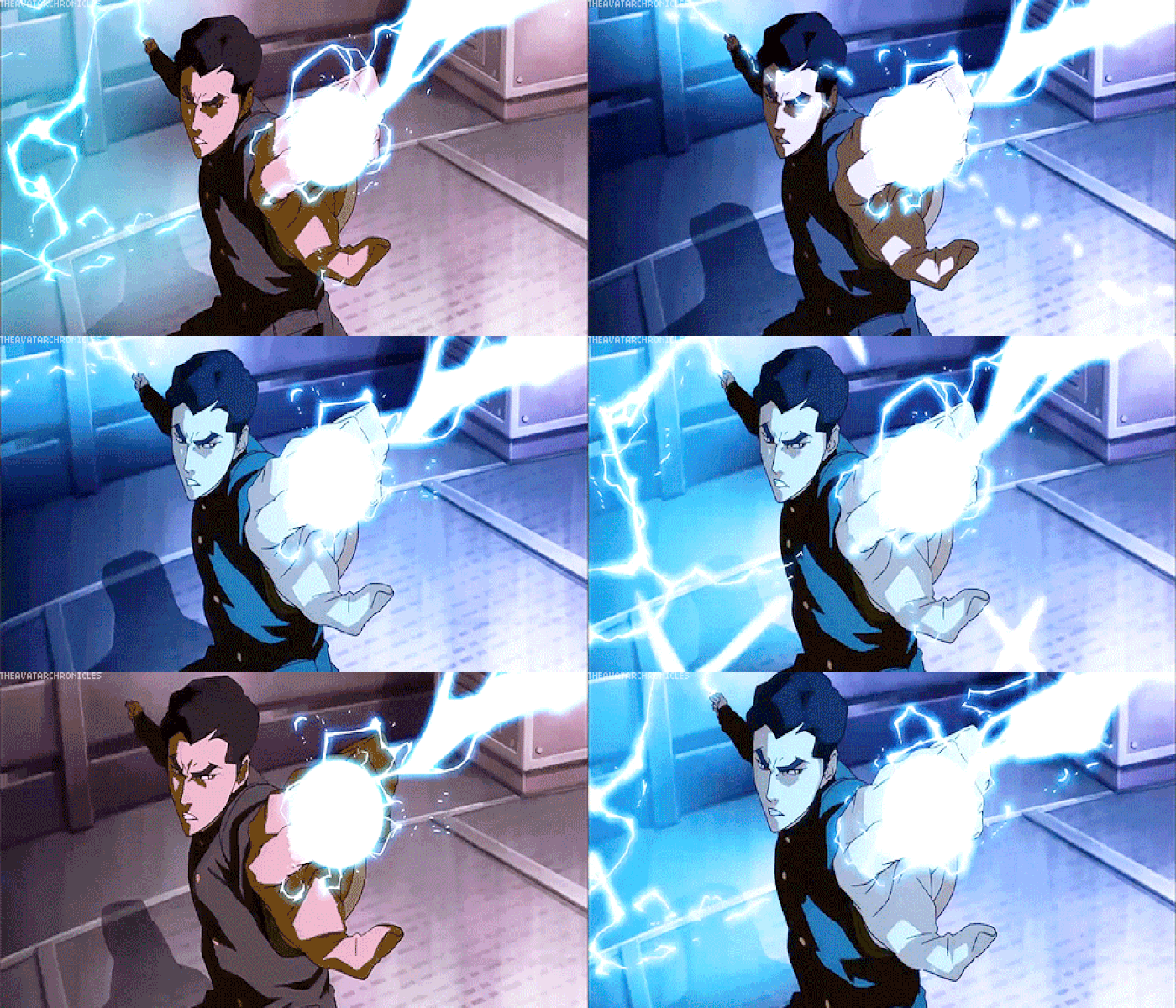
We’ve already mentioned that firebenders need to generate electric currents to firebend. Since lightning happens as a result of electricity moving through air, producing lightning would mean producing a high enough voltage to overcome the electrical resistance of air. However, firebenders could do this much more easily by sending lighting through their flames. Since flames are partially ionized, it’s actually easier to send electricity through a flame than through air. This video demonstrates the effect:

If firebenders send electricity through flames to produce lightning, it explains how they’re able to control its motion through the air and redirect it. Redirecting lightning just means creating a path of flames for the electricity to travel through. This also explains why it’s possible for characters in the show to react to lighting at all. Lightning in nature moves at 200,000 miles per hour(way too fast to dodge or see coming). Firebender lightning seems to move much slower than natural lightning, which is likely because the flames the lightning is traveling through don’t move as fast. The lightning attacks we see in the show aren’t single lightning strikes, but repeated bolts of lightning, each one travelling as far as it can before it runs out of fire to move through. The lightning only reaches its target once the flames reach their target. This concept also explains why lightning in the show appears fluid and tangible. We’re actually seeing flames which conduct great amounts of electricity.
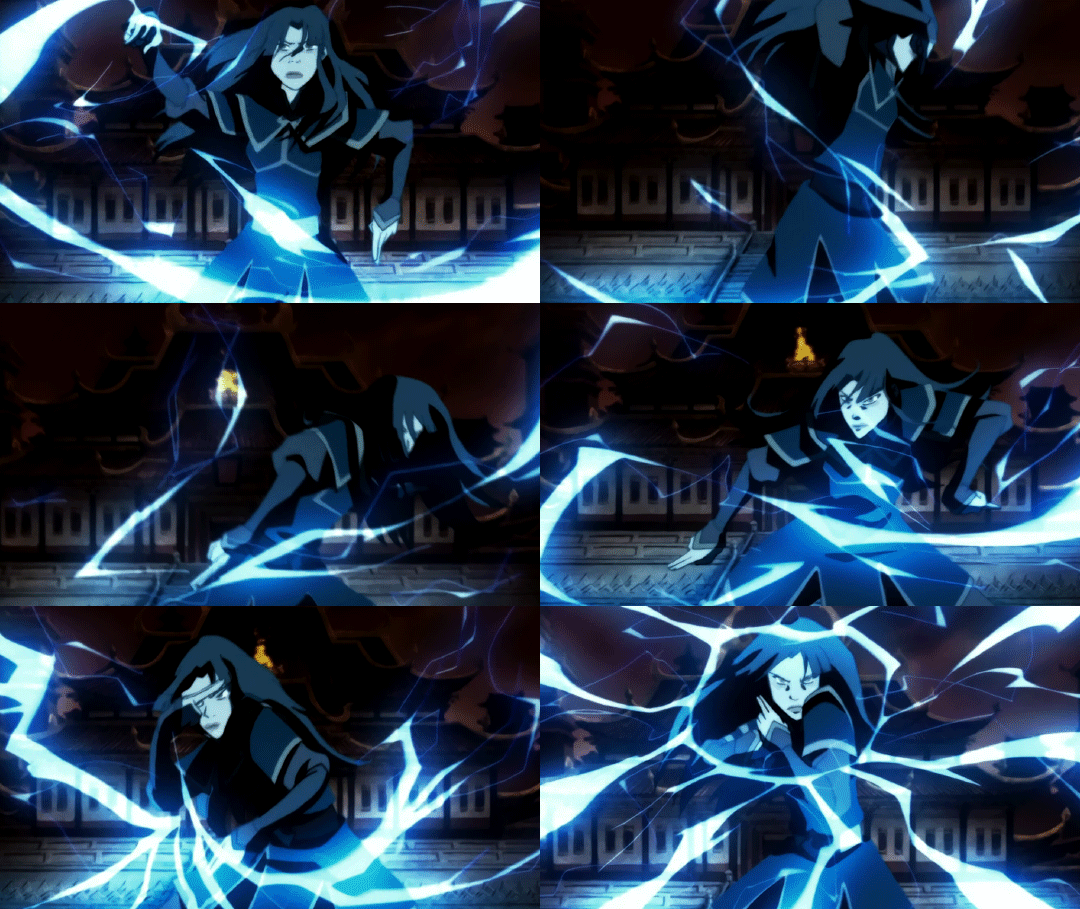
Image Credit: Nickelodeon

Perhaps we don't see the flames themselves because they’re not particularly bright. A dim flame like the one from a hydrogen fire would still be better at conducting electricity than air. Hydrogen fires involve fewer atoms than other types of combustion, so they’d take less energy to create. Firebenders would want to use weaker flames for lighting direction so they could save energy for generating the lightning itself. Any light the hydrogen fire did give off would be drowned out by the brightness of the lightning moving through it.

Creating Different Colors of Fire
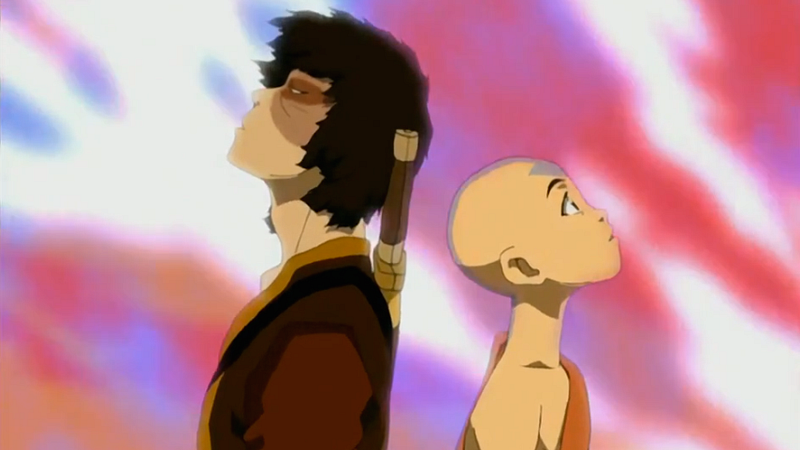
Image Credit: Nickelodeon

I already talked about the four main colors of fire in the show —yellow, orange, red-orange and blue — and wouldn’t have even included this section if not for this seen:
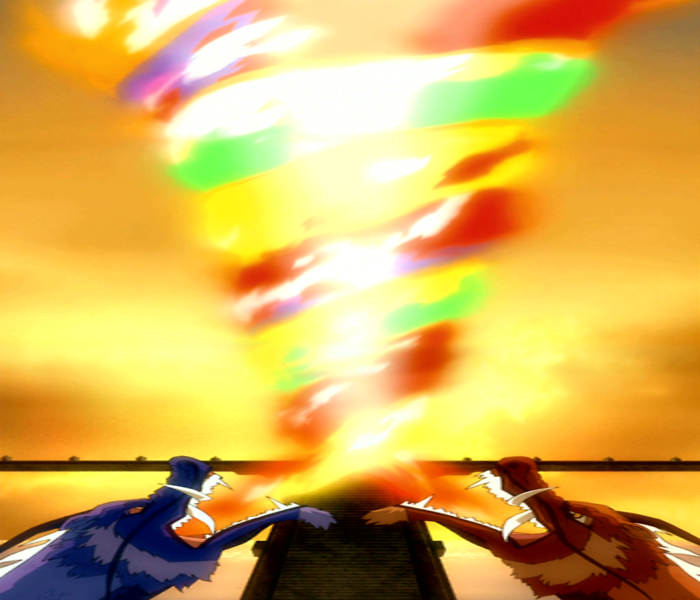
Image Credit: Nickelodeon

Here, we see the original firebenders producing red, yellow, orange, green and purple flames. Usually flames take on unusual colors because of the material being burnt. The simplest explanation is that the dragons are expelling chemicals that give the fire these colors. However, Zuko later goes on to create the same colors of fire in the canon comic book Smoke and Shadow. So this coloring of fire must have something to do with how the fire is being bent and not what is being burned. I can think of two ways this is happening.

  1. The dragons are controlling the temperature of the flames so well using electromagnetic fields that they can create regions in fire that burn at different temperatures without heat flowing between them. These different sections of flame would emit different frequencies of light similar to the red, blue and green pixels on a computer screen. In this case, the pixel flames would be emitting blue, red, orange and yellow light. There wouldn’t be any green or purple light being emitted. Anyone looking would just see a mix of blue and red or blue and yellow and their brains would interpret it as purple or green respectively. This is the less likely scenario as it would likely require a much more insane amount of energy to pull off.
  2. The dragons use electromagnetic forces to control the energy levels of free-floating electrons in the flames. Different materials produce flames of different colors because their atomic structure only allows electrons to change in energy by certain amounts. The amount of energy lost by electrons determines the frequency of light emitted. When electrons are unbound from atoms, they gain access to a far greater number of energy levels and can emit more distinct frequencies of light. If firebenders could directly affect the energy of electrons when unbounded using electromagnetism, they could control the exact frequency of light emitted, possibly including colors like green and violet. This is the more straightforward and likely option.

Drawing Energy from the Sun
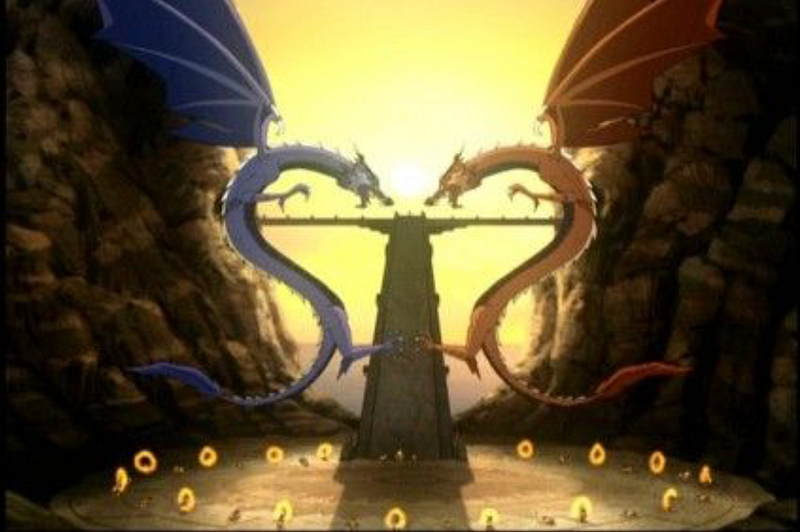
Image Credit: Nickelodeon

Firebenders supposedly harness energy directly from sunlight. If the quasiparticles emitted by benders interact with photons of light, they could gain energy. That energy could then be transferred to a firebender via electromagnetic induction. The excited quasiparticles would produce changing magnetic fields, which would then produce electric currents carrying useful energy. This would make firebenders sort of like photovoltaic cells, which convert energy from light into electrical energy. Firebenders must be able to store this energy over time, otherwise they wouldn’t be able to bend at night. As for them losing their bending during a solar eclipse, that makes no sense because it suggests they should also lose their bending at night when the Earth is between them and the Sun. Let’s just chock that up to spirit magic.

Image Credit: Nickelodeon

That concludes our look at the physics of firebending.
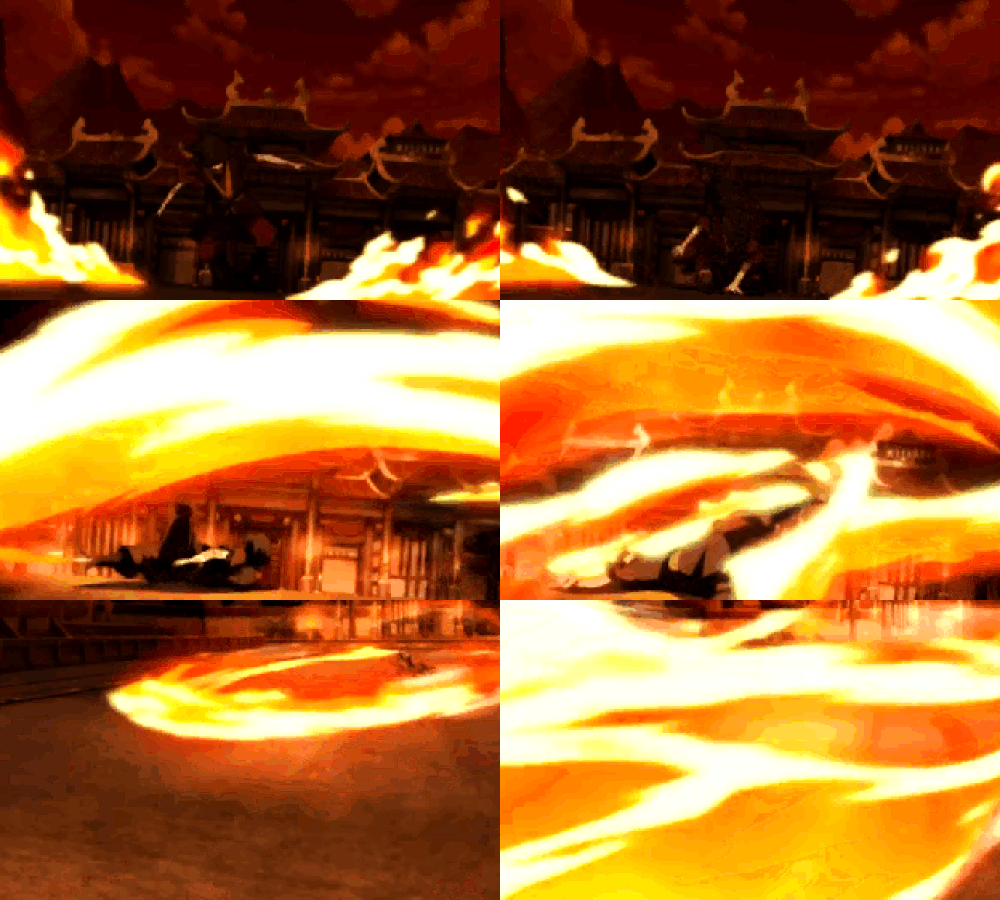
Image Credit: Nickelodeon

In my next post, I’ll look into the physics of airbending. As always, let me know anyways I could improve my hypotheses from this post or better explain them. See you next time.

Works Cited

DiMartino, M. D., & Konietzko, B. (Writers). (2010, June 30). Avatar: The Last Airbender [Television series]. Nickelodeon.

DiMartino, M. D., & Konietzko, B. (Writers). (2012, April 14). The Legend of Korra [Television series]. Nickelodeon.

Konietzko, B., & Yang, G. L. (n.d.). Avatar: The Last Airbender: Smoke and Shadow Part One. Dark Horse Comics.

Steele, Z. (2020, August 05). The Physics of Avatar: The Last Airbender and The Legend of Korra. Retrieved August 05, 2020, from https://readmedium.com/the-physics-of-avatar-the-last-airbender-and-the-legend-of-korra-1c212efb4b9a

Steele, Z. (2020, August 05). The Physics of Avatar: The Last Airbender and The Legend of Korra. Retrieved August 05, 2020, from https://readmedium.com/the-physics-of-avatar-the-last-airbender-and-the-legend-of-korra-1c212efb4b9a

Reich, H. (Producer). (2011, September 11). What is fire? [Video file]. Retrieved August 5, 2020, from https://www.youtube.com/watch?v=1pfqIcSydgE

Hahn, E. (n.d.). Eric Hahn. Retrieved August 05, 2020, from https://www.elgas.com.au/blog/1585-why-does-a-gas-flame-burn-blue-lpg-gas-natural-propane-methane

Alkanes. (2020, July 14). Retrieved August 05, 2020, from https://chem.libretexts.org/Bookshelves/Organic_Chemistry/Supplemental_Modules_(Organic_Chemistry)/Hydrocarbons/Alkanes

Alkanes. (n.d.). Retrieved August 05, 2020, from https://ef.engr.utk.edu/hyperphysics/hbase/Organic/alkane.html

Chemical Recombination. (2020, June 26). Retrieved August 05, 2020, from https://www.nrc.gov/reading-rm/basic-ref/glossary/chemical-recombination.html

Muller, D. (Producer). (2012, September 11). What’s In A Candle Flame? [Video file]. Retrieved August 5, 2020, from https://www.youtube.com/watch?v=a7_8Gc_Llr8&feature=share

Controlling Fire With My Hands Using a Wimshurst Machine [Video file]. (2019, December 22). Retrieved August 5, 2020, from https://www.youtube.com/watch?v=lF0M-Tr640E&feature=share

How Does a Photovoltaic Cell Work? (n.d.). Retrieved August 06, 2020, from https://www.planete-energies.com/en/medias/close/how-does-photovoltaic-cell-work

Zawischa, D. (n.d.). Fire and glow — the black body. Retrieved August 06, 2020, from https://www.itp.uni-hannover.de/fileadmin/arbeitsgruppen/zawischa/static_html/blackbody.html

Muller, D. (Producer). (2013, June 24). Can We Really Touch Anything? [Video file]. Retrieved August 5, 2020, from https://www.youtube.com/watch?v=bKldI-XGHIw&feature=share

The Action Lab (Producer). (2019, May 6). How to Make a Cold Fire Torch That You Can Touch and Not Get Burned![Video file]. Retrieved August 5, 2020, from https://www.youtube.com/watch?v=DnSRbnvm798

Afework, B., Campbell, A., Fedechko, R., Hanania, J., Heffernan, B., Jenden, J., . . . Donev, J. (2020, January 31). Hydrocarbon combustion. Retrieved August 06, 2020, from https://energyeducation.ca/encyclopedia/Hydrocarbon_combustion

Hanania, J., Jenden, J., Stenhouse, K., & Donev, J. (2019, February 24). Petroleum. Retrieved August 06, 2020, from https://energyeducation.ca/encyclopedia/Petroleum

Types of Fires. (n.d.). Retrieved August 06, 2020, from https://www.femalifesafety.org/types-of-fires.html

Hydrogen Flames: Hydrogen Tools. (n.d.). Retrieved August 06, 2020, from https://h2tools.org/bestpractices/hydrogen-flames

The Editors of Encyclopaedia Britannica. (2018, July 27). Shock wave. Retrieved August 06, 2020, from https://www.britannica.com/science/shock-wave

Patrick, M. (Producer). (2017, July 11). Game Theory: POKEMON — The TERRIFYING TRUTH of Fire Pokemon [Video file]. Retrieved August 5, 2020, from https://www.youtube.com/watch?v=fBn6uh-GYwQ&list=LLwXdnmrGRxRWfUtXZRqbUXg&index=134

Fire Whirl. (2020, April 6). Retrieved August 06, 2020, from https://www.skybrary.aero/index.php/Fire_whirl

Lallanilla, M. (2014, May 16). Whirling Flames: How Fire Tornadoes Work. Retrieved August 06, 2020, from https://www.livescience.com/45676-what-is-a-firenado.html

National Geographic. (2009, October 09). Lightning Facts and Information. Retrieved August 06, 2020, from https://www.nationalgeographic.com/environment/natural-disasters/lightning/

Dunbar, Brian. “Water Vapor Confirmed as Major Player in Climate Change.” NASA, NASA, 17 Nov. 2008, www.nasa.gov/topics/earth/features/vapor_warming.html.

Science Buddies. “Splitting Water.” Scientific American, Scientific American, 7 Apr. 2016, www.scientificamerican.com/article/splitting-water/.

Fire
Science
Sci Fi Fantasy
Science Fiction
Physics
Recommended from ReadMedium