
The Physics of Ezra and Sabine’s Force Jump
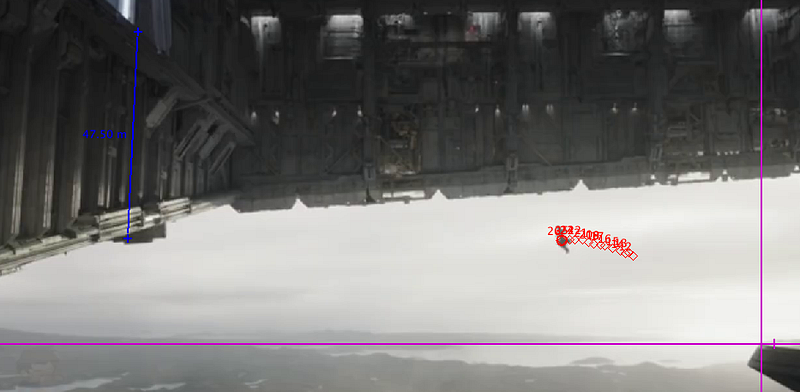
I’m not going to give away too many details, but there’s a cool scene in Ahsoka Epsiode 8. The basic idea is that Ezra is trying to make a jump into the bay of a Star Destroyer. Of course he can use the force to get a longer jump — but it’s just not enough. So, he gets a force boost from Sabine who is still on the landing platform.
That’s all the info you are going to get (but let’s be honest — if you haven’t watched Ahsoka yet, then you probably aren’t concerned with spoilers). But here’s what I like about this move. The episode gives this great view from the side. It’s like perfect for video analysis. Of course that’s just what I’m going to do.
Video Analysis of Ezra’s Force Jump
With video analysis, you can mark the location of an object in each frame of the video. If you know the “size” of the frame (pixel to meter conversion) and the time between frames (from the frame rate) then you get x,y, and t data. Nice.
In this video, the camera is looking perpendicular to the motion so that Ezra is at the same distance away (so we don’t have to worry about motion in that direction). Also, the camera doesn’t pan or zoom — which just makes everything easier.
There is one big problem — I don’t know the distance scale of the video. However, if I assume this is projectile motion (constant vertical acceleration) then I need two of the following three things:
- Distance scale (I don’t have this).
- Time scale (I’m going to assume the frame rate is in “real time”).
- Vertical acceleration — I technically don’t know this.
So, here’s what I’m going to do. I am going to assume that during the first part of the motion the only force on Ezra is the downward pulling gravitational force. Wait, here comes the crazy part — I will assume that the gravitational field (which would be the vertical acceleration) is 9.8 Newtons per kilogram. Yes, this the gravitational field on the surface of the Earth and this is a WHOLE DIFFERENT PLANET CALLED PERIDEA. I know that it’s crazy to make this assumption, but I don’t really have any other way to estimate the gravitational field. Anyway, when people move around they look like they are moving on Earth so it should be fine. Yes, the actors are actually on Earth.
I’m going to set the scale as the thickness of the bottom of the Star Destroyer and plot the motion of Ezra’s jump. I can then adjust this height until I get the correct vertical acceleration. Check it out (using Tracker Video Analysis — it’s free).
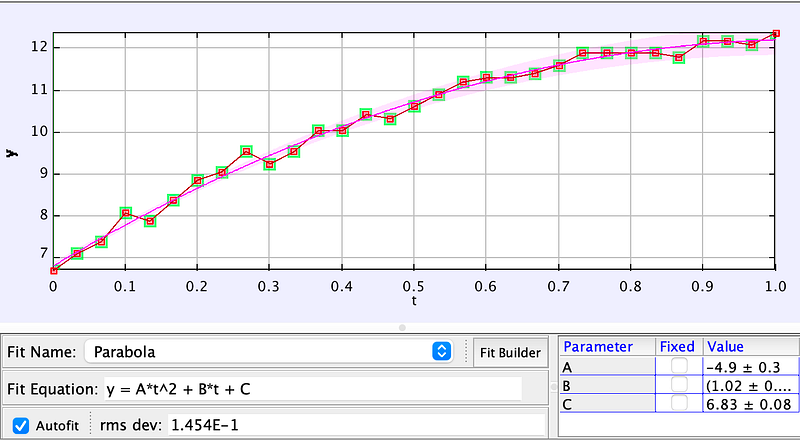
Notice that the coefficient in front of the t² term is -4.9 m/s². This matches up in the following kinematic equation.
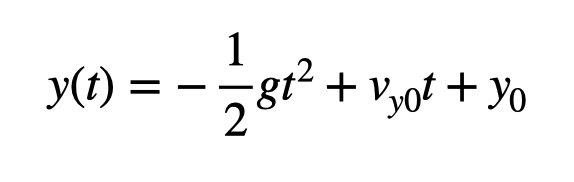
Such that the value for g would be 9.8 N/kg. Now I have my scale — the thickness of the bottom layer of the Star Destroyer is 23.6 meters. But more importantly, I also have the horizontal and vertical distance required for the jump. Ezra needs to jump UP 35.2 meters and OVER 71.2 m.
OK, I don’t actually know how a force jump works. I’m assuming that the force jump gives Ezra a larger launch velocity (that’s how jumps work). However, it is indeed possible that the force changes the vertical acceleration during the whole jump.
One more thing. Here is a plot of Ezra’s horizontal position during this first part of the jump.
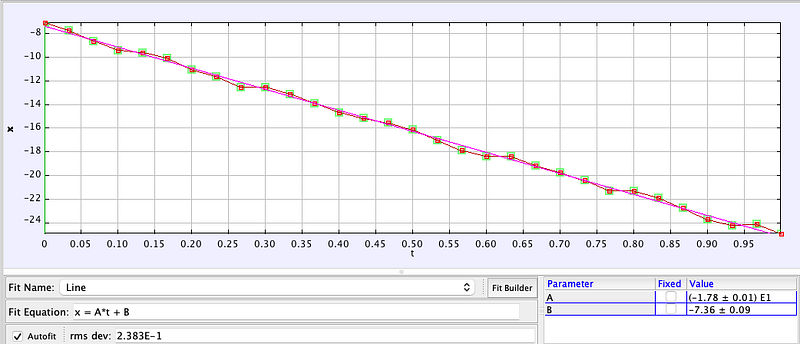
There are two useful things from this graph. First, it’s linear. That’s nice — it’s what we would expect for projectile motion with no horizontal forces. This also reinforces my force jump model that he only gets a boost on the launch speed. Second, I can get the horizontal velocity from the slope. Based on this, Ezra jumps with an x-velocity of 17.8 m/s.
What about his launch velocity in the y-direction? I can get that from the fitting parabola. If I assume that he starts his jump at time t = 0 seconds (I set the video so that this is true) then the coefficient in front of the t-term is the initial y-velocity with a value of 10.2 m/s. Putting this together with the x-velocity gives a total launch speed of 20.51 m/s at an angle of 30 degrees above the horizontal. I like that angle — it’s a nice number and suggests that some human animator picked it. Oh, but I’m also very happy that they gave Ezra a realistic motion (physics win).
Video Analysis of Sabine’s Force Push
We don’t have a continuous view of the whole jump — but that’s fine. We can deal with that. Yes, the camera moves around during this part of the motion, but Tracker Video Analysis can handle this using calibration point pairs (here’s an older tutorial for that). The best part about a camera that moves is creating a “world view” in which the camera DOESN’T move. Like this.
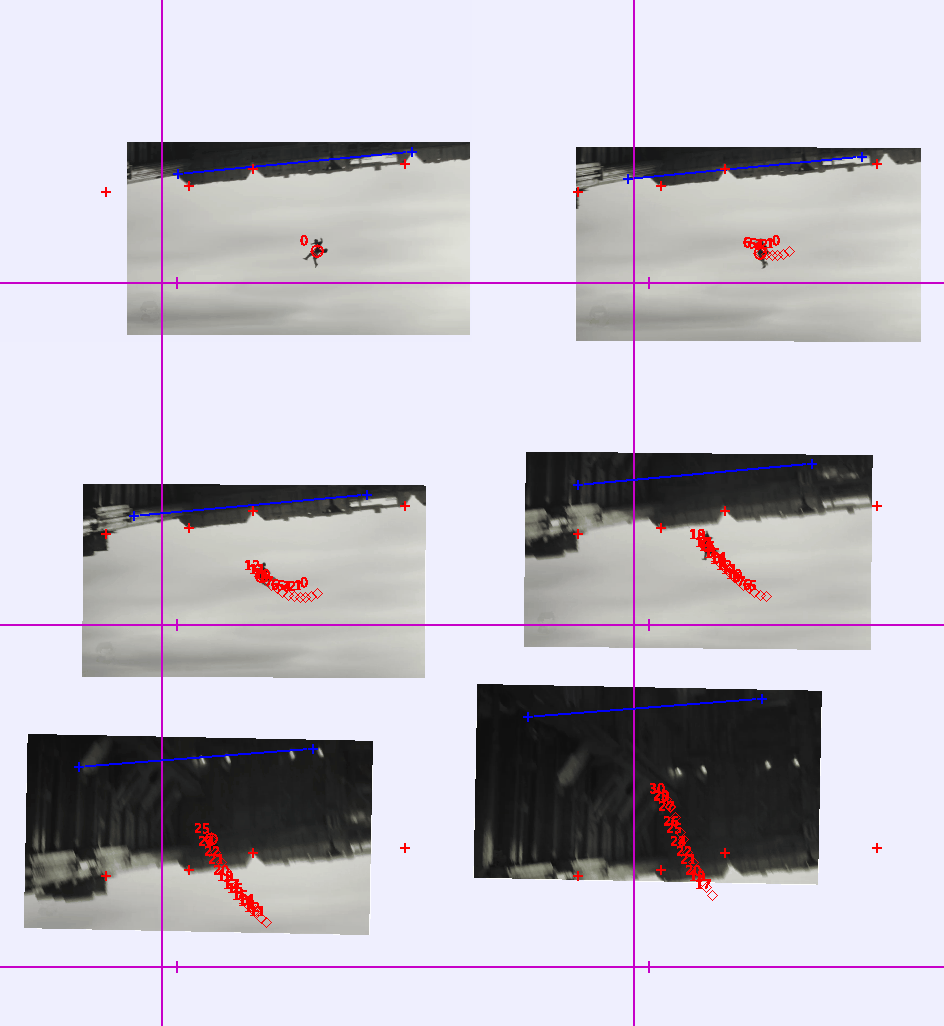
But what we really want is a plot of the horizontal and vertical position as a function of time. Note: I used stuff in the background from the previous motion to scale this video. This assumes the “camera” is far enough away to ignore perspective issues).
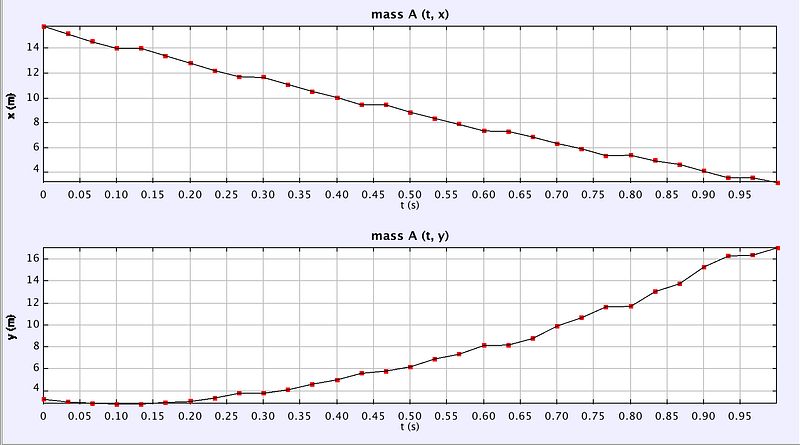
Looking at the horizontal data, it looks fairly linear. The slope gives a horizontal velocity of 12.58 m/s. Why is this different than the first part of the jump? It’s either a scaling problem or maybe there was air drag — I’m just going to proceed with this value.
In the y-direction, Ezra moves UP. Fitting a quadratic equation to the vertical data gives an acceleration of 32.6 m/s² for about 0.87 seconds. It’s difficult to say exactly when the force push from Sabine stops acting on Ezra.
Web VPython Model
You don’t fully understand something until you can model it. So, I decided to build a model of the Ezra-Sabine force jump (using Web VPython). Here are some details and comments.
- The motion is broken into 0.01 second time intervals. I can then approximate the forces as being constant during each interval. You actually don’t have to do that in this problem, but it works well enough and it’s simple.
- I just realized that I was off a little bit in my start position — which might give a different launch velocity. Oh well, it’s still a good start.
- There a couple of things I had to guess — how long does Ezra jump before Sabine pushes (I went with 1.5 seconds). How long does the Sabine push last? If you put this at 0.8 seconds, Ezra JUST makes it.
- I assumed Ezra was a sphere — and I made him larger that life so that he would be easier to see.
Here is my code (no comments added). This is what it looks like (the REAL Ezra doesn’t leave a trail).
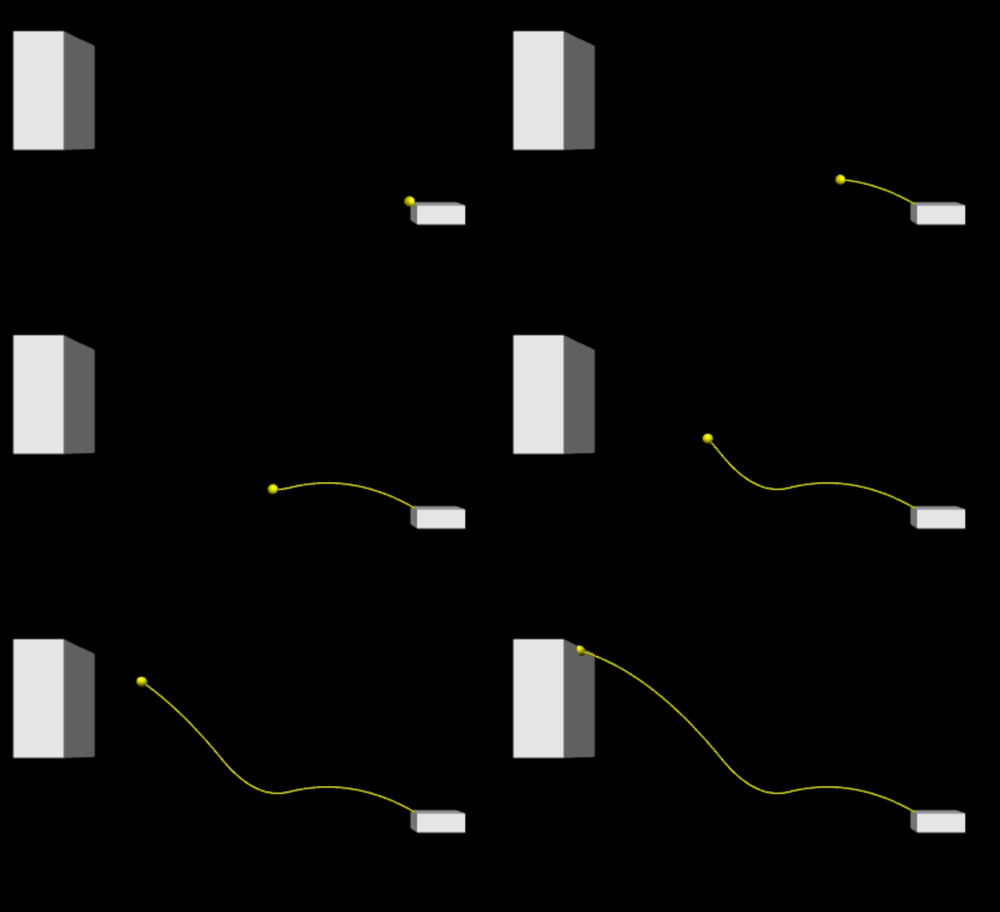
I like it.
Homework
You didn’t think you were getting out of here without homework, did you? Well, here are some questions.
- Suppose Ezra was going to jump at the same initial angle (30 degrees). How much faster would he need for his initial velocity so that he makes the jump without Sabine’s help?
- If Ezra uses his force jump over a distance of 1 meter, what value of Force force (in Newtons) would he need to get to the launch velocity of 20.5 m/s?
- Estimate the power of The Force during Ezra’s force jump (where power = the change in kinetic energy divided by the time interval). Yes, you will need to estimate the time it takes for this jump.
- Estimate the power of Sabine during her force push. Who exerts a greater force and who has a greater power?
- What about air resistance? If you add air drag to Ezra’s motion, how much does it change? Hint: assume he’s like a skydiver on Earth with a terminal velocity of around 54 m/s — you can use that to calculate his drag coefficient.
- What if Sabine was 0.5 seconds late with her force push? What would happen?