
The Person Who Taught Me About Being Human
“If we look straight and deep into a chimpanzee’s eyes, an intelligent, self-assured personality looks back at us. If they are animals, what must we be?” ― Frans de Waal
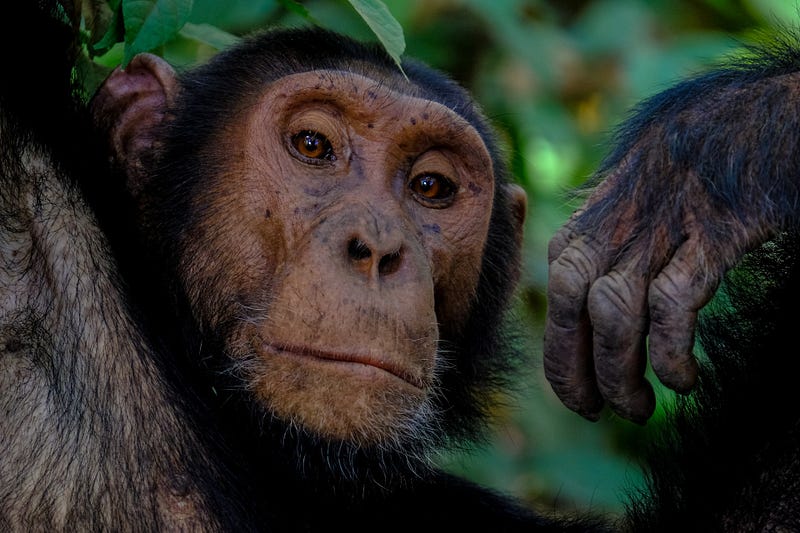
I met Franz De Waal in 1990 when he was teaching a course at Bush Gardens in Florida. It was part of my graduate program in Family Systems Theory, and my advisor insisted I take the course. I could initially not see the relevance of taking a course in Primatology. Midway through the course, I had an experience that changed my core outlook about life, humans, families and the work I was about to embark upon as a family therapist. The title of the course was “Peace Keeping Among Primates.”
Dr. de Waal’s course became the most significant course of my entire education, my growth as a Cultural Anthropologist and systems theorist and my growth as a human being.
My graduate advisor was surprised at my initial reaction and resistance because I had undergraduate majors in Cultural Anthropology and in the History of Art, as well as a graduate degree in History of Art/Islamic Studies. Frankly, I had no real use for studying Primatology. My only experience with primates was observing captive primates, and I found it unsettling. Years later, while I worked as a counselor briefly in a medium-security prison, I felt the same discomfort at the captive “human” primates housed there. By then, I understood that what I was observing were not natural behaviors but concentrated dominant behaviors, much the same years earlier I had seen and been repulsed by in the reactive dominating behaviors of captive Chimps and Gorillas in zoos. What unsettled me most was the inherent cruelty of not just imprisonment but the way in which we imprison other sentient lives as though they were just objects and treat them as though they were beneath our compassion and understanding.
Dr. de Waal’s course consisted of lectures and a seemingly never-ending series of films he had made in his fieldwork in Africa, observing the natural behaviors of Chimpanzees and Bonobos. The films were fascinating. The course was informative.
One evening, as I left the auditorium, which was located just inside the gates to Bush Gardens, I had what can only be characterized as a mild dissociative state that bordered on what psychologists classify as a Fugue state.
I had exited the building and could look down two midways.
One was the midway of games and rides. It was a place of loud voices and raucous carnival music, a pale imitation of African tribal music.
The other midway was the one to the nature area and was quieter. Typically, I would briefly turn and go down that midway before heading home because its relative park-like atmosphere was soothing after two hours of intensive lectures.
For some reason, that night, my attention was drawn to the entertainment midway, and at that moment, I realized I could not hear human voices. I could hear the imitation of African music, but the humans were silent to me. Not that they were silent, but they were silent to me. For the next ten minutes, I stood in awe as I watched “monkeys’ in clothes and saw almost all the behaviors I had spent the last five weeks observing in Dr. de Waals’s lecture.
At that moment, I understood why I was directed to take a course in primatology. I have never seen humans as all that special ever again. We were, after all, simply naked apes wearing manufactured colorful fur, and our social behaviors were, in fact, following the same evolutionary rule as all other primates. We had taken a different direction in our adaptation, but underneath our cultural behaviors, we still exhibited dominant, sexual and gender behaviors that were so similar as to be insignificantly different.
Over the next ten years, I would regularly enter this fugue state again, walking in malls, driving down the road, and sitting in my office watching family interactions. These served to remind me of that powerful realization that day in Bush Gardens and reinforced my ability to step away from all the chatter and noise we make with our philosophies, opinions, excuses and distractions from what we are really doing.
These episodes strengthened my thinking as an Anthropologist and cultural historian and my Buddhist practice. I opened myself more to the sentience of all things and awareness that we all want basically the same things in life: to love our young, eat our favorite foods, embrace, be safe, and know that we are part of something.
My understanding of human social behavior improved as well because, on my best days, I step back from human arguments about politics, race, feminism and gender and see them as opinions and self-soothing chatter. These episodes made me a better anthropologist and therapist because I could see with clarity behaviors as what they were and not what I wanted them to be.
Dr. de Waal would not remember me. I am one of thousands of students he taught over the years before he retired. I have never forgotten him, however.
I encourage those who are trapped in the opinion of political, feminist, gender and racial arguments to take time to read his extensive writings on primate behavior. You will find that you understand better how to address these issues and not simply argue out of reactive emotion but understand how much of our behaviors are part of the natural outgrowth of us being primates, or as Desmond Morris called us, Naked Apes.
I often return to reading Dr. de Waal to refresh my understanding of primate behavior. After all, as a family therapist, it is my job. However, I look to as many sources as I can that are based on fieldwork and ethnography to inform my opinions and understanding of social behavior.
As I reminded two young pregnant women recently in my practice who expressed guilt over their desire to be stay-at-home mothers and homemakers, both college educated and feeling guilty because they felt like such feelings betrayed feminism, “You do know that feminism is just an opinion, it is not a fact, simply a point of view. It is okay to live your life the way you want, free of someone else’s opinion.”
What I learned from Dr. de Waal and on the midway at Busch Gardens remains one of the great synchronous memories of my life. It was a moment when, instead of thinking I had lost my mind, I realized everything had come together that moment to ground me toward being a better human being.
I have pulled quotes from Good Reads to introduce you to the writing of Dr. de Wall and posted them here. I hope one or two will interest you enough to read his work and build your opinion on something more substantial than reactive emotions. Reading his work as a primatologist and Anthropologist will help you understand how far too many writers write with insufficient understanding of the topics they are writing about when they address politics, dominance, the patriarchy, the matriarchy, gender issues, sexuality, feminism and human behaviors in general.
“on August 16, 1996, when an eight-year-old female gorilla named Binti Jua helped a three-year-old boy who had fallen eighteen feet into the primate exhibit at Chicago’s Brookfield Zoo. Reacting immediately, Binti scooped up the boy and carried him to safety. She sat down on a log in a stream, cradling the boy in her lap, giving him a few gentle back pats before taking him to the waiting zoo staff. This simple act of sympathy, captured on video and shown around the world, touched many hearts, and Binti was hailed as a heroine. It was the first time in U.S. history that an ape figured in the speeches of leading politicians, who held her up as a model of compassion.” ― Frans de Waal, Our Inner Ape: A Leading Primatologist Explains Why We are Who We Are
“Without agreement on rank and a certain respect for authority there can be no great sensitivity to social rules, as anyone who has tried to teach simple house rules to a cat will agree.” ― Frans de Waal
“We have a tendency to describe the human condition in lofty terms, such as a quest for freedom or striving for a virtuous life, but the life sciences hold a more mundane view: It’s all about security, social companionships, and a full belly. There is obvious tension between both views, which recalls that famous dinner conversation between a Russian literary critic and the writer Ivan Turgenev: ‘We haven’t yet solved the problem of God,’ the critic yelled, ‘and you want to eat!” ― Frans de Waal, The Age of Empathy: Nature’s Lessons for a Kinder Society
“Nevertheless, scholars keep obsessing about selfish motives, simply because both economics and behaviorism have indoctrinated them that incentives drive everything that animals or humans do. I don’t believe a word of it, though, and a recent ingenious experiment on children drives home why. The German psychologist Felix Warneken investigated how young chimpanzees and children assist human adults. The experimenter was using a tool but dropped it in mid job: would they pick it up? The experimenter’s hands were full: would they open a cupboard for him? Both species did so voluntarily and eagerly, showing that they understood the experimenter’s problem. Once Warneken started to reward the children for their assistance, however, they became less helpful. The rewards, it seems, distracted them from sympathizing with the clumsy experimenter. I am trying to figure how this would work in real life. Imagine that every time I offered a helping hand to a colleague or neighbor — keeping a door open or picking up their mail — they stuffed a few dollars in my shirt pocket. I’d be deeply offended, as if all I cared about was money! And it would surely not encourage me to do more for them. I might even start avoiding them as being too manipulative. It is curious to think that human behavior is entirely driven by tangible rewards, given that most of the time rewards are nowhere in sight. What are the rewards for someone who takes care of a spouse with Alzheimer’s? What payoffs does someone derive from sending money to a good cause? Internal rewards (feeling good) may very well come into play, but they work only via the amelioration of the other’s situation. They are nature’s way of making sure that we are other-oriented rather than self-oriented.” ― Frans de Waal, Mama’s Last Hug: Animal Emotions and What They Tell Us about Ourselves
“They zoom in on the one visible sex difference that is found throughout the animal kingdom: male movements tend to be more brusque and resolute than those of females, which are more flowing and supple. We don’t even need to see whole bodies to make this distinction. When scientists attached little lights to the arms, legs, and pelvis of people and filmed them walking, they found that these dots alone contain all the information we need to distinguish gender. From watching just a few moving white specks against a dark background, subjects can tell right away if they are looking at a man or a woman. The walking pattern even varies with the stage of a woman’s ovulatory cycle.” ― Frans de Waal, Mama’s Last Hug: Animal Emotions and What They Tell Us about Ourselves
“Reprimanded children sometimes can’t stop smiling, which risks being mistaken for disrespect. All they’re doing, though, is nervously signaling nonhostility. This is why women smile more than men, and why men who smile are often in need of friendly relations. One study explicitly looked at this underdog quality of the smile in pictures taken right before matches in the Ultimate Fighting Championship. The photographs show both fighters defiantly staring at each other. Analysis of a large number of pictures revealed that the fighter with the more intense smile was the one who’d end up losing the fight later that day. The investigators concluded that smiling indicates a lack of physical dominance, and that the fighter who smiles the most is the one most in need of appeasement.” ― Frans de Waal, Mama’s Last Hug: Animal Emotions and What They Tell Us about Ourselves
“At birth, girl babies look longer at faces than do boy babies, who look longer at mechanical toys. Later in life, girls are more prosocial than boys, better readers of facial expressions, more attuned to voices, more remorseful after having hurt someone, and better at taking another’s perspective. The same differences have been found in self-report studies of human adults.” ― Frans de Waal, Mama’s Last Hug: Animal Emotions and What They Tell Us about Ourselves
“On the care side, we have the example of human societies in which children have multiple fathers. For example, children of the Barí in the Maracaibo Basin in South America often have one primary and several secondary fathers. The semen of all the men the mother has sex with is thought to contribute to the fetus’s growth, a phenomenon known as “partible paternity.” A pregnant woman will routinely take one or more lovers. On the day she delivers, she will utter the names of all these men. A woman who attended the birth will rush to the longhouse to congratulate each one of them, telling them, “You have a child.” Secondary fathers have an obligation to help the mother and her infant. Survival into adulthood is higher for children with extra fathers than it is for those without.” ― Frans de Waal, Different: Gender Through the Eyes of a Primatologist
“Every time I hear about manspreading — a term that entered the Oxford English Dictionary only in 2015 — I can’t help but think of primate males showing off their genitals. Women complain about the space men take up by sitting with their legs apart on public transportation. This unconscious male posture is often attributed to socialization and male entitlement, but it’s universal among primates. For example, if you walk behind a male vervet monkey, you won’t be able to miss his bright blue testicles, but they also stand out frontally when he sits down with his legs apart. Male primates often sit like this, as if everyone needs to know what sex they are. They also adopt this posture while soliciting a female. By showing off a stiff penis, they signal both eagerness and ability to perform.” ― Frans de Waal, Different: Gender Through the Eyes of a Primatologist
“Sweden, a nation that officially promotes gender equality, once pressured a toy company to change its Christmas catalog so that it featured boys with a Barbie Dream House and girls with guns and action figures. But when the Swedish psychologist Anders Nelson asked three- and five-year-old children to show him their toy collections, things turned out differently. Almost every child had his or her own room with a staggering average of 532 toys. After going through 152 rooms and classifying thousands of toys, Nelson concluded that the collections reflected exactly the same stereotypes as in other countries. The boys had more tools, vehicles, and games, and the girls had more household items, caregiving devices, and outfits. Their preferences had proved immune to the equality ethos of Swedish society. Studies in other countries confirm that the attitudes of parents have little or no impact on children’s toy preferences.” ― Frans de Waal, Different: Gender Through the Eyes of a Primatologist
“THE CONNECTION BETWEEN social status and reproduction has been lost in modern society, thanks to our prosperity and our access to effective birth control. Human psychology, however, can’t shake the effects of this age-old connection. Since our inborn tendencies derive from ancestors who spread their genes, their means of social success are engraved into our psychology. Both male and female primates, and both men and women, are eager to ascend the social ladder. This has always been the winning ticket. Our primate heritage is still visible in the way we evaluate male and female leaders. We pay attention to the physical size of men, for example, but not of women. You’d think that we’d pay at least as much attention to a man’s intellect, experience, and expertise, but we remain stubbornly sensitive to his height. Our biases echo a time when physical prowess mattered more.” ― Frans de Waal, Different: Gender Through the Eyes of a Primatologist


