
The Perks of Being an Ambivert
I can hear most of you now.
“Justin, what the hell is an ambivert?”
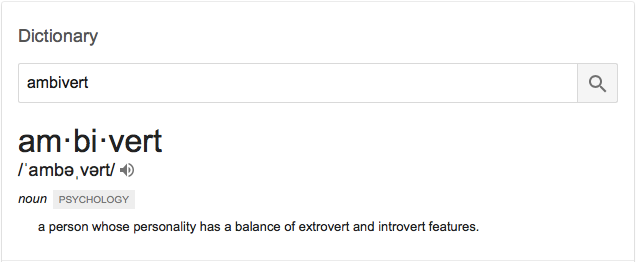
Well, dear reader, allow me to tell you. Actually, allow our wonderful friend Google to tell you because I’m lazy.
Let me ask you a question.
Wanna go to a party?
You will, most likely, answer this question with one of three answers. They are:
- “Hell yeah!”
- “Ew. No.”
- “It depends.”
Was your answer the first option? Congrats, you’re a spunky little extrovert!
Was your answer the second option? Also congrats, you’re a mellow me-time-is-the-best-time introvert!
For those of you who answered with option three, this article is for you.
Okay, I lied a little. Extroversion, introversion, and ambiversion exist more as a spectrum than they do as labels, even if you are confidently more one than you are the others.
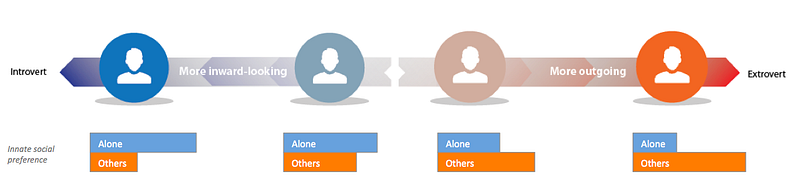
So what does it mean for those of us who identify more as an ambivert than either an extrovert or introvert? What are the perks?
1. Adaptability
This is arguably the most significant advantage ambiverts have over their more rigidly defined cousins. Those who are able to enjoy both time with others and times with themselves will find it far easier to adjust their energy to a multitude of different circumstances, having the ability to be more outgoing when the situation calls for it (like at a party) or more subdued (like at an important meeting).
2. Balance
Those who tend to identify as more of an extrovert tend to also be bigger risk takers, often making decisions more impulsively, while those who identify as introverts tend to avoid risk, often making decisions with more reservation. Ambiverts tend to take more calculated risks, meaning they see the potential for failure and hazard in certain decisions but choose to make them anyway because they’ve determined that the chances of failure or hazard are low or that the potential positive outcome outweighs the negative.
3. Best for Business
The general consensus is that extroverts have the best success in business, as their defining characteristic is their comfort with and desire for being around others. While this is certainly true, those who lean far towards extroversion can sometimes come off as too energetic and intense without realizing. Ambiverts have the advantage of being able to gauge their energy, making it valuable. They’re able to more accurately determine and match the energy of the person(s) they’re working with, making them more relatable and giving them a greater chance of success within the interaction.
4. Speak or Listen Accordingly
Sometimes Extroverts talk too much, sometimes introverts don’t talk enough. Either of these qualities can cause tension in social interactions. Ambiverts, being a mix of both, know the value of sharing ideas and contributing to conversation as well as the value of hearing what another person has to say and allowing them to contribute to the conversation, making the majority of their social interactions go smoothly.
5. It Can Be Learned
If you identify as an extrovert or an introvert and have read this far, you might be thinking “Damn, ambiverts got it all don’t they?” and the answer to that question is no, they just have an easier time being adaptable, and adaptability is something that can be learned.
Regardless of if you identify as an extrovert, introvert, or an ambivert, you can achieve the qualities that make an individual comfortable in any social situation, or, on the flip side, the qualities that allow an individual to be comfortably alone. It might be easier or harder for you depending on what you’re trying to achieve and where you fall on the spectrum, but the point is that it’s possible for anyone of any personality type.
Like this? Check out more of my work here:
The Gym — A Place For Mental Clarity
The Notion That Knowledge is Power is Wrong
An Introduction to Emotional Intelligence (EQ) Pt. 1
Practical Applications of Emotional Intelligence (EQ) Pt. 2