
The Performativity of an Uprising
‘Staging’ Terror in Franco’s Spain
In front of them, the earth bursts open with drumhead-rupturing thunder; beside them, with deafening booms; behind them, with thudding explosions. They suddenly feel as if they are standing on shaky ground, as if the earth were no more than a thin skin under which a gigantic cauldron of blazing fire was blazing up. Every second, that thin skin bursts at some point, shooting copper-red lava toward the heavens with enormous force from out of the fissure. Strangled with fear, a few of them wonder what would happen if it suddenly opened up here, right here under my body, which snuggles so trustingly up against its coolness.
Dwinger in Theweleit, 1987, 239
The Spanish Civil War is often referred to as the ‘Forgotten War’, a ‘pact of silence’ decreed that the mainstream parties involved would not talk about what happened. Through the staging of photographs, slogans and symbols, General Francisco Franco created a ‘character’ of an imposing and majestic dictator. Using fascist iconography and aided by a team of propagandists, he rewrote history to aid his reign of terror.
This article analyses the use of fascist iconography in Franco’s uprising during the Spanish Civil War. It looks at the ‘staging’ of images as a system of communication to underpin a nationalist and cultural performance according to Neil Jarman (researcher and writer) and how these contributed to Franco’s reign of terror. It will examine how Franco can be considered as a terrorist according to Alain Badiou (French philosopher) and how art reacted to his acts of terrorism but was also silenced for many years.
The cultish spirit of fascism combines politics, religion, and myths of the glorious past with contemporary events. Archaism — making reference to the distant past — suggests that history is not linear but rather a cycle of rebirth and regeneration, making a return to the values of a golden age possible. Visual references to Hellenic Greece, imperial Rome, and later neoclassical revivals evoke continuity with the past and thus provide a source of legitimacy and sense of destiny. Medieval art provided a model for the cult of the warrior, the crusader, and the orderly social hierarchies of feudalism.
Soules, 2007a, [online]
When one considers fascism, thoughts turn to the reign of terror forced on a number of European countries for example Hitler’s Nazi Germany and the Mussolini Regime in Italy. The common denominator employed by these regimes was the ability to effectively utilize strategies, chiefly propaganda to coerce the masses to believe in their cause. This influencing of public opinion has more recently been analysed as an extensive use of performance and expression used by various theatrical modes such as, drama, sport, opera, religion and iconography, to win over the support of the public. The theatricality of municipal exhibits in fascist countries makes for fascinating study in the manipulation and mobilisation techniques used for political purpose. Obviously the methods used took on various aesthetic forms according to the hegemony and tradition of that particular country. However with all fascist regimes there lies a fundamental aim, to bring about the reincarnation of a national community with the creation of a new anti-Marxist, post-liberal ‘Man’.
This ‘new man’ should be instilled with ritualistic, heroic ethics opposite to the self-indulgence of a materialistic socialist or liberal culture. Moreover the search for the fascist utopian ideal in practice required propaganda of a huge magnitude, including the overhaul of thinking in education, art, leisure and culture. This also gave rise to the need to discriminate against those who were enemies of the realm and therefore terror was used as a means to punish and prevent those who were. The acts of terror under fascist regimes were seen by their leaders as a necessary and cathartic medium to aid the regeneration of their culture. (Berghaus, 1996)
Franco was the head of the Nationalists in the Spanish civil war and leader of the Falange party, on becoming leader in 1937 he declared himself head of Spain. Franco’s motives were outlined in his Manifesto de las Palmas, (1936) he claimed to want “peace and love between Spaniards. Liberty and Fraternity without libertinage and tyranny.” (Forrest, 2000, 44) however what is clear from this manifesto, is that this could only be achieved within the law that he offered. Anyone who deceitfully ventured to destroy Spain would be dealt with and through this cleansing, social justice could be achieved with work and wealth for all. Franco ruled Spain for thirty-six years and could not have accomplished his longevity without support. So how did Franco gain his respect, celebrity and mass support? It is now that we need to turn to his use of propaganda, specifically fascist iconography, as a system of communication to performatively aid his uprising.
Since the earliest cave etchings, images have been used to communicate and convey meaning. They can induce deep sentiment in their viewer; give an instant message as a whole or gestalt (in parts). Religious icons have been used for many centuries to express the power of the deity and cultural icons exert the same supremacy in their own context. These powerful images have influence over us, we can be moved by their representation, as we see them, absorb them and remember them. In this way the image can continue to influence, it moves into our consciousness and continues to manipulate from our subconscious. We engage with the composition and meaning and gain pleasure from the way it animates our psyche. (Soules, 2007b [online]) It is therefore no coincidence that iconography has been used as a way to influence throughout time, whether it be through religion, war or our more contemporary advertising. This form of coercion takes thought and planning if it is to be successful and must relate directly to its audience’s sense of pride, loyalty, myth and culture.
For Franco and his team of propagandists, the use of images would assist not only his claim to leadership but reiterate his threats for those who opposed him. They were a part of a large system of symbols and slogans circulated in the media, books, schools, advertising and even religion. The images used were drawn from a range of myths, religious iconography, art history and historic events from each of the groups that supported his military uprising, giving force to his goal of Spanish unity. By drawing on parallels of past and present and learning from the propaganda used by his allies: Hitler’s Germany and Mussolini’s Italy and the Second Republic’s electoral propaganda, Franco staged his leadership backed with the slogan “One Fatherland, One State, One Leader”. (Basilio, 2003, 69)
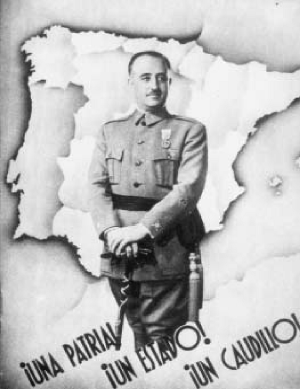
One of Franco’s earliest used symbols was the return to the yellow and red monarchical flag, rather than the red, yellow and purple striped flag of the Republic. By making the monarchical flag the representative symbol of the rebel-held regions, Franco appointed himself as the redeemer of Spain with the symbol of authority and royal influence. The adoption of this flag also placated the supporters of the military rebellion, who wanted the reinstatement of the monarchy. An accomplished military leader, Franco had already gained popularity and public acknowledgement for his ten years fighting to uphold Spain’s colonial territories. Therefore it was quickly recognised that the quickest and easiest way to sustain control over the rival factions, was to distribute powerful images of Franco. In 1937 dressed in his general’s uniform, a commemorative brochure was issued by the delegation of press and propaganda that communicated Franco to be the embodiment of national unity in Spain. (Figure 1) Monumentally placed over the map of Spain and between his slogan ‘Fatherland, State, Leader’ as previously mentioned, the image captures the state unity with a majestic leader at its helm. (Basilio, 2003, 68–70)
As discussed by Cornelia Brink in Secular Icons: Looking at Photographs from Nazi Concentration Camps, (2000) every photograph has a function within the collective memory of the culture it was taken in. For those behind Franco or not, his image would have a special emotional impact, he would be recognised as a symbol of power and terror to those who opposed him. Brink examines the objectivity of the photograph and how things can be left out and staged, moreover how “the significance attached to photographs by those individuals or groups for whom they symbolize something”. (Brink, 141) This exemplifies the thought behind fascist iconography, that the photographs produced were dramatic in as much as they were created to spark an emotional response, either positive or negative and ultimately be a piece of the jigsaw that propelled the goal of power.
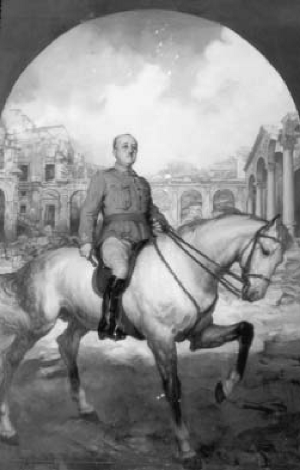
Neil Jarman reiterates the symbolic power of image and takes it a stage further. Jarman examines the use of banners and murals in national parades in Ireland and how the use of symbols and icons underpin the identity of dominant groups. As with the images used by the Francoist regime, they appeal to a patriarchal collective memory, with an openness of meaning allowing for varying interpretations. Jarman explains: “Broken down into simple segments, they could be viewed in a number of ways: as a series of single striking images, as a continuous narrative or as a group of structured moral oppositions.” (Jarman, 1997, 14) Franco’s team incorporated all three of these segments in the images distributed. There was a continuous narrative throughout the circulated paraphernalia, starting with Franco the saviour of Spain, then softer thoughtful expression portraits to show his deep consideration for the land, moving through to images believed personal to Franco’s iconography, with him astride a white horse, (Figure 2) thought to be directly linked to the patron saint of Spain. The pictures of Franco on horse-back sited him within the heredity of grandiose monarchs who were victorious in battle against those who opposed Catholicism. (Basilio, 2003, 91)
To scrutinise and interpret the visual image in more detail, Jarman turns to the work of Roland Barthes and how the analysis is derived from the study of semiotics. In simple terms “images are used as a system of communication, both to express meaning in a readily understood manner, through denotation and also within a coded, symbolic system, through connotation.” (Jarman, 1997, 14) Therefore using a more theoretical model that takes in to account a cultural knowledge, a coded symbolic system understood by its viewer and reinforcement with mottoes or slogans to dismiss ambiguity, the image can be a commanding and triumphant medium for effective persuasion and communication.
However it was not image alone that contributed to the success of Francoism. Whether it was premeditated or down to Franco’s introverted personality, scarce public appearance gave him celebrity status:
People gaze upon him…but only in photographs. He is a man who doesn’t appear in parades…He is felt, but not seen…Miracles evolve from his hours of hermetic solitude…and labor. The dictator’s elusive presence is consistent with the careful manipulation of his public image.
Basilio, 2003 77–78
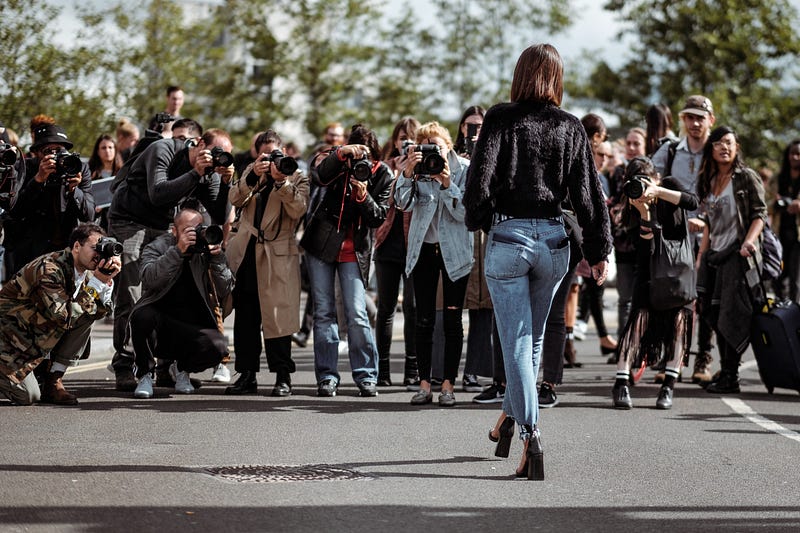
As with our contemporary celebrities, the general public craves not only media publication of their stars but to glimpse them in the flesh, for as long as the popularity lasts this becomes cyclical in nature, propelling their standing to new heights. Alleged to be “scrupulously honest, introverted, and a man of comparatively few intimate friends, he was known to shun all frivolous amusements.” (Payne, 2009, [online]) Therefore the city became his stage where rather than be seen, he was felt through posters, music, theatre and cinema. This was a trait of fascist ‘new man’ as explained by Berghaus; his private life was completely consumed within the elevated plane of national community. Social space was one of the most important contributors to the fascist ideal of a unified national State:
This expressed itself in the continual creation of a cultic social environment, both in forging of ‘sacred’ spaces, through monumental public building schemes, and through the constant invention of public ceremonies and rituals imbued with symbolic significance for the regeneration of the national community.
Berghaus, 1996, 23
Although no plan for oppressing individual interest was ever produced within theatre, it nevertheless also had a role to play. As a social space for the mainly middle-class audience it sought to underpin the legitimacy of the Franco regime. Two national theatres were set up in 1940, the Compañía de Teatro Nacional and the Español under the propaganda service to reiterate the splendour Spain was capable of achieving. However paradoxically the theatre became a vehicle for those interested in opposing the regime, moreover a slump in earnings meant that only the wealthy could afford to attend. (Gregor, 2007, 29–36)
Interestingly whichever fascist regime we examine, there seems to be a craving for personal celebrity and power. The fascist men were viewed as the defenders and even martyrs of the nation and religion. Emphasis was placed on life; the fallen heroes became immortal within the fascist cult, keeping alive the revolution. True to the fascist ideal ‘new man’ was at the forefront, women were rarely present in their thirst for power and unity, moreover it seems they were a ‘force’ to be avoided. The fascist man must be regal, he must evade all that is frivolous or impure and in his personal quest he could not be enveloped by a woman who could interfere with his pursuit.
The fascist fantasy — which was of course no fantasy for the millions of victims — springs from a dread that (perhaps) lies in the hearts of all men, a dread of engulfment by the “other,” which is the mother, the sea or even the moist embrace of love.
Theweleit, 1987, XV

It would seem that the similarity of this trait is strong between all fascist leaders. Theweleit believes this is born from the incestuous desire to penetrate the very earth itself, they desire the opposite sex but want it anonymous, whilst partaking in any act of sex their ultimate yearning is to forcibly suppress. Furthermore human beings no longer exist as people with limits, according to Freudian theories of the id, ego and superego; it is thought that these men have a damaged or fragmented form of the ‘ego’ not fully developed in early childhood. This splintering causes a male that can not perceive boundaries or develop a normal relationship with his mother; instead his mother is separate, situated as an object outside the self and vice versa. (Theweleit, 1987, 204–209) Perhaps this under development further explains the disassociation conveyed through the acts of terror seen under the Franco regime and gives insight to the psyche of not only the fascist dominant male but also a terrorist.
In our contemporary society the term ‘terrorist’ is used by the state as a person who uses violence and is a political adversary. However, Alain Badiou explains that originally a terrorist was someone who exercised political and judicial power justified by extraordinary circumstances, for example civil war. He further clarifies that from whichever angle you view it, terrorism connotes the negative. For Franco, those who opposed him would be viewed as the terrorist, however on the flip side he could be viewed as such by exerting his power by force on the masses. However, there seems to be three main criteria that shape the form of action taken by a terrorist: “non-State action, which emerges — reality or myth — from clandestine networks…violent action aiming to kill or destroy…an action which makes no distinction between civilians and non-civilians.” (Badiou, 2003, 145) It is the latter that can be overtly seen with the bombing of Guernica under the Franco regime.
In 1937 the small town of Guernica came under attack from German fighter planes who systematically aimed to wipe out the inhabitants through the use of high explosives and machine gun fire. The assault was ordered on Franco’s behalf to shatter the Basque conflict to Nationalist forces. (Forrest, 2000, 52) One-thousand, six-hundred civilians were either killed or wounded in the three and a half hour attack and the town continued to burn for three days. The town served no function as a military target and in essence was used instead as target practice:
The concentrated attack on Guernica was the greatest success,” making the dubious intent of the mission clear: the all-out air attack had been ordered on Franco’s behalf to break the spirited Basque resistance to Nationalist forces. Guernica had served as the testing ground for a new Nazi military tactic — blanket-bombing a civilian population to demoralize the enemy. It was wanton, man-made holocaust.
Stoner, 2009, [online]
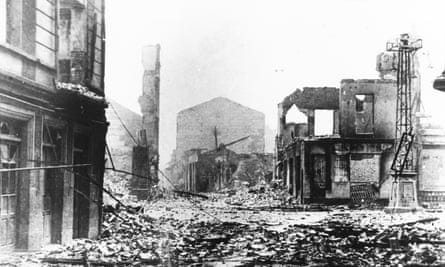
Innocent women and children were killed in the bombing and although sixty-one years later a formal apology was given by the German government, no formal apology has ever been made by the Spanish for their role in the bombing. This in itself highlights the performance of power and terror exercised by Francoism for nearly forty years. The dictatorship was so strong that those involved in War crimes would never be talked about and therefore never appeared in publication. Instead the idea that both sides committed violence and made errors was reinforced and therefore it was proposed, that it was best forgotten. It was not until 1996 that the ‘pact of silence’ was tentatively broken, however so much time had passed that both those responsible for the tyranny and their victims were few and compensation was meagre. (Durgan, 2006, [online]) Nevertheless within the Arts attempts to comment on fascist power and Franco’s performance were made.
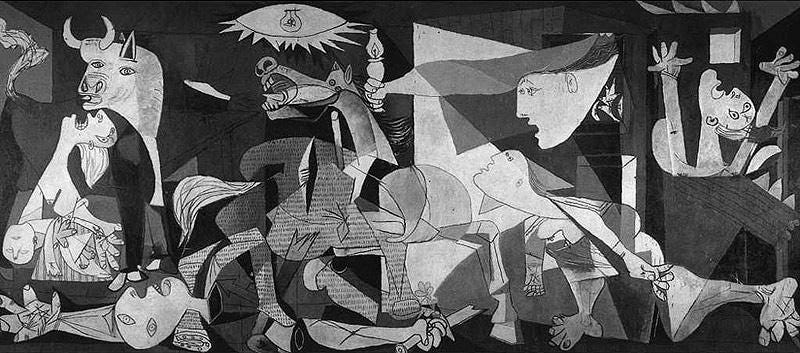
Perhaps one of the most powerful anti-fascist and anti-war statements was made with Pablo Picasso’s mural Guernica (1937, Figure 3). After being promised prosperity and stability as a Spanish citizen under Franco with the reality being death and annihilation, Picasso agreed to paint a visual demonstration of Francoism for the democratic government. Initial non-inspiration quickly reversed when he heard of the bombing of Guernica and witnessed the black and white photographs of the destruction caused. Horrified by what he had witnessed he immediately began to sketch what was to become one of the primary anti-fascist declarations.
From the outset Picasso aimed to not romanticise the mural or paint it in a realist nature, perhaps he believed this would disparage the true meaning of the work. Instead he used key motifs of outstretched arms, mother and child and animals in agony, to convey the horror the fascist regime had caused against the innocents. (Stoner, 2009, [online]) The bull could simply suggest Spain and the Spanish defiance, however taken in to context with the rest of the painting and looking at its stance, I believe it is a fundamental symbol for the arrogance and power seen under the fascist regime. The bull seems to be upright and strong and with its head turned from the rest of the scene, it appears to imply a refusal of the horror and rather a necessary means to an end, so implicit under fascist rule.
Picasso’s work was to become one of the most commanding condemnations of war and so influenced other artists to make comments also. Originally dismissed in his country “as the dream of a madman. Even the Soviets, who had sided with the Spanish government against Franco, reacted coolly. They favor more overt imagery, believing that only more realistic art can have political or social consequence.” (Stoner, 2009, [online]) Therefore Guernica went on tour and settled in New York at the Museum of Modern Art. As previously mentioned, images can have an influential and emotive impact and it was in its new home that it continued to bring about new anti-war statements.
For Joseph Gifford, a member of ‘The New Dance Group’, the mural made a deep emotional impact. A few weeks after seeing it, he came across a traditional piece of Spanish Flamenco music and decided it was perfect for his piece The Flight (1947). Gifford wanted the dance to convey the devastation of the bombing and asked his dancers to concentrate on the emotion and experience rather than the steps. Female dancer Catherine Cabeen danced the female part in collaboration with Gifford in UW Chamber Dance Company’s recreation of the piece in 2008. She describes the experience:
In the solo, I’m experiencing fear — hearing the sounds of the plane — she [the character] is alone so there’s that desperation of reaching out. Then when we’re in the duet, there’s destruction all around us but the partnership is helping us to survive at that moment.
Cabeen in Wick, 2008, [online]
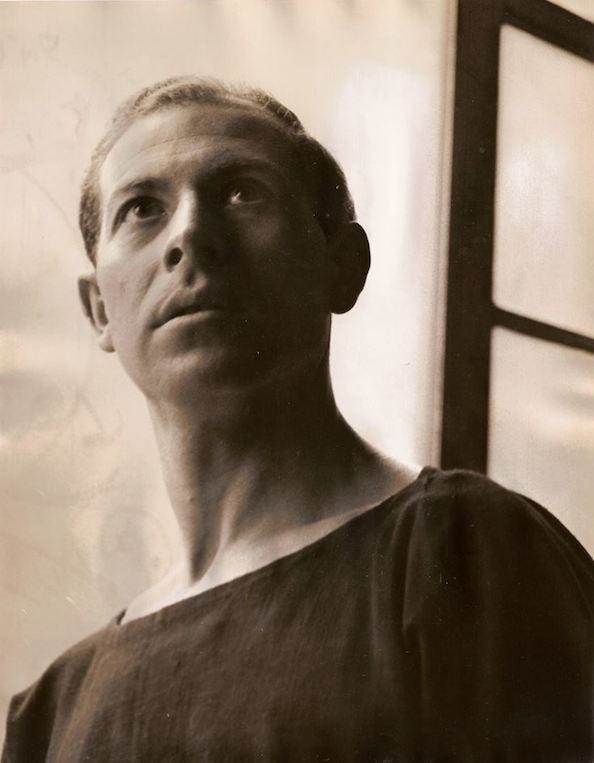
Gifford used imagery from the painting to create his work, the up-stretched arms and entwining of bodies combined with the authoritative Flamenco makes for poignant viewing. Although the original piece would have been viewed in a different context from the bombing and therefore would allow for cultural interpretation, it aimed to raise socio-political concern about war and fascism. (Holub, 2006, [dvd])
For Anna Sokolow, the daughter of a Russian immigrant who grew up in New York’s Jewish immigrant community, the Guernica bombing also made an impact. It is not clear whether she viewed the mural, however upon viewing footage from the documentary ‘Heart of Spain’, about the bombing of the civilians; she created a piece entitled Slaughter of Innocents (1937). Sokolow wanted her audience to connect with the suffering of the many women and children during the civil war. Described as “a dance of perpetual motion” (Balmori in Warren, 1991, 71) Sokolow danced the solo piece herself turning continuously, whilst her upper body and outstretched arms communicated the torment of loss. Sokolow believed that art ought to be an expression and a statement on contemporary existence:
My works never have real endings; they just stop and fade out, because I don’t believe there is any final solution to the problems of today. All I can do is provoke the audience into an awareness of them.
Sokolow in Brown, 1998, 107
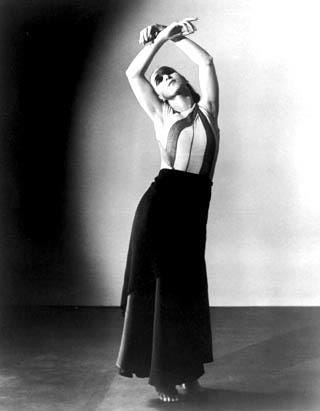
Thus through her piece Sokolow aimed to spark a reaction in her audience, make them consider the futility of war and the anguish and misery brought on innocent civilians primarily, women and children under the Franco regime. This in turn adds force to the male dominance in the fascist political psyche and how strength and oppression was used to combat resistance.
General Francisco Franco as with many fascist leaders promised an all embracing, morally and spiritually unified nation. He sought to convince the masses that with him as their leader, they could return to the national harmony and loyalty of days gone by. Spain would be reborn and rejuvenated and utopia for all would be achieved. It cannot be denied that along with his propaganda team, he was highly skilled in creating and performing his character and imposing it upon civilian Spain.
As discussed, the various images and their mass circulation in community spaces played a fundamental role in the reiteration of the Francoist regimes values, along with making Franco himself an icon of a ‘new’ Spain. However, with his reign came terror, as with the slaughtering of Jews in Nazi Germany, Franco failed to differentiate between the innocent and those who opposed him. How can one justify a climate of horror and the destruction of many to achieve one’s ultimate goal? The fact needs to be considered that this is unacceptable; terrorism cannot be legitimised, however, from the beginning of time it has been practised and still continues in or contemporary culture. Nonetheless to juxtapose this, the visual arts will no doubt continue to react against the horror. Whether it is in an overtly political manor, or to raise awareness and change in our culture, there will always be artists who are willing to ‘speak out’ in protest.
The final irony of this subject matter is that any protest against terrorism will need an iconography of its own; it will need to use the symbolic, the connotative and the denotative to convey meaning and arouse emotion in its audience. As a result our contemporary society continues to belong to a hugely divergent symbolic system, where the emotive is used as a powerful tool, whether it is through media, art, education or leisure, for different means on a daily basis.
Article written by Drama Llama | Educator | Writer | Academic | Consultant