
The People’s Movement, Part II
The fallout of the Palace Massacre, and the end of the Nepalese Civil War.
The People’s War intensified in the years following the palace massacre. Grief and mourning for the king and queen soon turned to rage and distrust. Official reports investigating the massacre stated that Prince Dipendra’s weapons were discharged accidentally, somehow killing ten members of the royal family, in various locations throughout the palace. The bodies of the royal family were cremated at Pashupatinath before a proper autopsy could be performed. Many suspected King Birendra’s brother Gyanendra, who would be crowned king following the death of Birendra (and, briefly, Dipendra), of orchestrating the event. He was in Pokhara during the massacre, and his son, Paras, who was at the palace during the attack, emerged unharmed. Perhaps Paras was the one to blame, skeptics speculated. Others suspected the involvement of the Indian Secret Service, or the United States’ Central Intelligence Agency.
Not long after Gyanendra took power, he dissolved the government and reinstated the monarchy, just as his father Mahendra did in 1960. He declared a state of emergency in Nepal. The Maoist insurgency was spreading across the Nepali countryside, making its way into Kathmandu. In November 2001, just a few months after the Palace Massacre, the Maoists broke their ceasefire agreement with the government and overran army barracks in the Kathmandu Valley, seizing government weapons. They looted guns from local police stations. Soon, Maoist attacks were occurring in nearly every district in Nepal, and the rebels were in control of nearly half the country. The king called in the army, and Nepal fell into a full-fledged civil war. By 2005, more than 13,000 people had died, many of whom were civilians caught in the crossfire.
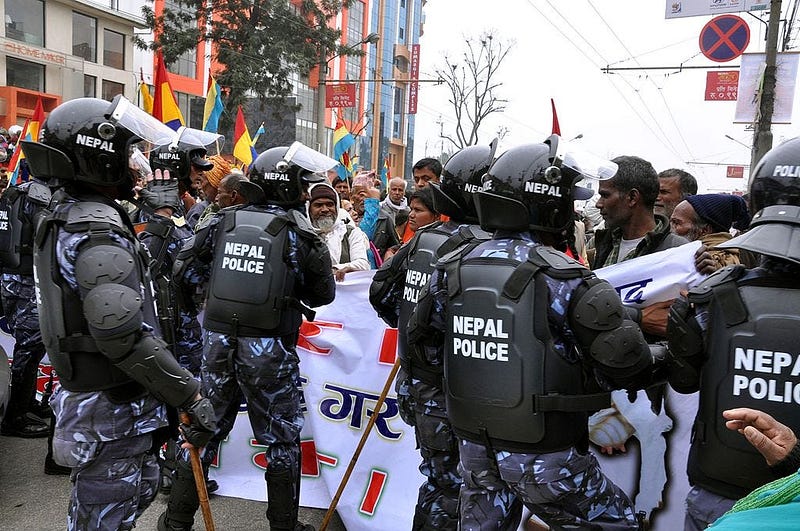

Protests and demonstrations on the streets of Kathmandu became more common and violent than ever, reaching a boiling point in April 2006, when 16 protesters were killed in a clash with Nepali police. The protesters demanded the king to relinquish his power and reinstate democracy. Confronted with the violence and social upheaval occurring under his “control” of the country, Gyanendra didn’t have much of a choice but to step down. A month later, the freshly reinstated parliament voted Gyanendra and the royal family out of power. With the king out of the picture, the Maoists were willing to negotiate. They signed a peace treaty, and just like that, Nepal’s decade-long People’s War was brought to an end.
In the years to follow, the Maoists renounced control over the land they had captured, handing it over to the Nepali government, who promised the people land reform. The People’s Liberation Army and the Nepali Army merged, and soldiers who once stood on opposite sides of battlefields found themselves on the same team. Many of the Maoist rebel leaders were voted into parliament. Men once labeled terrorists became legitimate government representatives. Yesterday’s Maoist freedom fighters are today’s members of the Nepali Communist Party.
A new constitution was commissioned and adopted in 2015, integrating the Maoists into the country’s government to stay. And though the violence has subsided, the nation’s Communist and Congress parties rarely see eye to eye. Case and point: the Millennium Challenge Corporation’s proposed foreign aid deal.
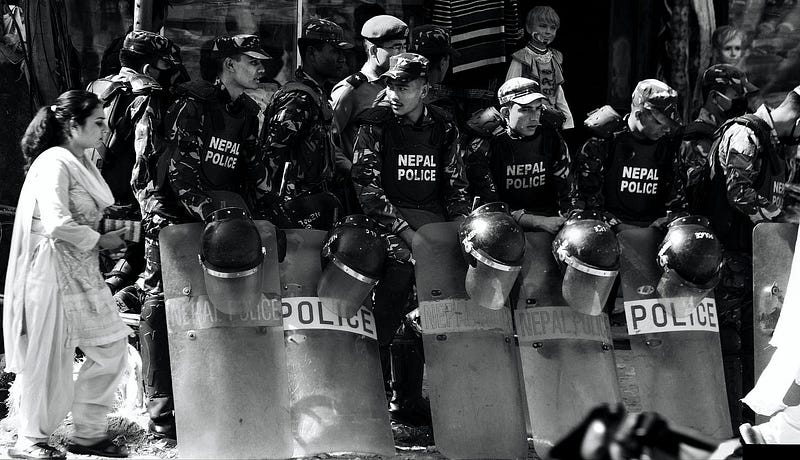
The streets were barricaded. Police officers wore riot gear and brandished rifles. “POLICE,” their bullet-proof vests read. Behind them, a couple blocks away, was the Supreme Court of Nepal and the Office of the Prime Minister & Council of Ministers. After the recent clashes outside of Nepal’s Federal Parliament building, the police weren’t willing to take any more chances. Across the street, in the confines of an athletic field called Sainik Tudikhel, another demonstration was underway. Men stood on a stage fit with concert speakers, delivering speeches about the government and the recent ratification of the MCC agreement to a crowd numbering in the thousands. From the streets, the police kept a close eye on the masses.
.jpg)
Siri and I were on our way to the Nepal Tourism Board to acquire my trekking permits, and we happened across the demonstration on our way there. As we made our way along Durbar Marg, on the sidewalk adjacent to the demonstration, a man spoke furiously in Nepali to cheers from the crowd.
Siri laughed. “He said, ‘The Prime Minister is a fucking puppet!’”
We stood just outside the gate and listened for a time. Siri translated the speeches for me. Some demanded that Nepal free itself from the rule of unworthy politicians. Others spoke of corruption among politicians and the police force and the need for reform. Many expressed their desire to keep American interests out of Nepal.
“Do you want to go in?” Siri asked me.
“Could be interesting,” I said. But I was hesitant. Crowds tend to make me uneasy, particularly politically charged crowds expressing anti-American sentiments, me being from America and all.
“Nobody is against the citizens of your country,” Siri assured me. “They are against your country’s politics. You aren’t in danger.”
I thought back to a video I’d seen of protesters, some of whom were likely in the crowd before me, lobbing rocks at Nepali police officers wearing riot gear. My instincts told me to steer clear of the mob, but I couldn’t resist my curiosity. I was eager to understand what the people of Nepal thought and felt about their country’s foreign relations.
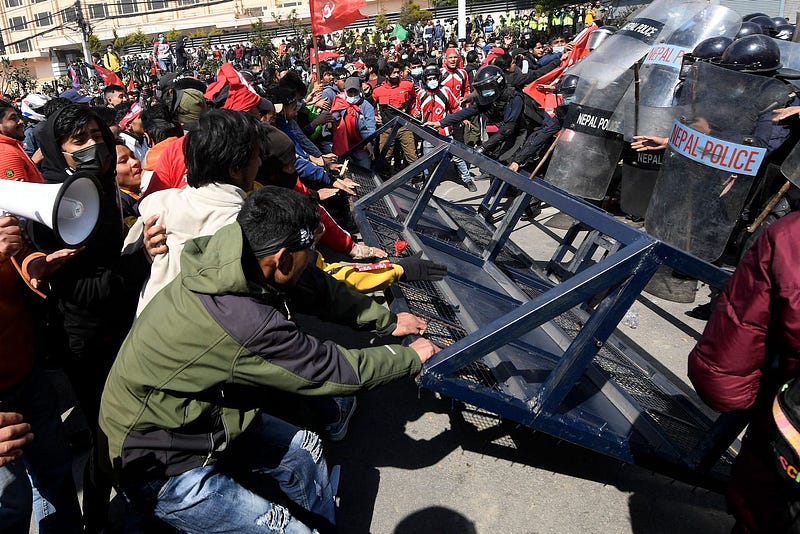
We walked through the gate and among the crowd of mostly young men. Some waved Nepali flags in the air. Others held signs. “NO MCC,” one read. “DOWN WITH MCC,” read another. “BACK OFF USA.” And “SAVE THE MOTHERLAND.” Siri talked with members of the crowd, relaying their sentiments to me, some of which I scribbled into my notebook.
“Are you a journalist?” a young man asked me in English.
“No, just a traveler.”
“Where are you from?”
“I’m from Canada,” I lied.
“And what do you think about MCC?”
I didn’t know what to think about it, I told him. On one hand, it seemed like a good deal for the Nepali people. The agreement provides the country with half a billion dollars in funding to build roads and provide more people with electricity. “The MCC Nepal Compact marks a new chapter in the U.S.-Nepal Partnership and is designed to increase the availability of electricity and lower the cost of transportation in Nepal,” the Millenium Challenge Corporation’s website reads. “It will help support the Government of Nepal to better deliver critical services to its people, ease the movement of goods around the country, and open new opportunities for private investment — all to create sustainable development for the people of Nepal. Strengthening the reliability of key infrastructure will put the country’s economy on a firmer growth trajectory, advance stability, support regional security, and reduce poverty.”
“But it seems the people of Nepal are opposed to US troops coming into the country,” I said.
“Years ago,” a young man by the name of Mahesh told me, “nobody had a problem with MCC. It was good for Nepal. But then the Americans added to it, you see. Now they want to put US soldiers in our country!”
Mahesh and his fellow anti-MCC protestors believe the agreement is a disguise to more closely position US troops to China. Nepal, they said, is just a pawn in a larger geo-political chess match. The Nepali Communist party sees the agreement as “part of a larger strategy by the West led by the United States to encircle China,” in the words of the Kathmandu Post. But there is a more self-serving motive behind the Nepali Communist Party’s stance on MCC. “If the MCC will be passed in Nepal, the Communist Party will cease to exist because the U.S. will never tolerate the word ‘Communist,’” an unnamed “Communist leader” told The Diplomat, an online news magazine covering politics in the Indo-Pacific region. Not to mention, much of the anti-MCC rhetoric among Nepali communists has roots in Chinese propaganda seeded on social media channels like Facebook and TikTok.
“We are a very poor country,” Mahesh continued. “We need more power, better roads — we need more for our people. But this is not about Nepal,” Mahesh said of the MCC agreement. “It is about the United States and China.”
“We are caught in the middle,” another protester by the name of Rama told me. “We want a free Nepal!”
Siri and I talked with a few more protesters. All of them expressed similar sentiments — the desire for a free and independent Nepal, the needs of the Nepali people, the despair of being stuck between the interests of larger, more powerful nations.
We left the demonstration and walked a few blocks to the Tourism Board before the office closed for the day. I bought my permits and returned, walking along the sidewalk of Durbar Marg. The protest was still in full swing, and it seemed to be growing.
Later that evening, protesters clashed once again with Nepali police.
Note: This article is an installment of a many-part series chronicling my travels in Nepal in early 2022. The series is a travelogue, written with the intention of bringing you along on a journey through this beautiful and deeply fascinating country. If you’re interested in reading more about my travels in Nepal, follow along here on Medium @quentinsepter.