
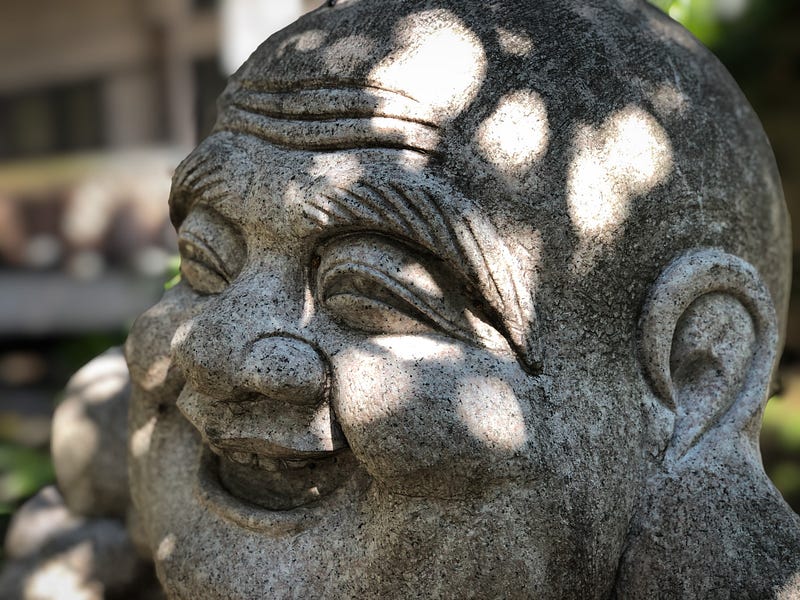
The Path to Happiness
November Six Word Photo Story Challenge: “Happiness”
Buddha’s path to happiness: end suffering.
I am not Buddhist, but I do try to include Buddhist principles in my mindfulness practice and lifestyle.
I suspect the Buddha is cool with that.
Siddhartha Gautama, the Buddha, was born into a royal family in the foothills of the Himalayas in what is now Nepal. He lived a sheltered life of luxury and comfort, but he was always aware of the suffering of the world. When he was 29 years old, he left his palace and wandered the land, seeking an end to suffering.
For six years, Siddhartha practiced extreme asceticism, but he found no peace. Finally, he sat under a bodi tree, determined not to rise until he had found the truth. After a long night of meditation, he attained enlightenment and became the Buddha, the “Awakened One.”
The Four Noble Truths are the foundation of Buddhism. They are the truths or realities for the “spiritually worthy ones.” The truths are:
Dukkha (The Truth of Suffering)
Dukkha is a Pali word that is often translated as “suffering.” However, dukkha is a much broader concept than just physical pain. It also includes mental suffering, such as dissatisfaction, anxiety, and stress. Dukkha is a fundamental aspect of existence, and it is caused by our craving and attachment to impermanent things.
Samudaya (The Truth of the Cause of Suffering)
The cause of dukkha is craving and attachment. Craving is the desire for something we do not have, while attachment is clinging to something we do have. Craving and attachment lead to dukkha because they are based on the illusion that things are permanent and unchanging.
Nirodha (The Truth of the Cessation of Suffering)
Suffering can be ended by extinguishing craving and attachment. This is not about suppressing our desires, but rather about seeing things clearly for what they are. When we see that things are impermanent, unsatisfactory, and not-self, we will no longer crave them or attach to them.
Magga (The Truth of the Path to the Cessation of Suffering)
The Buddha taught that suffering is caused by craving and attachment. He also taught that there is a path to liberation from suffering, the Noble Eightfold Path. The Eightfold Path is a practical guide to living a moral and ethical life, and it includes the following steps:
- Right understanding
- Right thought
- Right speech
- Right action
- Right livelihood
- Right effort
- Right mindfulness
- Right concentration
The Buddha spent the rest of his life teaching the Dharma, the truth he had realized. He traveled throughout India, teaching to anyone who would listen. As he traveled, he attracted a large following of monks, nuns, and lay people, and he established the Sangha, the Buddhist community.
The Buddha died at the age of 80 in Kushinagar, India. His teachings have been preserved in the Pali Canon, a collection of scriptures that form the foundation of Theravada Buddhism. The Buddha’s teachings have had a profound impact on the world, and they continue to inspire people today, including yours truly.
As a mindfulness teacher, I pass on a secular practice which is nonetheless deeply inspired by Buddhist philosophy and psychology.
Thanks to Vidya Sury, Collecting Smiles, for this month’s prompt, and to Mary Chang Story Writer, for this and every month’s six word photo story challenge.


