
The Path to a Sustainable Future: What Is ESG?

Undeniably, any business has a more significant impact than solely what it sells. The bigger a company becomes, the more it entangles itself with the community around it. That’s where ESG can be helpful.
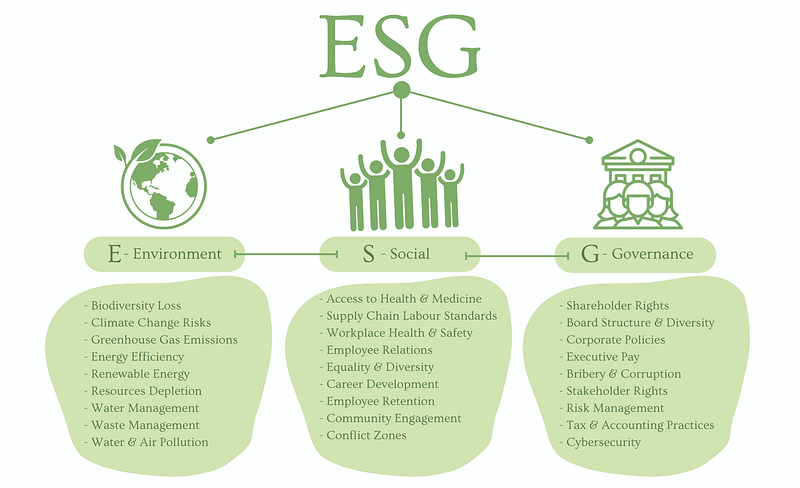
ESG — short for Environmental, Social, and Governance — is a set of standards that measure a company’s impact on those three areas.
How well a corporation can integrate within the communities where it operates, while being respectful of its individuals and caring about environmental issues is essential for its success in the long run. Having high ESG ratings can also decrease risks and increase investments for a business.
Different stakeholders — investors, customers, suppliers, and employees, for example — can use ESG metrics to evaluate corporations and their sustainability, including their impact on the planet and the communities where they operate.
But what exactly is ESG? And how has it become a critical component of the investment landscape?
In this article, I’ll explain the three areas of ESG and how they can be used to create a more sustainable and socially responsible future. While also making a company more attractive to investors and all its stakeholders.
ESG Principles
ESG is critical for any business. It’s becoming the dominant way to assess how a company contributes to the world, in addition to making a profit.
ESG factors assist in evaluating an organisation. These factors, although non-financial, have a direct impact on long-term risks and return on investment. As a result, companies that have higher ESG scores are more sustainable, helping us make the world a better place.
But, ultimately, it’s not only about an organisation being more conscious. A company that scores high on ESG metrics is also a better investment. These corporations are less risky and more likely to succeed in the long run.
But how can a stakeholder measure a company’s ESG efforts?
There are several principles that an organisation can evaluate when deciding which metrics to measure and report in its ESG efforts. These principles are related to the main pillars of ESG — Environmental, Social, and Governance — and each company will implement them according to its realities and needs.
There’s no unique framework for reporting and measuring ESG, and thus there’s no exhaustive list of principles. There are also no regulations about which ones each business is required to consider. Anything that affects a company’s relationship with any of the three pillars should be included.
And although there’s no one unified ESG regulation, there are numerous frameworks that a corporation can use to measure and report its ESG efforts.
Each framework has its own metrics to examine the ESG impacts of a company. They also adhere to different methodologies and scoring systems.
Some popular frameworks today are:
- GRI (Global Reporting Initiative)
- CDP (Carbon Disclosure Project)
- SASB (The Sustainability Accounting Standards Board)
- TCFD (The Task Force on Climate-Related Financial Disclosures)
- PRI (UN Principles for Responsible Investments)
- ISSB (International Sustainability Standards Board) (in development)
Which framework is the best for any business will depend on the goals and characteristics of each organisation. That also applies to which principles and metrics a company focuses on.
Some metrics may need to be measured and disclosed by law (especially those relating to governance), others because there are industry regulations or because they’re important to the company or its stakeholders. It’s also essential to consider what investors seek when evaluating which metrics to measure and disclose.
Ultimately, choosing a framework and a set of principles will be up to each corporation, depending on what is relevant for them. What metrics to measure in relation to a principle will also vary depending on the company and the chosen framework.
So let’s dive into each pillar of ESG and see some of the principles they can comprise that might be part of a company’s ESG efforts.
Environmental Principles
The E in ESG stands for Environmental.
The environmental criteria in ESG relate to an organisation's processes, policies, practices, and overall effect on the natural environment.
The main goal is to minimise the business’ environmental impact, targeting different areas of the organisation to implement more sustainable, ethical practices. It can also include initiatives to give back to the planet, such as creating more energy than the company requires or planting trees to offset carbon emissions.
Every business interacts with the natural environment differently, and its impacts may vary depending on the industry sector or location. From operations and supply chain management to products or services, the issues it faces and their importance will vary widely.
That’s why there’s no consensus on what principles a company needs to implement in their ESG efforts.
Some of the environmental principles to take into account are:
- Biodiversity Loss
- Climate Change Risks
- Greenhouse Gas (GHG) Emissions
- Energy Efficiency
- Renewable Energy
- Resources Depletion
- Water Management
- Waste Management
- Water & Air Pollution
Examples of environmental business practices include:
- Lower energy consumption
- Reduce water intake
- Create more sustainable products (biodegradable, for example)
Social Principles
The S in ESG stands for Social.

The social criteria in ESG relate to an organisation’s processes, policies, practices, and overall effect on all its stakeholders. That includes its workforce, investors, suppliers, customers, regulators, and the communities where it operates.
The main goal is to have a positive impact on all the people affected by the company and its operations.
While environmental aspects differ widely from one organisation to another, some social factors are part of every company. Topics such as community engagement and health and safety for staff apply to all businesses and should always be considered.
Social principles can be very broad, encompassing all company relationships with people. Including training its employees, having a diverse workforce, and fair pay for its employees and all those in its supply chain.
Some of the social principles to take into account are:
- Access to Health & Medicine
- Supply Chain Labour Standards
- Workplace Health & Safety
- Employee Relations
- Equality & Diversity
- Career Development
- Employee Retention
- Community Engagement
- Conflict Zones
Examples of social business practices include:
- Invest in local community projects
- Provide training for employees
- Ensure its supply chain is free of human rights abuse, such as modern-day slavery
Governance Principles
The G in ESG stands for Governance.

The governance criteria in ESG relate to an organisation’s processes, policies, and system of controls by which a company is managed, and decisions are made.
The main goal is accountability. Governance policies focus on ensuring that a corporation is healthy in its internal affairs and conducts business ethically.
Governance principles are often mandatory, and sometimes the metrics have to obey local laws. Furthermore, a corporation must be transparent about its activities with all its stakeholders.
It’s also part of the governance aspect to implement, measure, and report all the business’ ESG efforts.
Some of the governance principles to take into account are:
- Shareholder Rights
- Board Structure & Diversity
- Corporate Policies
- Executive Pay
- Bribery & Corruption
- Stakeholder Rights
- Risk Management
- Tax & Accounting Practices
- Cybersecurity
Examples of governance business practices include:
- Anti-corruption measures
- Protecting customer data
- Accurate reporting on financial performance
ESG Ratings and Metrics
ESG principles guide a company’s ESG efforts, but metrics are necessary to quantify these actions.
Some examples of ESG metrics are:
- Environmental Metrics: GHG emissions, total energy consumed, total water consumption
- Social Metrics: Percentage of gender/racial/ethnic group representation for management and employees, total recordable incident rate, rate of standard entry level wage by gender, average hours of training per employee
- Governance Metrics: number of data breaches, annual total compensation ratio of CEO to median of all employees
ESG metrics allow for the creation of reports that stakeholders can use to evaluate all ESG efforts within a company. These numbers can also help an organisation track its progress and modify its programs accordingly.
ESG metrics are diverse by nature, since they cover several unique topics and areas. Although quantitative metrics are more useful and often requested, qualitative information can be helpful for some investors or other stakeholders.
Organisations that use a framework to measure and report their ESG efforts will find the metrics to be used within the framework. These frameworks will help a company to build an ESG strategy, implement it and assess its success.
It’s also the metrics that the organisation will use in its ESG reporting, which can be useful with all its stakeholders — from employees to customers to current and future investors.
A business can also get ESG ratings from a third-party score provider, which will measure the company’s ESG commitment — based on its performance and accountability. Rating agencies will analyse publicly available information on the organisation’s ESG efforts and use this information to provide a score.
Different rating agencies and different frameworks may use distinct metrics for the same principles. For example, employee training is measured by the amount invested in the GRI framework but by training hours in the SASB.
This can make it challenging for stakeholders to compare ESG metrics across agencies and organisations, particularly investors when building or updating their investment portfolios.
Despite all these challenges, evaluating a company’s ESG efforts can provide valuable information for investors. They can use these metrics to decide which companies to add to their portfolio and which to remove. In addition, these metrics provide insights into a business’ long-term sustainability, social responsibility, and financial performance.
Other stakeholders, such as consumers and employees, use ESG metrics and ratings in their decision-making processes. With sustainability becoming a top-of-mind topic, ESG metrics and ratings can influence who people buy from, who they work for, or even if they want to do business with a company.
Why ESG Matters
ESG measures a company’s environmental and societal impact while being accountable for its governance. These metrics assist in evaluating organisations and, although non-financial, they directly impact long-term risks, return on investment and even the long-term success of a business.
ESG factors have become a critical component of the investment landscape. ESG Investing offers a way to align investment with the values of investors. It’s a way to support ethical, sustainable, and socially responsible companies that have more than profit on their agenda.
There are numerous frameworks to choose from and several principles that can be used. Ultimately, which is appropriate for any corporation will vary case-to-case.
By incorporating ESG efforts, a business can create a more sustainable future. It’ll reduce its impact on the planet, improve its relationships with everyone involved, and have transparent and ethical ways of operating. In addition, ESG efforts make a company more attractive to all stakeholders — consumers, employees, suppliers, and, in particular, investors.


