avatarCarolyn Hastings

Free AI web copilot to create summaries, insights and extended knowledge, download it at here

2892

Abstract

oking at the painting, the more I felt the need to continue writing. The need to translate into words my interpretation of what the painting spoke of. So here it is, a prose poem.</p><h1 id="739f">The Patchwork Quilt</h1><p id="7f31"><i>The <b>flush </b>of her cheek like a fresh spring bloom pregnant with a yearning love for <b>all</b> that is conceived, immortalised, in the symbolic creation, a beautiful progeny <b>flowing</b> from her blessed hands. With <b>each</b> <b>stitch</b> she nurtures her descendants, <b>binding</b> them snug and warm with their forebears, a taut, unbroken thread of continuance and connection that yields <b>only</b> to the supple plying of hands and the persistent <b>pull </b>of the womb. Her precision stitches, each one a <b>tiny</b> latch, invisibly, indelibly interlocking <b>their</b> past, <b>her</b> present, <b>their</b> future.</i></p><p id="b168"><i>The telling of the spent cup and plate, time-lapsed, like the passage of a ship through the mystical ages bearing <b>Isis</b>, the goddess of fertility and motherhood, and <b>Na’amah</b>, Noah’s wife, with her apron pockets <b>filled</b> with seeds, summoned<b> </b>forth to sow the abundant crops of their ordained legacies with each <b>passing</b> of the sewing needle through the cloth.</i></p><p id="87b8"><i>Her solitary companion, faithful, ever-present loyalty, as much a part of the intricate tapestry of interlaced lives as <b>any</b> human being, now slumbers in sweet reverie marking, by consent, his territory, date-stamping the tessellated hexagons with pawed imprints and embalming them with his <b>own</b> pheromone charm.</i></p><p id="e8b0"><i>My eyes dwell upon this <b>scene</b> much like her eyes focus on her labour of love, oblivious to the world beyond our respective peripheral fields. An ambience of wellbeing and contentment permeates from the canvas and envelopes <b>me</b> in its wholesomeness and grace. I <b>feel</b> blessed by something I cannot quite explain but know to be real. A gentle stirring, a flourishing of purpose. I step away and the threads of the patchwork quilt trail behind me.</i></p><p id="ea4b"><b>© Carolyn Hasting 2021</b></p><h1 id="e8b1">About the artist, Lance Calkin</h1><p id="51b9"><a href="https://en.wikipedia.org/wiki/Lance_Calkin">George Lance Calkin</a> (1859–1936) was a celebrated English portrait painter who, during his career, became the Royal portrait artist for King Edward VII and King George V. Calkin worked predominantly in oils on canvas. <a href="https://artuk.org/discover/artworks/the-patchwork-quilt-47506">The Patchwork Quilt</a> was painted in 1887 and is currently held at the Nottingham City Museums & Galleries in England. Unfortunately, no records have been found about the painting, the quilt or the woman.</p><h1 id="f594">About monoku</h1><p id="a9db">The term, <i>monoku</i>, literally means one verse (<

Options

a href="https://www.etymonline.com/word/mono-">mono</a> - from Greek, meaning one or single; <a href="https://educalingo.com/en/dic-en/haiku">ku</a> — from Japanese, meaning verse). Monoku is a contemporary, Westernised derivation of <a href="https://literaryterms.net/haiku/">haiku</a>. A <a href="https://www.underthebasho.com/utb-2018/essays/2451-monoku-an-experiment-with-minimalism-in-haiku-literature.html">monoku</a> is composed of 17 syllables or less written in one line; all lower-case letters; minimal, if any, punctuation; and including a natural pause created by speech rhythm. The words are arranged such that they can be interpreted multiple ways, becoming something of a word puzzle. Modern monoku often have a dash to mark the natural pause, for example - <b><i>patchwork quilted memories — forever love stitched interwoven time</i></b><i> </i>This form of monoku is known as <i>broken monoku</i> whereas the dash-free style is <i>unbroken monoku</i>.</p><figure id="f5b5"><img src="https://cdn-images-1.readmedium.com/v2/resize:fit:800/1*Mr5vXgMrhmbPDEal54YZZQ.png"><figcaption>courtesy of <a href="https://medium.com/literary-impulse">Literary Impulse</a></figcaption></figure><p id="f8b9"><b><i>Thank you for reading.</i></b> I hope my words have piqued your interest in the term, <i>eudaimonia</i>, enough to consider contributing to the prompt. We invite all <a href="https://medium.com/paper-poetry"><b>Paper Poetry</b> </a>and <a href="https://medium.com/literary-impulse"><b>Literary Impulse</b></a> writers (current and new) to take part in this exciting collaboration. To learn more about the <b>Eudaimonia prompt</b>, please check the guidelines here —</p><div id="6a63" class="link-block"> <a href="https://medium.com/paper-poetry/%CE%B5%E1%BD%90%CE%B4%CE%B1%CE%B9%CE%BC%CE%BF%CE%BD%CE%AF%CE%B1-a-collaboration-prompt-by-literary-impulse-paper-poetry-da180865483e"> <div> <div> <h2>εὐδαιμονία: A Collaboration Prompt By Literary Impulse & Paper Poetry</h2> <div><h3>Inked Partnership on the digital canvas</h3></div> <div><p>medium.com</p></div> </div> <div> <div style="background-image: url(https://miro.readmedium.com/v2/resize:fit:320/1*pz9ZoTs4MRPjJpE4Ugw4eg.png)"></div> </div> </div> </a> </div><h1 id="4f78">Image credits</h1><p id="2664">Lance Calkin’s 1887 oil painting, The Patchwork Quilt, sourced from <a href="https://www.flickr.com/photos/38205659@N03/30342559486">“Lance Calkin — The Patchwork Quilt”</a> by <a href="https://www.flickr.com/photos/38205659@N03">irinaraquel</a> is marked with <a href="https://creativecommons.org/publicdomain/mark/1.0/?ref=ccsearch&amp;atype=rich">CC PDM 1.0</a>. This artwork is marked as being in the public domain.</p></article></body>

Literary Impulse & Paper Poetry ‘Eudaimonia’ Prompt Submission

The Patchwork Quilt

A monoku and prose poem
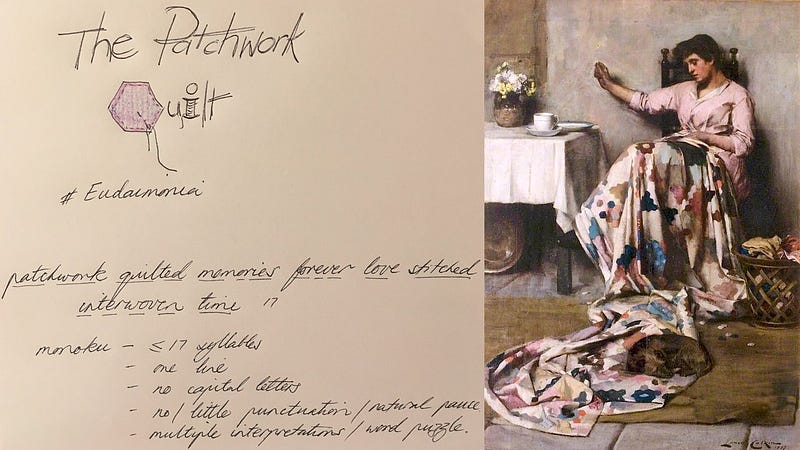
Image assembled by author using author’s handwritten words and Lance Calkin’s 1887 oil painting, The Patchwork Quilt (source — credit in footnote)

patchwork quilted memories forever love stitched interwoven time

I wrote the words (it’s a monoku but more about that later) before I found the image to go with them. I hadn’t intended these eight words to be my contribution to the Literary Impulse-Paper Poetry collaboration’s Eudaimonia prompt but that all changed when I happened across the photo of Lance Calkin’s oil painting, The Patchwork Quilt. Art, for me, is like music — and poetry too for that matter. I know what I like when I see it~hear it~read it. For me to like art~music ~poetry, it needs to speak to me in some way. To reach into me, to touch me — that sounds creepy but I’m sure you know what I mean.

Calkin’s painting, The Patchwork Quilt, spoke to me. It also spoke to the words of my monoku. When I realised that, I was bathed in a profound sense of ‘This is so right’. I let myself bask in that sensation while I studied the painting some more. To be honest, I wanted to stay in that moment, to hang onto that feeling. I wanted to clutch it to my chest and guard it like a possessive mother hen protecting her offspring. I wanted it for myself. Does that make me selfish? If you’d asked me that question a while ago, I probably would have said exactly that, ‘Probably’. That was before I learned the term, eudaimonia, the condition of human flourishing.
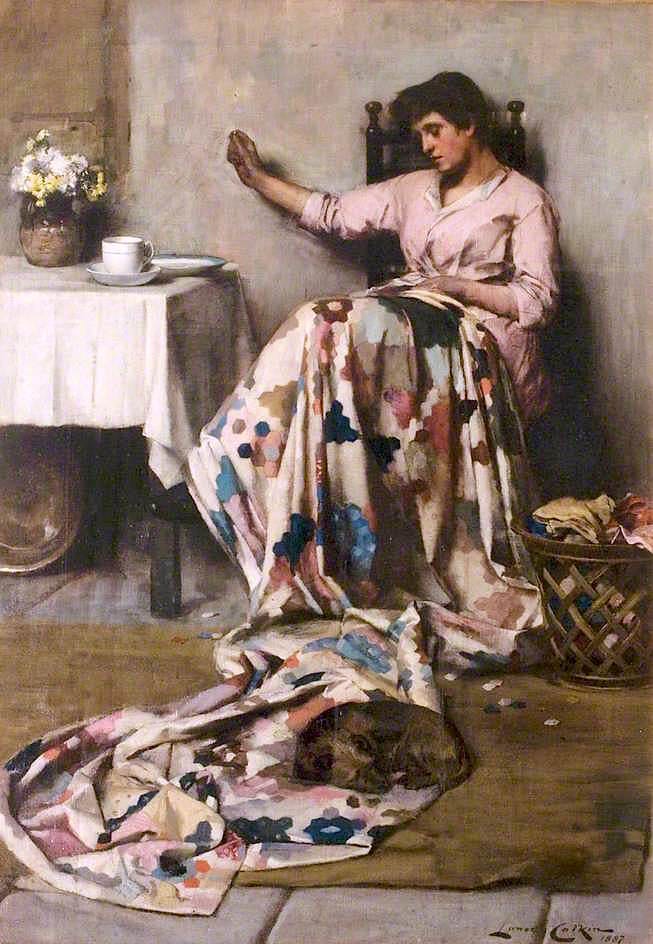
Lance Calkin’s The Patchwork Quilt (source — credit in footnote)

I had a deeply rewarding sense that when the eight words I’d strung together were juxtaposed with Calkin’s painting, they conveyed much more than surface level meaning. Isn’t that what poetry is meant to do? And more pointedly, isn’t that what monoku poetry is meant to do? But that’s not really for me to answer. That’s something that only you, dear reader, can answer for yourself.

The longer I spent looking at the painting, the more I felt the need to continue writing. The need to translate into words my interpretation of what the painting spoke of. So here it is, a prose poem.

The Patchwork Quilt

The flush of her cheek like a fresh spring bloom pregnant with a yearning love for all that is conceived, immortalised, in the symbolic creation, a beautiful progeny flowing from her blessed hands. With each stitch she nurtures her descendants, binding them snug and warm with their forebears, a taut, unbroken thread of continuance and connection that yields only to the supple plying of hands and the persistent pull of the womb. Her precision stitches, each one a tiny latch, invisibly, indelibly interlocking their past, her present, their future.

The telling of the spent cup and plate, time-lapsed, like the passage of a ship through the mystical ages bearing Isis, the goddess of fertility and motherhood, and Na’amah, Noah’s wife, with her apron pockets filled with seeds, summoned forth to sow the abundant crops of their ordained legacies with each passing of the sewing needle through the cloth.

Her solitary companion, faithful, ever-present loyalty, as much a part of the intricate tapestry of interlaced lives as any human being, now slumbers in sweet reverie marking, by consent, his territory, date-stamping the tessellated hexagons with pawed imprints and embalming them with his own pheromone charm.

My eyes dwell upon this scene much like her eyes focus on her labour of love, oblivious to the world beyond our respective peripheral fields. An ambience of wellbeing and contentment permeates from the canvas and envelopes me in its wholesomeness and grace. I feel blessed by something I cannot quite explain but know to be real. A gentle stirring, a flourishing of purpose. I step away and the threads of the patchwork quilt trail behind me.

© Carolyn Hasting 2021

About the artist, Lance Calkin

George Lance Calkin (1859–1936) was a celebrated English portrait painter who, during his career, became the Royal portrait artist for King Edward VII and King George V. Calkin worked predominantly in oils on canvas. The Patchwork Quilt was painted in 1887 and is currently held at the Nottingham City Museums & Galleries in England. Unfortunately, no records have been found about the painting, the quilt or the woman.

About monoku

The term, monoku, literally means one verse (mono - from Greek, meaning one or single; ku — from Japanese, meaning verse). Monoku is a contemporary, Westernised derivation of haiku. A monoku is composed of 17 syllables or less written in one line; all lower-case letters; minimal, if any, punctuation; and including a natural pause created by speech rhythm. The words are arranged such that they can be interpreted multiple ways, becoming something of a word puzzle. Modern monoku often have a dash to mark the natural pause, for example - patchwork quilted memories — forever love stitched interwoven time This form of monoku is known as broken monoku whereas the dash-free style is unbroken monoku.
courtesy of Literary Impulse

Thank you for reading. I hope my words have piqued your interest in the term, eudaimonia, enough to consider contributing to the prompt. We invite all Paper Poetry and Literary Impulse writers (current and new) to take part in this exciting collaboration. To learn more about the Eudaimonia prompt, please check the guidelines here —

Image credits

Lance Calkin’s 1887 oil painting, The Patchwork Quilt, sourced from “Lance Calkin — The Patchwork Quilt” by irinaraquel is marked with CC PDM 1.0. This artwork is marked as being in the public domain.

Paper Poetry
Poetry
Eudaimonia
Art
Eudaimonia Li Pp
Recommended from ReadMedium