
The Paradox of Christian Morality
Political morality separated from its Christian foundation
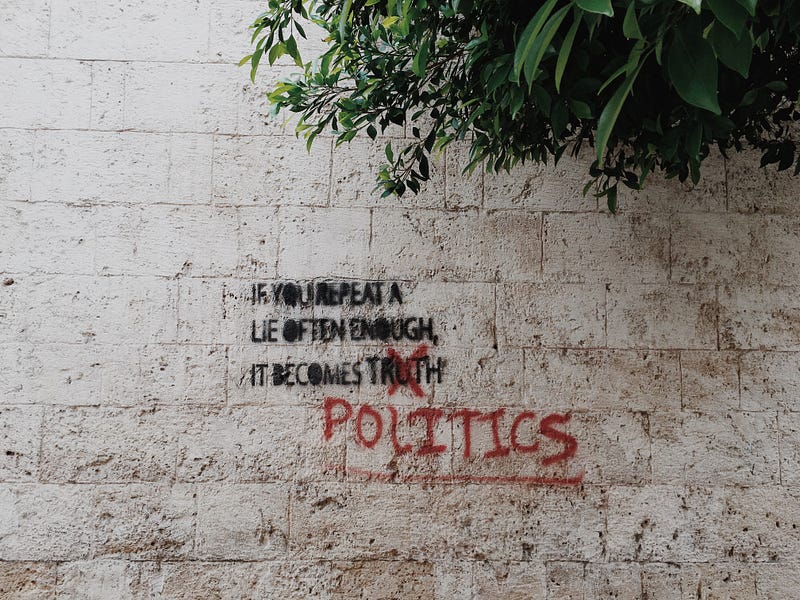
Our social and political climate today is inundated with angry voices that are convinced of their own righteousness and their opponent’s depravity. We are quick to highlight the sins of others and call for their due penance, all while ignoring the beam in our own eye. Why use words and phrases with such religious overtones to describe our secular cultural moment? I believe that much of the anger and fighting that is becoming more and more part of our culture today is intimately connected with the separation of our shared morality from its foundation.
I propose that the major driver of self-righteousness in American political discussions is largely due to the embrace of a moral framework that is broadly Christian in nature without being grounded in the life and teachings of Christ. In other words, as a society, we have accepted the Christian moral framework while rejecting the foundation on which it stands.
To be clear, it is not at all my intention to argue that our problems are due to the moral decline of our nation, or that we have to restore America to the ‘Christian nation’ it once was (as if that ever was true). I do not believe secularization has made us less moral. Rather, I believe we have embraced a heightened level of morality as we have become more secular. And that is precisely the issue. When a framework is separated from its foundation, the whole system falls.
This is the paradox of Christian morality. The moral system (which is largely derived from the Hebrew scriptures) only works if it is grounded in the life of Christ. Without this grounding, the moral system (as with all moral systems) leads to self-righteousness, arrogance and exclusion. This was precisely the message that Jesus and his followers gave to the Jews in the first century. And this is precisely the practical outworking of today's ethical and political discussions.
To fully understand ourselves and why we are all so angry, we must take a step back and learn about how we got to this point and the cultural influences that have shaped the discussions we are having.
How did we get here?
We do not live in a vacuum. Our thoughts, our values, our ideas — they have all been shaped and influenced by our environment and the culture in which we were raised. Beyond this, our culture itself does not exist in a vacuum but has been shaped for centuries — millennia, rather — by social, ideological and religious philosophies. For the West in particular, any honest discussion of morality and ethics in our society today must consider the profound influence that Christianity has had on shaping our culture and beliefs.
The concept of human equality and basic rights derives from the Judeo-Christian belief that all people are created in the image of God. Our insistence that love, justice and mercy are fundamental values arises from in the teachings of Jesus and his disciples. Even non-judgmentalism and tolerance are grounded in Christian morality. Most of the moral critiques of our political opponents or of the law itself are often variations of Christan themes. Love your neighbor, care for the poor, the call for justice of the oppressed and marginalized, to see the inherent worth in a human being regardless of their status — all of these philosophies are derived from the Christian moral framework.
This is not to say that the morality of the West today is the same as Christian morality, or that one must be a Christian to hold any of these values. Please hear me: I am not making the claim that you must be a Christian to hold ethical values. My point here is that contemporary American cultural values and beliefs find their roots in the Christian worldview.
However, as the West grows more secular, the central tenant of Christianity, that Jesus is Lord, has been increasingly rejected. Ideas that are foundational to the Chrisitan worldview, such as the self-sacrificial love that Jesus exemplified in his death on the cross, are no longer the driving motivation and foundation of our morality. The principles of our cultural morality remain rooted and grounded in Christian ethics, while our worldview shifts from the very foundation on which these ethics stand.
The Paradox of Christian Morality
What happens when Christan morals are stripped from their foundation? You get a system of law that only works to condemn. Actually, this is true for any moral system; it is not specific to Christianity. Any moral system is composed of laws that tell you what to do or what not to do. And when you step outside of these laws, you stand condemned by the laws. Of course, the laws have no literal power to punish transgressors. Thus, if the moral system is to be enforced, it must be enforced by the people who embrace the laws. And when people assume this power, it inevitably leads to self-righteousness, judgment and condemnation when disagreements arise. It is the practical outworking of the mixture of human tendency and law enforcement.
If this is not specific to Christianity, what makes the Christian worldview any different? Whereas other law codes and moral frameworks inherently rest on the ‘goodness’ of the adherents, the Christian innovation was to ground morality not in our own ‘goodness’, but rather the ‘goodness’ of Jesus. Contrary to popular interpretations, Christianity is not a moral framework that trains adherents to ‘be good’, as any other moral framework would. Rather, Christianity recognizes the fact that we are not good, not in the perfect sense, and that human history has proven that we never fully live up to our moral codes. We have a moral code, but at some point in our lives, we all break that moral code.
The message of Christianity is not that we now have found a way to achieve moral perfection (thus to stand blameless in the presence of God), but rather that God came down to us, incarnate in the man Jesus. He lived the morally excellent life that we cannot achieve and gave himself up for us in an act of full self-sacrificial love that would go on to define the Christian community. At the heart of Christian morality is mercy, forgiveness and divine love. We believe that it is through Jesus that we become righteous, not through our own power. We balance our emphasis on morals with the humility that stems from the acknowledgment of our own guilt. We are motivated by an act of love on our own behalf, while we were yet morally imperfect.
Thus, self-righteousness has no place in our morality, because self-righteousness is antithetical to the Christian worldview.
The love exemplified in Jesus does not coerce people to follow our moral standards. It does not withhold forgiveness from people who deeply offend us, nor does it look for graveling in order to reconcile. As St. Paul famously put it in his letter to the Corinthians,
“Love is patient and kind; love does not envy or boast; it is not arrogant or rude. It does not insist on its own way; it is not irritable or resentful; it does not rejoice at wrongdoing, but rejoices with the truth. Love bears all things, believes all things, hopes all things, endures all things. Love never ends.”
I am aware that many readers at this point will object that they do not believe in Jesus as portrayed above, and that’s okay. I am not here arguing that you should. Rather, I am explaining the Christian mindset from the vantage point of the Christian worldview, which in turn is the answer to why the Christian moral system is markedly different than other moral systems (even those with a Christian veneer). The motivation behind Christian ethics is often misunderstood, even by many Christians.
The effects of separating Christian morality from its foundation
The practical outworking of this separation of Christian morality from its grounding in the self-sacrificial love of Jesus is a return to self-righteousness, anger and judgmentalism in society and politics, which is demonstrated by prominent voices across the political spectrum. Let’s briefly look at two contemporary issues in particular to illustrate this point.
On the left, ‘cancel culture’ has arisen to claim attack and/or claim the careers of those (typically people who are also one the left) who say something out of line. Often there is no forgiveness, no tolerance, no mercy. Greg Lukianoff and Jonathan Haidt have documented many instances of this The Coddling of the American Mind. I understand that there is a debate as to whether or not cancel culture actually exists, but this proves the point. Many are blind to the phenomena because they inherently believe that these people are just getting what they deserve for not living up to their moral standards, morals that find their basis in Christian teaching. To be clear, I am not making a case to defend any of these people. My point is that the culture itself is a direct result of clinging to a moral system that has been deeply shaped by Christianity without also embracing the core motivation of Christianity. Instead, it becomes rigid, unyielding moralism.
But the left does not have a monopoly on this issue. Even though the right is often itself conflated with Christianity, this separation of Christian morals from the foundation of the love of Christ is also a problem for the political right. One of the highest ideals of the right is the sanctity of life. This is obviously relevant to the abortion debate, but it also comes out in the recent counter slogan to the black lives matter movement, ‘all lives matter’. Yet, while the literal truth of this can be tied to the Chrisitan doctrine of the image of God, it is apparent that for many, this is much more of a rhetorical device than a heartfelt belief. For many, ‘all lives matter’ ends as soon as they meet their ideological opposite, an illegal alien, or just someone they think hasn’t worked hard enough. This is hardly loving your enemies. It is true that Jesus did believe that ‘all lives matter’, but it is his actions of eating with tax collectors and sinners, touching the untouchables, and loving those in sin that complete his ideology.
Conclusion
Examples similar to those above could be multiplied, but perhaps the separation of Christian morals from the foundation of Jesus is best seen simply in the demonization of both the left and the right by their political opponents. Our political conversations are filled with vitriol and self-righteousness. The left tends to focus on the morals of equality, justice and care for the poor. The right tends to emphasize morals that are focused on avoiding sin. But each side derives their morals from the shared Christian framework that has deeply influenced American culture. Each side assumes the high moral ground and all but outright claims that their opponents are colluding with the devil himself. Each side has lifted up their favorite morals while moving further away from the foundations upon which those morals once stood.
Jesus did not demonize those who did not share his moral convictions. His driving motivation was a self-sacrificial love. And it is this love that sits at the heart of the Christian message. Without this love as the foundation of our morality, we return to the self-righteous, moralistic mindset of the very people that Jesus criticized so heavily (and the very people that sent him to his death).
Jesus and his early followers brought this world a new way of framing morality — a framework that allowed for a high moral calling without self-righteousness, anger and judgmentalism. He did this by grounding these morals in his own righteousness, forgiveness and self-sacrificial love. When you separate Christan morals from the core beliefs of Christianity, the whole system collapses into what we see today. Law without love is self-righteousness and condemnation. And I don’t know that it can be any other way.


