
The Paradigm of the Goddess is not the Patriarchy with a Woman on Top
It’s an entirely different reality
For me, the Goddess is not a female replacement for a male god in the sky watching over us, judging our actions, making sure we get it right — or else! Rather, she is the womb-like container that holds us, as well as the field of potentiality within that container. We and all of reality arise out of and dissipate back into both her field and container again and again, like seeds into the Earth.
The fecund ground of her being nourishes, protects and feeds us as we, with our experiences, which include death, feed her. She is the Source, the All. Gods live within her. This is the paradigm of the Goddess.
The paradigm (worldview) of the Goddess is a way of being, a reality different and other than the current mechanistic paradigm (life as machine) we live in, (also referred to as the patriarchy). The paradigm of the Goddess is one of alive interconnectedness. This web of connectedness is revealed more and more through biology, physics, biochemistry, and cosmology.
This reality has also been confirmed to me through divinations I have done in my time as an initiated diviner.
When I first encountered the paradigm of the Goddess in the books of archaeologist and scholar Marija Gimbutas — wherein she catalogs the archaeological remains of Paleolithic and Neolithic cultures of Old Europe, long forgotten — I felt in my body the memory of a time when we truly lived in this way, in alignment with the paradigm of the Goddess.
I have spent the past thirty years trying to listen to that memory. I believe if we can match the energetic vibration of that time and paradigm, remember it deep in our bones, it could find its place once again in current reality. That faint echo has been my guide and teacher. It has been an interesting, challenging, and exciting journey.
The paradigm of the Goddess is a oneness, an interconnectedness, a wholeness that contains individual components that are each sovereign wholes while simultaneously one. The Goddess is source energy, source of all, the womb that contains and holds all. We are embedded within her consciousness, generated and sustained by it. She is the holographic universe of which we are part and parcel — holograms — as well as the vastness at once.
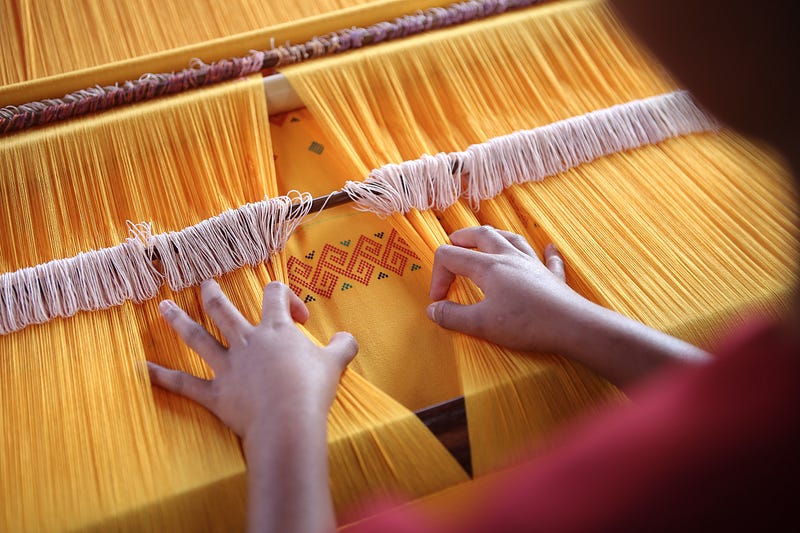
In divination, it reveals itself as vast networks alive and interacting. Each lifeform helps to create this web. Through choices and actions, we add to this complex tapestry, co-creating and participating with all the dimensional realms. She is the multi-dimensional loom onto which our individual experiences create the texture and patterns of reality. In this web, we are always connected, have instant access to all, and are never truly separate.
We are at once the vastness and the reduced focused lens, the wholeness and the small individual stories, ourselves and her. Light is the thread that weaves form into the thick and ever-present darkness. Consciousness is the needle with which we stitch our designs. It is ineffably beautiful to look upon.
Elegant genius.
All the lives we live and timelines we create are etched as memory onto this holographic body. Through divination and other forms of collaboration, we are able to interact with this grand, ever-present now.
What would it mean for us moderns and post-moderns to allow ourselves to integrate this understanding back into our psyches and the systems we have created and try to live according to this knowing once again?
What might change? What might be possible?
©Theresa C. Dintino 2022