
The Pandemic — Season Three
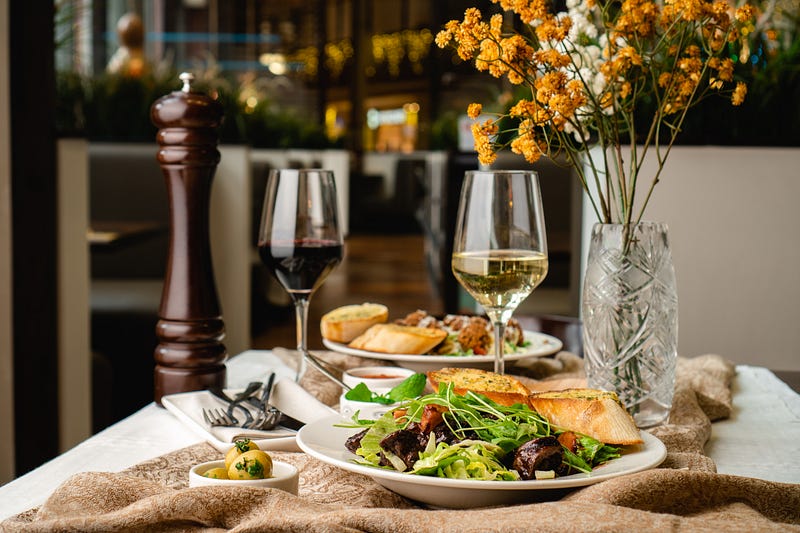
As I walked into the dining room, I was struck by the elegant table that my partner had set for dinner. Darrel had dimmed the lights, lit two candles and set a vase of flowers in the centre of our glass table.
“Let’s dine like its March, 2020”, he said.
I shared his feeling of deja vu. During the pandemic lockdowns, we would try to mix things up a little by treating ourselves to elaborate dinners. After spending several hours in the kitchen executing a complex menu, we would set the table with our favourite linens and enjoy our own cooking. These dinners were an antidote to the pandemic lifestyle. But unfortunately, the delicious food and wine we treated ourselves to, never compensated for our missing friends and family. In fact, our fancy dinners always made me feel a little sad.
By the time June, 2021 rolled around, Darrel and I estimated that we had eaten four hundred meals, together, and alone, at our dining room table. We were more than ready to move on.
Although public health restrictions have ebbed and flowed as successive waves of the pandemic have washed over us, I thought they were ending for good with the advent of the vaccines. But the latest iteration of the virus, the omicron variant, has made me feel naive. To use one of the buzzwords of the pandemic, we have pivoted back into public health restrictions. The week before Christmas, public health authorities were urging Canadians to use rapid tests as a way to enjoy safe holiday get togethers. Only two weeks later, the same officials were exhorting the public not to squander rapid tests on social events so that there would be sufficient supplies for testing symptomatic people.
A week before Christmas, Darrel and I donned our masks to sit through a matinee screening of Belfast at a Toronto movie theatre. We followed this up with a glass of wine and pizza in a restaurant which maintained one empty table between occupied tables as a COVID safety measure. As of January 5, neither the cinema nor the restaurant are open. In my mind, both activities now belong to a golden time of high adventure and reckless abandon.
Because of the about face in the pandemic, January 2022 feels eerily similar to January 2021. During the first week of January, I noticed that there were several tables of patrons inside a restaurant near my house, enjoying a last social get together before restaurants are prohibited from offering indoor dining. Before every closure, I have seen similar farewell gatherings of friends in restaurants. At this time last year, the news was full of stories about selfish snowbirds enjoying illicit sunshine in Florida, in defiance of the Canadian government’s international travel ban. This year, the snowbirds are in the news again but this time, the stories are sympathetic. At the end of their travels, many snowbirds have found themselves stranded because of cancelled flights or out-of-time COVID test results. Last year at this time, my freezer was full of holiday treats that I planned to deliver to friends since we were unable to get together. This year, my freezer is also stuffed but it is because our holiday dinners were cancelled when large indoor gatherings started to look like omicron breeding grounds.
After adopting as an article of faith that the vaccine would keep me safe no matter where I might venture in the world, it is hard to accept that the vaccine does not offer a guarantee against infection by omicron. It seems that the vaccines provide only limited immunity, meaning that although vaccinated people can be infected by the omicron virus, they will get less sick than if they were not vaccinated. This is the bad news and the good news. But there is also the really bad news that omicron spreads like a gasoline fire. Apparently, it is only a matter of time until we all get it.
Faced with exponential growth in the number of people testing positive for coronavirus and the certainty that a percentage of those infected will start to populate our hospitals again, Canadian governments are redeploying the tools used repeatedly during the first two years of the pandemic to slow the spread of the virus. As if the return to lockdown was not sufficiently disorienting, Ontario’s premier has described it as a return to Step 2 of the Province’s “reopening plan”. Isn’t this a re-closing?
Since public health tools are limited and there are a finite number of ways in which they can be combined, the implementation of pandemic control measures has started to resemble a medical version of Top Chef. With each wave of the pandemic, public health authorities have come up with a new recipe for the use of public event spaces, social gatherings, restaurants and schools. The stringency of each new set of restrictions should reflect the severity of the pandemic control measures required. But some of the combinations don’t seem sensible.
The current limitation on social gatherings is numeric rather than a restriction to members of the same household, as it used to be. Under the new restriction, each of us can be exposed to a larger number of potential corona virus carriers than before. What if I choose to spend an evening with four friends, each of whom spent the previous Saturday evening with four other friends. Why is this safe when it wasn’t before?
Under the new lockdown rules, publicly funded testing will be available to people who are symptomatic for COVID, only if they are also members of high risk groups or work in high risk settings. This means that we will no longer have a reliable count of the number of people who have been infected by the virus. On the other hand, testing is still required for anyone who wants to get on a plane to Canada. Why do we still have this requirement? Is it to protect Canadians against imported COVID? Or to protect passengers in planes from COVID infested passengers? Doesn’t someone who rides the GO train every day from Oshawa to Toronto, have a similar interest in knowing whether any of the other passengers has COVID?
Last winter, when my social life was reduced to taking walks in sub-zero temperatures or sitting on my front porch nursing hot coffee with friends, I took some satisfaction for my socially responsible pandemic behaviour. But when Darrel and I sat down together to enjoy pandemic dinner four hundred and one at our dining room table, I just felt sorry for myself. I know that I am more fortunate than the people who have been terribly ill or who have lost family members or friends to the virus. I’m also far better off than the people who lost their jobs or their minds in the fallout from the pandemic. But I can’t help feeling disappointed. Omicron has fought back the vaccines and the pandemic is raging on for a third loathsome season.


