
The Palio — The Heart and Soul of Siena
While tourists might observe the Palio festivities for a few days once in a lifetime, the people of Siena live the Palio 365 days a year, every year of their lives
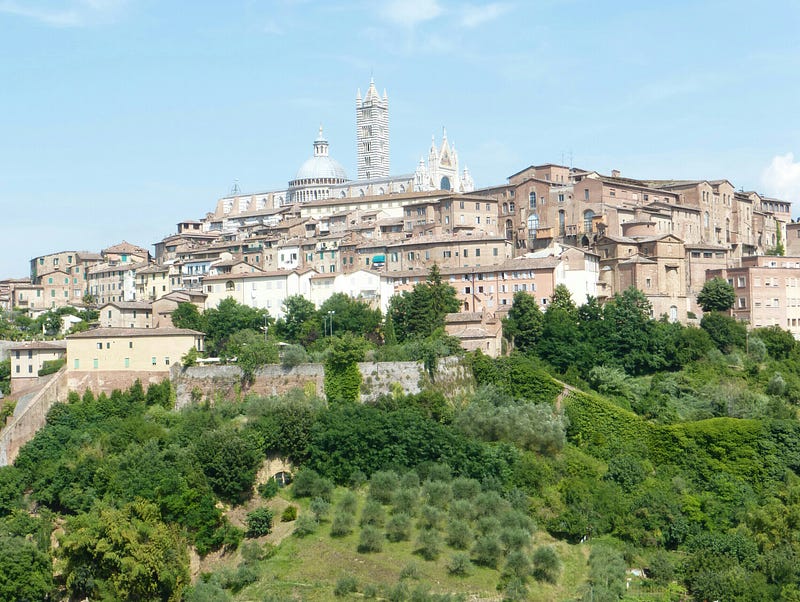
The Palio of Siena is a world-famous, centuries old, semiannual race that defines the very heart of the town and its residents’ identity.
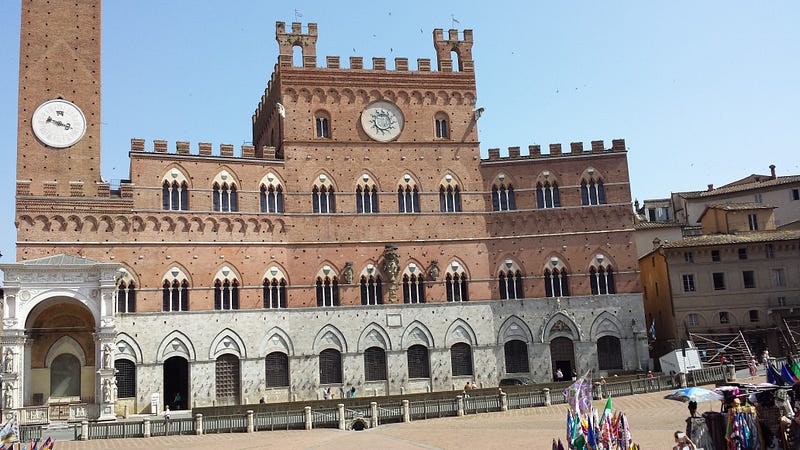
In 2018 I had the privilege of watching the July Palio from the balcony of a palazzo on the Piazza del Campo, the main public square in the city’s historic center.
I was in Siena attending a language school which hosted a number of cultural sessions and excursions during my stay. It was through these presentations that I learned about the social culture of Siena and the importance of a bareback horse race that to an outsider might seem to be nothing more than an excuse for a party but for the people of Siena is the heart and soul of who they are.
What it means to be Sienese
The birth announcement was posted on the neighborhood message board on Via Pantaneto. On it, Valdimontone, the contrada (city ward) of the Ram, proclaimed the birth of its newest member.
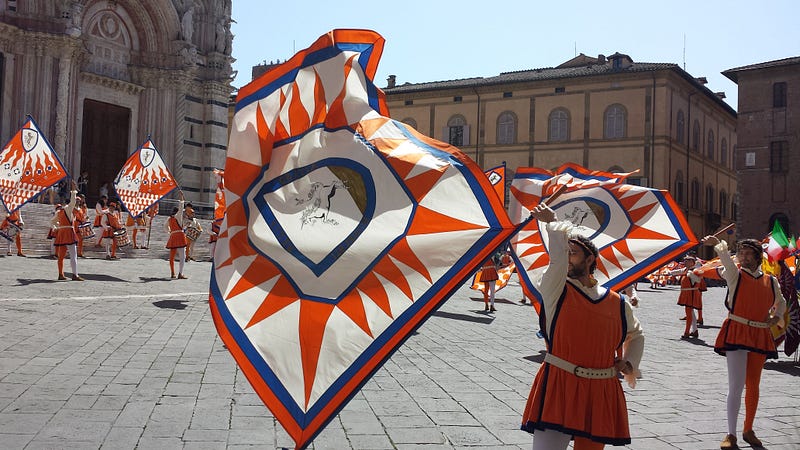
In due time, she would be baptized in the contrada’s church and wear for the first time the red and gold fazzoletto (bandana) that would, through its colors and throughout her life, declare her affiliation with, affection for, dependence upon, and loyalty to the Valdimontone contrada.
Her fellow montanaioli (members of the Valdimontone ward) will become her second family. She will celebrate together with them the milestones of her personal life in addition to the significant annual events of her contrada, which include the annual week-long celebration honoring their patron saint, La Madonna del Buonconsiglio, and, of course, the festivities surrounding the Palio races in July and August.
Citizenship of the heart
While she is legally an Italian citizen and, more importantly for her, a citizen of Siena, she will identify herself, first and foremost, as Valdimontonese, and the solidarity which will develop with her “tribe” will ensure that she will never celebrate nor mourn life events in isolation and loneliness.
And at the end of her life, the montanaioli will carry her coffin to the church in which she was baptized, not draped with the white pall of the Catholic Church, nor the Italian or Sienese flag, but covered with the red and gold bandiera (flag) of Valdimontone.
So it is for the contradaioli, the members of each of Siena’s 17 contrade.
History, structure, and purpose of the contrade
Historically, the contrade were craft or merchant guilds which incorporated within their territories militia units to aid in the defense of the Sienese city-state primarily against its medieval rival, Florence.
Currently each contrada functions mainly as a civic organization with its own administrative council, social club, church, stable, and museum, with membership no longer determined by one’s trade. Today, it is the first home in which a baby lives that determines his or her contrada affiliation.
While there are no restrictions as to where, as an adult, one can reside within Siena, changing houses or apartments, or even moving out of Siena or out of Italy, does not affect contrada membership. Once a montanaiolo — or a member of any of the other sixteen contrade — always a montanaiolo.
One family, different contrade
It is not infrequent that each member of a nuclear family belongs to a different contrada. A man and woman, belonging to different contrade, can marry and take an apartment in the territory of a contrada to which neither belong. A child of theirs, whose first home is in this third contrada, will belong not to the contrada of the mother or father, but to the contrada within which the child’s first home is located.
Until the child is of an age, perhaps ten or eleven, at which he or she might begin to participate in contrada events without parental supervision, the parents will attend processions and the Palio with the child’s contrada. This need to accompany their child does not allow the parents to don the fazzoletto their child wears, nor may they wear that of their own contrada. They will accompany their child without any signaling of their own affiliation.
The Palio
While numerous events throughout the year are observed with a sense of solidarity and fraternity, none is more important, more emotional, or more central to the soul of the contradaioli than the Palio races which take place on July 2 and August 16 in the main square, Piazza del Campo.
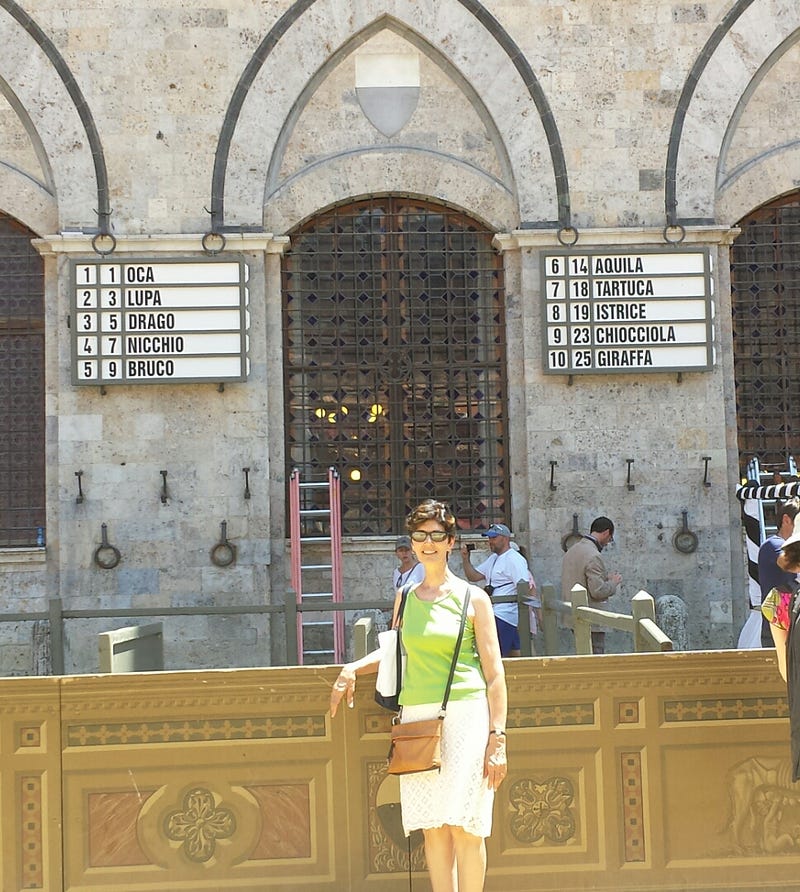
The four days of festivities and preparation begin with the tratta, the choice of the ten horses that will run and their assignment, by lottery, to the ten participating contrade.
Six practice races, le prove, are then run over the course of these four days. La prova generale which is run the evening before race day is preceded by a squad of carabinieri (Italy’s version of the French gendarmerie) on horseback performing a mounted charge and followed by la cena della prova generale, an outdoor feast held by each of the participating contrade.
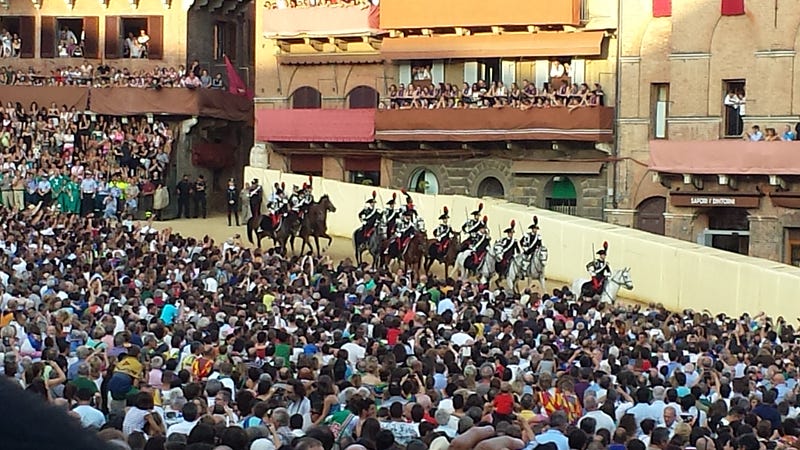
The final practice on the morning of the race, dubbed la provaccia (the bad race) due to the fact that the jockeys work the horses lightly, is followed in the afternoon by the blessing of the horses inside the church of each contrada.
Only the horse of one contrada, Drago, is blessed outside its church, Chiesa di San Domenico, because of the many steps at the church entrance. Preceded by a procession of i tamburini (drummers) and gli alfieri (flag bearers) in medieval garb and after the veneration of the relics of the contrada’s patron saint, the parish priest quietly performs the blessing ritual, ending with the audible command, “Vai e torni un vincitore!” (“Go and return a winner!”)
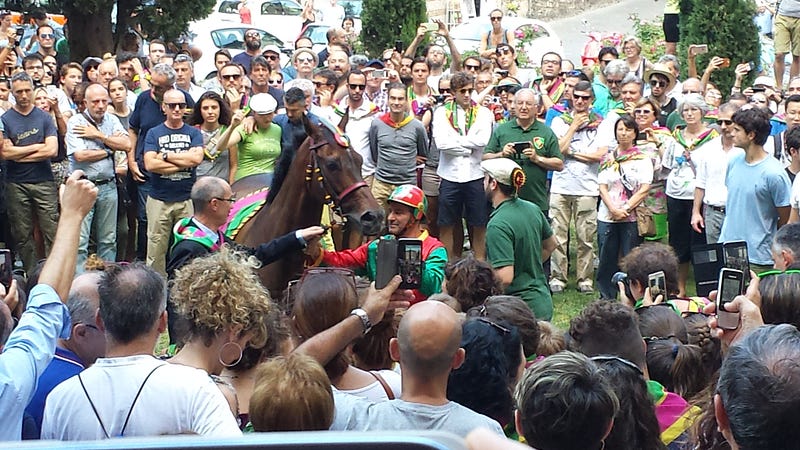
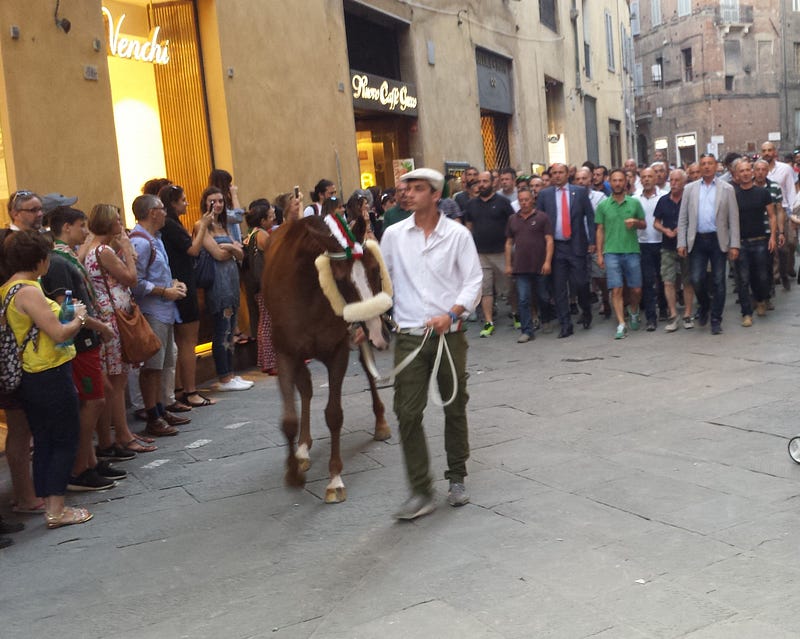
The narrow, flagstone streets of Siena, during these four celebratory days, at times become gridlocked as each horse is led to and from Piazza del Campo by the barbaresco, its caregiver, followed by first the contrada’s officials escorting their fantino (jockey) and then hundreds of contradaioli in their fazzoletti, the men first and then the women, singing the inno (anthem) of their contrada as they follow their horse to and from the Campo.
Race day
By midafternoon on race day, the shell-shaped Piazza del Campo, the temporary bleachers on the outer periphery of the track, and the balconies of the surrounding palazzi begin to fill with tourists and contradaioli. While there are no turnstiles ticking off the number of spectators attending the Palio, estimates range from sixty to eighty thousand, most of whom are standing shoulder to shoulder in the center of the piazza.
At about 4:30 the passeggiata storica, the two-hour parade of medieval pageantry, begins, at which point ingress and egress are prohibited. After the passeggiata, the track is slowly swept and inspected as anticipatory tension builds.
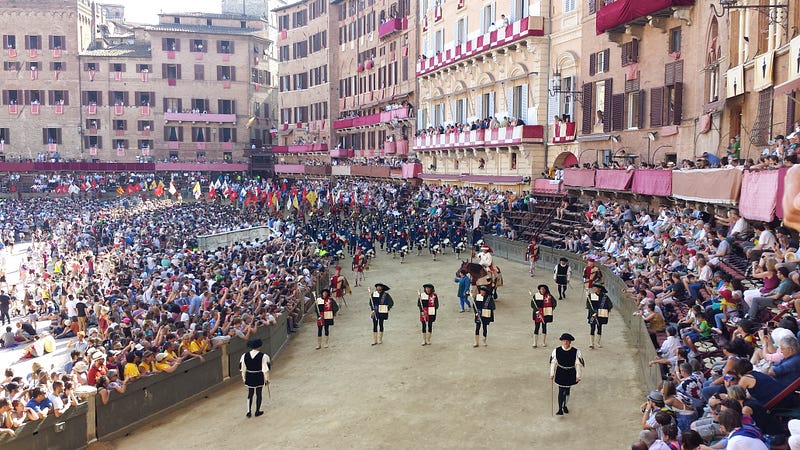
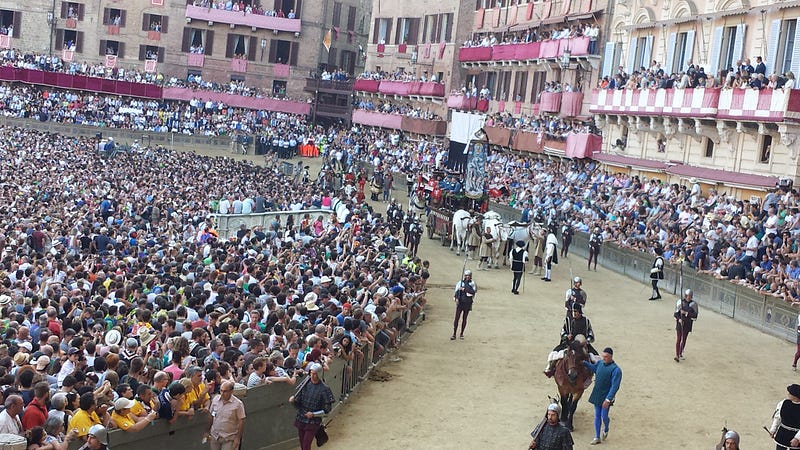
Once horses and riders enter the track from the entrone, the internal courtyard, of the Palazzo Pubblico, the piazza becomes startlingly silent as the crowd awaits the announcement of the starting positions, which is determined at that moment by lottery.
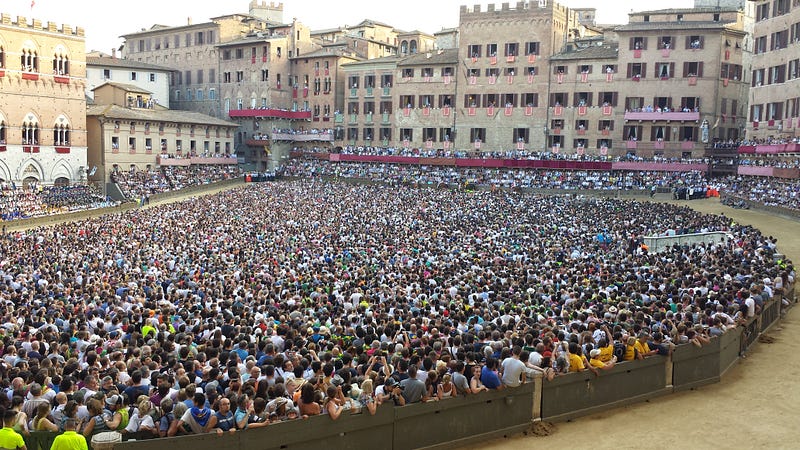
The race itself, three laps over the hard packed ring of dirt that was laid a week prior, lasts less than three minutes, followed by celebratory pandemonium as hundreds of emotional members of the winning contrada, along with their horse who is now riderless and their jockey who now rides atop the shoulders of a hefty contradaiolo, exit the Piazza and make their way to, in July, the church of Santa Maria in Provenzano or, in August, the Duomo to render thanksgiving to the Blessed Mother and begin their euphoric triumphant festivities.
Every day, every year
While tourists might observe the Palio for four days once in a lifetime, the people of Siena live the Palio 365 days a year, every year of their lives. From the time they first don the fazzoletto until the day they begin their final rest beneath the bandiera, they are sustained by the fruits of a cultural tree birthed in antiquity. The significance of the Palio to the contradaioli cannot be overstated nor to the outsider can it be fully understood. Simply said, to the Sienese, the Palio is life.