
The Painting
Canvas of Reality
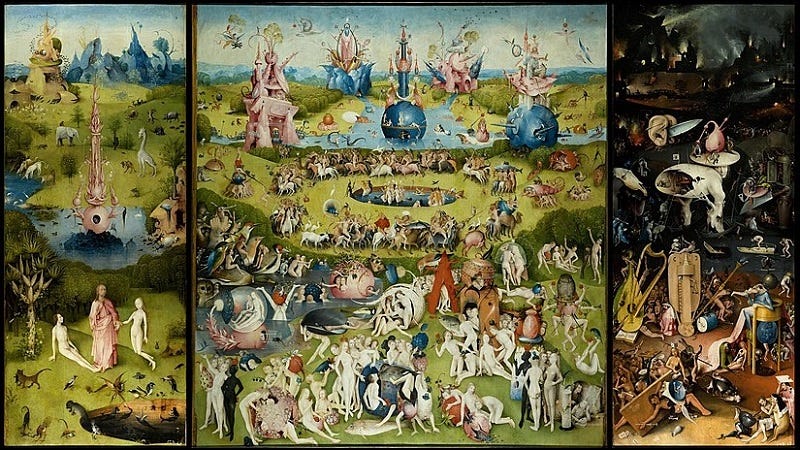
Bodies, minds and hopes — all painted on the canvas of dichotomy
One fall day in 1968, nearing noon — echoes of the cool autumn morning still lingering in the shadows and in the clear, crisp air despite a warming sun — as I walked past the little café on my left (and as I turned towards it) I saw a very large painting leaning up against the small, red building.
Perhaps not leaning, a closer look revealed that it hovered, rather, in the air between me and the windowed wall (farther from me than from the wall), new and brave and talkative.
Surprised and amazed, I stopped to look. It was very detailed.
And as I studied the canvas, I saw living, moving multitudes: scores of people lingering, dwelling, looking, crowding, doing, pointing — they could have been painted by Hieronymus Bosch (“The Garden of Earthly Delights” comes to mind now that I look back); brilliantly painted, these multitudes, and so alive, so magically moving and alive.
And as I gazed upon this wide, deep, and three-dimensional scene I knew that those on the canvas (perhaps in the canvas is the better preposition), that when they looked up, they saw right and when they looked down they saw wrong; that when they looked up they saw good, and when they looked down they saw evil; that when they looked up they saw God, and when they looked down they saw the Devil; that when they looked up they saw white, and when they looked down they saw black; that when they looked up they saw love, and when they looked down they saw hate; that when they looked up they saw brave, and when they looked down they saw cowardly, and so on, one dichotomy after the other, looking up and looking down, up and down ad infinitum.
Up and down, up and down, this looking multitude.
This I saw, this I knew.
Then they asked me, these lookers up and lookers down, if I agreed. Is this how I saw things as well, how I felt about the world?
I studied the canvas some more, and I took my time because I wasn’t at all sure that I did agree. And as I stood there musing and gazing and musing some more, the painting turned impatient with me. Well, said the multitude, what is it, agree or disagree?
But as I looked some more I found that I could not agree, for no matter how hard I tried, looking up I could see no right, and looking down I saw no wrong, no love and no hate, no braves nor cowards. All I saw was higher up on canvas and lower down on canvas: all I saw was impatient painting awaiting my reply.
Then, before answering the painting, I turned away from the canvas and its multitudes and looked to my right at the long, autumny lawn, stretching for a long, well-tended acre and tenderly leaved here and there by autumn’s golden whisper. And what I saw was that this world, too, the one in the fall sunshine, was but a painting where looking up yielded good and looking down frothed evil. And then I realized that I was no longer part of this canvas either. I realized that you had to be part of the canvas, you had to live, and breathe in the painting, painted, to believe and perceive these many, many, many dualities.
You had to be painted (aka created).
And gazing across the lawn, I saw all as painting, neither up nor down, neither good nor evil — just painting.
The Buddha knew all about this and even had a word for it: Upekkhā.
I never got around to answer the impatient canvas.
© Wolfstuff
P.S. If you like what you’ve read here and would like to contribute to the creative motion, as it were, you can do so via PayPal: here.


