
The Painfully Patient Way to Build a $5,000 Monthly Writing Business
It took me 795 days to eclipse this heralded milestone, but my approach eventually worked.

I started freelancing full-time in July 2019. About 26 months later, I’ve finally built a stable $5,000-per-month writing business.
I took somewhat of an unconventional approach to get to this point.
Until now, I’ve only surpassed this income milestone twice — October and November of 2020 when I had a couple of high-paying copywriting gigs. Otherwise, across the other 24 months, I’ve averaged $2,202 of monthly income.
That said, in my very biased opinion, I think the typical bystander would say I have my shit together. And, for the most part, I do.
I’ve worked with some reputable companies. I maintain an active professional presence on LinkedIn and Twitter. I’ve built a respectable following. I even wrote a book about freelance writing.
But I haven’t made a ton of money as a freelance writer (and I’ve been very transparent about that).
Why?
Several reasons.
I don’t cold pitch
I hate cold pitching. For starters, I just haven’t had a worthwhile return on investment from a time standpoint. During my first few months of self-employment, I spent countless hours crafting personalized pitches with free content advice to practically no avail.
Sure, a handful of pitches went further than the initial email — a couple even landed me gigs. But it’s such a time suck to (a) locate a relevant company, (b) analyze their website for copy and content issues/opportunities, (c) find the appropriate contact — use hunter.io if pitching is your thing, (d) craft a concise and persuasive email, and, the last and worst step, (e) wait for days or weeks or months (or indefinitely) for a reply.
As you can imagine, it’s pretty hard to build a business without actively soliciting your services, but it’s not impossible. (I’ll explain how I managed to do this later.)
I set my rates high from the get-go
If you’re familiar with the wonderful world of freelance writing, you know that new writers typically charge per word. You likely also know that it’s not uncommon for new writers to charge $0.05 to $0.10 per word when they first open their proverbial doors to clients. Based on these rates, a writer would have to procure a lot of gigs to make a decent living.
For example, you’d need to write fifty 1,000-word blog posts every month to maintain a $5,000 monthly income. Of course, it depends on what you’re writing about and how much research/editing is required, but that’s an insane and unsustainable number in my opinion.
Instead, I set my rates at $0.35 per word on day one.
This excluded a lot of potential opportunities — I’ve turned down more work than I’ve accepted. I’m sure that sounds absolutely bananas, considering freelancing is so unpredictable from a monetary perspective, but I wasn’t about to sell myself short. I was confident in my writing abilities and I valued my time.
Speaking of time…
I spend way more time on personal projects
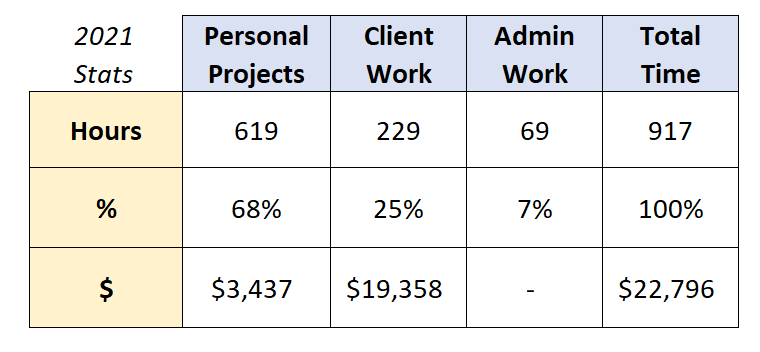
My writing business sustains me financially, but, so far, I’ve been closer to the poverty line than the six-figure mark. One of the biggest reasons is that I’ve spent about 68% of my time on low-earning (and non-earning) personal projects — like my currently free investing newsletter and a soon-to-release book about freelance writing.
Here’s a monthly breakdown of my time and earnings since January.
This platform is responsible for all of my “personal projects” income in 2021. It’s been kind to me financially, but it’s not like I’m even remotely close to earning a livable wage here.
Once I launch a paid subscription for my newsletter, it will (hopefully) generate some income. But, as of right now, I’ve put 237 hours into this venture and earned $0.
Last but certainly not least, I’ve spent 83 hours this year on my book — and that’s just time spent editing and preparing for publishing. I didn’t track my time in 2020, but I spent way more time writing it.
Guess how much money I’ve made from my book thus far? $0.00
Obviously, that’s because it hasn’t launched yet — but it goes to show how much of my time is allocated to non-earning projects.
Why do I do this? Because, in my opinion, client work is akin to a traditional corporate job. There are assignments. There are deadlines. There are emails and meetings. There are quasi-bosses (even though it’s usually more of a collaborative effort between equals).
If I filled up on client work, my schedule would resemble a traditional 9-to-5. I didn’t leave the corporate world to build a replica of my past life.
Instead, I spend the vast majority of my time on personal projects because the potential payoff is exceedingly higher than my client work. In other words, I look at my personal projects as long-term investments.
For this reason…
I’ve never prioritized money
Well, let me put that another way, I’ve never prioritized making money. However, I have focused on saving money and living within my financial lane.
I had a pretty distinct advantage entering the entrepreneurial jungle: substantial runway.
Before I was a freelance writer, I worked in banking for a few years. Looking back, I spent more money during that timeframe than I should have, but I still made enough to set aside a year of expenses. On top of that, I cut my living expenses by 32%.
Coupled together, my runway and spending mentality allowed me to write without much financial pressure. The peace of mind was invaluable — I can’t stress enough the importance of entering entrepreneurship with financial stability.
As a result, I was able to build a business my way.
Long-term strategies can pay off
Last month, everything started clicking. It’s as if the entrepreneurial floodgates opened. High-paying companies crawled out of the woodwork. Existing clients needed more content. I’ve had to turn down solid opportunities.
A month ago, I barely delivered $1,000 of client work. Going forward, I expect to earn anywhere from $5,000 to $7,500+ each month.
Sometimes, the unpredictability of freelance writing works in the writer’s favor.
Before we go any further, I want to set something straight: I’m not trying to put myself on a pedestal. I’ve been transparent about my income for a long time (even when it was concerningly low). Frankly, I used to get imposter syndrome when I read about people making good livings from freelancing. Now, I’m just maintaining that transparency.
If I didn’t think my approach could help others, I wouldn’t even bother sharing it because I think the “how I make a bunch of money freelancing” topic is a bit saturated nowadays. But I think writers — especially those who are willing to be patient — are neglecting a key strategy.
What’s my “secret”?
How I built a $5,000 per month writing business
I alluded to part of my strategy already. I don’t cold pitch and I set my rates high. This not only drastically thins the pool of potential clients but also creates a mountainous obstacle: they have to come to me.
But that’s exactly how I’ve gradually acquired steady, high-paying clients: inbound marketing.
More specifically, inbound marketing on LinkedIn.
LinkedIn is arguably the most valuable and underappreciated platform for gaining freelance writing clients. If you aren’t active on LinkedIn as a freelance writer and you’re looking for work, you’re missing a monumental opportunity.
Here’s exactly how I leveraged this platform to build a $5,000+ freelancing business.
Share announcement posts
Since day one, LinkedIn has been my primary source of clients. And I mean that literally — on my very first day of self-employment, I announced my transition from corporate banking to freelance writing on LinkedIn.
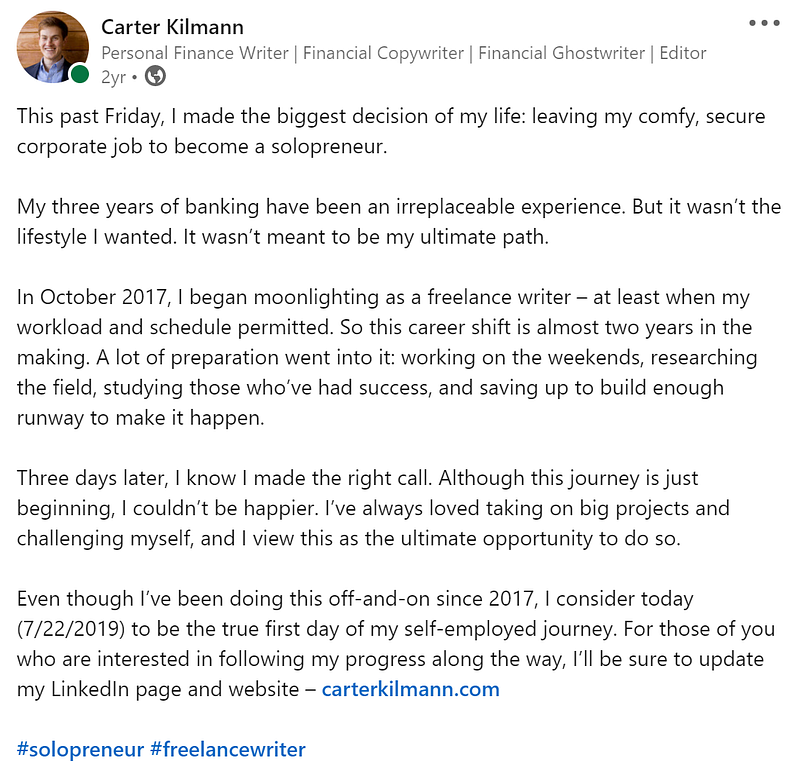
The post attracted over 36,000 views, 227 likes, and 16 comments. More importantly, the announcement helped me land my first three clients.
You don’t have to keep quitting jobs to get people’s attention on LinkedIn though. You can also share major milestones (like crossing a certain income threshold or getting published by a reputable site) and anniversaries (e.g., “Two years ago today, I quit my job.” — that sort of thing).
Optimize your profile
From there, I optimized my profile to appeal to potential clients and editors. Here’s a summary of what to prioritize:
- A clean, professional headshot. Did you know you can also use a video to introduce your profile?
- A distinct headline that specifies your services. Here’s my headline as an example: “Personal Finance Writer | Financial Copywriter | Financial Ghostwriter | Editor.” You can view these as keywords that potential clients are most likely to search.
- A “Featured” section that showcases either your best work or a link to your website/portfolio. I use this section to display my investing newsletter and personal finance publication.
- A concise “About” section that positions you as an expert and solution to clients’ problems. Think of it as a written elevator pitch.
- A detailed “Experience” section with textual support and links to samples. You can view my profile as an example.
- Several endorsements from existing clients. If you’re brand new to freelancing, this one might take some time to develop — but you could also ask previous managers for endorsements.
Maintain a presence as a thought leader
This is the key ingredient that most writers are missing in their recipes. Even though I’ve been semi-active on LinkedIn since I became self-employed, I only recently discovered the significance of being a “thought leader.”
And it’s not as hard as it sounds. By sharing engaging, thoughtful, and/or informative posts on LinkedIn, you can attract clients to you. This takes maybe 15–30 minutes to accomplish. I’ll give you an example.
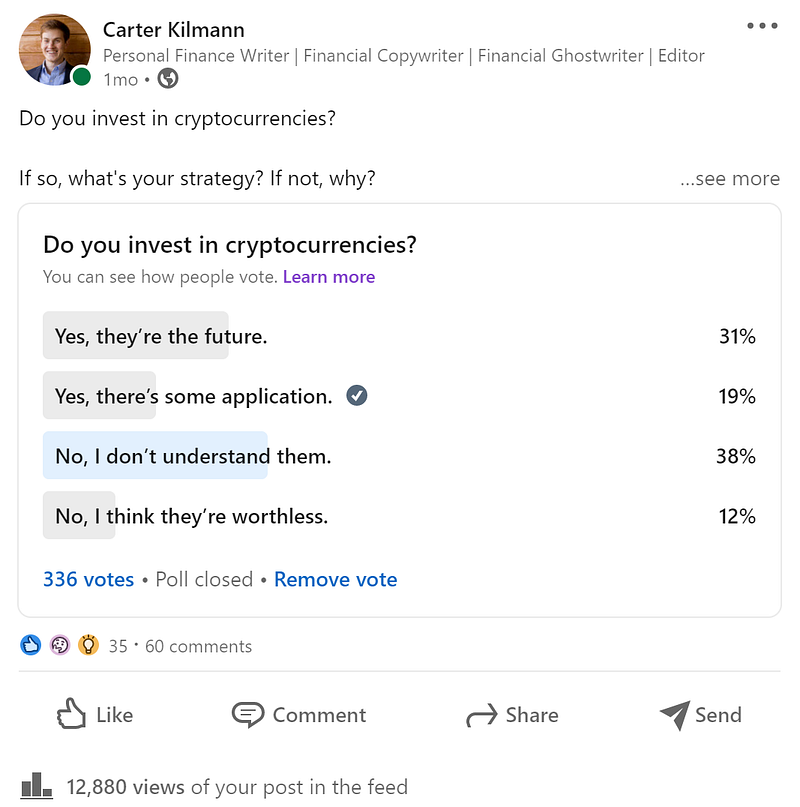
Here’s a poll I shared last month (LinkedIn loves polls). There are 13 words, not including hidden hashtags. It took about 10 minutes to conceive.
Yet, the engagement was through the roof.
The challenging part is being a consistent thought leader.
Fortunately, last month, I decided to commit to being ultra-active on LinkedIn. I posted every single day for a month — and then a few extra days because I couldn’t shake the (good) habit. More importantly, I didn’t have to recreate the wheel. I leveraged my existing content, sharing snippets of previously published stories, quotes, lessons, etc.
The results have been insane.
This is an area that I think a lot of writers are neglecting. Posting regularly on LinkedIn about your niche or industry can lead potential clients to your profile. Whoever thinks LinkedIn isn’t monetized already isn’t connecting the dots (which was me a month ago).
Turn down low-quality work
Like I mentioned, I’ve turned down more work than I’ve accepted, especially on LinkedIn. As backward as it sounds, this has been integral to my business’s growth.
Rejecting work is one of the surprisingly difficult things to do as a freelance writer. Since freelancing is an unpredictable rollercoaster, it’s hard to rationalize turning down an opportunity to make money. That said, there’s such a thing as “bad” money as a self-employed writer.
For example, $500 sounds like a sweet payday for a single gig. But what if that gig is a 5,000-word ebook on a topic you’re vaguely familiar with? In my experience, the money isn’t worth it because it undervalues a more important currency: your time.
Remember, this is the patient way to build a stable business. As you build a portfolio, an audience, credibility, and authority, you’ll slowly attract higher quality clients that recognize your value.
This is the opposite of a get-rich-quick scheme
If anything, inbound marketing is a get-decent-income-slowly scheme. But if you’re patient and willing to adopt the financial mindsets I’ve mentioned, it’s a realistic and doable strategy.
To recap, here’s how I slowly built a $5,000 monthly writing business:
- I saved a year of expenses, which served as runway for my business in case I didn’t make any money.
- I cut my monthly expenses by budgeting and trimming areas of overspending.
- I set my rates high from day one to weed out low-quality gigs and maximize my time.
- I employed an inbound marketing strategy through LinkedIn, which included optimizing my profile, posting frequently, sharing major milestones, and turning down low-value work.
It’s not easy, it might not even be efficient — but long-term consistency backed by financial stability can help you make a comfortable living as a freelance writer.
What’s it like to write for a living? Let me show you.